Overview of the local government accountability system
Published 21 October 2026
Applies to England

© Crown copyright 2026
This publication is licensed under the terms of the Open Government Licence v3.0 except where otherwise stated. To view this licence, visit nationalarchives.gov.uk/doc/open-government-licence/version/3 or write to the Information Policy Team, The National Archives, Kew, London TW9 4DU, or email: psi@nationalarchives.gov.uk.
Where we have identified any third party copyright information you will need to obtain permission from the copyright holders concerned.
This publication is available at https://www.gov.uk/government/publications/overview-of-the-local-government-accountability-system/overview-of-the-local-government-accountability-system
Executive summary
Introduction
This document brings together in one place how local authorities are scrutinised and held to account by residents, through local scrutiny and checks and balances, and by central government.
The document is organised into three main sections: accountability to the public; local scrutiny and checks and balances; and system stewardship, service regulation and departmental oversight.
It is intended to serve as the central reference point for understanding how local authorities are held to account, how oversight functions operate, and how residents, partners and government can use these mechanisms to support effective and resilient local government.
The accountability system is an essential part of the local government landscape. It outlines the roles, responsibilities and expectations of local authorities and central government in delivering for local residents and stakeholders and includes mechanisms to hold local authorities to account for delivery and for use of public money. The system is made up of many different frameworks, guidance and laws making it difficult to navigate and use to hold local authorities to account effectively. This document sets out the whole system in one place for the first time to help make the system clearer to understand and easier to navigate.
As the Local Government Accountability System evolves, this document will be updated. It was last updated on 21/10/26.
Accountability to the public
Councils and strategic authorities operate with democratic legitimacy and possess a general power of competence that grants them autonomy within legal limits.
They are primarily accountable to the public through elections, consultations, the right to raise complaints, and the ability to scrutinise annual accounts.
Local authorities have requirements to be transparent and provide information about their decision-making and activities through open access to data and public meetings. Along with local media scrutiny of services and governance, residents have access to information that enables them to hold their local authority to account.
Local scrutiny and checks and balances
Each local authority has its own system of internal checks and balances. The Head of Paid Service, Section 151 Chief Finance Officer, Monitoring Officer, overview and scrutiny committee, performance management arrangement, and code of conduct all help ensure decisions are lawful, transparent and in the public interest.
Further safeguards are also provided by internal and external audit and the statutory framework for prudent financial management.
System stewardship, service regulation, and departmental oversight
Government departments sponsor independent regulators, auditors, inspectorates and ombudsmen that assess the quality and safety of key services. Their findings play a key role in identifying poor performance and prompting improvement. Ombudsmen investigate individual complaints and help ensure local authorities act fairly and lawfully.
Central government occupies a stewardship role for the overall health of the local government system. This includes monitoring financial sustainability, governance, and service performance, supporting improvement, and intervening where there is evidence of Best Value failure. The Best Value Duty requires local authorities to make arrangements to secure continuous improvement in the way in which their functions are exercised and provides the basis for addressing organisational or systemic failure.
The MHCLG Secretary of State can initiate a variety of non-statutory or statutory interventions where a local authority is failing, or at risk of failing, to comply with the Best Value Duty.
Some departments operate service-specific intervention regimes for areas for which they own the overall policy.
Local authorities are assisted to improve through a sector support offer, funded by MHCLG and organised primarily through the Local Government Association, including peer challenge, mentoring, and training opportunities.
Best practice is shared through peer networks and expert organisations.
1. Introduction
1.1 Accountability in a changing local government landscape
Local councils and strategic authorities are independent and autonomous bodies with their own democratic mandate, making them first and foremost accountable to the public through elections. Councils possess a general power of competence under section 1 of the Localism Act 2011, granting them autonomy within legal limits. Strategic authorities will also possess a general power of competence for the purpose of economic development and regeneration under Schedule 4 of the English Devolution and Community Empowerment Act 2026.
While councils and strategic authorities are autonomous, the functions of local authorities are regulated by a framework of rules and mechanisms, which ensure they are acting responsibly and in accordance with their significant duties and financial stewardship. These include internal checks and balances, audit, the best value duty, scrutiny from regulators and departments, and more.
Whilst local leaders have their own local democratic mandate, central government has a duty to assure value for money for service delivery where they are funded through taxpayers. Central government also has a duty to act promptly to intervene to address systemic risk and failure in local authorities.
Recent years have seen substantial structural changes in the local government sector, driven by increased devolution and greater partnership working. Rewiring the State sets out the government’s vision of a radical shift in where powers and resources lie so that people can shape their own areas and hold government to account. This will involve supporting local leaders to drive growth, providing control over local tax revenue, and developing strong local institutions, as well as accompanying accountability measures such as designating Chief Executives of Mayoral Strategic Authorities as Local Accounting Officers.
The government has introduced key measures, such as integrated settlements, council funding reforms, and the Local Outcomes Framework, to support these developments. The English Devolution and Community Empowerment Act 2026 brings in the next stage of local authority accountability. It establishes the Local Audit Office, which will improve the audit system for local government by ensuring that audits are robust, consistent, transparent and timely. It will also strengthen accountability around mayoral strategic authorities through Local Scrutiny Committees. The government is also consulting on revised statutory guidance on the Best Value Duty, which sets out what constitutes Best Value and describes the department’s approach to support and intervention, emphasising the shift towards preventative measures to resolve problems before they escalate.
The government has published the Local Outcomes Framework that sets out top priority outcomes delivered at the local level and driven by councils as leaders of place with their partners. Not only will this allow citizens to understand the performance of public services in their area, but it will enable government at all levels to take action to ensure that the approximately £80 billion spent by local government each year is used effectively. This document sets this all out for the benefit of citizens, local authorities, and all who work with them, for the first time in one place.
A clearer articulation of the system will make it easier for citizens, local government, local partners and central government to understand the checks and balances and routes of accountability and oversight. Clearer accountability strengthens trust in institutions which will support greater devolution and public service reform.
1.2 Outline of the Accountability System
The Local Government Accountability System applies to all local authorities in England and refers to the collection of oversight arrangements that help citizens, peer organisations, local partners and central government scrutinise and hold to account local authorities. The system is comprised of democratic accountability to residents, and the legal requirements, frameworks, and processes intended to maximise value for money, improve local service performance, and guarantee standards are met. Whilst all local authorities are in scope of the system, the degree to which it applies to each depends upon the type of authority.
Local authority collaboration with partners, including the private sector, public organisations, and charitable and non-profit organisations, is central to successful delivery of outcomes. While local authorities often share responsibility with local partners for delivery, they ultimately retain significant accountability for outcomes. This is especially true where partners are voluntarily commissioned by the local authority.
This document organises the system into 3 sections:
- accountability to the public – how the public engages with local democratic and accountability processes, and how government and local areas ensure that the public has access to the information that enables them to do this
- local scrutiny and checks and balances – how local stakeholders (inside and outside of the organisation) ensure that there is good governance and value for money
- system stewardship, service regulation, and departmental oversight – how central government, regulators and ombudsmen monitor local authority performance and intervene to address failure
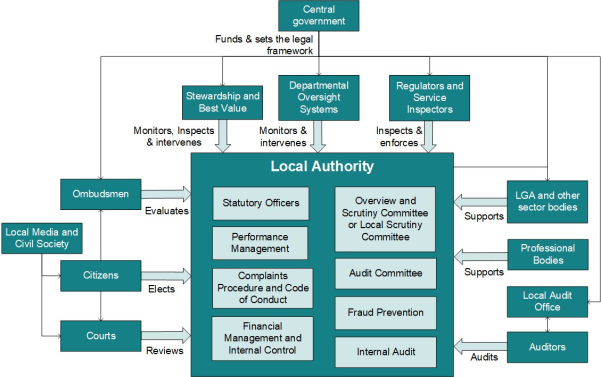
Figure 1: Diagram of the local government accountability system that indicates how different mechanisms hold a local authority to account.
Alt text:
Local authorities are accountable through a range of mechanisms.
Central government sets the legal framework and oversees local authority performance through the Best Value Duty and through various department oversight systems. It also funds regulators, service inspectors, and ombudsmen, which monitor, enforce, and evaluate issues.
Central government also funds the Local Audit Office which oversees external audits of local authorities by independent auditors.
Residents hold local authorities to account through local elections and other democratic mechanisms. Residents and civil society groups can take action in the courts. Local media and civil society groups identify issues and inform citizens.
Local authorities have arrangements for local scrutiny and checks and balance. These include statutory officers, performance management, complaints procedures, financial controls, overview and scrutiny committees (or local scrutiny committees), fraud prevention, audit committees, and internal audit.
Local authorities are also supported and constructively challenged by sector bodies and professional bodies.
1.3 Recent changes to the system
Government has undertaken reforms to the local accountability system:
-
the Local Outcomes Framework (LOF), will measure the role local authorities play in delivering outcomes in their local areas
-
multi-year simplified funding as part of the Local Finance Settlement 2026-27 to 2028-29, giving local authorities greater flexibility and ability to plan
-
devolution agreements including 7 integrated settlements which bring power and funding closer to local communities
-
a new Local Audit Office will be established to oversee the local audit system
-
Local Scrutiny Committees will strengthen local democratic accountability in Mayoral Strategic Authorities by providing earlier, deeper and more visible scrutiny of mayoral decision-making, delivery and value for money, alongside a new route for residents to raise issues of local concern through petitions
-
central government’s statutory powers have been expanded to address excessive risk in local authority borrowing and investment
-
government is consulting on a revised statutory guidance on the Best Value Duty
As the Local Government Accountability System evolves, this document will be updated.
1.4 Key definitions
Below are terms used within this document that are used in different ways in legislation and other guidance. To aid understanding of the local government accountability system, the following terms have been defined in the context of this document:
Local authority
A statutory administrative body responsible for governing a defined local area and delivering a range of public services and regulatory functions on behalf of the state. In this document, a local authority can refer to the following institutions:
- county councils
- district councils
- borough or city councils
- unitary authorities
- London boroughs
- parish councils
- strategic authorities (both mayoral and non-mayoral)
- the Greater London Authority (GLA)
- National Park authorities including the Broads authority
- fire and rescue authorities
- economic prosperity boards
- conservation boards
- port health authorities
- local transport authorities
- local planning authorities
- waste disposal authorities
- the City of London Corporation
- the Council of the Isles of Scilly
The term local authority covers a diverse range of local public bodies. It includes local councils, strategic authorities, bodies created by councils, and some bodies that operate independently of councils. Different accountability mechanisms apply to different types of local authority.
Some authorities, such as local transport authorities and local planning authorities, are not separate institutions but legal functions or statuses exercised by councils or strategic authorities. Where this is the case, the governance, accountability and intervention arrangements that apply to the council also apply to those authorities.
Other authorities, including some fire and rescue authorities and waste disposal authorities, may be joint bodies established by groups of councils to deliver services across more than one council area.
Finally, bodies such as national park authorities, the Broads Authority and conservation boards are established independently of councils to carry out specific statutory functions within defined geographic areas, while still operating at a local level.
Local council
A local government institution and type of local authority that is governed by democratically elected councillors and provides services and regulatory functions in a local area. In this document, a local council refers to the following institutions: county councils, district councils, borough or city councils, unitary authorities, and parish councils.
Local councils are responsible for delivering a variety of local public services in areas of education, social care, housing, planning, transport, waste, fire, public health, licensing, community amenities, and more, while representing and responding to the needs of their local communities. They are not responsible for police services, which are the responsibility of the local Police and Crime Commissioner.
Principal council
A term referring to all councils except for Parish councils. May also be styled as ‘principal authority’.
Unitary authority
An elected single-tier local government institution responsible for all local public services within a specific area. It combines the functions of county and district councils. They may also be styled as a ‘London borough’, ‘metropolitan borough’, or ‘city council’ in some areas.
County council
An elected upper-tier local government institution in England, responsible for county-wide public services such as education, children’s services, adult social care, transportation and waste disposal. County councils operate in tandem with lower tier district councils in a two-tier system.
District council
An elected lower-tier local government institution, responsible for local services like waste collection, planning applications, housing, leisure services and open spaces. District councils work in tandem with upper tier county councils in a two-tier system and are responsible for elections and council tax collection.
Strategic authority
A regional local government institution formed by collaborating councils to take collective decisions. They manage powers devolved from central government over strategic, cross-boundary issues like transport, housing, skills, and economic development. Some but not all strategic authorities have elected mayors. Strategic authorities comprise ‘combined authorities’ or ‘combined county authorities’ as well as the Greater London Authority. There are multiple types of strategic authorities, including single foundational strategic authorities, foundational strategic authorities, mayoral strategic authorities, and established mayoral strategic authorities.
Some strategic authorities have elected mayors who lead the strategic authority. These are different from local authority elected mayors, who lead the local council, and ceremonial or ‘civic’ mayors, who are not elected by the public and hold no executive powers.
The Greater London Authority
An authority in London that holds devolved powers. It has an elected mayor and a 25-strong elected member London Assembly that holds the mayor to account.
Parish council
A small elected or directly democratic local government institution that is the lowest tier of local council in some parts of England. Parish councils have some limited powers around management of community assets, consultation in planning decisions, and provision of funding. They may also be popularly styled as ‘town’, ‘community’, ‘neighbourhood’ or ‘village’ councils.
National park authority
An administrative body responsible for maintaining a national park. Includes the Broads Authority.
Fire and rescue authority
A statutory body that provides services responsible for rescuing or protecting people and their property from fires, road traffic collisions, and other emergencies. A fire and rescue authority can be an upper-tier or single tier council, a strategic authority, or a standalone joint entity created by multiple councils.
Port health authority
A statutory body responsible for preventing dangerous epidemic or contagious and infectious diseases being introduced into the country and responsible for ensuring the wholesomeness of imported food. The role of a port health authority may be undertaken by a council or by a joint entity created by multiple councils.
Conservation board
A body responsible for maintaining a conservation area established by the Secretary of State to oversee an Area of Outstanding Natural Beauty.
Economic prosperity board
A joint body responsible for functions relating to the economic development and regeneration of its local authority areas.
Best Value Duty
A statutory requirement for local authorities and other public bodies defined as best value authorities in Part 1 of the Local Government Act 1999 to “make arrangements to secure continuous improvement in the way in which its functions are exercised, having regard to a combination of economy, efficiency and effectiveness”.
1.5 Key related documents
This document serves as the primary reference point for the entire local government accountability system. There are other documents that set out important parts of the system in more detail, and these are detailed below.
The Accounting Officer for Local Government (the Permanent Secretary of MHCLG) sets out their role and the assurance they receive in the Accounting Officer System Statement. It includes an Annex elaborating the Local Government Accountability System for the purposes of setting out the accountability processes under the responsibility of the MHCLG Accounting Officer.
The local government accountability system applies to devolved local government institutions. The English Devolution Accountability Framework (EDAF) details the processes that hold to account strategic authorities with devolved powers. The system, as set out in this document, applies to devolved authorities along with the processes set out in the EDAF. This document will refer to the EDAF where appropriate.
The Improvement and assurance framework for local government published by the Local Government Association (LGA) aims to support local authorities by outlining the components of accountability and assurance as well as signpost guidance and support to increase local authorities’ effectiveness in conducting these requirements.
Statutory guidance on the Best Value Improvement and Intervention Framework provides clarity to the local government sector in England on how to fulfil the Best Value Duty. It sets out what constitutes Best Value, the standards expected by the department, the department’s approach to assessment, assurance and support, and the models of intervention at the Secretary of State’s disposal in the event of failure to uphold these standards.
2. Accountability to the public
As bodies delivering services in the interests of the public, local authorities are first and foremost accountable to the public, as their activities require democratic legitimacy.
- local authorities are primarily accountable to the public through regular local elections
- the public also helps scrutinise local authority decisions in consultations and by attending public local authority meetings
- where a local authority has failed to meet its statutory obligations or residents feel decision-making was not conducted properly, they may raise this with the council itself, the relevant ombudsman, or initiate a legal challenge
- citizens can ask questions or object to published accounts during a 30-day inspection period
To enable residents to make well-informed voting decisions and engage meaningfully with consultations, the following mechanisms ensure the public availability of information on local authorities:
- transparent council data, procedures and decisions, including by freedom of information requests and the Local Outcomes Framework
- inspectorate-published reports and data
- Local Government and Social Care Ombudsman published data
- local authority annual financial statements and annual governance statements
- external auditor reports, certificates, statutory recommendations, Advisory Notices, and Public Interest Reports
- national and local media and social media scrutiny
2.1 Electoral accountability and other accountability mechanisms available to residents
Local elections are the primary accountability mechanism for the general public over a local authority. The direct democratic accountability of councillors to the electorate is an important mechanism ensuring that they will manage spending and services effectively in the interest of residents. Some areas with devolved institutions are additionally accountable through mayoral elections. The Greater London Authority is accountable through mayoral and assembly elections. Further information on devolved authorities can be found in section 3 of the English Devolution Accountability Framework.
Local authorities are also accountable to residents through consultations, where they must consider people’s views in decision-making. Local authorities are legally required to consult in a wide variety of circumstances relating to local authority responsibilities, including when determining how to meet their Best Value Duty. They should also consult residents in some circumstances that are not required by law but would facilitate stronger decision-making, such as for budget setting or policy formation. Local authorities should follow the government consultation principles.
During an audit, residents can hold their council to account by asking specific questions, or by raising objections to the public accounts where they suspect the accounts are unlawful.
In addition to this, local authorities may provide additional processes for engagement such as through a petition scheme or public questions. They can set out these opportunities in the local authority constitution.
2.2 Transparency to the public
To allow democratic accountability to be effective, it is crucial that the public can easily understand what functions institutions are responsible for and how they are performing. This understanding is important in strengthening the effectiveness of the accountability mechanisms available to residents outlined above, including elections.
This requires transparency in local authority processes and public availability of performance data. Local authorities should also communicate clearly with their residents about what their role entails and ensure key information is easily accessible online. Local authorities should ensure their publicity complies with the Code of Recommended Practice on Local Authority Publicity.
National and local news publishers, down to the hyper-local and community level, play a key role in bringing greater transparency and accountability to local decision making, enhancing public trust and understanding, exposing corruption, and fostering civic engagement. Local authorities are required under multiple pieces of legislation to publish certain information relating to decisions on such matters as planning, road management, and alcohol licensing in print local newspapers. Commonly known as statutory notices or public notices, this information keeps communities informed of decisions made by their local authorities which may affect their quality of life, local services or amenities, or property. Local authorities can also share information on social media, local newsletters, and other communication methods.
Local authorities must conduct an annual review of the effectiveness of the local authority’s system of internal control and publish an annual governance statement under regulation 6 of the Accounts and Audit Regulations 2015. Alongside this, local authorities must publish unaudited annual financial statements on their websites under regulation 10 of the same regulations, which residents can inspect, ask questions, and object during a 30 working-day inspection period set by each local authority. Following this, local authorities must publish the audited financial statements, the local auditor’s report and the local auditor’s certificate alongside a notice of the conclusion of the audit. See the National Audit Office Guide to your rights for further information.
Local auditors have statutory powers to publicly highlight issues of concern where either remedial action cannot wait for the publication of accounts, or the concern exceeds the scope of the audit. This early warning system can take the form of statutory recommendations, Advisory Notices or Public Interest Reports. Once established, the Local Audit Office will collate published reports made by auditors.
Councils differ from central government in that they take decisions in public and there are expectations around residents having access to the decisions and being able to participate in meetings. All formal meetings held by a local authority must be open to the public under Part 2 of the Local Authorities (Executive Arrangements) (Meetings and Access to Information) (England) Regulations 2012, except in instances where publicity would be against the public interest, such as where confidentiality needs to be maintained. The public is also entitled to have access to documents relating to council meetings and executive decisions made by executive members or officers, published in advance of meetings. Under regulation 9 of the 2012 regulations and regulation 9 of the the Local Authorities (Executive Arrangements) (Access to Information) (England) Regulations 2000, the local authority must publish a forward plan that details when key decisions will be made, at least 28 days before the relevant decisions.
The Greater London Authority is required under section 48 of the Greater London Authority Act 1999 to hold a ‘People’s Question Time’ meeting at least twice a year where members of the public can ask the mayor questions. Other local authorities can also conduct a similar public meeting to engage with residents.
Access by the public to local authority data allows local people to hold their local authority to account, contribute to the local decision-making process, and help shape public services. Local authorities are subject to the Freedom of Information Act, meaning that local authorities must share information requested by the public within 20 days of the request, subject to specific exceptions. Additionally, the Local Government Transparency Code 2015 requires most local authorities (see paragraph 1) to publish, on a regular basis, certain information about their expenditure, procurement and assets. This includes information on local authority counter-fraud work. Under the Accounts and Audit Regulations 2015, local authorities must publish a statement of accounts and the auditor’s report and certificate by the statutory deadline for each financial year.
Local authorities must abide by data protection requirements under the UK General Data Protection Regulation (UK GDPR) and the Data Protection Act 2018. Citizens have the right to make requests regarding their personal data when it is held by a local authority, such as what data exists on them and for this data to be rectified or erased. See the Information Commissioner’s guide to individual rights for further information.
The Local Outcomes Framework (LOF) enables outcomes-based performance measurement against key national priorities delivered at the local level and driven by councils as local leaders of place. The LOF digital tool will display the outcome metrics in the framework in an accessible format. It will be available for citizens to understand the outcomes in their local area in comparison to other local areas. This will empower them to utilise the accountability mechanisms outlined above including making informed voting decisions.
Inspectorates publish reports and data on local authority services. A full list of regulators and service inspectors can be found in section 4 of this document. The Local Government and Social Care Ombudsman reports annually on complaints investigated, with published data available for each English local authority.
2.3 Resident complaints and redress
Where a local authority has failed to deliver a statutory duty, failed to deliver a duty of care, violated a person’s legal rights, or is perceived to have come to a decision without following required procedures, a resident may take action in response.
Residents can first complain to the local authority. Local authorities should maintain a complaints procedure. Local councils are required to maintain a complaints procedure for social services under the the Local Authority Social Services Complaints (England) Regulations 2006. In some cases, the council must reply to complaints within a legal timeframe.
Once a local authority has responded to the complaint, or has taken too long to resolve a complaint, a resident may then make an appeal to an Ombudsman. Ombudsmen have powers of investigation and may issue recommendations, require specific action, or order compensation, depending on the body in question. Ombudsmen relevant to local authorities are listed in Section 4.
MHCLG sponsors the Local Government and Social Care Ombudsman, which investigates complaints by residents who have suffered personal injustice arising from maladministration by local authorities, social care providers and some other public bodies. This Ombudsman service provides a free and impartial way to put things right when they go wrong. Their recommendations improve public services and help to ensure that faults are not repeated.
MHCLG also sponsors the Housing Ombudsman, which makes the final decision on disputes between social housing tenants and their landlords.
Administrative justice can also be provided in some circumstances by organisations such as the Public Services Ombudsman, the Pensions Ombudsman, the Information Commissioner’s Office and the Office of the Schools Adjudicator.
The HM Courts and Tribunals Service has established a number of service-specific tribunals to consider appeals about specific public services, such as the First-tier Tribunal (Special Educational Needs and Disability).
Residents have a statutory right of appeal against a specific decision or recourse through the courts via judicial review. They may also initiate legal action against a council where it is failing to fulfil a statutory duty, violating a person’s rights under the Equality Act 2010 or Human Rights Act 1998, or failing to meet a duty of care.
3. Local scrutiny and checks and balances
Local authority councillors and officers must make decisions that meet appropriate standards and spend money legally and prudently. This is ensured by the following local authority statutory duties:
- councillors are required to spend and borrow money with regularity and propriety
- appoint a Head of Paid Service responsible for managing the local authority and its staff
- appoint a Section 151 Officer who must alert councillors and the auditor in the case of unlawful expenditure or an unbalanced budget
- appoint a Monitoring Officer responsible for reporting when a decision could be unlawful
- maintain an internal audit and to be audited by an external independent auditor, who is also a prescribed person for whistleblowing alongside the National Audit Office
- maintain an internal performance management system
- establish an Overview and Scrutiny Committee and appoint a statutory Scrutiny Officer
- operate control systems to prevent and detect fraud
- maintain and abide by a code of conduct and constitution, including a complaints process
- maintain a list of pecuniary and non-pecuniary interests
3.1 Internal scrutiny
Local scrutiny is an essential check on local authority spending and member conduct. Local authorities should promote a culture of scrutiny that ensures high standards for decision-making. Engagement with the scrutiny function should be encouraged at all levels of the local authority, including the executive. The ‘golden triangle’ of the statutory roles of the Head of Paid Service, the Section 151 Officer, and the Monitoring Officer are together responsible for the corporate health and effectiveness of principal authorities, strategic authorities and some other types of local authority.
While the executive is responsible for proposing and implementing the budget and policy framework, ultimate accountability lies with the full elected council. The council provides the first level of internal scrutiny for decisions. Under section 37 of the Local Government Act 2000, councils and strategic authorities must draft and subsequently abide by a constitution to guide decision making.
Councils and strategic authorities operating executive arrangements must have an overview and scrutiny committee under Part 1A of the Local Government Act 2000, Local Democracy, Economic Development and Construction Act 2009 and the Levelling-up and Regeneration Act 2023. These committees have statutory powers to scrutinise decisions the executive is planning to take, those it plans to implement, and those that have already been taken/implemented. They also make reports and recommendations to the authority on the discharge of its functions and on matters that affect the authority’s area or residents. This includes scrutinising accounts and local audit reports. Recommendations following scrutiny enable improvements to be made to policies and how they are implemented.
Upper and single tier local authorities are also required to designate a statutory Scrutiny Officer, who promotes and supports the overview and scrutiny committee. Further information on overview and scrutiny can be found in the statutory guidance for councils, combined authorities and combined county authorities.
Local authorities must appoint statutory officers responsible for key service areas and responsibilities, including:
- a Director of Children’s Services under section 18 of the Children Act 2004
- a Director of Adult Social Services under the Local Authority Social Services Act 1970
- a Director of Public Health under section 30 of the Health and Social Care Act 2012
- an Electoral Registration Officer under section 52 of the Representation of the People Act 1983
- a Returning Officer under section 35 of the Representation of the People Act 1983
Under the English Devolution and Community Empowerment Act 2026, there will be an enhanced scrutiny regime for Mayoral Combined Authorities and Mayoral Combined County Authorities, which will be known as Local Scrutiny Committees (LSCs). Until the new LSC system is brought into practice, the existing system of overview and scrutiny will remain in place in these authorities. The Greater London Authority already operates an equivalent scrutiny model. The overview and scrutiny committees system will remain the appropriate scrutiny regime for foundational strategic authorities.
Devolved authorities have specific scrutiny requirements and should operate by the principles of the Scrutiny Protocol. Further information on scrutiny for devolved authorities can be found in section 2 of the English Devolution Accountability Framework.
3.2 Internal performance management
To comply with statutory duties such as the Best Value Duty, external audit, and local scrutiny requirements, local authorities should maintain an internal performance management system which monitors service performance and adjusts local authority operations accordingly. Performance appraisals should be conducted consistently, with capability and disciplinary procedures being used as appropriate.
Local authorities should implement accountability and assurance mechanisms when working with partners. See A guide to effective accountability and assurance of delivery in place-based partnerships and Local authority company review guidance for further details.
3.3 Prudent spending and financial management
Local authorities have statutory duties that require councillors to spend money with regularity and propriety and restrict borrowing to what is affordable.
Lower tier and single tier councils, the billing authorities, and strategic authorities must set their council tax at a level which will balance their budget under Part 1 of the Local Government Finance Act 1992 and under article 9 of the Combined Authorities Finance Order 2017 and Schedule 6 of the Greater London Authority Act 1999. Relevant local authorities (see section 23) must restrict borrowing to what is affordable under section 2 and section 3 of the Local Government Act 2003.
County councils, unitary councils, district councils, and parish councils must have regard to the Treasury Management Code and The Prudential Code for Capital Finance issued by the Chartered Institute of Public Finance and Accountancy (CIPFA), and the statutory guidance on Local Government Investments and on minimum revenue provision published by MHCLG when making borrowing or investment decisions. When making decisions, local authorities must take into consideration the requirements for sustainable reserves and contingency funding as appropriate.
Under section 151 of the Local Government Act 1972, councils, strategic authorities, and some other types of local authority “shall make arrangements for the proper administration of their financial affairs and shall secure that one of their officers [the Section 151 Officer or Chief Finance Officer] has responsibility for the administration of those affairs”. The Section 151 Officer is an important mechanism for holding councils to account and has duties and powers to alert councillors and the auditor in the case of unlawful expenditure. Councils can review the Code of Practice on Good Governance for Statutory Officers published by Solace for guidance.
Section 114 of the Local Government Finance Act 1988 requires the Section 151 Officer to issue a report (a section 114 notice) to all councillors if there is unlawful expenditure or an unbalanced budget. The Section 151 Officer must also report to the council when the council tax is being set on the robustness of the estimates and the adequacy of the reserves allowed for in the budget. The authority’s full council must meet within 21 days of the issuing of the section 114 notice to consider it, and during that period the authority is prohibited from either pursuing the course of action which is the subject of the report (in the case of unlawful expenditure) or entering into new agreements involving the incurring of expenditure (in the case of an unbalanced budget).
Scrutiny of a local authority’s financial management is enabled by the Accounts and Audit Regulations 2015, which requires that elected members maintain a sound system of internal control. This includes keeping up-to-date accounting and financial transaction records, maintaining arrangements for the management of risk and an effective internal audit. Annually, local authorities must prepare accounts which are subject to external audit and review the effectiveness of the system of internal control in place. Under the English Devolution and Community Empowerment Act 2026 local authorities must establish an audit committee to monitor and review the effectiveness of the authority’s internal controls, risk management and financial reporting.
Most local authorities (see paragraph 1B) must appoint a Monitoring Officer under section 5 of the Local Government and Housing Act 1989, who must report to the council when any proposal, decision or omission is likely to lead to contravention of any enactment, rule of law or statutory code.
3.4 Audit
Local authority annual accounts must be audited externally by an independent auditor. The independent auditor is required to give an opinion on whether the financial statements of the audited body give a true and fair view, and whether all statutory provisions relating to the accounts have been complied with. They are also required to satisfy themselves that proper arrangements are in place to achieve effectiveness, efficiency, and economy in the use of resources.
External auditors can also pursue action in the courts where they believe that either elements of the accounts, the actions or decisions of an authority, or the authority’s failure to act, are unlawful (sections 28 and 31 of the Local Audit and Accountability Act 2014).
The auditor is under a duty to consider making “a report in the public interest” on any significant matter coming to their notice during an audit. Any public interest report must be considered by the full council within one month and be published. The auditor is also required to share the report with the Secretary of State of MHCLG.
Both the external auditor and the NAO are prescribed persons under the Public Interest Disclosure Act 1998, to which employees may make protected ‘whistleblowing’ disclosures.
When established, the Local Audit Office will coordinate the audit system for local authorities, ensuring audits meet appropriate standards. The body will oversee and strengthen the local audit system by appointing and managing auditors, monitoring audit quality, and publishing national insight reports. It will assume responsibility for the Code of Audit Practice, set audit standards, and address systemic weaknesses across the market. It will also produce national insights from audit reports and oversee professional bodies. Further detail can be found in the Local audit reform strategy 2025.
The Financial Reporting Council and professional bodies have an oversight role in the current audit framework, mirroring their regulatory roles within the companies’ audit sector.
3.5 Fraud
As with any organisation, a local authority can be investigated and individuals prosecuted by the police where there is evidence that fraud has occurred. Local authorities are under an overriding duty to protect the public purse and must operate control systems to prevent and detect fraud and corruption and appropriately manage risk under section 4 of the Accounts and Audit Regulations 2015. Local authorities should ensure they have a clear counter fraud policy embedded into their systems as detailed in the CIPFA Code of Practice on managing the risk of fraud and corruption and follow the recommendations set out in the latest Local Government Counter Fraud and Corruption Strategy. The Local Government Transparency Code 2015 sets out the specific counter fraud requirements they must publish annually. Local authorities are required to comply with Part 2 of the Code.
3.6 Maintaining standards in public life
Councils, strategic authorities and some other types of local authority (see paragraph 6) are legally required to maintain standards set out in Chapter 7 of the Localism Act 2011, including to:
- promote and maintain high standards of conduct
- adopt their own code of conduct – which as a minimum must be consistent with the Seven Principles of Public Life (the Nolan Principles)
- have in place arrangements to investigate and decide on alleged breaches of the code, often undertaken by a standards committee
- maintain a register of both pecuniary and non-pecuniary interests
If a council is taking too long to consider a complaint against a member of the local authority, or the decision on the potential violation of the code of conduct has not been made properly, a resident may submit a complaint to the Local Government and Social Care Ombudsman. The Ombudsman can then investigate to establish if there was a fault in how the local authority resolved the complaint and compel the local authority to remedy this.
Professional bodies have professional standards codes they manage. If a professional working in a local authority fails to meet these standards, they may be disciplined by the professional body.
4. System stewardship, service regulation, and departmental oversight
Central government plays a significant role in the oversight of local authorities.
MHCLG has the responsibility for ensuring the overall local government system functions effectively and in the interests of residents. As part of this, MHCLG plays a stewardship role, monitoring local authorities and, if necessary, intervening to prevent failure and ensure the delivery of best value. Central government funds sector support to help local authorities improve their capabilities. Additionally, government departments sponsor regulators and service inspectors with various powers to inspect and enforce standards for local authority services. Departments across central government monitor delivery where they are funding local authorities to deliver national priorities at the local level.
4.1 Regulation and inspection of local authority services
Central government departments sponsor service inspectors and regulators to monitor performance, resolve service complaints, and enforce standards. They hold diverse powers which may include conducting inspections, issuing improvement notices, imposing fines, and in certain cases may withdraw the right of a service provider to operate.
Regulators and service inspectors
- Ofsted
- Care Quality Commission
- Regulator of Social Housing
- Health and Safety Executive
- Environment Agency
- Building Safety Regulator
- Transport Commissioners
- Planning Inspectorate
- Teaching Regulation Agency
- His Majesty’s Inspectorate of Constabulary and Fire & Rescue Services
- Equality and Human Rights Commission
- Information Commissioner
- Office for Environmental Protection
- Food Standards Agency
There are also a range of redress bodies which can consider complaints and appeals from individuals about the specific actions and decisions taken by local authorities. These are outlined in more detail in section 2.3.
4.2 The Best Value duty
MHCLG has a stewardship role for the overall health of the local government system. This includes monitoring local authorities’ governance, leadership, financial sustainability, service performance and capacity to meet statutory duties. The department draws on evidence from published data, audit findings, inspectorate and regulator reports, engagement with authorities, information from other government departments, and intelligence from sector partners.
All Best Value authorities (see paragraph 1) are subject to the Best Value Duty under Part 1 of the Local Government Act 1999, which requires them to make arrangements to secure continuous improvement, having regard to economy, efficiency and effectiveness. The department’s approach to Best Value assessment, assurance, support and intervention is set out in the published statutory guidance: Best value standards and intervention: a statutory guide for best value authorities. Where concerns arise, the department may engage early, support improvement, seek further assurance, or consider statutory inspection or intervention.
Ministers have a range of powers to act in cases of failure. If a council does something to cause concern, ministers may write to them reminding them of their obligations. If issues continue, this could lead to a non-statutory inspection or risk assessment visit. If serious concerns continue, responses can escalate to a statutory intervention, including the appointment of a person nominated by the Secretary of State (referred to as “commissioners” or “envoys” in previous interventions) to exercise a specified function or functions of an authority for a specified period.
4.3 Monitoring local authority performance
Central Government obtains a range of data from local authorities to meet various needs. These are agreed jointly with the Local Government Association and the datasets are catalogued and published in the Single Data List. All financial data is taken from one or a combination of Office for National Statistics data, the publicly available statistical returns provided by local authorities to the department, or from authorities’ Whole of Government Account Returns submitted to HM Treasury. Other information including soft intelligence is primarily gained from our interaction with authorities and from other government departments.
The Annual Conversation Programme and annual data survey are led by the department’s English Devolution teams. They present formal and structured opportunities for strategic authorities to provide the department with data and insights to help us better understand what is happening on the ground in each strategic authority, including what is going well and any challenges they are facing, and to work in partnership to address any challenges.
MHCLG uses the Local Outcomes Framework to understand local council service performance in contributing to outcomes. Devolved institutions with integrated settlements have bespoke Integrated Settlements Outcomes Frameworks (ISOFs) which measure areas on a variety of metrics. These are linked to a matrix of mitigations for the integrated funding settlements where performance is failing to improve.
4.4 Sector support
MHCLG funds the Local Government Association (LGA) sector support offer to help councils and strategic authorities meet their Best Value Duty of continuous improvement. This comprises a variety of resources and tools, managed through LGA principal advisers and regional support teams. The government expects local authorities to take up opportunities of sector-led support as part of meeting their Best Value Duty of continuous improvement.
The sector support offer includes corporate peer challenges; bespoke councillor and officer support, mentoring, and training; mediation; peer networks; resources and tools such as LG Inform; and guidance and direct support for councils with severe performance and/or financial issues. The wider support offer also includes support for specific services such as children’s services and adult social care.
Support is additionally available through a variety of expert organisations and peer networks including professional networks.
Beyond this, the community and voluntary sector can act as a critical friend, advocate for different groups, and support the interface between the local authority and stakeholders.
4.5 Departmental oversight
Key national priorities are delivered at the local level, and central government provides funding to local authorities to empower them to improve outcomes. Central government departments therefore need to understand local authority performance to ensure the right mix of support is in place.
Accountability Frameworks
Central government utilises various frameworks to track progress against specific priorities or objectives, and to set shared expectations of how to measure improvement.
Published frameworks include:
- Local outcomes framework (LOF)
- Integrated Settlements Outcomes Frameworks (ISOFs)
- Adult social care priorities for local authorities
- Adult social care outcomes framework (ASCOF)
- Public health outcomes framework (PHOF)
- Better Care Fund Framework 2026/27
- National Combating Drugs Outcomes Framework
- Children’s Social Care National Framework and Dashboard
- Dashboards on homelessness
- Neighbourhood Health Framework
- Outcome Indicator Framework for the 25 Year Environment Plan
- Early years foundation stage statutory framework
Service-specific interventions
Service-specific intervention regimes are set by departments and address service failure that is not systemic or organisational. The scope and extent of intervention regimes vary depending on the service area and responsible department. When seeking to address underperforming services, departments should follow the principle of escalating interventions, starting with a support offer and/or unintrusive non-statutory interventions. Where this is unsuccessful at improving outcomes, departments may choose to use statutory powers where they have these. For example, the relevant Secretary of State may issue warning or improvement notices to authorities or service providers.
For some services, the law grants Secretary of States stronger powers of intervention. These comprise measures such as but not limited to those related to children’s services, schools, fire and rescue services, adult social care, planning, and public libraries.
Most local government funding is pooled in the local finance settlement, giving local leaders flexibility in how they deliver services. However, where local authorities are recipients of grants from central departments, they are held accountable if they fail to deliver against the grant requirements or where expenditure is deemed ineligible, which in some cases could result in clawback of the grant.
5. Annex: Links and guidance
Introduction
Accounting Officer System Statement - GOV.UK
English Devolution Accountability Framework - GOV.UK
Improvement and assurance framework for local government - Local Government Association
Best Value Improvement and Intervention Framework - GOV.UK
Accountability to the public
Consultation principles - GOV.UK
Code of Recommended Practice on Local Authority Publicity - GOV.UK
National Audit Office - Guide to your rights
A guide to individual rights - Information Commissioner’s Office
Local Outcomes Framework - GOV.UK
Local government complaint reviews - Local Government and Social Care Ombudsman
Local Government and Social Care Ombudsman
Office of the Schools Adjudicator
HM Courts and Tribunals Service
Local scrutiny and checks and balances
Local Authority Company Review Guidance
Treasury Management Code - CIPFA
The Prudential Code for Capital Finance - CIPFA
Statutory guidance on Local Government Investments - GOV.UK
Capital finance: guidance on minimum revenue provision (5th edition) - GOV.UK
Code of Practice on Good Governance for Statutory Officers - SOLACE
Code of Audit Practice - National Audit Office
Local audit reform: a strategy for overhauling the local audit system in England - GOV.UK
Fighting Fraud Corruption Locally Strategy 2020 - Cifas
CIPFA Code of Practice on managing the risk of fraud and corruption
Cifas Local Government Counter Fraud and Corruption Strategy
Local government transparency code 2015 - GOV.UK
The Seven Principles of Public Life - GOV.UK
System stewardship, service regulation, and departmental oversight
Regulator of Social Housing - GOV.UK
Health and Safety Executive - GOV.UK
Building Safety Regulator - GOV.UK
Transport Commissioners - GOV.UK
Planning Inspectorate - GOV.UK
Teaching Regulation Agency - GOV.UK
His Majesty’s Inspectorate of Constabulary and Fire & Rescue Services - GOV.UK
Equality and Human Rights Commission
Office for Environmental Protection
Food Standards Agency - GOV.UK
Integrated Settlements Outcomes Frameworks for 2025 to 2026 - GOV.UK
Sector support offer for local authorities 2025/26 - Local Government Association
LGA principal advisers and regional teams - Local Government Association
Integrated Settlements for Mayoral Combined Authorities - GOV.UK
Adult social care priorities for local authorities - GOV.UK document
Adult social care outcomes framework - GOV.UK (ASCOF)
Public health outcomes framework - GOV.UK (PHOF)
Better Care Fund Framework 2026/27 - GOV.UK
National Combating Drugs Outcomes Framework - GOV.UK
Children’s Social Care National Framework - GOV.UK
Children’s Social Care Dashboard - GOV.UK
Dashboards on homelessness - GOV.UK
Neighbourhood Health Framework - GOV.UK
Outcome Indicator Framework for the 25 Year Environment Plan - GOV.UK
Early years foundation stage statutory framework - GOV.UK
Final Local Government Finance Settlement: England, 2026-2027 to 2028-2029 - GOV.UK