Organic Action Plan for England
Published 14 October 2026
Applies to England

© Crown copyright 2026
This publication is licensed under the terms of the Open Government Licence v3.0 except where otherwise stated. To view this licence, visit nationalarchives.gov.uk/doc/open-government-licence/version/3 or write to the Information Policy Team, The National Archives, Kew, London TW9 4DU, or email: psi@nationalarchives.gov.uk.
Where we have identified any third party copyright information you will need to obtain permission from the copyright holders concerned.
This publication is available at https://www.gov.uk/government/publications/organic-action-plan-for-england/organic-action-plan-for-england
Ministerial foreword
Across England, organic farmers, growers and food businesses play an important role in producing high-quality food while caring for soils, wildlife and the rural communities they are part of. In doing so, they also help advance wider goals for nature recovery, cleaner water and greater climate resilience.
People across the sector have been frank with me about what holds them back and clear about what they could achieve. They want to grow their businesses and reach new customers without losing what makes their work worthwhile.
This plan is our answer, and its purpose is to turn that ambition into action.
The opportunity is plain. More shoppers are choosing organic food and drink than a few years ago, yet the share of England’s farmland managed organically has barely moved. That gap is a chance for English producers. We want more farmers able to make the change, and stronger supply chains to carry their produce from field to shelf. This Organic Action Plan for England sets out how government and industry will act on that opportunity.
The English Organic Forum has worked closely with government on this plan. Its members have brought valuable expertise and practical experience to the discussions, and I am grateful for their support.
Government and industry each have a part to play. Together, we will remove barriers, develop the market for organic products, help more people understand how organic food is produced, strengthen supply chains and open up new opportunities for businesses across the sector. The plan also recognises how organic farmers can help maintain healthy soils, support biodiversity and produce food sustainably.
Organic farming should not be treated as a niche. More people are looking closely at where their food comes from, how it is produced and whether it meets standards they value. They want confidence in the choices available to them and access to high-quality food.
As demand for organic products grows, we want farmers, businesses and consumers to share in the benefits. That means more opportunities for producers, stronger domestic supply chains and greater choice for consumers. Organic food should not be viewed as something available only to a select few. As the sector grows, high-quality organic food should become a more visible and accessible choice for households across the country.
The plan is part of the government’s wider work with the farming industry. Organic is one path among several towards farming that is both productive and good for the land. But its long experience of nurturing soils, supporting wildlife and relying less on synthetic inputs holds lessons for everyone. It can make a real contribution to our goals for nature, food security and rural growth.
Right Honourable Dame Angela Eagle DBE MP
Secretary of State for Environment, Food and Rural Affairs
The Organic Sector in England
Scale and significance
Organic farming and organic food and drink production play a distinctive, though still relatively small, role within England’s wider agricultural sector, accounting for around 3.4% of the utilised agricultural area. It nevertheless represents an increasingly important component of the food system. UK organic retail sales reached £3.9 billion in 2025, sustaining the growth trajectory that has seen the market expand by 4.2% in the preceding year alone. England accounts for the largest share of organic land in the United Kingdom at approximately 301,000 hectares, and the sector supports farmers, processors, certification bodies, retailers and supply chain businesses across the country. Yet this growing consumer demand is often being met by imports, with the trade gap in organic goods continuing to widen.
The British organic sector is internationally respected and influential. British organic farmers, researchers and non-governmental organisation (NGOs) led the way with the introduction of the first organic standards in the 1960s and 1970s and continue to contribute significantly to research, innovation and standards development in organics internationally. English organic businesses operate in export markets across Europe and beyond.
Organic production offers an essentially place-based approach: successful organic farming depends on how farmers make best use of the resources offered by their land and environment. Natural fertility supplied by legumes in rotations, enhanced soil health and pest management achieved through ecological balance demonstrate the environmental benefits that organic production can deliver. This Organic Action Plan for England includes several case studies showing place-based examples of organics in action.
The environmental case for organics
The Office of Environmental Protection’s 2026 progress report on the Environmental Improvement Plan (EIP) identifies nature-friendly farming as a critical mechanism for improving nature on agricultural land.
The evidence for the environmental benefits of organic production relative to conventional non-organic production is well established and continues to develop, although not all impacts are equally well evidenced across sectors. A comprehensive review commissioned by Defra and conducted by the Organic Research Centre (ORC) in 2025 confirms the breadth and consistency of the evidence across a range of production systems (see Table 1). Benefits of organic agriculture for environment and animal welfare in climates such as England’s include the potential for measurable improvements to soil health and soil carbon levels, water quality and farmland biodiversity. This systematic literature review also shows how organic farming reduces the application of synthetic nitrogen fertilisers and pesticides, inputs whose environmental costs are increasingly well understood, and supports higher standards of animal welfare. Organic production looks at the whole farm system, therefore these benefits happen naturally from the overall approach, rather than from focusing on individual aspects of the farming system.
At the farm level, organic production reduces exposure to synthetic input prices and can improve animal welfare while reducing antimicrobial use.
Case study: Apricot Centre in South Hams, Devon, supporting local nature recovery
The Apricot Centre near Dartington in South Hams used a combination of regenerative farming practices including organic and biodynamic, specifically designed to improve biodiversity, soil health, and habitat quality while maintaining food production. These measures directly align with the types of actions encouraged under nature recovery policies such as Local Nature Recovery and Environmental Land Management (ELM) schemes.
A 120-acre farm implemented agroforestry, rotational grazing, crop rotation and permaculture. These measures restored habitats, improved ecological connectivity, increased biodiversity and achieved carbon-neutral status This demonstrates how organic farming can deliver tangible local nature recovery outcomes. By employing organic methods, such as avoiding synthetic pesticides and fertiliser, it helped support pollinating insects (such as bees and hoverflies), soil organisms including earthworms and beneficial microbes and more diverse plant communities within and around fields.
Not only did the centre report a 400% increase in biodiversity across the site, but measures were implemented while creating a commercially successful enterprise, with the centre described as an environmentally pioneering and financially viable business.
Table 1: Summary of key findings from a recent review conducted by the Organic Research Centre for Defra
See the full review commissioned by Defra and conducted by the Organic Research Centre (ORC) in 2025.
| EIP goal | Organic evidence | Evidence (based on peer-reviewed literature, spatial data, Critical Control Point (CCP) analysis and farm-scale data) |
|---|---|---|
| Restored nature | Strong evidence | Strong peer-reviewed evidence of biodiversity benefits; supported by farm-scale assessments |
| Chemical exposure | Strong evidence | Clear prohibition on most pesticides in standards |
| Sustainable resources (soil health) | Strong evidence | Strong peer-reviewed evidence supported by farm-scale assessments |
| Climate change (adaptation) | Strong evidence | Strong evidence of enhanced soil health and diversity in cropping systems; building resilience |
| Clean water | Moderate or some evidence | Moderately strong evidence from literature; standards relating to nutrient management indicate aspiration |
| Public engagement | Moderate or some evidence | Farm-scale data indicated high levels of public engagement; not explicit in standards |
| Environmental hazards | Moderate or some evidence | Flood and drought mitigation indirectly supported through soil health improvements; moderately strong benefit |
| Biosecurity | Moderate or some evidence | Moderate aspiration in standards |
| Waste minimisation | Moderate or some evidence | Moderate aspiration in standards |
| Climate change (mitigation) | Weak or no evidence | Some positive but overall weak evidence on greenhouse gas (GHG) mitigation, compounded by differences in functional units (land area vs product) |
| Clean air | Weak or no evidence | Limited evidence; not explicitly addressed |
Challenges
The organic sector has not been immune to the pressures facing farming more broadly, including labour availability, the increased cost of living and climate volatility. Within the organic sector specifically, there are challenges that go beyond these shared pressures.
Defra’s annual organic farming statistics for 2025 show a 7.3% increase in UK organic land area compared to 2024. However, growth in England is lagging. Although England has the largest organic land area in the UK (301,000 hectares), total organic area (both fully converted and area under conversion) has only increased by 1.5% compared to 2024 and has been between 289,000 and 324,000 hectares (2.7% and 3.5% of utilised agricultural area) since 2012. As a result, growing consumer demand, alongside demand for intermediate inputs such as animal feed, is increasingly being met by imports. The trade gap in organic goods is widening, with a particular import dependency in horticulture. This represents a missed opportunity to realise the environmental and economic benefits that could be delivered through increased domestic organic production. While conditions in England do not allow growth of all horticulture products, there may be an opportunity to focus on fruit, vegetables and pulses that are seasonal to the UK in order to improve the environmental footprint of UK agriculture and increase availability of organic domestic produce.
Conversion barriers remain. Many farmers who might benefit from organic farming lack clear, practical information on what conversion entails, what financial support is available, and what markets they could access.
Certification costs, the conversion period, and uncertainty about price stability all act as deterrents. These barriers are not insurmountable but addressing them will require sustained and co-ordinated action over time.
Consumer awareness also remains uneven. A consumer study on barriers and opportunities for UK and organic foods published in 2024 found that a significant proportion of consumers are unclear about what the organic label means and what standards underpin it. Greater clarity on the regulated, independently certified nature of organic status is associated with stronger purchasing intention. Closing this knowledge gap is a clear market development opportunity.
Case study: Local food systems change in Bury, Lancashire
Bury’s school meals programme demonstrates the role that public sector procurement can play in supporting local and organic supply chains. All 56 local authority schools have achieved Food for Life Served Here Gold certification, exceeding the requirement for 25% of food spend to be organic.
The approach has created a stable market for regional suppliers while maintaining affordability. The programme generated significant cost savings despite increasing organic purchasing, challenging the perception that organic food is always more expensive. Around 35% of food stock is sourced within 20 miles of Bury. Suppliers including Organic North and Dunsters Farm have benefited from longer-term demand and clearer opportunities to plan and invest.
The programme has also supported wider engagement across schools, parents, suppliers, council teams and community organisations. Its benefits include increased use of organic ingredients, support for local employment, improved access to fresh and healthier meals for children, and reduced environmental impacts. Sustained public sector demand has helped make organic food part of routine school meal provision.
Opportunities for growth
The conditions for renewed growth in the English organic sector are in place. Consumer demand is rising but is not being fully met by domestic production where it can be, creating a clear, if still developing, market opportunity. Government funding schemes include dedicated support for organic conversion and maintenance. International experience demonstrates clearly that a co-ordinated package of production support, market development and public procurement measures can drive substantial, sustained growth in domestic organic supply.
Based on the Soil Association’s 2026 Organic Market Report, home delivery makes up about 13% of the UK organic market, compared with supermarket retail at 67%. Evidence from studies on consumer insights and barriers and opportunities for UK and organic foods has shown that consumers can be willing to purchase organic produce of British origin, but that the limited availability and range can lead to them purchasing produce that has its origin outside of the UK. Therefore, there is an opportunity here to support UK businesses to cater to a larger proportion of the demand for domestic organic products within our supermarkets.
The organic sector is already structuring itself to maximise growth opportunities. For example, there are existing sector groups that focus on feed, seed, horticulture and dairy where organic producers come together to share insights, technical knowledge and advice. The emerging UK Organic Trade Forum is working together to support the existing work of certifiers on plans to drive growth, including with multiple retailers and others on the organic brand proposition. The actions in the Organic Action Plan for England (OAPE) provide opportunities for Defra and the organic sector to bring together and further expand on this existing work.
Public sector procurement represents an additional significant opportunity. Government Buying Standards for Food and Catering Services (GBSF) set a long-term ambition for 10% of public sector food spend to meet higher environmental production standards (HEPS), of which organic is a central component. Achieving this ambition at scale would provide the supply chain certainty needed to encourage organic conversion, while improving the environmental outcomes associated with food served in public sector settings.
Organic supply can be successfully structured to maximise efficiency and reach a wider range of people, using for example short supply chains, focusing on availability rather than choice, or supplying direct to very local communities. This can be via organic box delivery services or through local small independent shops. These local opportunities support the government’s food strategy aims, in particular the goal of connecting people to local food systems. Organic land area varies across the regions of England (see Figure 1). The South West of England has a significantly higher proportion of organic land with 46% of all of England’s organic land, while the remaining regions have from 3.9% to 15% of England’s organic land. Taken together, this shows that growth opportunities will differ by region, and that support will need to reflect both existing organic strengths and areas with scope to expand.
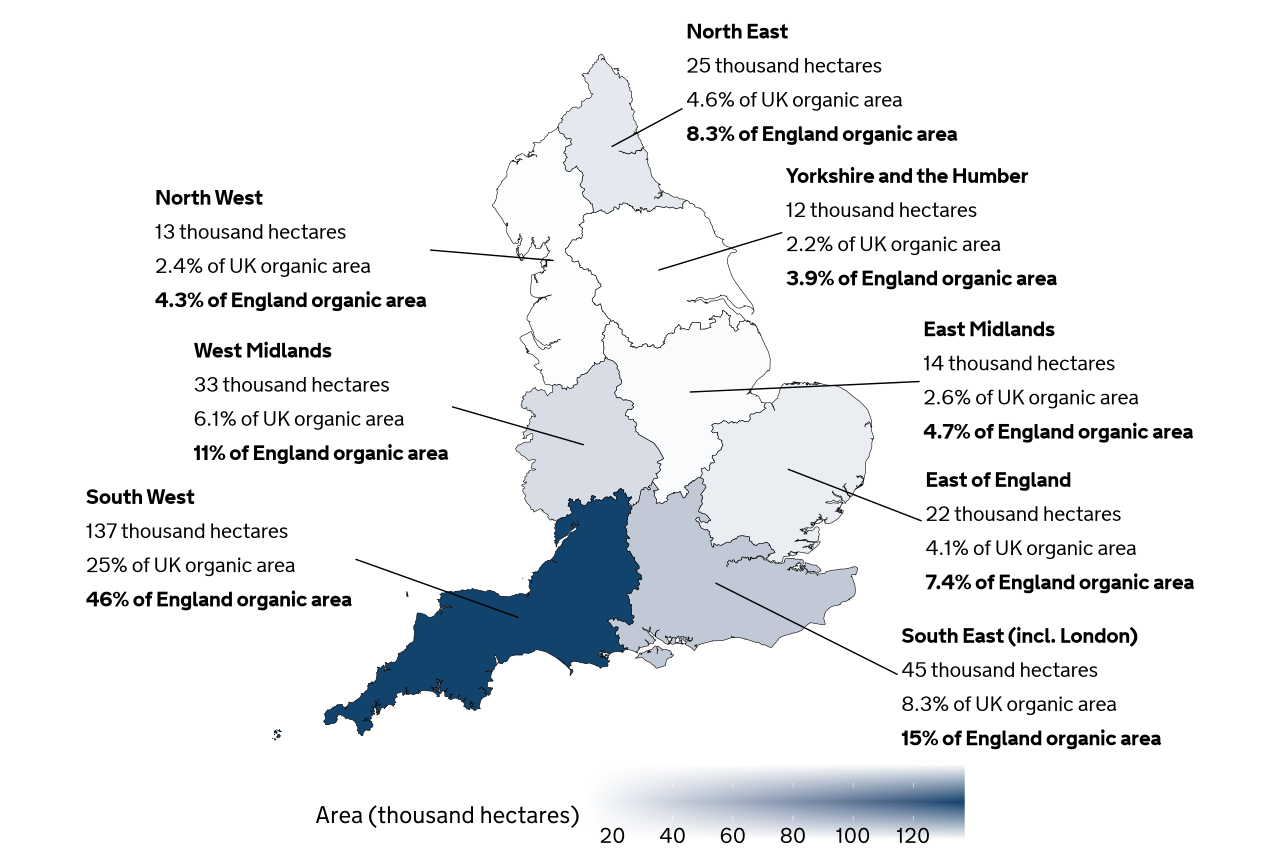
Figure 1: A map of England, divided by region. It depicts organic land area regionally in hectares, percentage of UK organic area, and percentage of England organic area. Table 2 indicates the data shown in the map.
Table 2: Organic land area in hectares
| Region of England | Total organic area | Percentage of England organic area | Percentage of UK organic area |
|---|---|---|---|
| North East | 25 thousand hectares | 8.3% | 4.6% |
| North West | 13 thousand hectares | 4.3% | 2.4% |
| Yorkshire and the Humber | 12 thousand hectares | 3.9% | 2.2% |
| East Midlands | 14 thousand hectares | 4.7% | 2.6% |
| West Midlands | 33 thousand hectares | 11% | 6.1% |
| East of England | 22 thousand hectares | 7.4% | 4.1% |
| South East (including London) | 45 thousand hectares | 15% | 8.3% |
| South West | 137 thousand hectares | 46% | 25% |
Case study: Growing Communities, Hackney
Growing Communities provides a local route to market for seasonal organic food in Hackney. The organisation buys directly from farmers and growers and sells to residents through veg bags, collection points, schools and community retail.
For households, the model provides a regular means of buying organic produce. For growers, it offers a more stable customer base and a greater share of the retail price. By shortening the supply chain, the model reduces reliance on intermediaries and helps retain more value with producers.
The offer is based on seasonal, mainly plant-based food, sourced as locally as possible. It treats organic food as part of local food infrastructure, rather than solely as a premium retail product. This approach has also informed the Better Food Traders network, which supports other communities to develop fairer routes to market and lower-impact food systems.
Funding
There are already existing government funding sources that are available to organic producers. The Sustainable Farming Incentive (SFI) and Countryside Stewardship schemes include dedicated payment options for organic conversion and maintenance, recognising organic farming as a system that delivers multiple public goods simultaneously, as well as the environmental benefits.
The OAPE is designed to complement the SFI and the wider Environmental Land Management (ELM) framework by addressing the non-financial barriers to conversion that financial payments alone cannot remove: information gaps, peer support, market access and supply chain development. This ensures a more complete and coherent support offer, maximising the contribution of organic farming to the government’s broader objectives.
While SFI will provide a stable framework, Defra will keep the SFI organic offer under review and will consider refinements and improvements where possible, ensuring that the conversion and management of organic land is supported at an appropriate level. In addition, Defra will work with the English Organic Forum (EOF) and the wider organic sector to deliver this plan.
Alignment with government policy
The Organic Action Plan for England (OAPE) is not a standalone initiative. It is designed to operate as an integral part of the government’s wider food, farming and environment policy programme. It will do this in part by contributing to multiple strategic priorities while reinforcing delivery across key initiatives. These initiatives include the Land Use Framework, Environmental Improvement Plan, Farming Roadmap, Food Strategy and Environmental Land Management schemes.
The OAPE will continue to operate within the wider regulatory framework governing organic production and trade. Future developments to that framework, including those arising from any UK-EU SPS agreement, may present opportunities to support growth in the organic sector and facilitate trade in organic products.
Food security, domestic production and sustainable land use
The OAPE supports the government’s ambition, set out in the Food Strategy policy paper and reflected in the Land Use Framework (2026), to increase the production of high-quality food within England. These policies emphasise a more resilient and sustainable food system, in which domestic production plays a stronger role in meeting national demand.
The OAPE also aligns directly with the Land Use Framework’s vision for multifunctional land use, where agricultural land supports food production alongside climate resilience and nature recovery. Research has shown there are considerable benefits to be gained by increasing the area of organically managed land, and the OAPE contributes to this approach, helping food production and environmental outcomes to work more closely together rather than in competition.
Environmental improvement and climate resilience
The Environmental Improvement Plan (EIP) identifies nature-friendly farming as a key mechanism for achieving the government’s environmental targets. The EIP includes an ambition that 65 to 80% of landowners and farmers adopt nature-friendly farming on at least 10 to 15% of their land by 2030. Organic farming is strongly aligned with the EIP’s ambitions on soil health, water quality, biodiversity and reduced chemical use, providing a whole-farm system capable of delivering these outcomes simultaneously.
The OAPE will strengthen this contribution by supporting more consistent monitoring and evaluation, helping to ensure that the environmental benefits of organic production are linked to national environmental targets. In this way, organic farming is positioned not only as a proven approach, but also as a measurable contributor to wider environmental improvement and climate resilience goals.
Farm profitability, resilience and sector growth
Improving farm profitability and resilience is a central priority of the Farming Roadmap, building on recommendations of the Farm Profitability Review. Within this context, organic farming can provide a viable route to improved business performance for some farms through market differentiation. Sector information, including the Organic Farm Management Handbook published by the Organic Research Centre, helps farmers assess those opportunities and understand the business implications of conversion.
The OAPE aligns sector growth activity with wider efforts to strengthen farm business performance, ensuring that organic production is recognised not only for its environmental benefits but also as an economically attractive pathway for some. By addressing barriers such as access to markets, information and supply chains, the OAPE helps create the conditions for sustainable sector growth.
Market development, supply chains and public procurement
The development of resilient domestic supply chains is a key element of the government’s wider food system agenda and the work of the Food and Farming Partnership Board (FFPB). Aligning organic sector growth with FFPB-led sector plans as far as possible will help ensure that organic production is embedded within mainstream agricultural development.
Public procurement provides a further lever for market development. Building on the Government Buying Standards for Food and Catering Services (GBSF), Defra will explore opportunities to increase the proportion of food meeting higher environmental standards in the public sector. Organic certification offers a clear and robust route to meeting these standards, supporting demand while advancing sustainability objectives.
The Organic Action Plan for England
Purpose and scope
The OAPE sets out how government and the organic sector will work together over the period 2026 to 2036, and beyond, to create the foundations to grow domestic organic production, broaden consumer access to organic food, and unlock the benefits that organic farming can deliver, including environmental and economic. It is a joint plan, co-developed by Defra and the English Organic Forum (EOF), which together will oversee its delivery. While focused within England, there will be actions that inevitably spread across the UK. Some actions within this plan will involve collaboration and integration across national boundaries within the UK.
The plan is organised around 3 themes, each containing specific, deliverable actions with indicative timescales. It draws on both the international experience and on the growing domestic evidence base.
Outcomes
Delivery of this action plan will be assessed against these 5 outcomes. How this will be achieved is outlined in the section: Governance, delivery and monitoring.
1. A year-on-year closing of the gap between imports and exports of organic goods, achieved through an increase in domestic organic production and manufacturing.
2. Ambition to grow the organically managed land area in England to 10% to support growth across the range of organic sectors (horticulture, arable crops, poultry, red meat and dairy).
3. An assessment of the contribution of organic production and consumption to government’s Environment Improvement Plan’s 10 goals, and the associated reductions in fertiliser and pesticide use that organic conversion delivers.
4. A sustained increase in the share of organic food within public sector purchasing.
5. Growth in the knowledge and understanding of organic production among farmers, growers, and consumers.
Themes
The OAPE will work under 3 overarching themes:
1. Increase and manage organic supply through targeted support for existing and new organic producers and processors.
2. Realignment of existing and emerging domestic supply and demand; increase proportion of sales met by domestic production.
3. Increase demand for English organic produce through increasing consumer awareness and stimulating demand from the public sector.
Theme A: Increase and manage organic supply through targeted support for existing and new organic producers and processors
England’s organic land area has remained static in recent years while consumer demand has grown. This mismatch highlights a structural issue in the domestic supply base, rather than a lack of market opportunity. The barriers to conversion are well documented:
- finding clear, practical information
- the costs and time of the conversion period
- uncertainty about market stability
- a shortage of peer support from established organic producers
For many farm businesses, these factors combine to create a level of perceived risk that outweighs potential returns, particularly during the conversion period. These barriers are not inherent features of organic farming, and they can be overcome with targeted support, as seen from other countries’ focused efforts.
The OAPE takes an enabling approach to production support. It will not replace the strong existing regulatory framework; it is intended to complement the work of certification bodies that enables the trust consumers have in the organic standards and associated outcomes.
The OAPE aims to ensure producers considering conversion have access to the peer networks, innovation funding and market intelligence they need to develop their businesses. This co-ordinated approach is intended to reduce perceived and actual risks associated with conversion and to improve confidence in the long-term viability of organic systems.
Government funding schemes, such as the SFI scheme, provide financial support for organic conversion and maintenance. The actions in this theme sit alongside and complement SFI, addressing the non-financial barriers that funding alone cannot remove. Together, these measures are expected to increase conversion rates, improve retention of existing organic producers, and support sustainable growth across priority sectors. The organic offer within ELM and SFI will be kept under review, with refinements and improvements considered where possible.
Actions under Theme A
Year 1
1. Defra to maintain a well-defined ongoing organic offer within the Environmental Land Management scheme to contribute to the delivery of the whole-system environmental benefits delivered by organic production, contributing to the EIP 10 goals. This will be clearly communicated to current and potential producers.
2. Building on existing platforms, EOF and the organic sector to develop and maintain clear signposting of information for producers considering organic conversion, covering certification requirements, Environmental Land Management scheme eligibility, financial modelling tools, market access routes, and case studies from established organic producers across a range of sectors and scales.
3. Building on signposting work, EOF and the organic sector to ensure prospective farm converters have the necessary one-to-one guidance throughout the conversion process, utilising existing agricultural advisory infrastructure, complemented by knowledge exchange between established organic producers and those considering conversion, and potentially groups established under the Farmer Collaboration Fund. Priority will be given to sectors with the greatest import dependency and where there is potential for increased domestic production.
Years 2 to 4
4. Develop specific growth activities for organic producers within the following subsectors: horticulture, arable, dairy, red meat and poultry, as well as how to address challenges for small urban and peri-urban businesses. These will be developed with certification bodies and the organic sector and will align with the Food and Farming Partnership Board sector growth plans, which includes horticulture agroecology. This will identify production gaps, market opportunities and the support required to help close the gap between domestic supply and demand.
Years 5 to 10 and onwards
5. Defra and EOF to collaborate on understanding priorities for innovation and identifying existing available innovation support for organic businesses, including grants (where applicable), training and peer networking. Priority areas will include small-scale processing and abattoir capacity, direct and local market development, and supply chain digitalisation.
Theme B: Realignment of existing and emerging domestic supply and demand; increase proportion of sales met by domestic production
While Theme A focuses on enabling production, Theme B addresses the equally critical challenge of alignment in ensuring that existing and emerging domestic organic supply is effectively matched to current market demand. In practice, this alignment is often weak, with producers, processors and buyers operating with incomplete information about each other’s needs and constraints. England’s organic market is already demonstrating sustained growth, yet this demand is not being fully met by domestic producers. A significant share of demand is therefore met through imports, reflecting gaps in domestic production as well as wider supply chain constraints. Closing this gap depends on better information flows, stronger co-ordination across the supply chain, and a clearer understanding of where the most immediate opportunities lie.
By systematically identifying supply gaps, bottlenecks and under-served product categories, government and industry can take targeted action to support expansion in the areas of greatest opportunity. This includes not only increasing organic output in priority sectors such as horticulture, but also ensuring that appropriate processing, distribution and trading mechanisms are in place to bring products efficiently to market. In doing so, this plan recognises that supply chain development is a shared responsibility, requiring collaboration across commercial actors as well as support from public policy.
Current data availability is uneven, particularly at commodity level and across different parts of the supply chain. Improved data on production, trade and consumption will enable more responsive and strategic growth. Better data will also support more informed contracting decisions and investment planning, areas where uncertainty currently limits growth.
Together, these actions are intended to create a more coherent and resilient organic sector, better able to transform existing demand into sustained domestic growth.
Actions under Theme B
Year 1
1. English Organic Forum to identify priority products for English production most suitable for action to strengthen domestic supply chains and support market opportunities.
2. Co-ordinate sector and category activity and identify emerging market opportunities, through the UK Organic Trade Forum. This will bring together commercial actors in the supply chain, and across the devolved nations.
Years 2 to 4
3. Defra to negotiate with prospective partners the establishment of an Organic Observatory, to collect and publish key sector data on a regular basis, alongside devolved nations. Priority datasets, such as held by Agriculture and Horticulture Development Board (AHDB), will include import and export volumes, domestic production by commodity, organic land area and conversion rates, evidence on impacts of organic production, price differentials, and consumer purchasing trends.
4. In collaboration across government, the organic sector and supply chains, actions will be taken to improve alignment between domestic supply and demand with the intention of reducing reliance on imports. This will be achieved by developing a mechanism to enable buyers, including retailers, producers and processors to identify supply gaps, bottlenecks and surplus capacity, and to share best practice and reduce reliance on imports.
Years 5 to 10 and onwards
5. In collaboration with the organic sector, review research priorities for the organic sector, building on the Defra-ORC evidence review and economic modelling in line with the Farm Business Survey. This will identify the most important knowledge gaps and focus future research accordingly.
6. Identify international opportunities for the key brand of British organic products, supporting producers with export plans. International markets are both a key market in their own right, as well as support for producers to manage production fluctuations and domestic oversupply.
Theme C: Increase demand for English organic products
C1: Increase consumer awareness
Consumer demand for organic food can only be sustained and grown if consumers understand what the organic label means and why it matters. In practice, purchasing decisions are influenced by price, availability, habit and trust, with understanding of labels playing only one part. Research consistently shows that clarity about the regulated, independently certified nature of organic status is associated with stronger purchasing intention, although this relationship is not always straightforward where price differences are visible or organic products are not consistently available.
Research published in 2024, Consumer study on barriers and opportunities for UK and organic foods, found that a significant proportion of English consumers remain uncertain about what organic certification guarantees. Improving clarity about certification and standards will therefore be important in supporting consumer confidence and helping demand grow.
Actions under Theme C1
Year 1
1. Develop and build understanding on what works in consumer awareness through other insight and intelligence including:
a. using existing consumer research on content and delivery, including behavioural insights
b. identifying and commissioning further research to support clear messaging on organic food
c. considering insights from successful campaigns in other countries
Years 2 to 4
2. Develop an industry-led sector-wide marketing activation plan setting out priorities and opportunities. This will:
a. create a consumer awareness campaign, co-ordinated by EOF, focusing on the benefits of organic products, including environmental outcomes, and addressing accessibility
b. use key seasonal moments (for example Organic September)
c. be supported by point-of-sale materials and a digital engagement programme
d. include sector-specific plans
e. engage retailers, brands and suppliers in national campaigns, alongside training and engagement for retail decision makers
C2: Stimulate demand from the public sector
Public sector food procurement is a direct and significant lever for driving domestic organic market development, although its impact depends on how it is implemented in practice. The public sector in the UK spends approximately £5 billion per year on food and drink, across schools, hospitals, prisons, military establishments and other government settings. Directing even a modest share of that spend towards organic and other food produced to higher environmental standards would increase confidence across the supply chain to encourage organic conversion, while simultaneously improving the environmental quality of food served in public settings. This creates a stable and predictable source of demand, which is critical for enabling producers and suppliers to make medium and long-term investment decisions.
The Government Buying Standards for Food and Catering Services set a long-term ambition for 10% of public sector food spend to meet higher environmental production standards. Organic is explicitly identified as a qualifying standard within this framework. Evidence from Denmark, Vienna, Malmö and other international jurisdictions demonstrates that ambitious public procurement targets can be achieved without significant overall cost increases, provided that procurement practice is reformed and that the organic supply chain has sufficient time and support to scale to meet demand, and Sustain’s Bridging the Gap report and policy review demonstrates how this could be achieved in practice with UK specific examples. A phased and targeted approach will therefore be required, focusing initially on commodities where domestic supply can scale most readily.
Building on the success of programmes such as Food for Life Served Here, which recorded £7.5 million of organic spend by participating caterers in 2024, the actions in this theme will support a systematic increase in the organic content of public sector menus, while developing the supply chain capacity to deliver it.
Actions under Theme C2
Year 1
1. EOF and the organic sector to identify the organic commodities, starting with milk, cereals and seasonal vegetables, where domestic supply could most readily scale to meet increased public sector demand, subject to budgetary constraints, and engage relevant sector bodies in developing supply-side readiness plans. This could be through development of a working group of organic sector representatives and public sector procurement leads, including Department for Education (DfE), NHS Supply Chain, the Government Commercial Agency (GCA), and local authority procurement consortia.
Years 2 to 4
2. Defra to publish clear guidance for public sector contracting authorities on how organic products qualify under the Government Buying Standards for Food and Catering Services higher environmental production standards category, including practical guidance on specification writing and supplier engagement.
3. EOF and Defra to work with relevant partners to develop a place-based approach trial; publish local case studies of good practice in organic public procurement, in partnership with local authorities, taking note of Local Nature Recovery Strategies (LNRS). This would also draw on UK and international examples, including the Food for Life Served Here programme, Sustain’s Bridging the Gap pilots, as well as successful international procurement models to support procurement teams in understanding what is achievable and how.
Years 5 to 10 and onwards
4. Defra to consider establishing reporting mechanisms to track organic spend as a proportion of total food spend across government departments, arm’s length bodies and other public sector delivery mechanisms such as school catering.
Governance, delivery and monitoring
The successful delivery of the OAPE depends on clear governance arrangements, transparent monitoring and effective collaboration between government and the organic sector. This section establishes the framework through which the plan will be implemented, overseen and continuously improved, ensuring that actions translate into measurable outcomes over the period 2026 to 2036, and beyond.
Delivery of the OAPE will be overseen jointly by Defra and the EOF acting through the existing Defra and EOF Organic Policy Forum. This forum will provide strategic leadership, co-ordinate activity across delivery partners, and ensure alignment with wider government policy objectives, including the Environmental Improvement Plan, the Land Use Framework and the Food Strategy. It will serve as the key mechanism for maintaining coherence across Themes A to C, ensuring that any initiatives relating to supply, market development and demand operate as a co-ordinated package rather than as discrete initiatives.
Effective delivery will require engagement beyond central government and the organic sector. Implementation will therefore involve a broad network of stakeholders, including certification bodies, the Food and Farming Partnership Board, retailers, processors, procurement bodies and advisory services. The governance structure will support regular engagement with these actors to ensure that delivery reflects both policy priorities and commercial realities, and that barriers emerging during implementation are identified and addressed promptly.
A structured monitoring and evaluation framework will be established to track progress against the OAPE’s 5 core outcomes. This framework will draw on a combination of existing data sources and new datasets developed through the Organic Observatory (Theme B). Key indicators will include:
- changes in organic land area and conversion rates
- domestic production levels by commodity
- trade balance
- public sector procurement performance
- consumer awareness
Monitoring will be designed not only to track activity, but to assess the impact of the plan in contributing to wider government objectives, including Environmental Improvement Plan targets.
The OAPE is intended to be adaptive in response to changing circumstances. The governance framework will therefore include mechanisms for periodic review of priorities and actions, informed by monitoring data, sector feedback and wider economic and environmental conditions. This will ensure that the plan remains responsive to:
- emerging risks and opportunities, including changes in market demand,
- input costs,
- climate impacts and
- developments in international trade.
Effective governance will ensure that the OAPE operates as part of a coherent whole within the government’s wider food and farming system. By linking delivery, monitoring and governance directly to existing policy frameworks and data systems, the plan strengthens the role of organic farming as a measurable and accountable contributor to national objectives on food security, environmental improvement, and climate resilience.