
Local Land Charges live service manual
Updated 28 September 2026

© Crown copyright 2026
This publication is licensed under the terms of the Open Government Licence v3.0 except where otherwise stated. To view this licence, visit nationalarchives.gov.uk/doc/open-government-licence/version/3 or write to the Information Policy Team, The National Archives, Kew, London TW9 4DU, or email: psi@nationalarchives.gov.uk.
Where we have identified any third party copyright information you will need to obtain permission from the copyright holders concerned.
This publication is available at https://www.gov.uk/government/publications/local-land-charges-live-service-manual/local-land-charges-live-service-manual
Handover pack
This manual outlines the support available to a local authority following the transfer of their statutory local land charges function to the Chief Land Registrar (HM Land Registry). It contains a guide to common questions that arise in live service.
1. Notice period
HM Land Registry (HMLR) recognises the importance of a smooth transition when a local authority transfers their local land charges (LLC) register to live service. The LLC Programme is committed to supporting local authorities (LAs) throughout the notice period and into live service. The formal handover meeting usually takes place just before or during the notice period to confirm the transition into live service.
- During this period, the LA may continue work to resolve any charges being imported ahead of the go-live date.
- We would only ask an LA to continue providing an LLC1 service after the notice period has ended in exceptional circumstances.
2. Conditions of use of the service
Authorised users who access HMLR’s LLC Register through the application programming interface (API) or the graphical user interface (GUI), agree to be bound by the conditions of use.
HMLR may modify or add to the conditions of use at any time, without issuing direct notification. We recommend that users review the conditions regularly to stay informed of any updates. Continued use of the API or GUI confirms acceptance of the latest conditions. If you do not agree to the updates, you must stop using the API and accessing the GUI.
3. Live service
3a. Maintenance by local authority
- Whoever registers charges within the LA should ensure that they complete this in a timely manner
- The named contact at the LA should cascade any email about service outages or planned changes to all users within their organisation.
- HMLR cannot provide legal advice as to whether a charge is an LLC.
- Guidance about the HMLR LLC service is available in Practice Guide 79 - local land charges.
3b. Maintenance by local authority (API ONLY)
- LAs may experience API errors when the data is being transferred to HMLR’s LLC Register.
- The LA is responsible for monitoring these errors and flagging them to their Relationship Manager where necessary.
- Relationship Managers can provide some assistance in resolving these errors, but input from the incumbent suppliers may also be required.
- Reports detailing API errors should be available daily. LAs should contact their supplier if these reports are not currently available.
- LAs must notify their Relationship Manager in advance of any planned maintenance to their internal systems that may affect the LLC Register.
- LAs should keep the LLC Register safe and secure and choose a safeguarding limit.
3c. Maintenance by local authorities & other originating authorities
- LAs - must ensure the any existing agreements covering the registration of charges initiated by other originating authorities (OOAs) are maintained and remain fit for purpose.
- OOAs – HMLR’s preferred approach is for OOAs to register their own charges directly.
- All charges initiated by an OOA must be registered in a timely manner to avoid the risk of compensation liability.
3d. Maintenance by HM Land Registry
Live service monitoring
HMLR Relationship Managers actively monitor the following:
- Zero activity over seven calendar days.
- Monthly calendar completeness checks against the top three charge categories.
- Delayed registrations.
- If the register is updated in a timely manner.
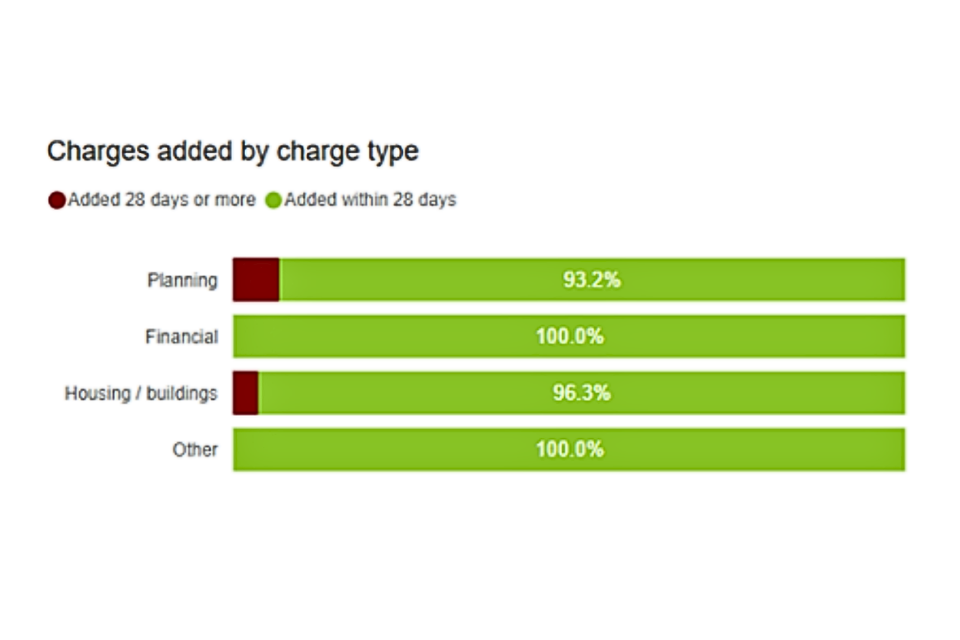
Examples of Charge type added within 28-day period:
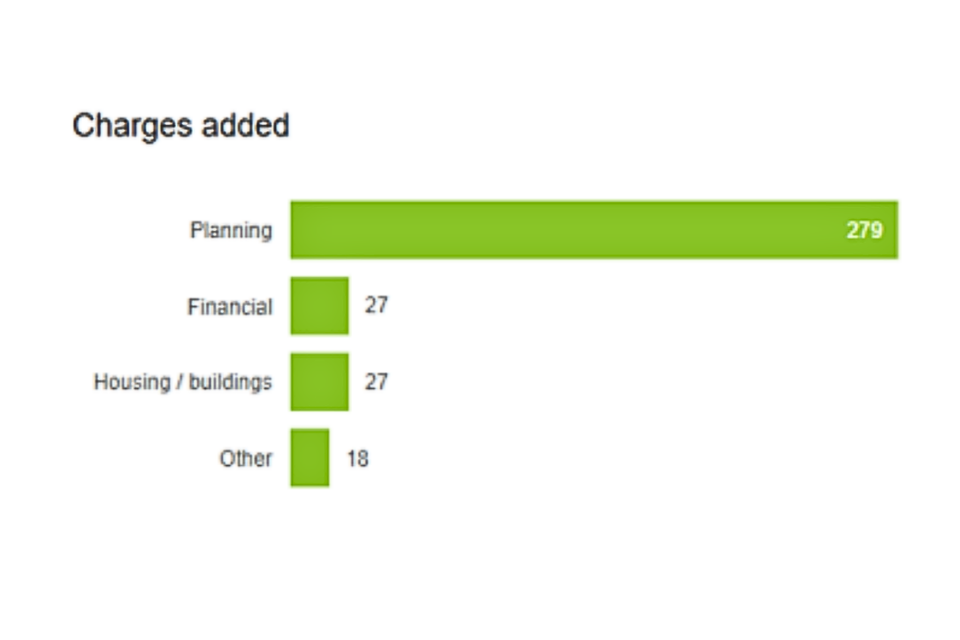
Example of volume of charge type added:
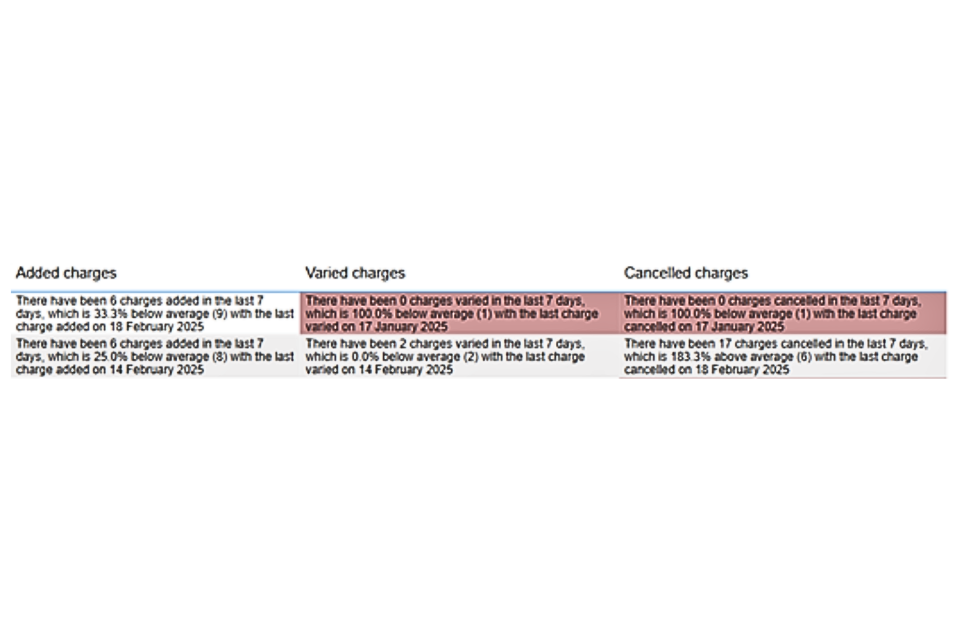
Example of types of volume of charges added/varied/cancelled within last seven days
Accuracy of the register
Each month, HMLR carries out quality checks against key components of any new and edited charges in the register. The assessment is split into linear and inspection tests, with acceptable quality levels applied to each test. Each LA will receive a report outlining their performance as shown below.
Example of Linear and inspection test categories:
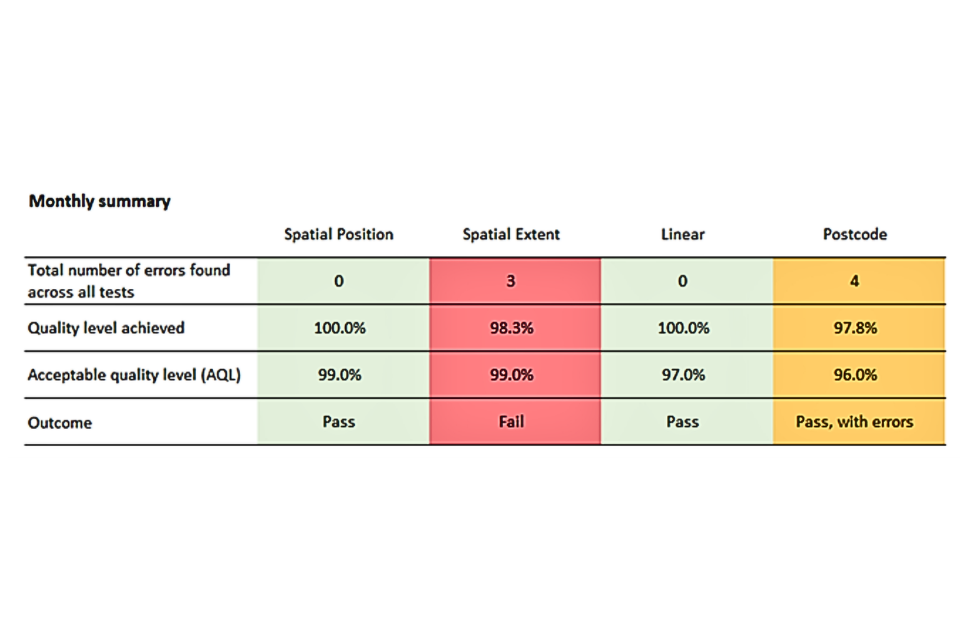
Example of check description and summary of failure
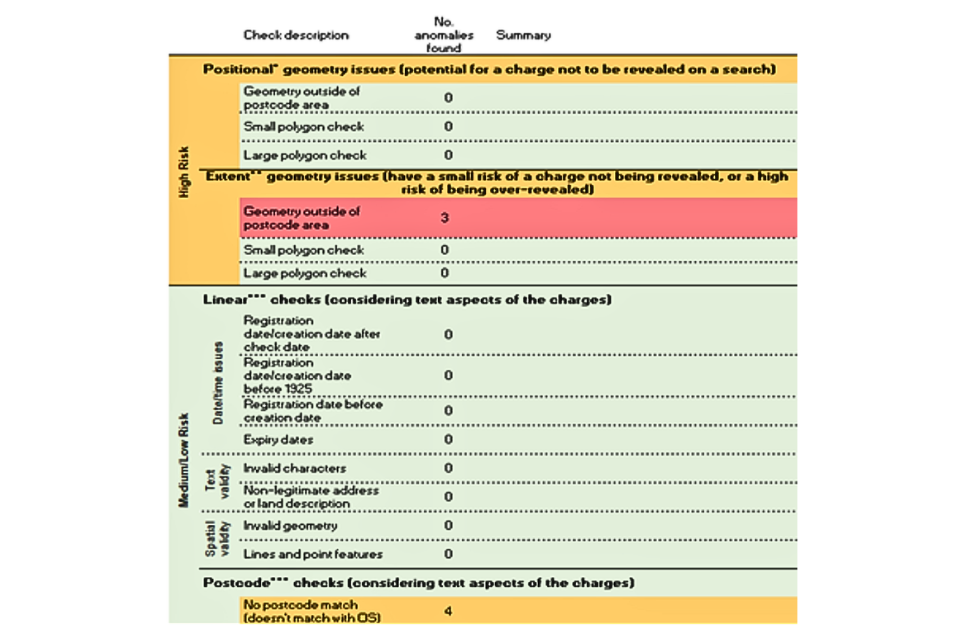
- Positional - assesses if the polygon covers ALL properties included in the charge address.
** Extent – assesses if the polygon covers the correct extent and is the correct shape for the charge described.
*** Linear and postcode - primarily textual errors but also includes invalid and incorrect (line and point) geometry errors.
LAs will receive a supplement sheet detailing each charge that has failed the quality checks. LAs must review these charges and complete the supplement sheet to record any action taken on that charge, for example: no action required, cancelled or corrected.
Completed supplement sheets must be returned to your Relationship Manager within 10 days of receipt. If no action is required on a charge, LAs must provide an explanation to support that decision before submitting the supplement sheet. The Quality Assurance Team will review the comments, and the Relationship Manager will update the register to prevent the charge from failing future checks.
Example of supplement sheet issued to a local authority:
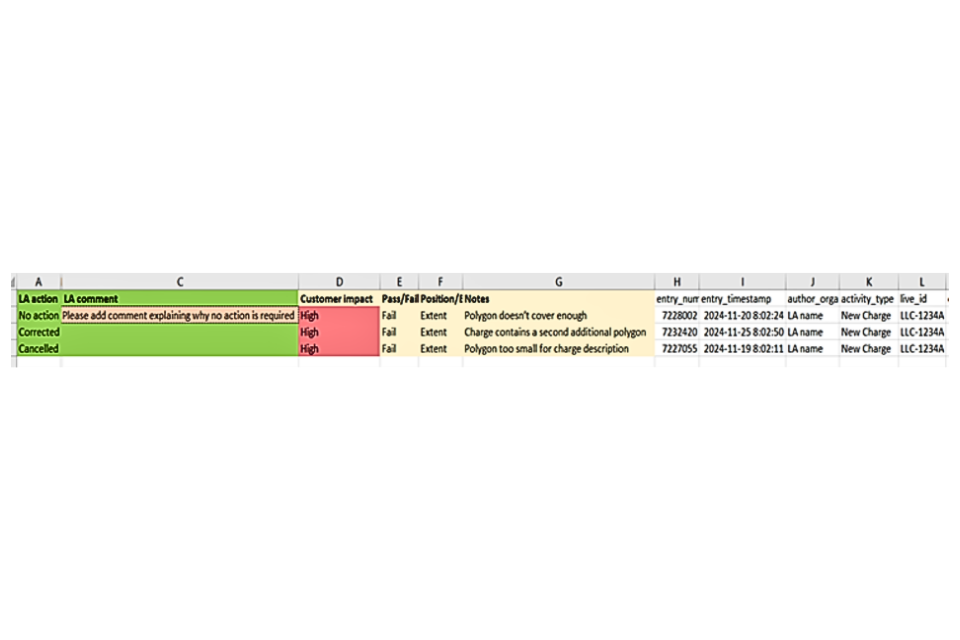
Example of supplement sheet
3e. Customer enquiries
Enquiries that should be handled by the LA:
- Search result clarification, for example clarifying an unclear result or incomplete charge information.
- ‘One-off’ errors in search results where the LA needs to amend or correct a charge entry.
- Further information relating to specific charges – for example a financial charge.
- Specific missing charges.
- All document requests relating to a search.
- CON29 enquiries.
Enquiries that should be directed to HMLR:
- Technology or access issues and error messages on GOV.UK, the HMLR portal and/or Business Gateway.
- Light Obstruction Notice document requests.
- Registration of Light Obstruction Notices.
- Fee enquiries including fee refunds.
- Assisted digital search requests.
- Environmental Information Regulation 2004 search requests.
- Searches revealing more than 250 charges.
Collaborative enquiries
- Developing themes such as missing charges, duplicate charges and incomplete charges.
General customer enquiries relating to Local Land Charges can be made via the:
- Local land charges contact us form.
- HMLR Customer Contact Centre on 0300 006 0444 available between 08:00 – 16.30 Monday to Friday. This is a dedicated Local Land Charges number.
- post - HMLR Local Land Charges Processing Team, PO Box 326, Mitcheldean, GL14 9BQ
4. Compensation protocol
HMLR, the Local Government Association and the Welsh Local Government Association have agreed a protocol for dealing with compensation claims under section 10 of the Local Land Charges Act 1975 (as amended by the Infrastructure Act 2015).Full details of the compensation protocol can be found on GOV.UK.
5. Help pages
5a. HM Land Registry live service contact information
For all LLC live service enquiries, contact your HMLR Relationship Manager. They can also assist with API and user interface (UI) related questions, including live service data or process issues and your organisation’s performance in registering charges.
If your Relationship Manager is out of the office and your enquiry is urgent, please contact the SPITeam@landregistry.gov.uk.
5b. IT support from HM Land Registry
If you experience any technical issues, refer them to your own IT support services in the first instance. If you cannot resolve the issue internally, report any outage that affects your ability to register, vary or cancel charges to the HMLR IT Service Desk by email or by telephone on 0300 006 0400, between 07:00 and 17:00 Monday to Friday.
The HMLR IT Service Desk will record the details of the incident and escalate to the appropriate support team. HMLR will provide an estimated resolution timeframe and regular updates until the issue is resolved.
HM Land Registry will report issues or change in activity
HMLR actively monitors the LLC service. Users will be notified of any issues or planned maintenance that may affect service availability. Subscribe to email alerts to make sure you always receive notifications.
Local authorities must report changes to HM Land Registry (if you are not using an API)
You should notify HMLR of any change to the ‘white-listed’ IP address of your named contact. Please provide the following information to HMLR as soon as possible:
- Name of user
- Email address of user
- Authority name
- Public IP address of authority
- Type of account
6. Memorandum of Understanding
Memorandum of Understanding
Between Local Land Charges team and:
- Building Control
- Planning
- Planning Enforcement
- Housing
- Legal
- Grants
- Debtors
- Environmental Health
- Property
Date: xx/xx/20xx
Purpose
This Memorandum of Understanding (MOU) is between the local authority (LA) local land charges (LLC) team and internal council departments. It sets out the service standards both parties must meet to ensure the council registers charges on time following the migration of the LLC Register to HM Land Registry (HMLR). It also outlines the working arrangements and timeframes for registrations between the LLC team and the departments listed above.
Background
The LA LLC team migrated its LLC Register to HMLR on xx/xx/xx. The council remains responsible and accountable for creating, administering, and enforcing local land charges, and will continue to update the register on behalf of departments.
The LA must update the LLC Register immediately with any new or altered registrations, so that HMLR can provide accurate searches to customers. The LLC team will aim to do this no later than xx working days from the date the charge is created.
Failure to register charges promptly may result in a charge not appearing in search results. If this happens, HMLR may pay compensation to a customer and recover that compensation from the council. If HMLR identifies a significant number of late registrations, it may contact customers to recommend resubmitting a search. This does not affect HMLR’s ability to recover compensation from the council.
All LA departments must notify the LLC team promptly to minimise financial risk. Target timeframes are currently not being met, and late registrations may place a financial burden on the council.
The council is responsible for ensuring the details of registrations are accurate, which is of equal importance to timeliness. An error made during the application process could result in HMLR paying compensation to a customer and recovering any paid compensation. HMLR will monitor and report on the accuracy of registrations monthly.
Department responsibilities
- Send all new registrations to the LLC team immediately, and no later than xx working days from the point of decision or completion.
- Send all updates to registrations to the LLC team immediately, and no later than xx working days from the point of decision or completion.
- Send all registrations to the LLC team at [email address]
LLC team responsibilities
- Enter all registrations onto the LLC Register immediately, and no later than xx working days from receipt.
- Complete all updates to the LLC Register immediately, and no later than xx working days from receipt.
- Return any queries or errors to the relevant department within xx working days of receipt, with details of what action is needed.
Monitoring and reporting
The LLC team will monitor all registrations by departments on an individual registration basis. The department will be asked to provide the reason for any delayed notifications received outside of the above timeframes. If a late notification results in a customer loss because the LLC team did not receive it within the agreed timeframe, the relevant department may be asked to meet any resulting compensation claims. Processes may be amended to achieve compliance.
Signed by: On behalf of LLC team
Signed by: On behalf of XXXXXXXXX (Department)
7. Quarterly local authority performance reports
HM Land Registry (HMLR) has issued quarterly Local Land Charges (LLC) performance metric reports to local authorities (LA) since 2024/25. These reports cover everything from charges added late, to searches conducted on a dataset.
The content of the report are highlighted in the screenshots below:
Quarter activity tab
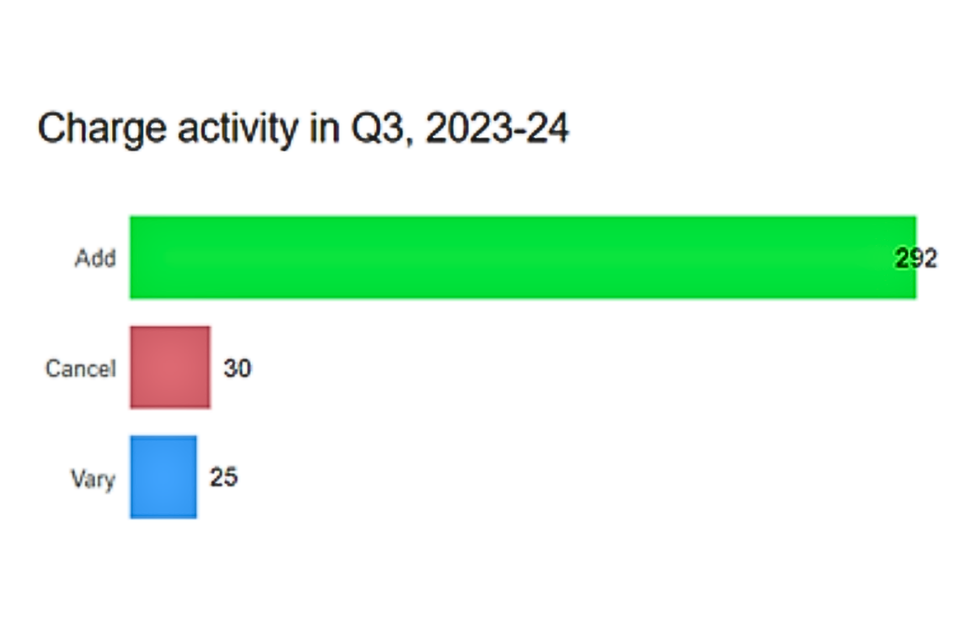
These break down how many charges have been added, varied, and cancelled over the last quarter and whether this was done via the API or Maintain.
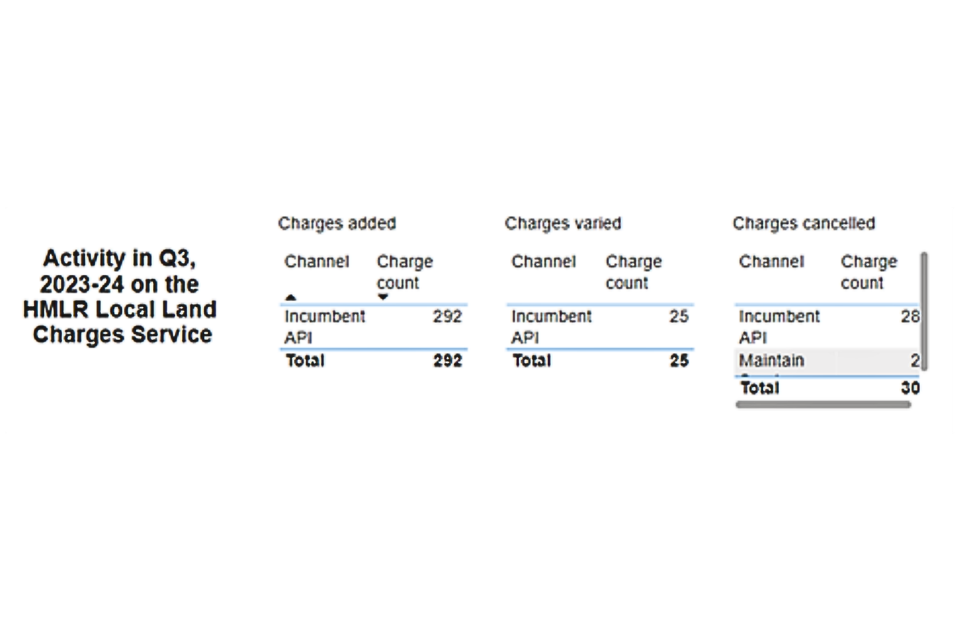
Example of Volume of charges added/varied/cancelled in a quarter:
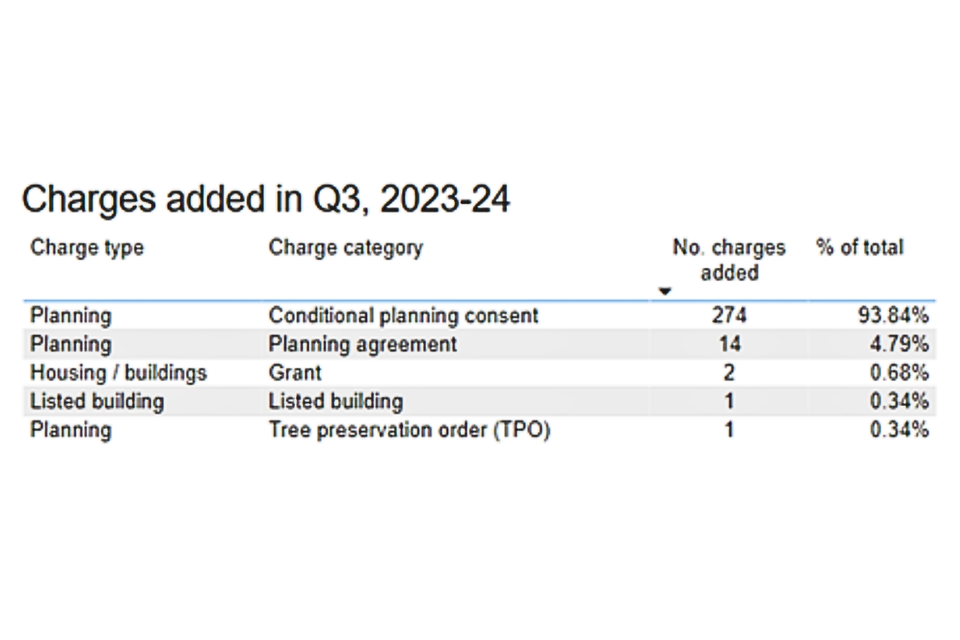
This analyses the specific number of each charge that have been added:
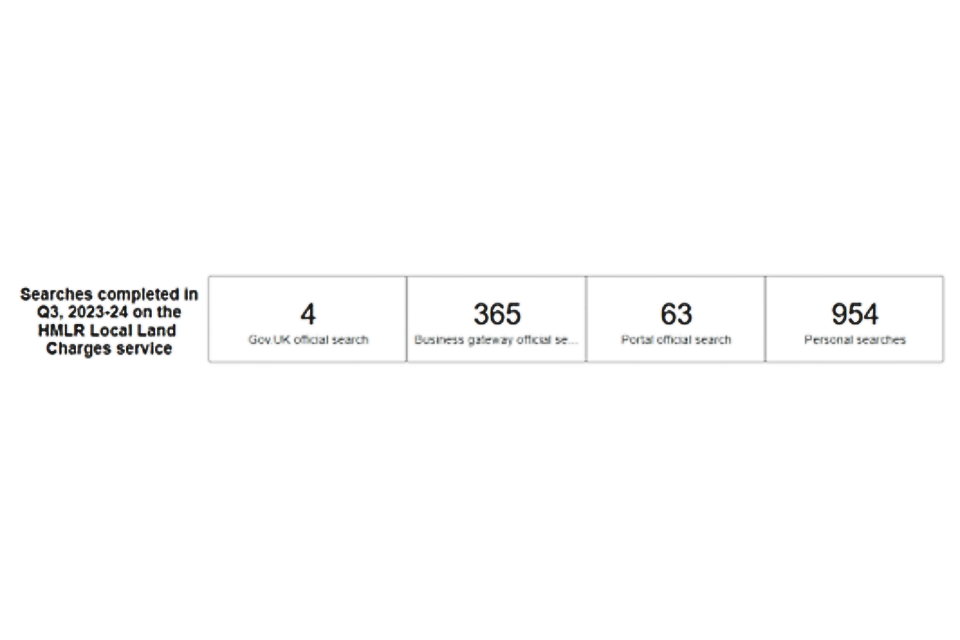
This section presents the official figures for all searches and the platform the search was conducted on:
Trends tab
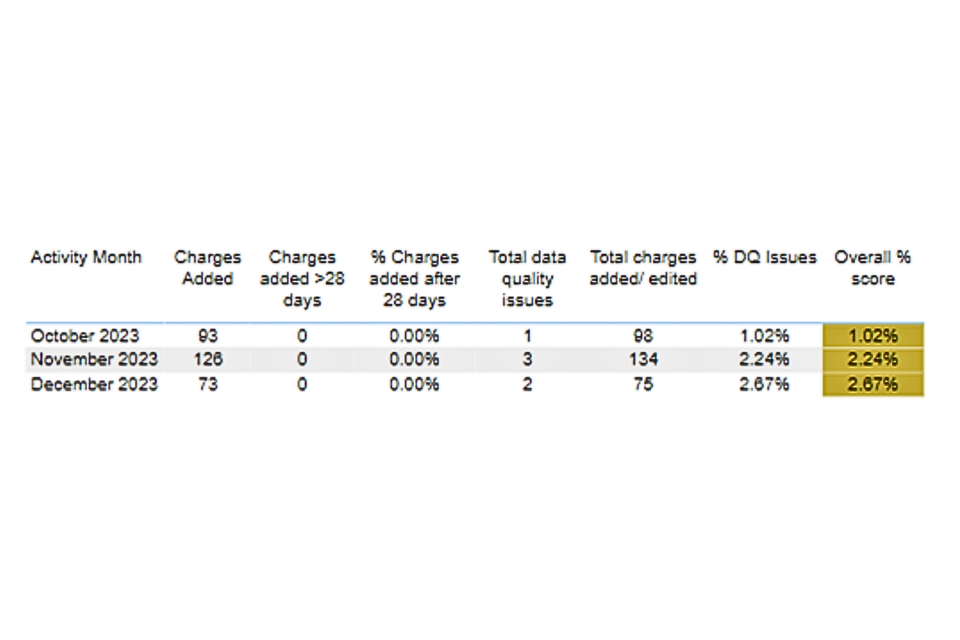
The table below shows the breakdown of charges added over a 28 day period. It also highlights any charges, added in the past quarter, with data quality issues. They are broken down into sub-percentages, which are used to calculate an overall score and colour grading (gold, silver, bronze, special measures [red]). The lower the percentage, the better the score.
It highlights how a LA is ranked against others, calculated from overall percentage scores for that quarter. It also states which performance bracket the LA falls within.
The line graph identifies the shortest and average time taken to register a charge in the past quarter. The information in the line chart provides an accurate picture of when late registrations occur for LAs to track trends internally.
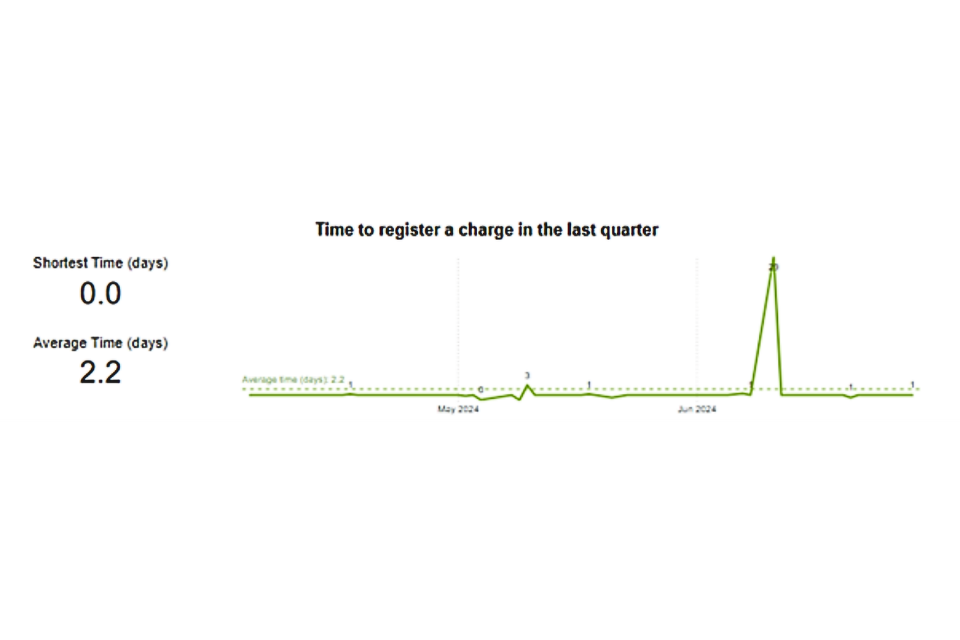
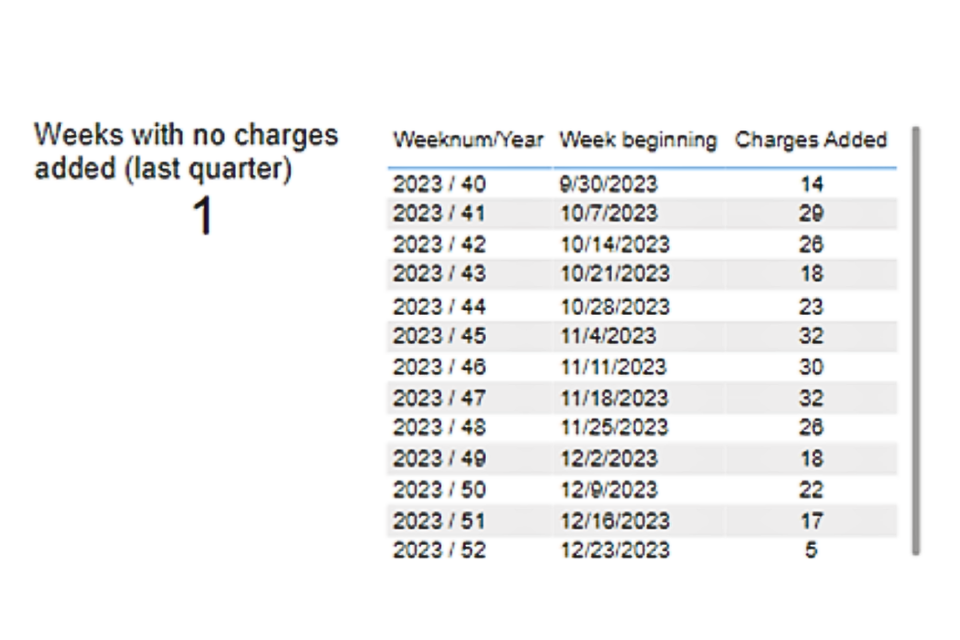
The table shows anywhere a charge was not registered over the last quarter.
It displays whether all charge types have been registered in the past quarter. If they have, it will show as green, otherwise it will show as red. When the average time to register is below 28 days it will show as green, but any longer than this will show as red.
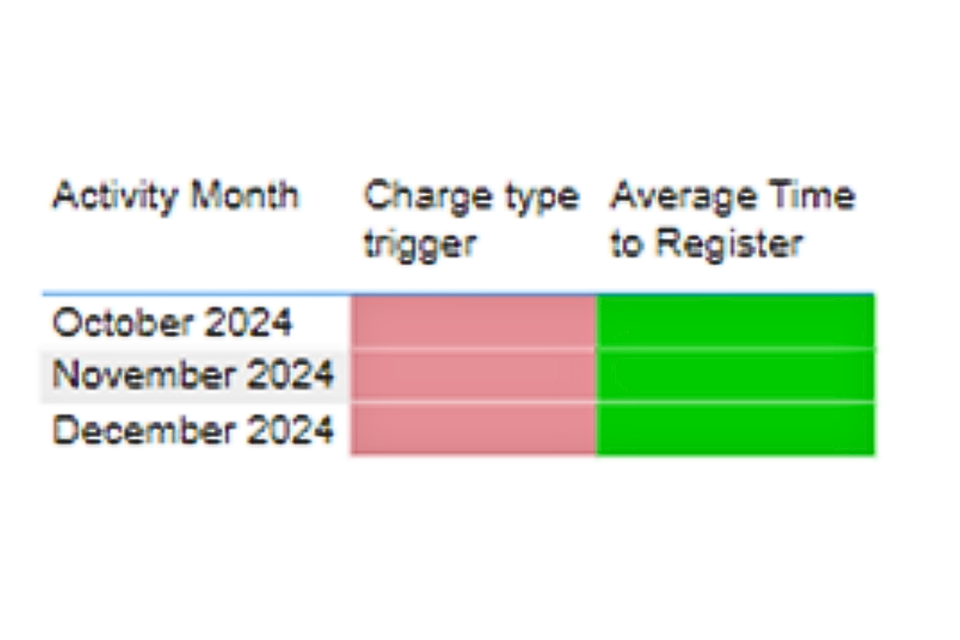
Example of monthly activity for charge type and time to register:
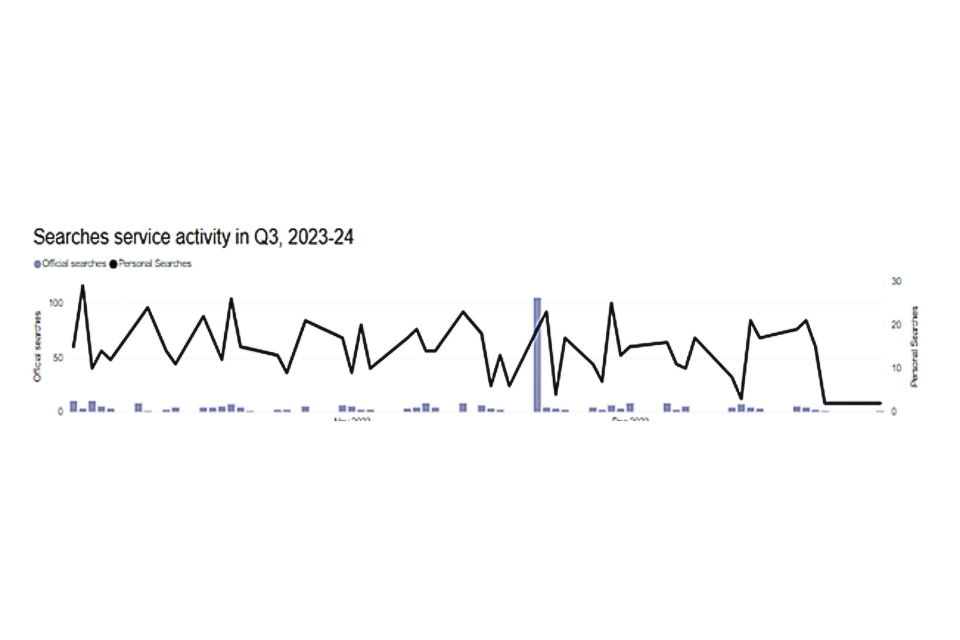
This section compares the number of personal searches against official searches in the past quarter using a bar and line graph.
8. Land Data Award – Best Migrated Local Authority
How we assess LA performance
A local authority (LA) must have been live for a minimum of six months before it is assessed for the Best Performing Migrated LA annual award. There are two metrics which are essential for our customer base:
- Time taken to register a charge: measured by comparing the decision or creation date with the registration date.
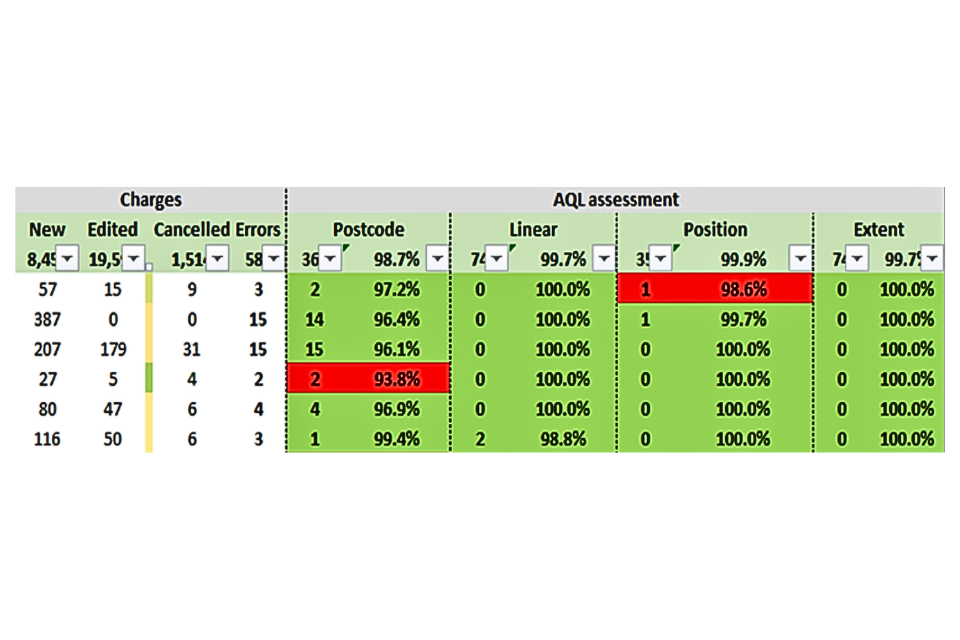
- Accuracy of charge entries - covers all charges added or varied since the LA went live.
Providing an up-to-date register
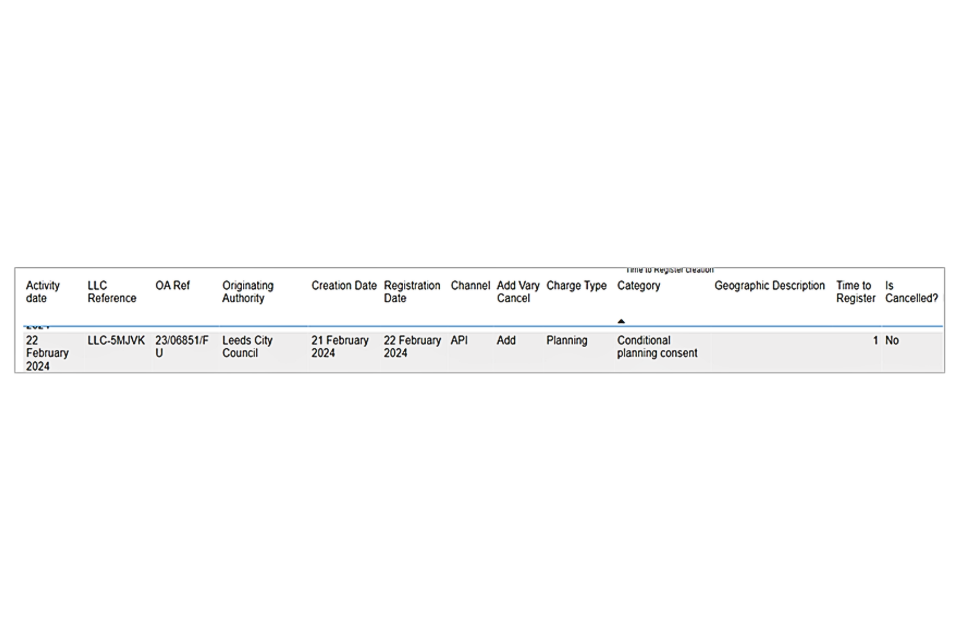
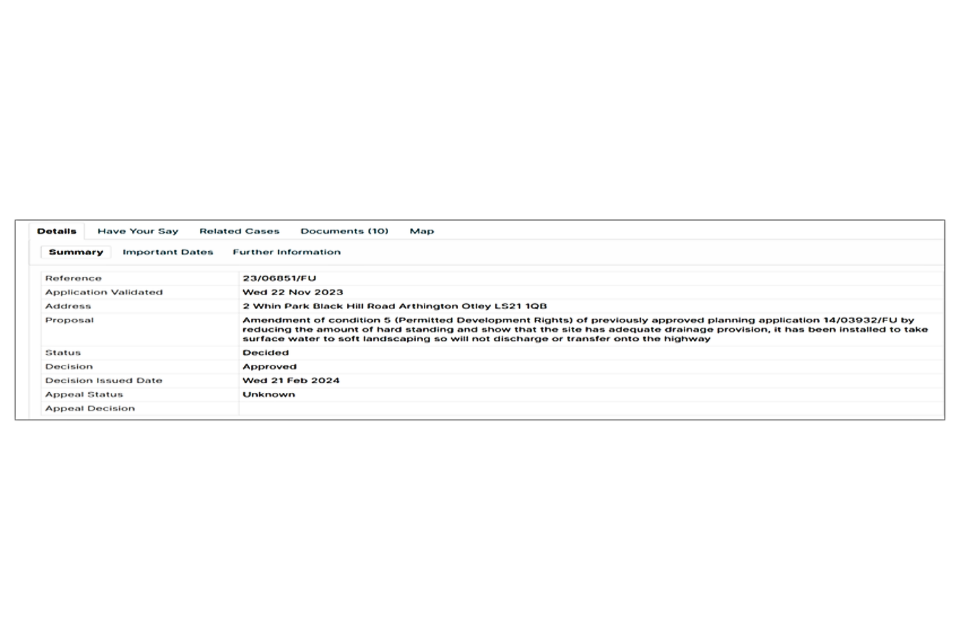
Please note - 28 days is a customer service metric and does not mean LA avoids liability by achieving this standard.
Providing an accurate register
9. Training for local authorities/other originating authorities to use Maintain User Interface
Allocating resource/pre-meeting preparation
- The Service Performance and Integration (SPI) team delivers training on a rota basis.
- On receiving a training request, the SPI team will liaise with relevant colleagues and complete all associated documentation, including the training rota and log.
- The person requesting training must complete the Maintain Training Schedule, which is available in ‘Supporting Resources’ .
- Two weeks prior to the training session, the SPI team will contact the local authority (LA) to request a copy of a planning consent to use during the session.
- The LA may also wish to provide additional charge types for use during the training; this will be agreed during a conversation.
- If the LA is unable to provide live charges for the training session, the SPI team will load mock charges into the training environment.
- The SPI team will try to schedule training at the most convenient, however if three or more intended attendees are unable to attend, an additional session may be offered.
- Any staff unable to attend the training session will be directed to supporting material, including a slide pack and video.
10. Allocating resource within local authorities/other originating authorities
- The local authority (LA) should ensure there are enough users set-up to maintain the register during absences, to maintain timely updates.
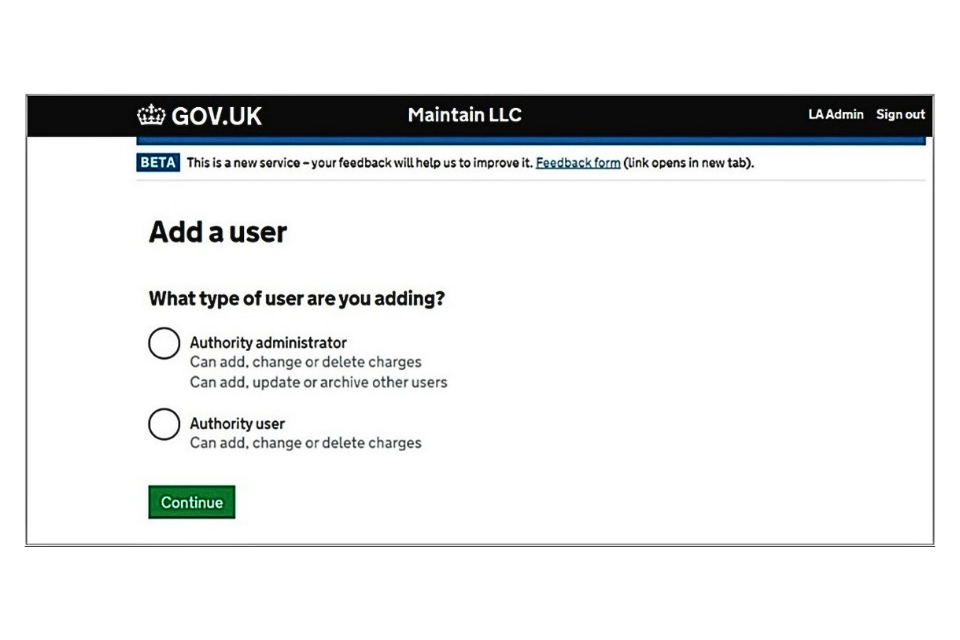
- Add a new user: if training a new LA or other originating authority (OOA), admin users will be shown how to set-up new ‘authority administrator’ or ‘authority user’ users. Admin users can manage users and manage source information, as well as update the Local Land Charges (LLC) Register.
- One authority administrator is allowed per LA/OOA .
- If training is for a LA or OOA admin user, they will be shown how to update an existing user.
Training breakdown
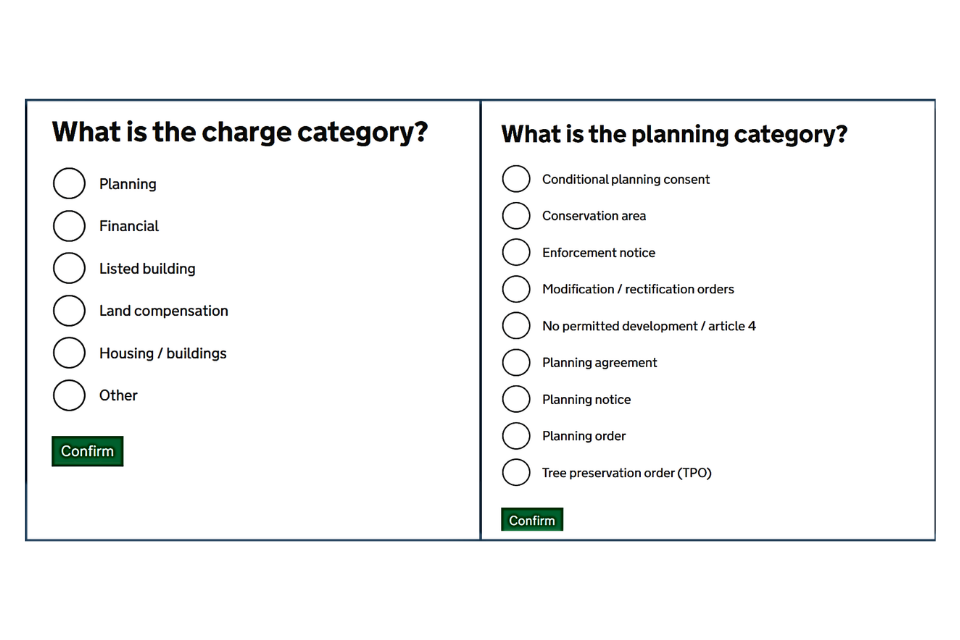
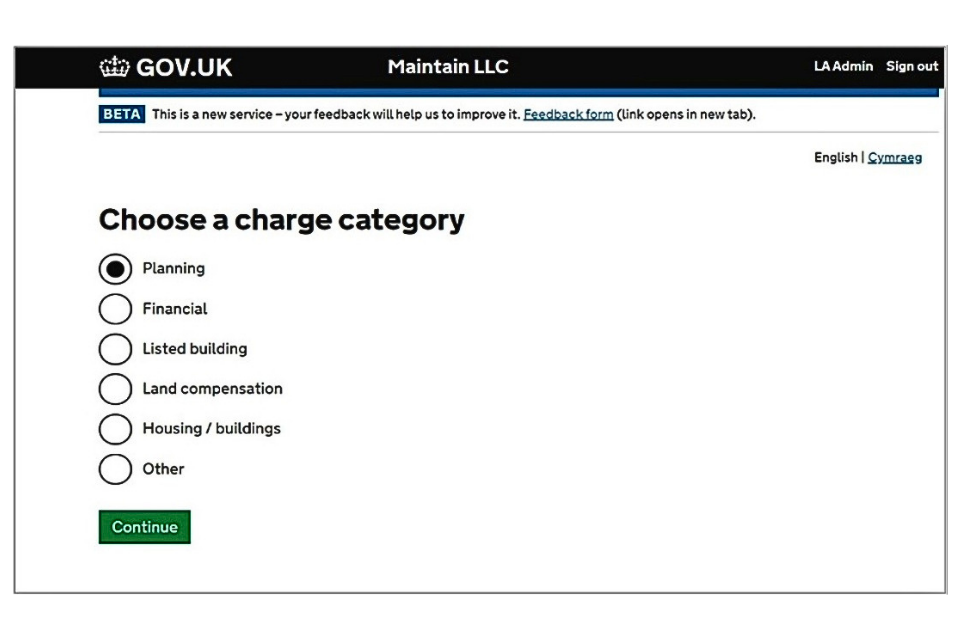
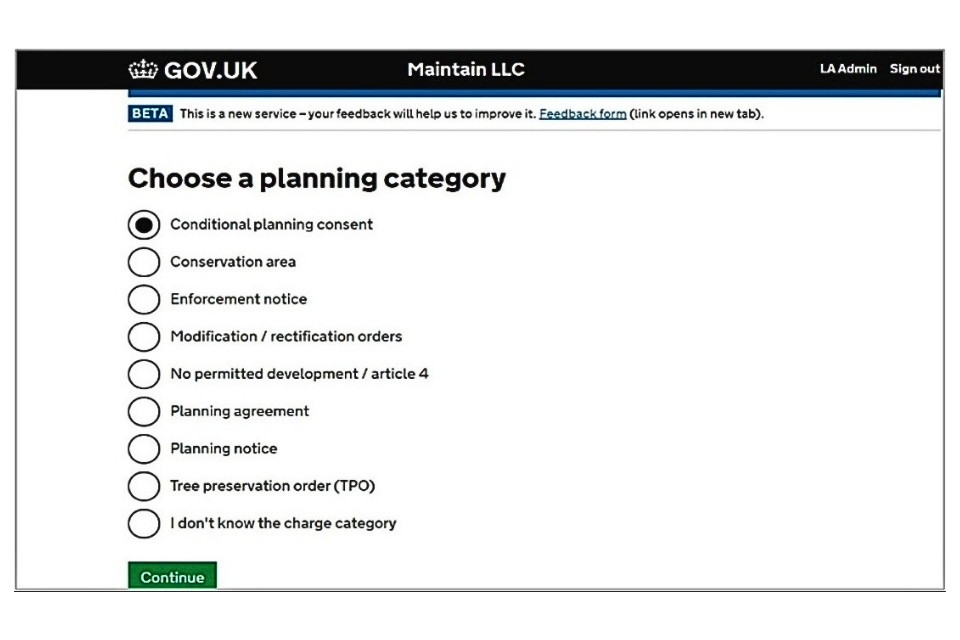
- Many charges will be planning consents. The trainer will show users how to add a charge by selecting ‘planning’ as the charge category and ‘conditional planning consent’ as the subcategory.
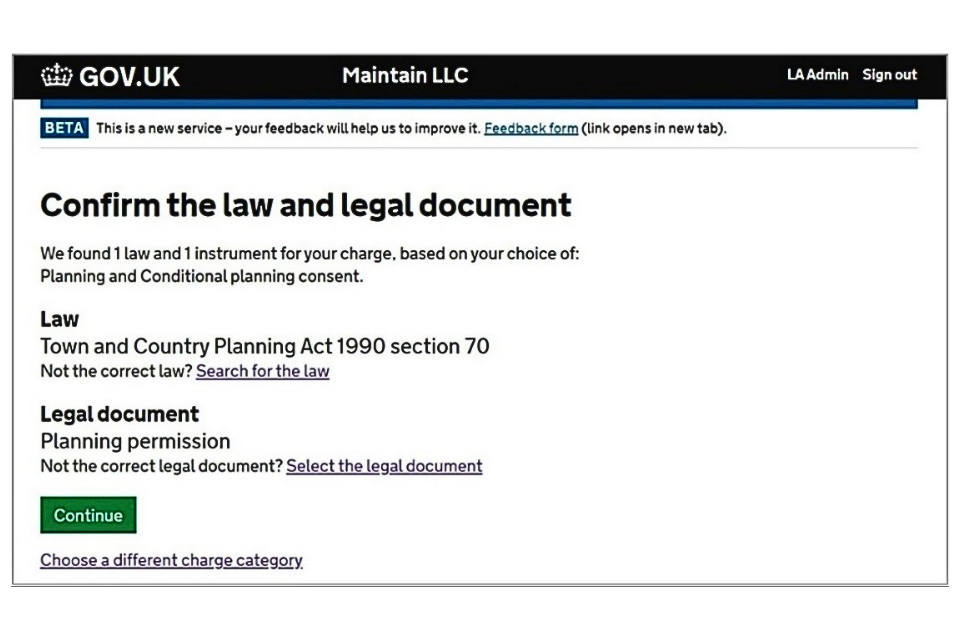
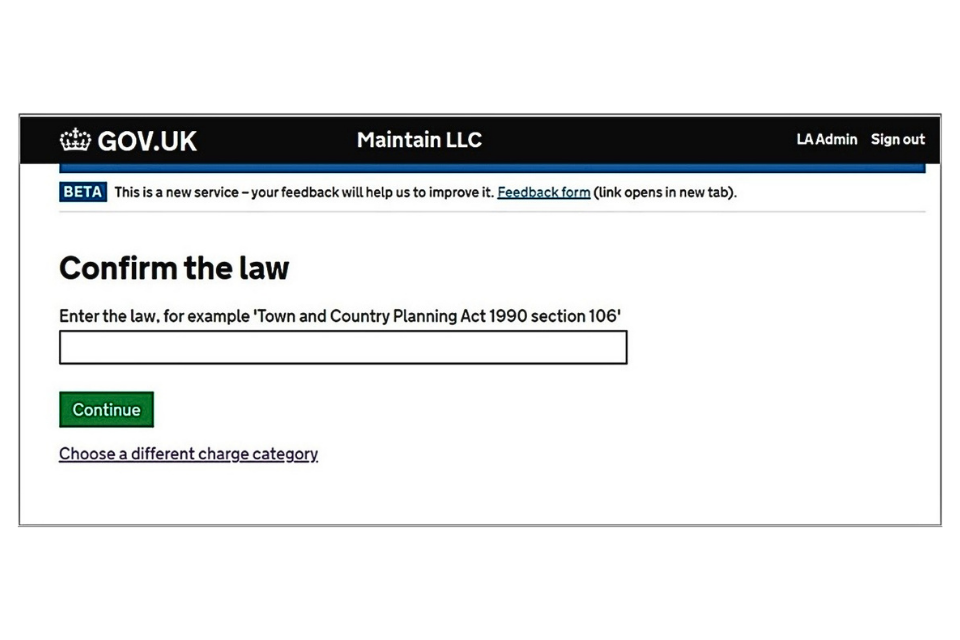
- The law and legal document for planning consents will always be preselected, but the LA/OOA can change them by selecting ‘search for the law’ and ‘select the legal document’.
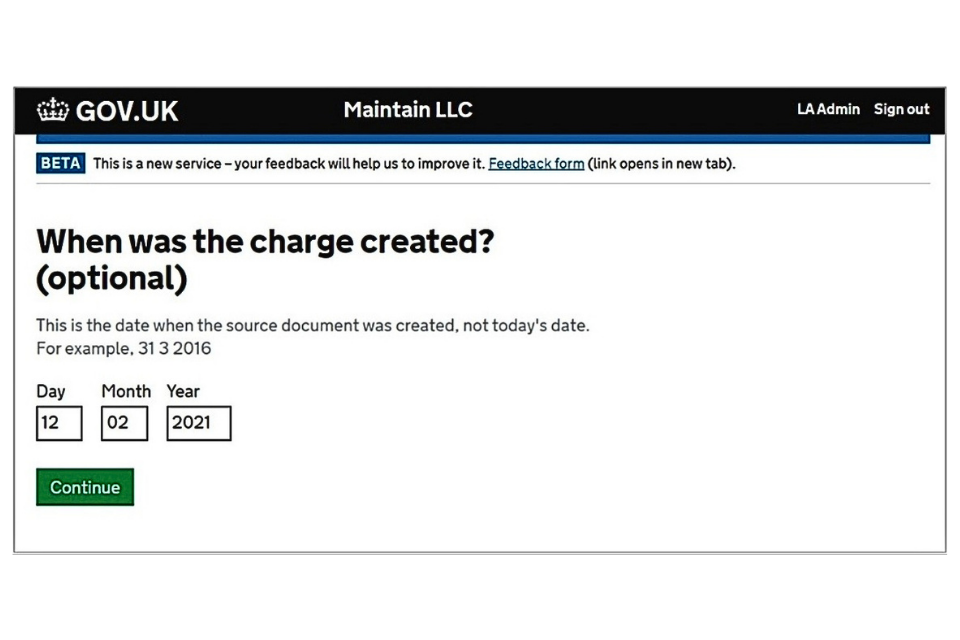
- The charge created date is optional, but users should complete it using the date on the decision notice.
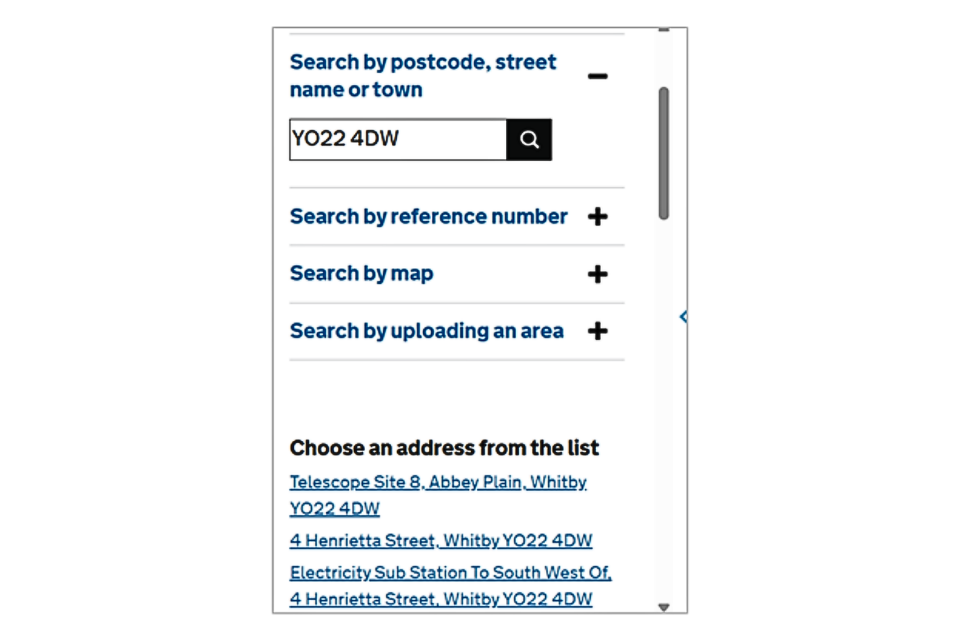
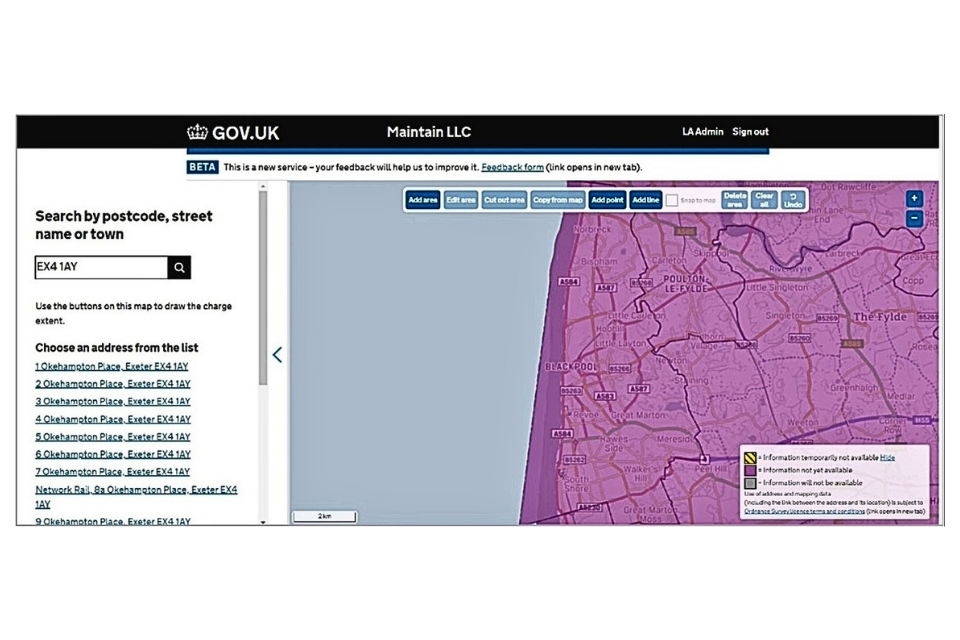
The LA/OOA will be shown how to search using postcodes:
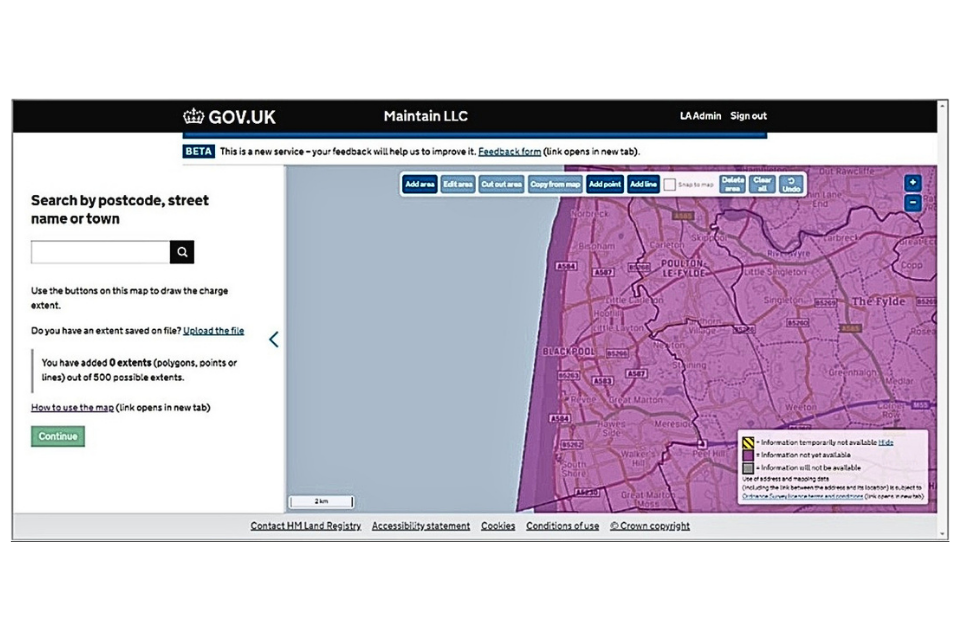
Using mapping tools
All users are to be shown mapping tools and how they work.
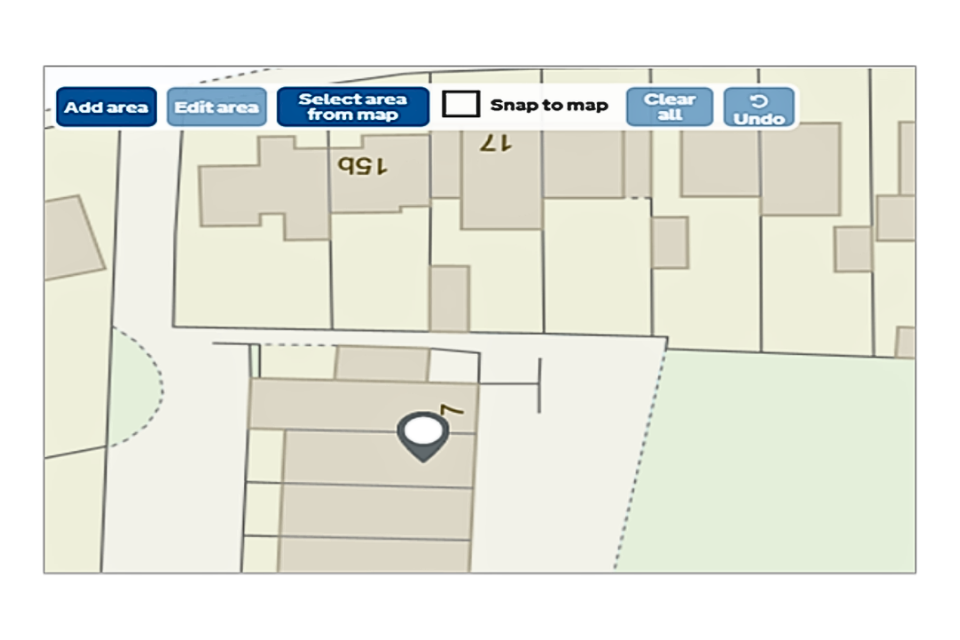
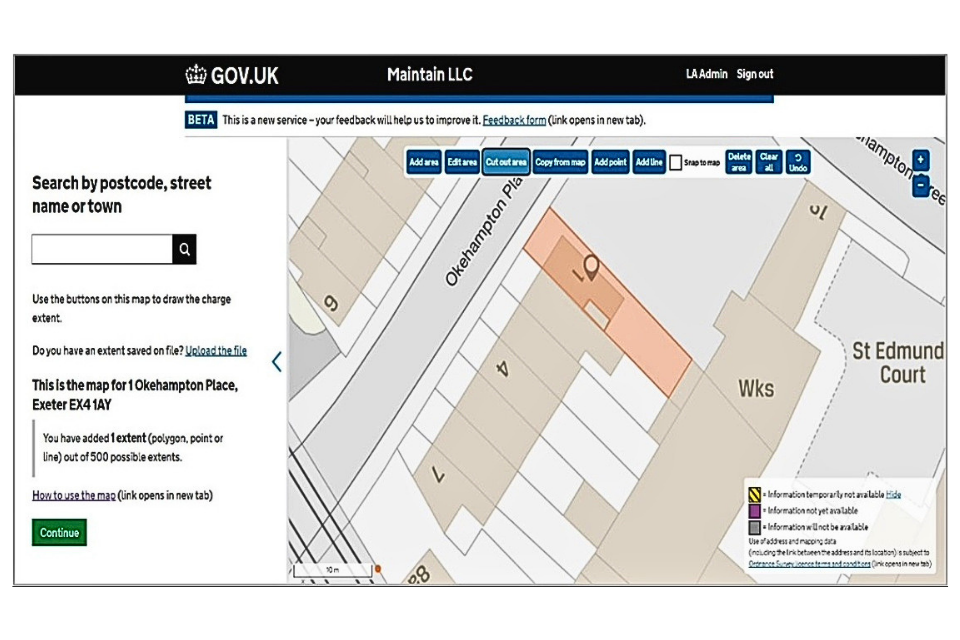
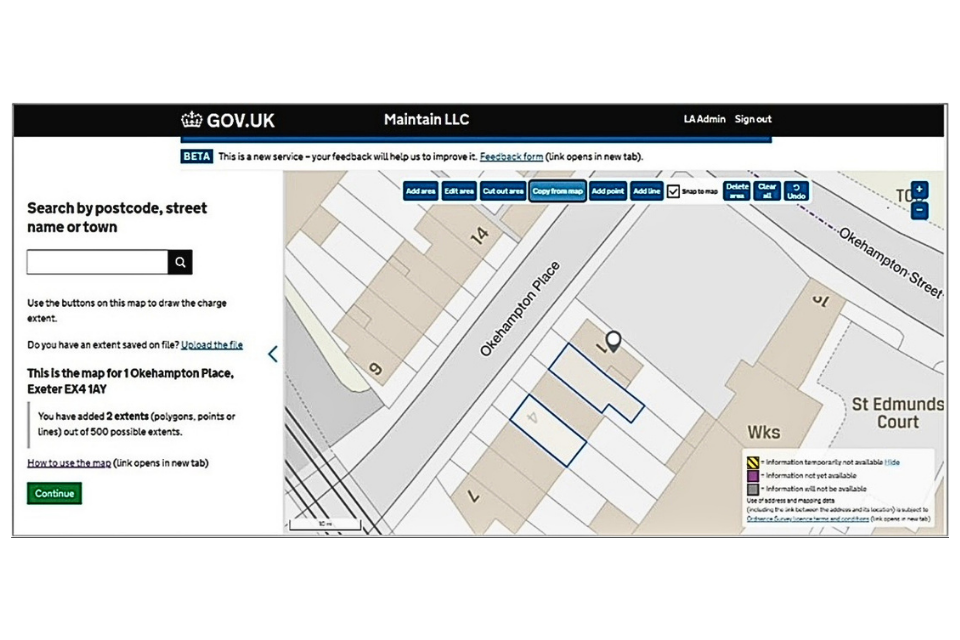
- Using the ‘add area’ button, the LA/OOA should also select ‘snap to map’ to ensure that the polygon ‘snaps to’ the nodes on the basemap and produces a more accurate extent.
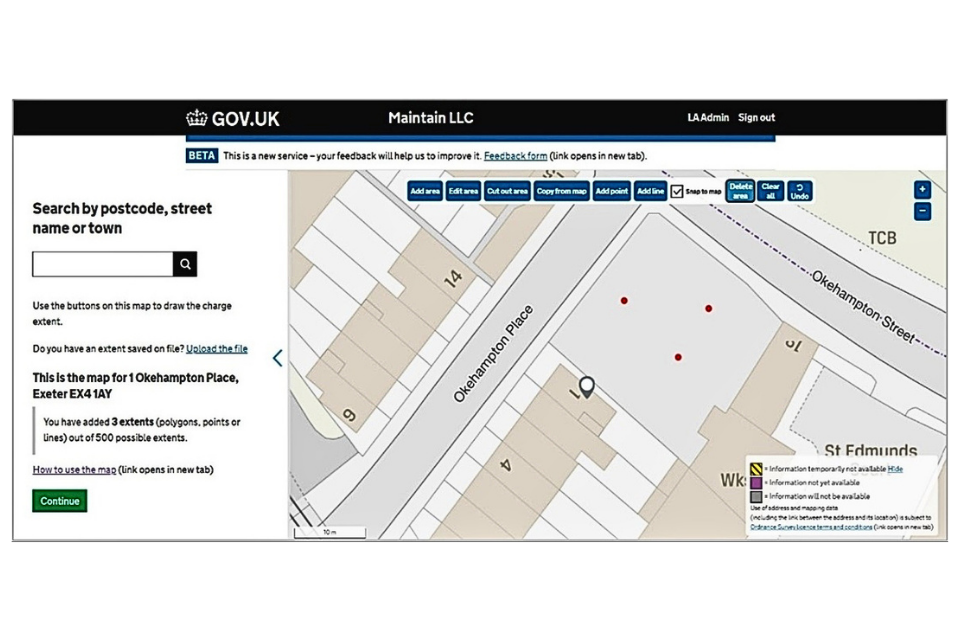
- ‘Add point’ and ‘add line’ should only be used where appropriate.
- Examples of when to use a point include: bollards, gravestones, individual/small trees (not groups of trees or fields with many trees in, unless a point is used is chosen to represent each individual tree), ATMs, small adverts, flagpoles, drain covers.
- Examples of when to use a line include: narrow pipes, narrow drains, adverts on the side of buildings, fences, gates, small walls (that are not adjoined to an affected building).
- ‘Copy from map’ will capture the building only. It can be very useful for buildings with unusual or curved shapes.
- When the user has completed drawing their extent, they should check that the number of extents they believe they have added is the same as the number shown on the left-hand side of the screen.
- LA/OOAs can access help by clicking on the ‘how to use the map’ link.
- LA/OOAs can increase the map size on screen by clicking on the show/hide sidebar.
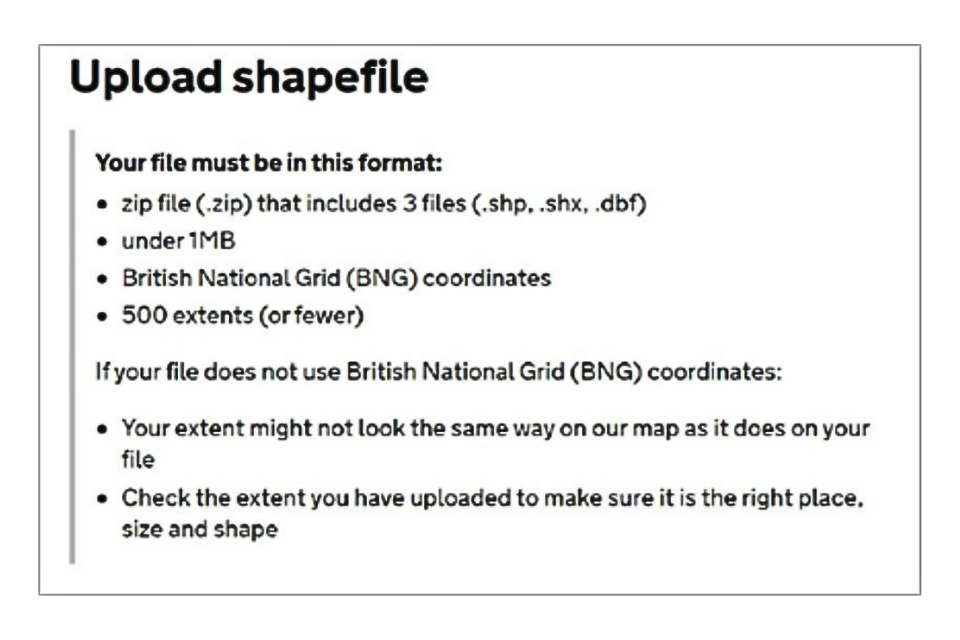
Uploading a shapefile
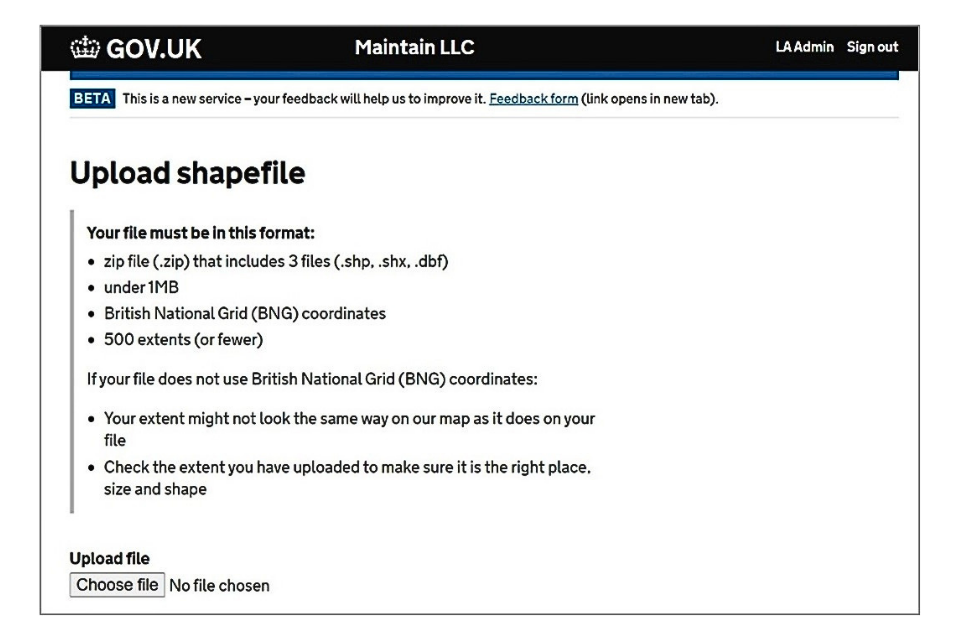
As an alternative to drawing an extent on the map, the LA/OOA can upload an existing authority extent.
Note: users may need assistance from their GIS officer to complete this process.
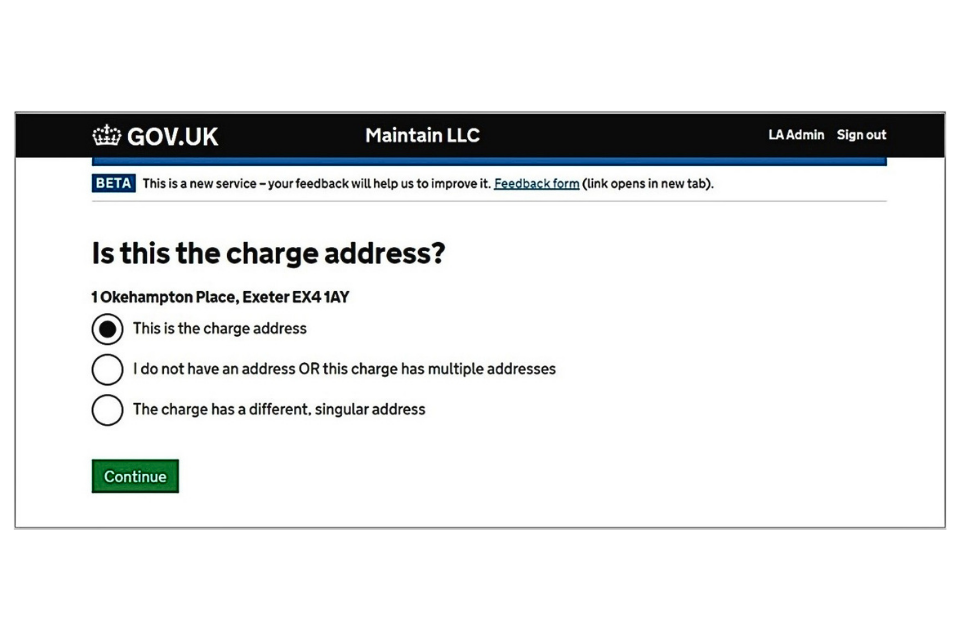
Confirming charge address
This page allows the trainer to demonstrate how the LA/OOA can amend an address selected on the map page. An LA/OOA may need to amend the selected address where:
- the address selected was used only to locate the approximate vicinity on the map. In this instance the user should select ‘I do not have an address’ or ‘this charge has multiple addresses’, for example:
- the charge has been registered against a piece of land adjacent that did not have an address listed.
- the charge has been registered against Nobles Cottage and Bosuns Cottage.
- When the LA or OOA chose the incorrect address by mistake or for another reason, the user should select ‘The charge has a different, singular address’. This will allow them to search by another postcode, for example:
- the user selected Nobles Cottage but then realised the charge should be register against Captains Cottage.
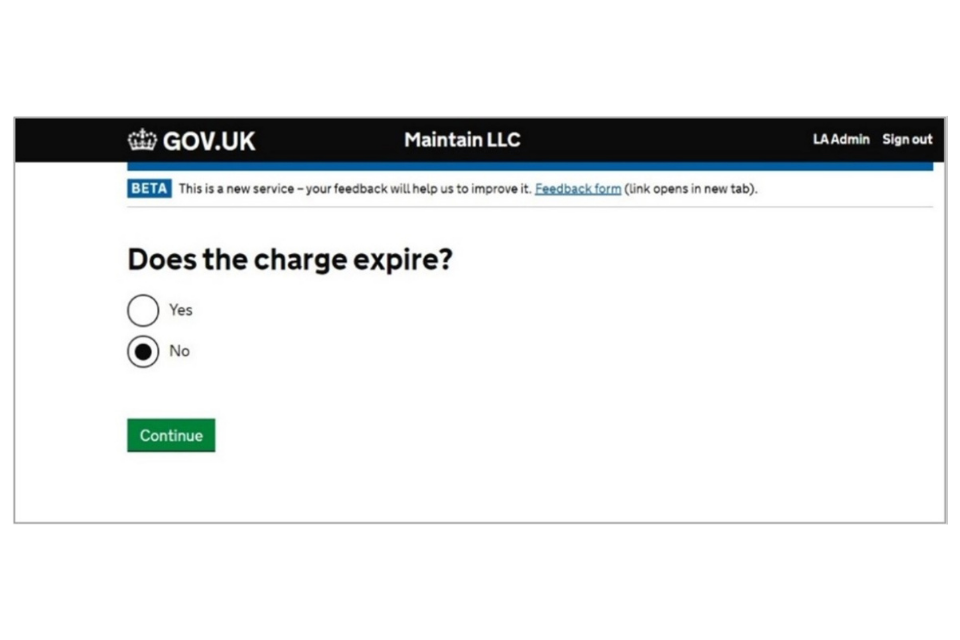
Adding an expiry date
- Few charge types have an expiry date, but where a charge does the trainer will encourage the LA/OOA to add it. Common examples are Housing Grants (including Disabled Facility Grants) and Assets of Community Value.
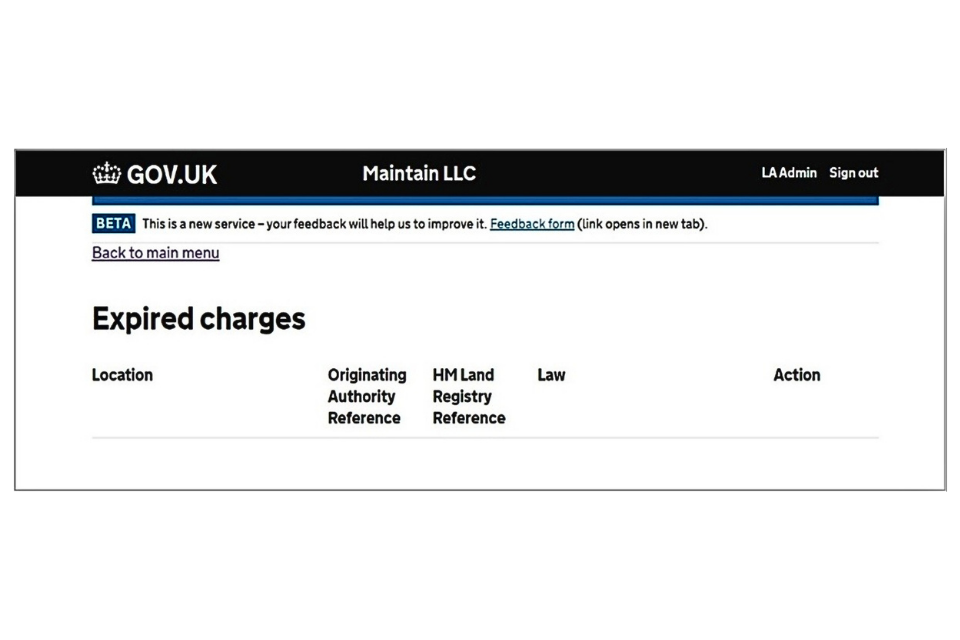
- If an expiry date is added to the register, the charge will not automatically be removed — HMLR has no power to do so. Expired charges will appear on an expired charges list.
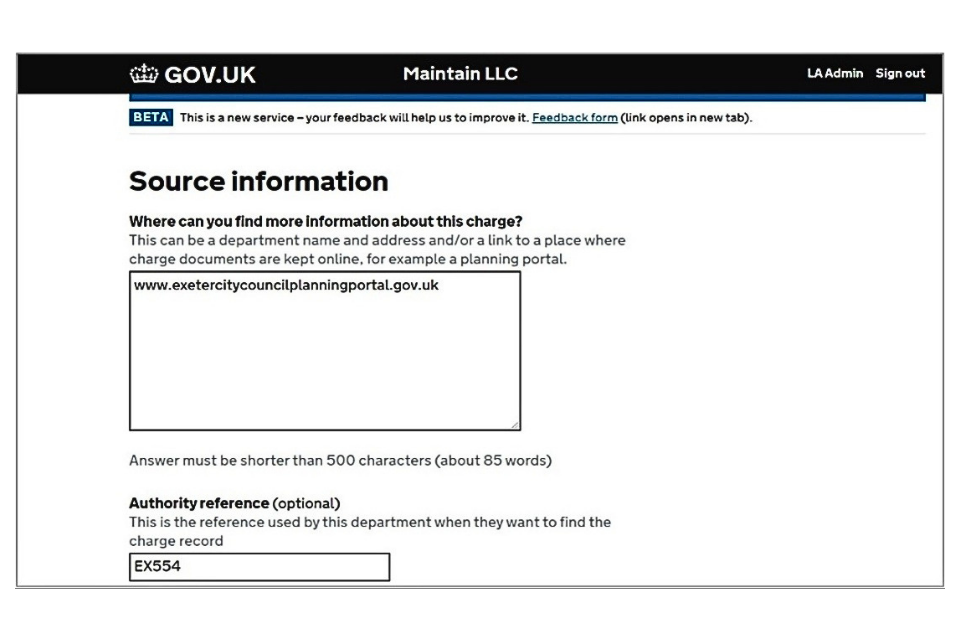
Adding source information
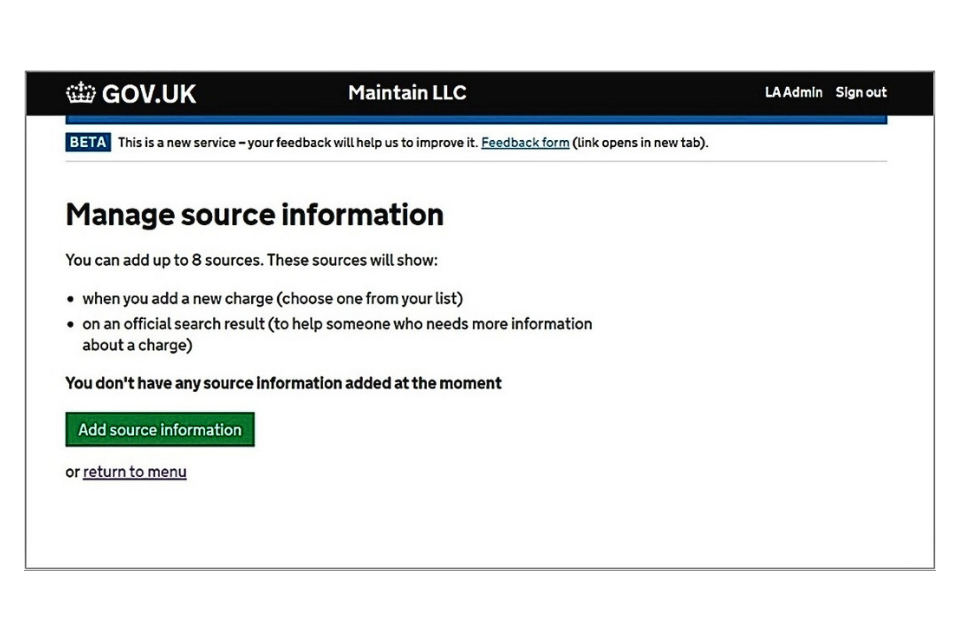
- Show LA/OOA how to complete the free format box to add the source information. They may know this better as the ‘place of inspection’.
- Many LA/OOA’s choose to have this information as their website, planning portal, office location etc.
Adding an authority reference
- This appears on search results and gives customers a reference to quote when contacting the LA with queries about a specific charge.
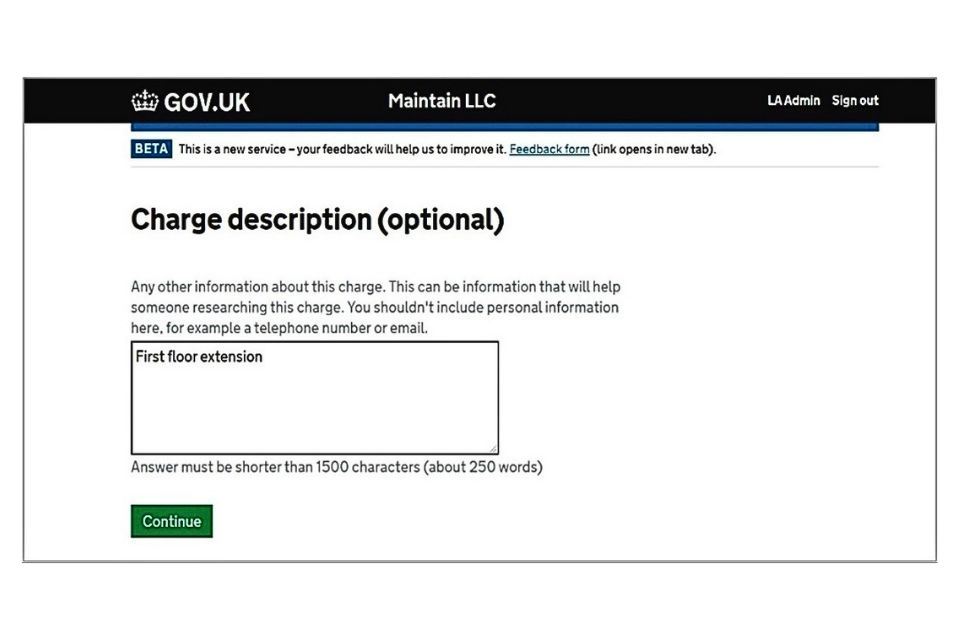
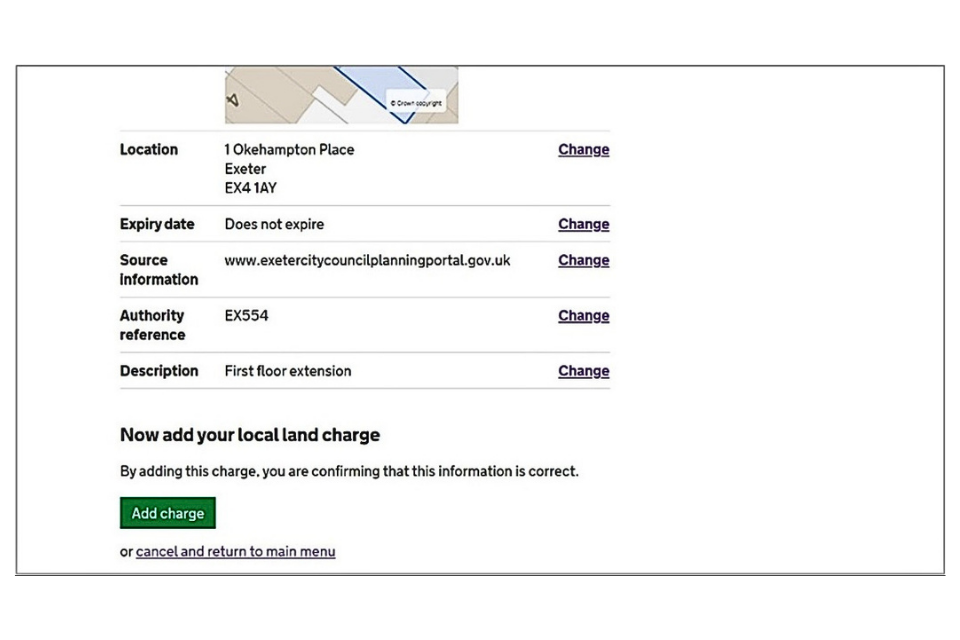
Adding a charge description
- This provides customers with more details about the nature of the charge. For example, a planning consent may include a description, such as a ‘two-storey rear extension and garage’.
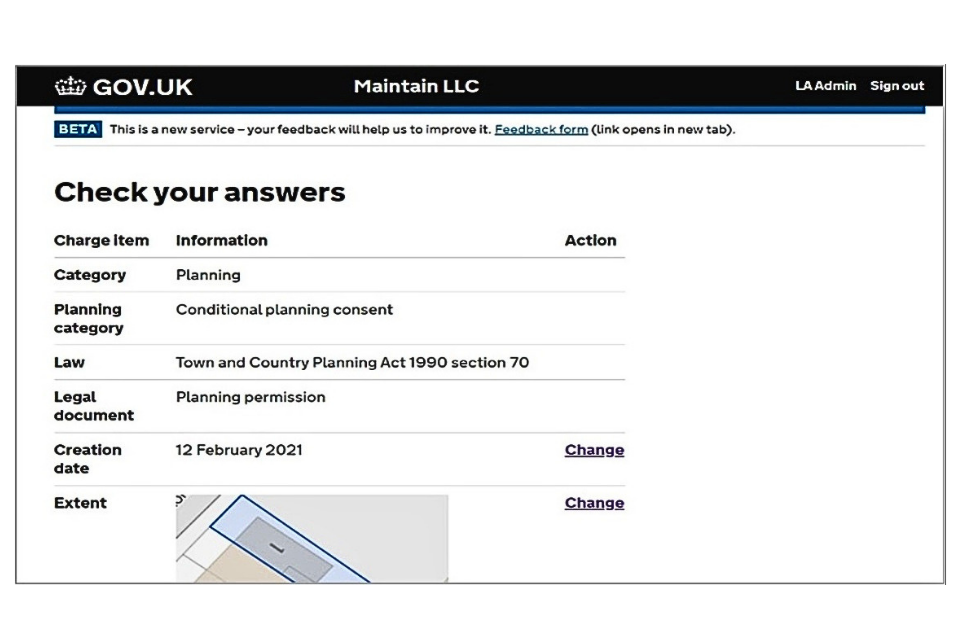
Adding charges and checking answers
- The LA/OOA must check the information they have entered carefully.
- Most fields can be edited by selecting ‘change’.
- The only fields that cannot be edited are ‘category’, ‘law’ and ‘legal document’, as the initial selections determine the subsequent screens presented to the user.
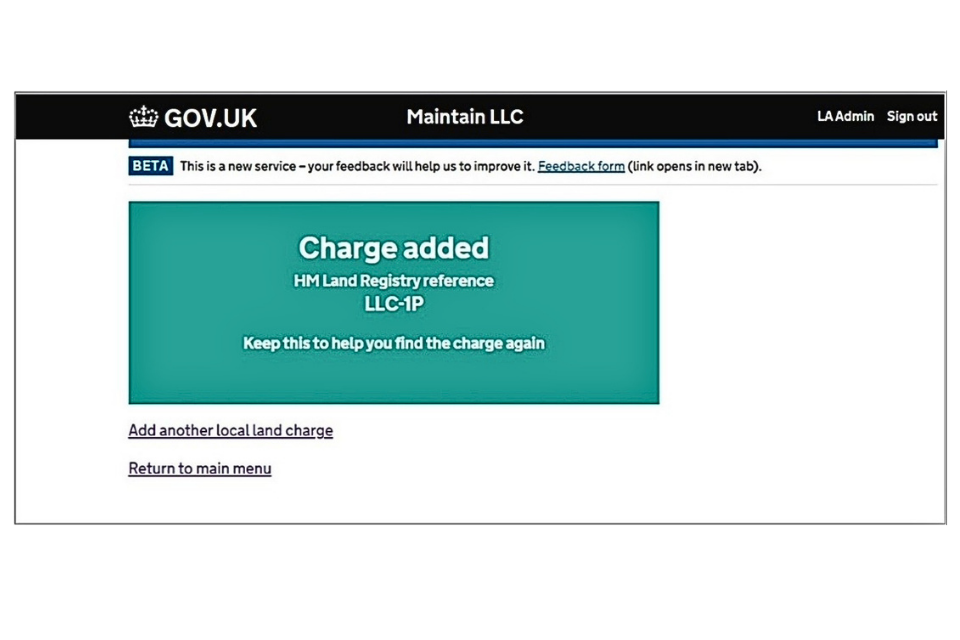
- When the LA/OOA has clicked ‘add charge’ on the check your answers page, they will see confirmation that the charge has been added to the register. This happens in real time, with no delay. The charge will appear on search results immediately.
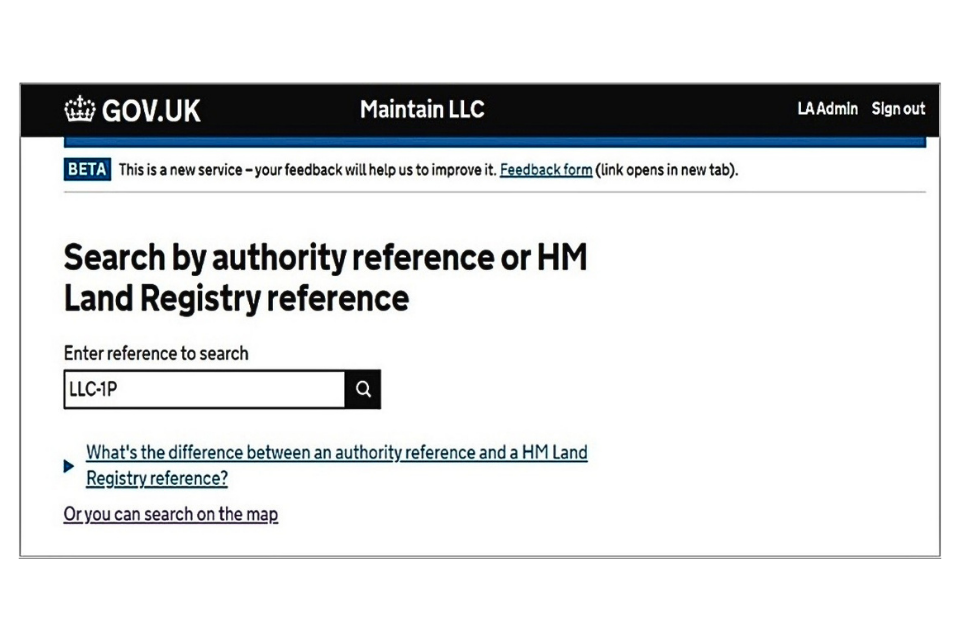
- The LLC reference can be used to find the charge later should it need amending or cancelling (although they can also search by authority reference).
Finding a charge
- The LA/OOA is shown how to find a charge on the register by searching by postcode, street name or town, or by using the map. They can also search by HMLR reference or LA reference.
Update and cancel a charge
- The LA/OOA will be shown how to update and cancel a charge.
11. GOV.UK and Maintain Local Land Charges
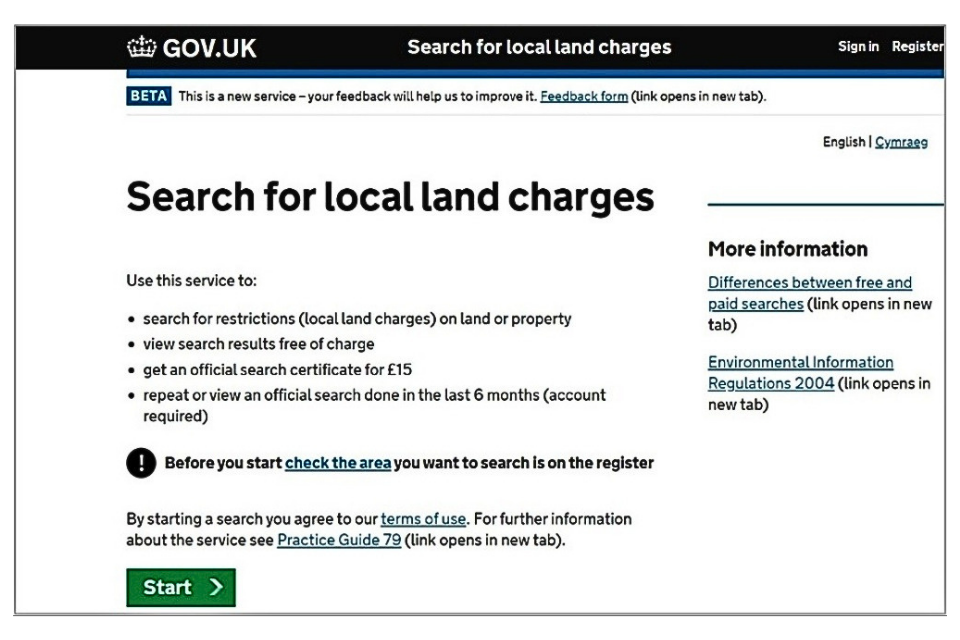
Maintain LLC – start page
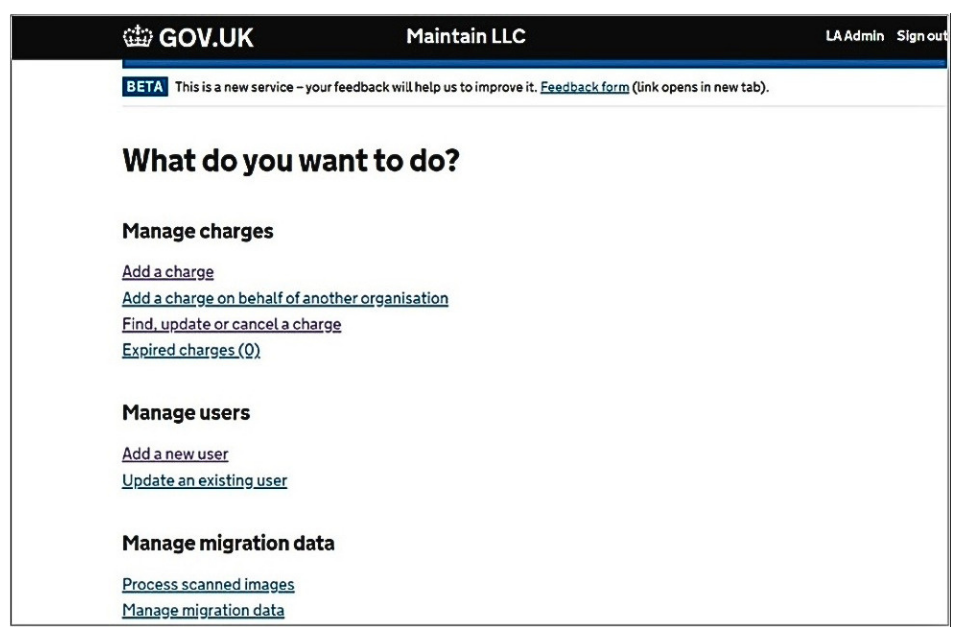
Maintain LLC – home page
Adding users
Charge category
Subcategory
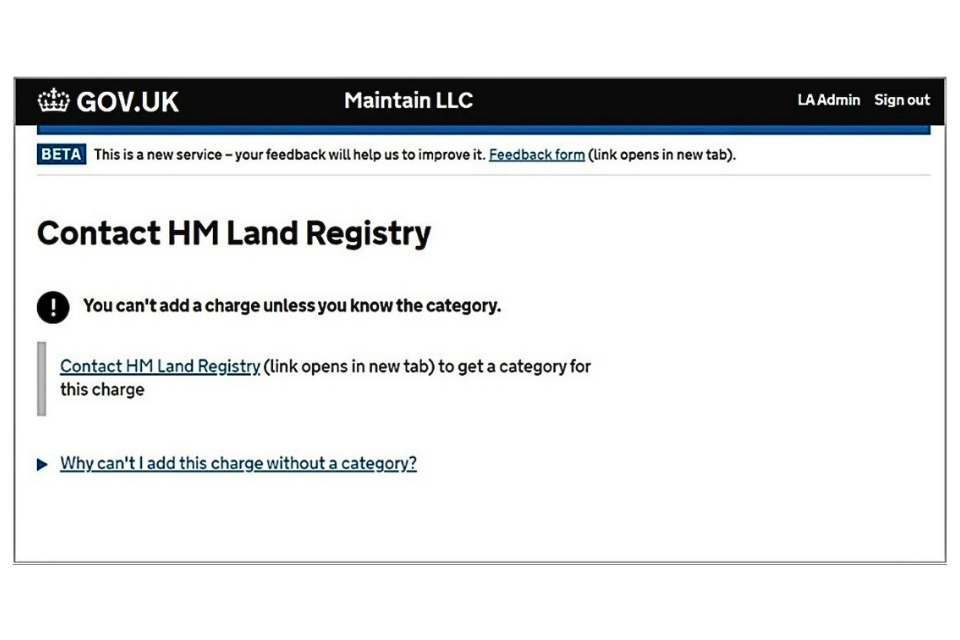
Selected - I don’t know charge category
Law and legal document
Spatial mapping
Upload shape file
Centre the map
Mapping tools
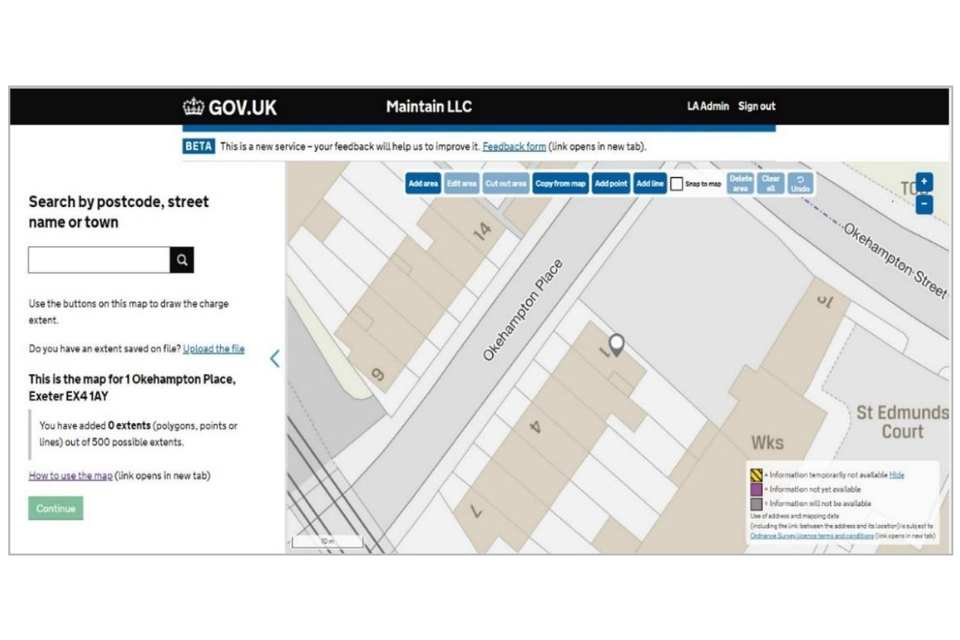
Add area
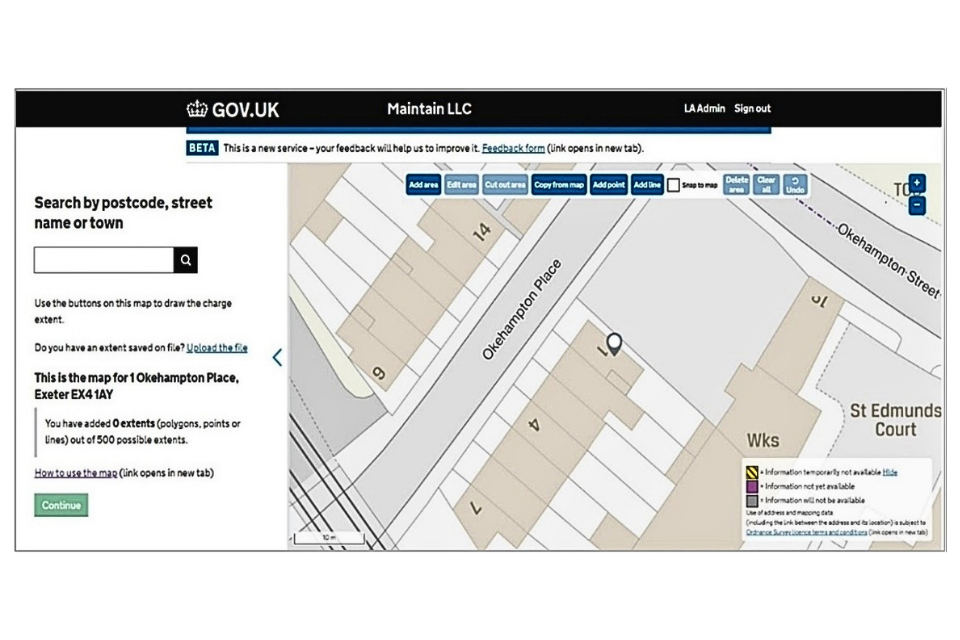
Add points
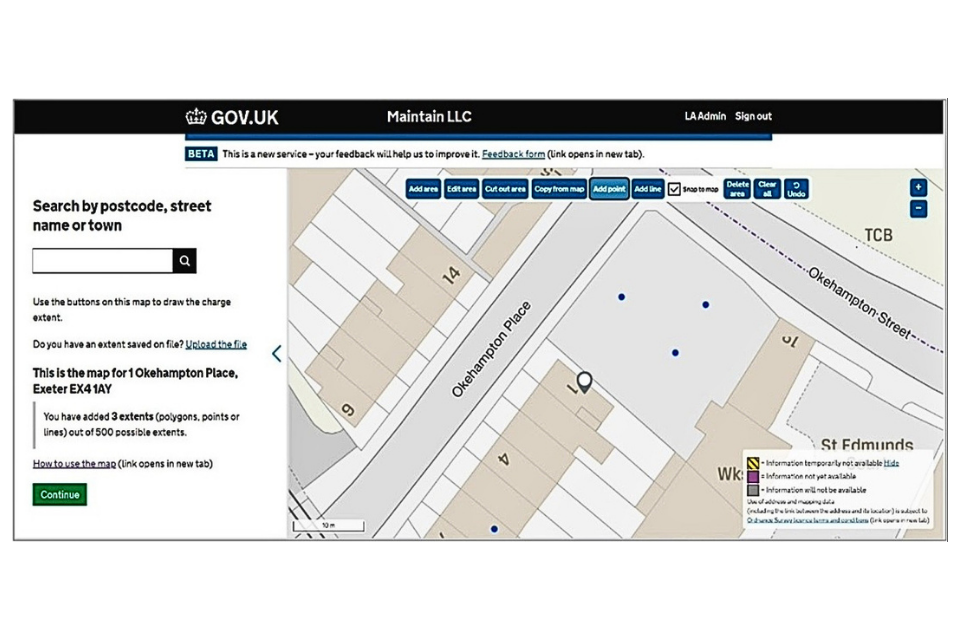
Add lines
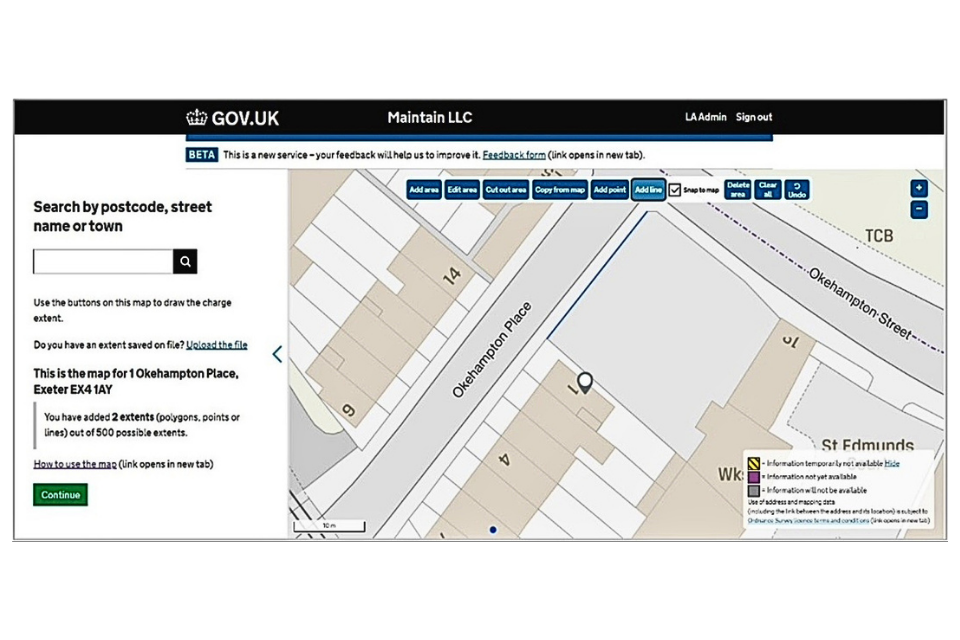
Cut out area
Copy from map
Delete
Charge address
Charge expiry date
Source information
Charge description
Check answers
Check answers
Charge added
Search for a charge
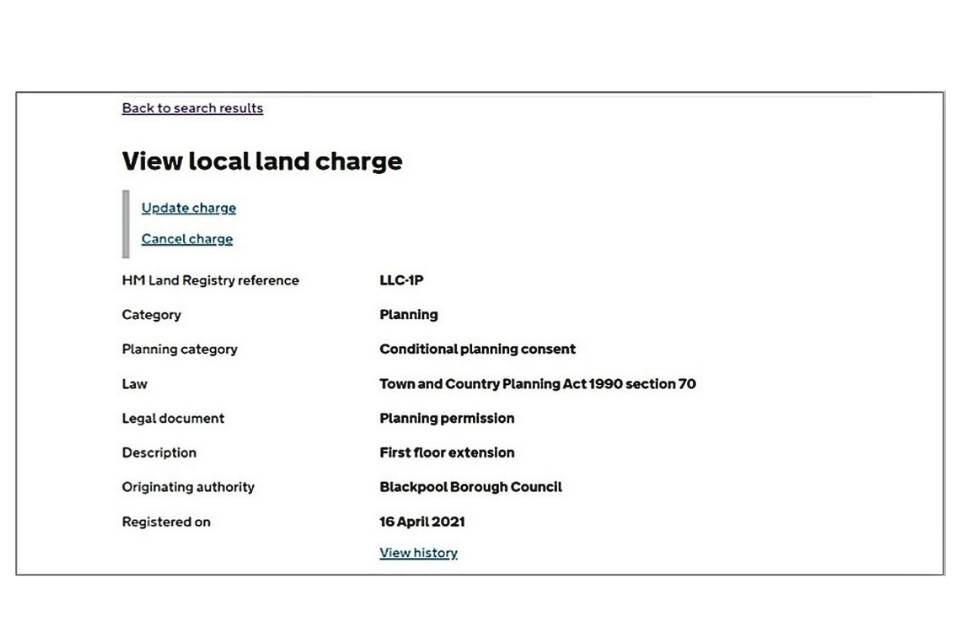
View local land charge
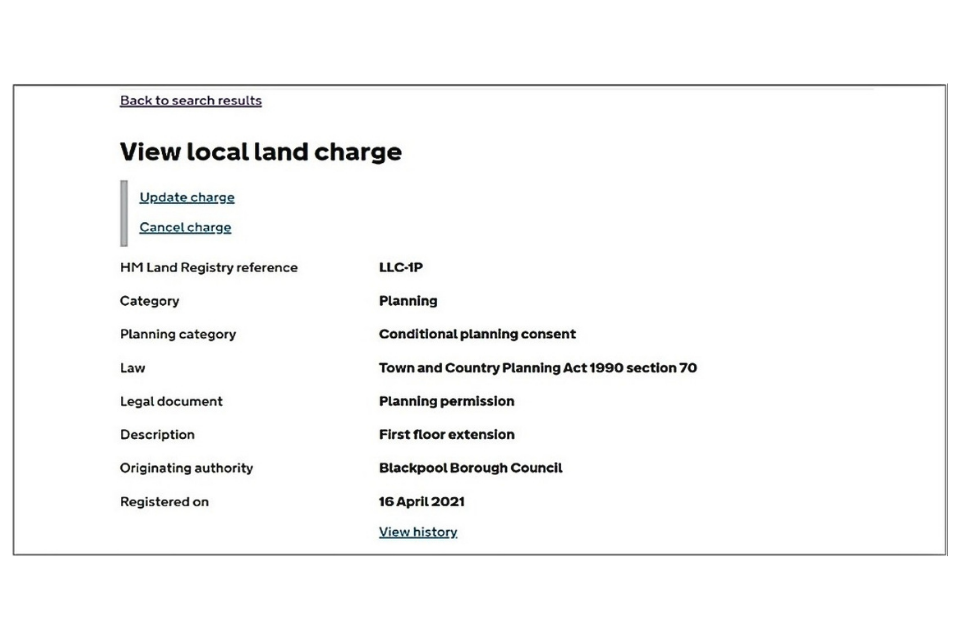
View local land charge
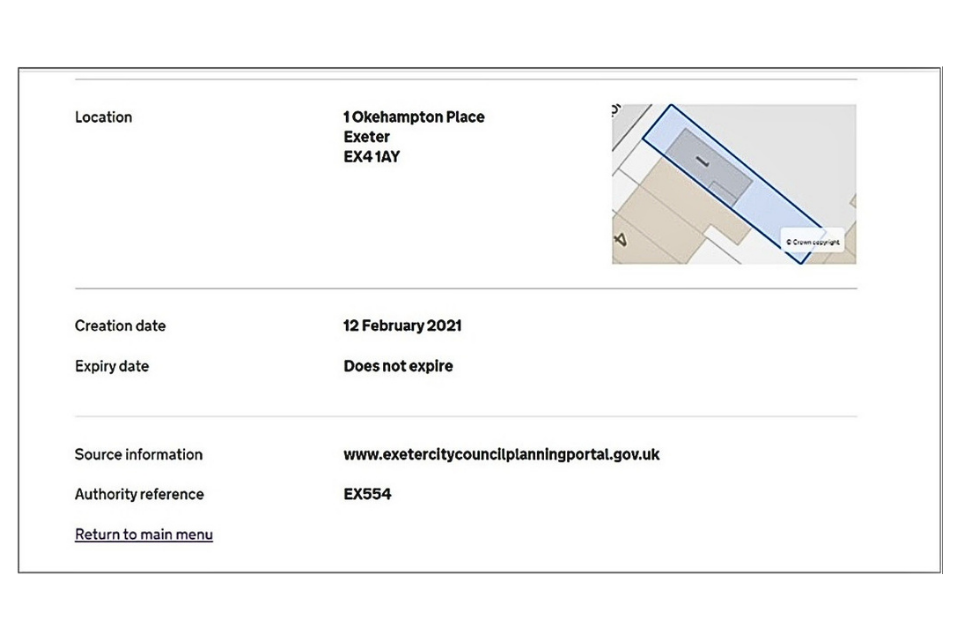
View local land charge
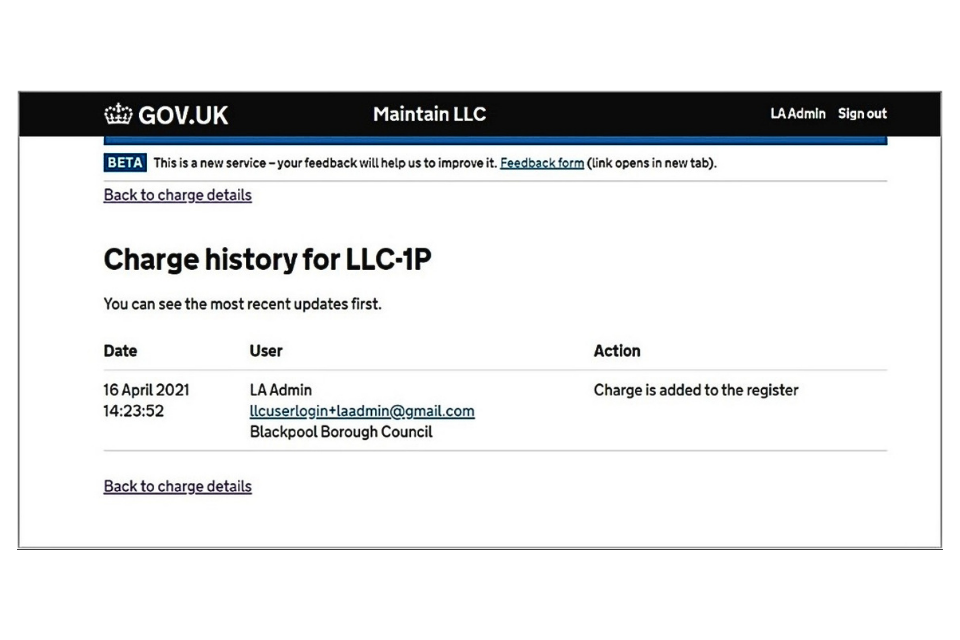
View history
Expired charges
Manage source information
12. Policy on listed buildings and capturing curtilage
What are listed buildings?
- Listed buildings are protected structures of architectural or historic interest.
- The register of listed buildings (the ‘list’) is maintained and administered by Historic England in England, and Cadw in Wales.
- A listed building may not be demolished, extended, or altered without special permission from the local planning authority.
- Each listed building includes a principal listed building and may also include curtilage objects or structures.
What is curtilage?
- The curtilage of a principal listed building is broadly the land and any other buildings around and associated with it.
- Structures and objects should be included in the listing if they are within the curtilage of the principal listed building and have been since before 1 July 1948.
- Not all listed buildings have curtilage.
Why is there a specific policy for listed buildings?
-
By law, listed buildings include any object or structure within the curtilage that forms part of the land and has done so since before 1 July 1948. To deal with the difficulties arising from this part of listed building law, HMLR created a specific, bespoke policy for capturing the spatial extent of listed buildings.
-
The policy on listed buildings has not changed but the guidance has been updated to provide greater clarity to develop a consistent approach and ensure the dataset is as accurate as possible.
Misinterpreting the guidance
- In one case, the local authority (LA) incorrectly captured an extent covering the entire LA and applied a note to cover the entire extent.
- In other cases, we suspect only the principal listed buildings were captured.
What is the policy on capturing curtilage?
Overarching principle: it is the LA’s responsibility to provide spatial extent for listed buildings.
- Where a listed building charge includes curtilage structures or objects, this must be reflected in the spatial extent.
- If the LA cannot identify whether curtilage structures are included in a listing, it should include all structures or objects considered to be affected by the charge on a case-by-case basis, following the guidelines below:
- the extent must be large enough to minimise the risk of excluding land that may be affected by the charge, which could lead to liability issues.
- the extent must not so large as to include land that is clearly not subject to the charge.
- In these cases, there is no need to add a note.
- In exceptional cases where the extent of the curtilage cannot be accurately identified, the LA should provide an extent including all reasonable possible curtilage and a note to the registration added as follows.
- “Refer to [name of relevant local authority] for details of the particular buildings, objects or structures constituting the listed building for the purposes of this charge.”
- The note should only be used in exceptional circumstances as detailed above.
Specific object(s), feature(s) or buildings defined
- In many cases the object, feature or building will be explicitly described in the charge address or land description and/or the supplementary information/charge description.
For example:
| Address/Land description | Supplementary Info |
|---|---|
| Church of All Saints, Gateway piers & lamp-post CHURCH LANE, WHITEFIELD | Grade II Listed Building |
- Where the LA can identify the position/extent of the objects/features with reasonable precision, it is acceptable to map each object affected individually.
- Where the LA cannot identify the position of features or objects with certainty, or where it is not practical to map each feature independently, the LA may use a generalised footprint based on the fenced extent. In this case, the caveat note is not needed.
For example:
|# Supplementary information | | — | |# Subsidiary features: in the churchyard are a stone CROSS and a LYCH GATE, both erected by anonymous parishioners in 1913. At the south-east corner of the churchyard is a lynch gate, an open oak-framed canopy with a tiled roof resting upon low stone-coped brick walls.
The structure has been adapted to serve as a war memorial.
| The cross, immediately west of the church, set on a square stepped plinth. |
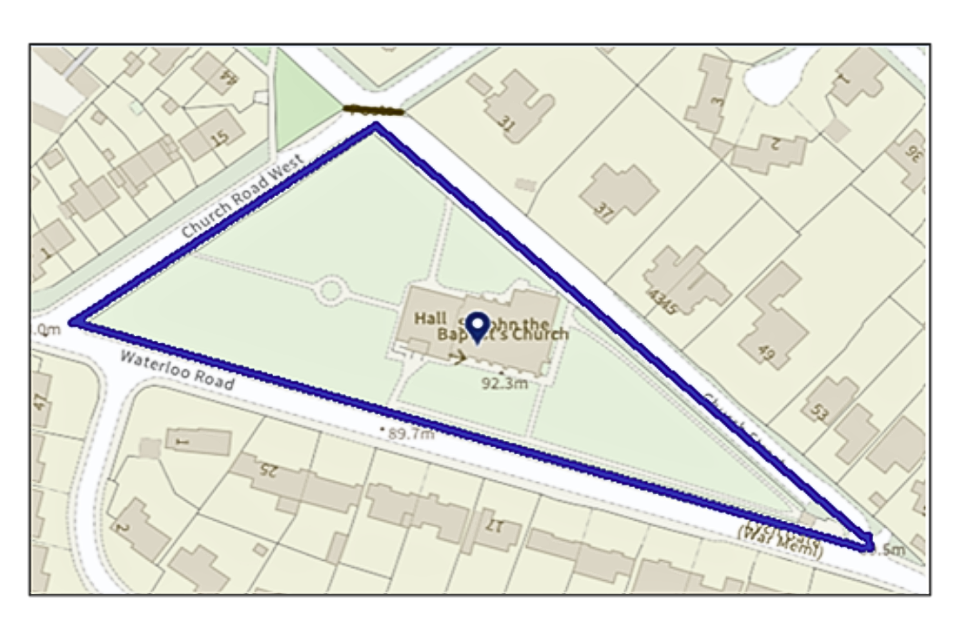
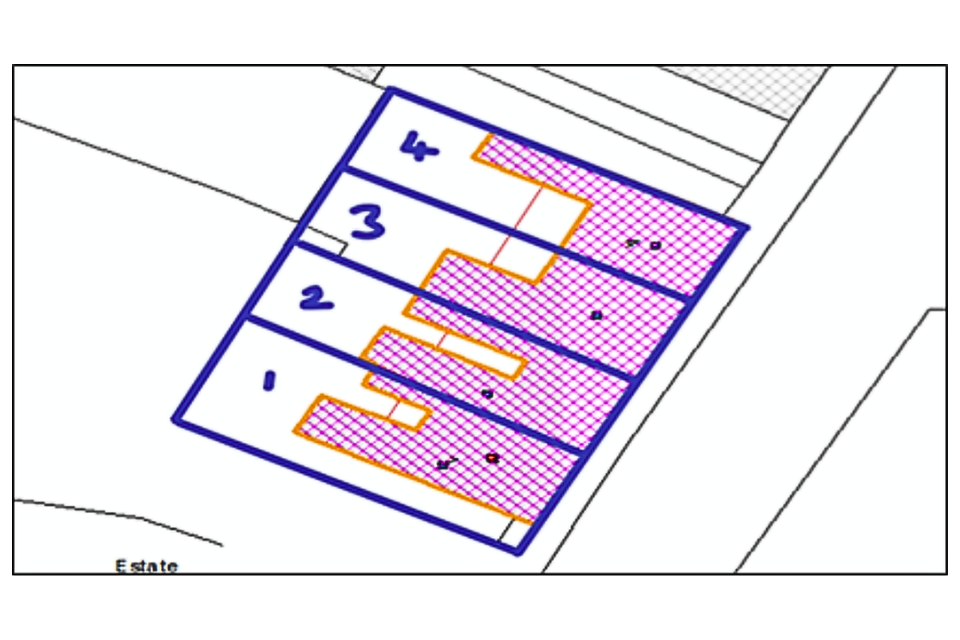
- Where it is clear that objects or features are an integral part of the physical structure of the addressable property, it is acceptable for the LA to capture only the building outline. A polygon covering the fenced extent would also be acceptable.
For example:
| Supplementary information |
|---|
| Listing description: Terrace of 4 cottages. Coursed squared gritstone, grey slate roof. 2 storeys, 4 bays, centred arched surround with a square hoodmould which continues to side, over a chamfered flat-headed mullion window of three 4-centred arched lights. The 3 left-hand cottages have the window to right of the door. Hipped roof and 3 ridge stacks with paired octagonal corniced flues, to centre, left and right. Right return: 2-light window to first floor, as front; eaves band. |
Two entries, one listing
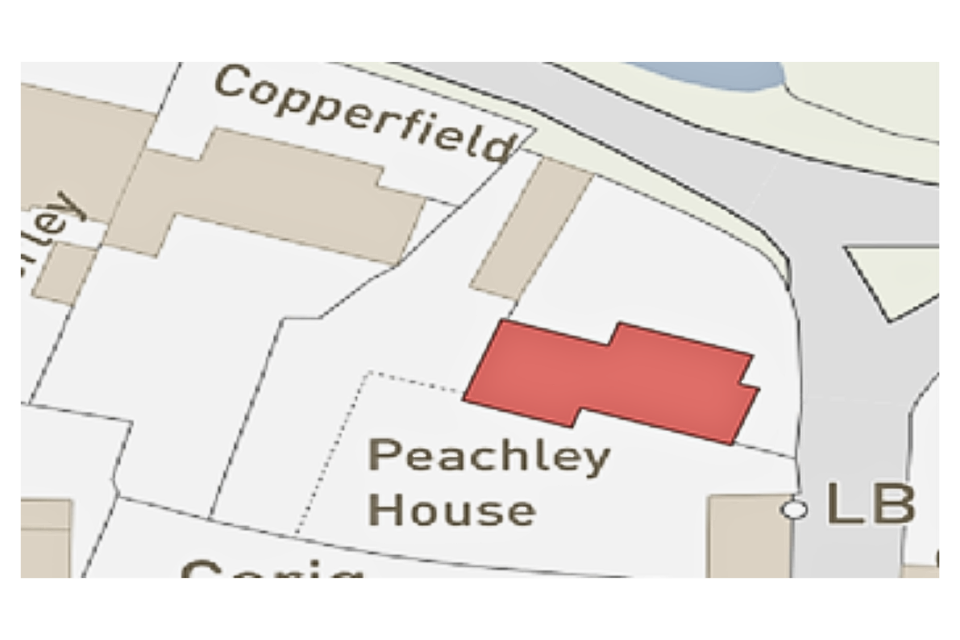
Some LAs have adopted an approach where two charge entries have been created with one for the building and one for the curtilage.
For example:
| Address | Supplementary information |
|---|---|
| Peachley House, Church Lane, WR2 6QY | Listed building: Peachley House |
| Grade: II Historic England Ref: 1178949 |
| Address | Supplementary information |
|---|---|
| Peachley House, Church Lane, WR2 6QY | Curtilage listed: The property is deemed to be curtilage listed and therefore comes under restrictions that apply to listed buildings: Within the curtilage of Peachley House Grade: II Historic England Ref: 1178949 |
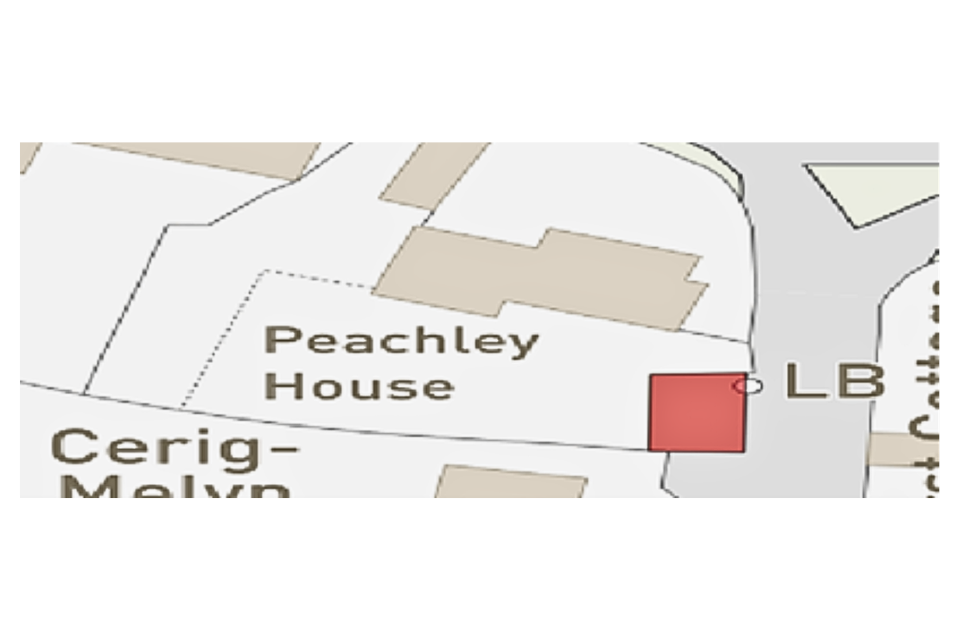
- Whilst it is preferred that these are consolidated into a single charge entry, it may not always be practicable. There is little risk and both parts will be revealed on a search so they will be accepted.
To prevent erroneous failures, it is essential that this method is flagged as early as possible in the migration.
Specific object feature or building not defined
Where the address and/or supplementary information does not give details, the charge is deemed to be ‘silent’ as to what is specifically affected.
If a ‘partner’ has not been created/supplied, it is not appropriate for the LA to capture the specified addressable property only – even if the caveat has been added.
| Address | Supplementary information |
|---|---|
| Peachley House, Church Lane, WR2 6QY | Listed building: Peachley House |
| Grade: II |
In this example a search against the secondary building will not reveal the charge.
Where the charge is deemed to be ‘silent’ about what is specifically affected, the LA should capture the entire fenced extent as a minimum.
| Address/land description | Supplementary information |
|---|---|
| St Peter’s Church, Pedmore Lane | LBII |
In this example, it is entirely possible that either the Rectory and/or the Lych Gate are within the listing though they are not specifically described. Therefore, it is important for the LA to cover the entire extent, not just the church building described.
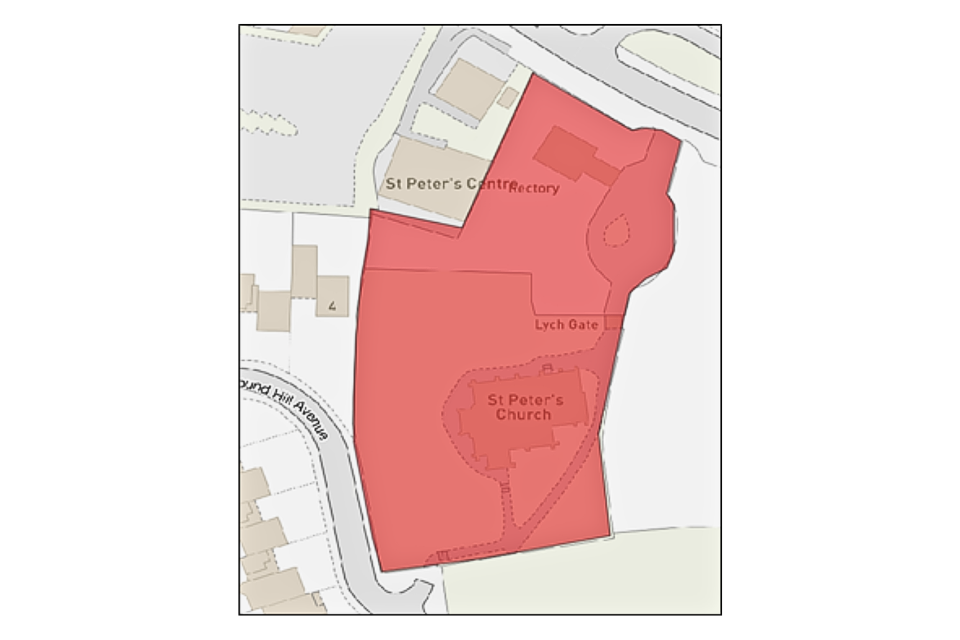
For example:
Charge is ‘silent’ as to what is specifically affected, and the LA should capture entire fenced extent as a minimum.
| Address/land description | Supplementary information |
|---|---|
| 707 High Road Tottenham London N17 8AD | Town and Country Planning Act 1971 Section 54 - List of Buildings of Special Architectural or Historic Interest List of buildings compiled by the Secretary of State for the Environment and including the above property Order Date: 22/07/1949 707 High Road N17 fronting onto Church Road Grade II Listed Building |
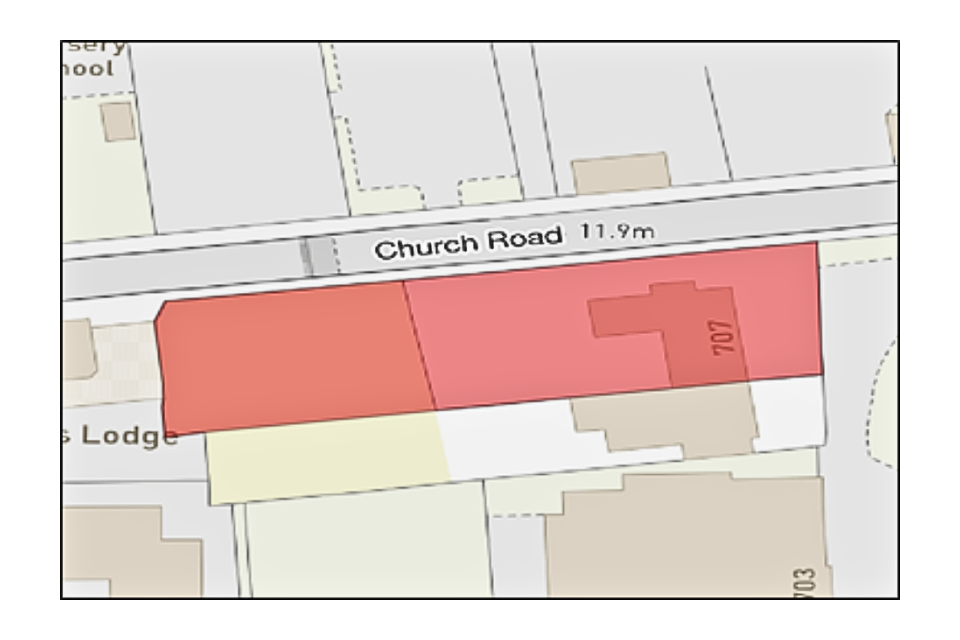
In some rare instances the charge will be ‘silent’ as to what is specifically affected. The nature of certain land/properties means it may not be immediately obvious what is within the curtilage.
In these circumstances the LA can capture a larger generalised extent. This can be done using either single or multiple geometry features. All possible curtilages should be covered and the following note added to the charge:
Refer to [name of relevant local authority] for details of the buildings, objects or structures constituting the listed building for the purposes of this charge.
More information is available on Historic England’s website.
What does this mean for LAs?
- When they are live on the register:
-
If an error is identified, such as primary building being captured and the curtilage missed, the LLC Programme will talk to the LA and agree on a procedure to rectify the position.
- In-flight LA migrations:
- Any reassessment in respect of LAs in migration will be considered at POD level on a case-by-case basis with the possible impact on the agreed migration schedule.
13. HM Land Registry Local Land Charges application programming interface common error codes
The following list of errors are displayed in log files, in agreement with incumbent suppliers. They are generated either in the source system or through email log files and are available for review purposes only.
List of errors
| Error code | Error text | Description of error | Action or resolution |
|---|---|---|---|
| 502 | An error occurred whilst sending the request. The remote server returned an error 502 – bad gateway | Network connectivity problem | Could be firewall, network or software settings usually in the LA infrastructure. Usually occur during the implementation of the API. Will require HMLR tech delivery support, HMLR networks and LA IT to resolve. |
| E050 | Error code”: E050”, “error_message”. “Internal Server Error”} | The CCF HMLR does not have valid settings in the HMLR JWT key. | Requires HMLR tech delivery support. |
| E400 | Geometry must be simple and valid | Complicated or large spatial | Can occur with very large complicated spatial polygons with lots of co-ordinates. Normally accompanied by a large error log associated with the record. Resolution is to check the polygon for any errors, simplify it or export the polygon from the source system and send to HMLR to upload via the UI. |
| E400 | Charge address is a required property | Missing charge details | Add an address to the record or if the record contains multiple addresses add an address to the location field in TLC. |
| E400 | Charge-geographic-description is a required property. ‘Charge-address’ is a required property | The record does not have a geographic description for the location recorded in field location on the TLC registration screen. | Add an address to the record or if the record contains multiple addresses add an address to the location field in TLC. |
| E400 | ‘Uncommon charges’ is not valid | Invalid charge type subcategory | Uncommon charges are applied during migration where one isn’t currently available. These can only be applied during migration and not in live service. The charge type subcategory will need amending to a valid value for the record to be accepted. |
| E400 | Statutory provision, “error_message”: “Example statutory provision” is not valid | Incorrect statutory provision | The record has been assigned an incorrect statutory provision which either needs amending in the source data or via a custom rule. Normally it is source data amendment. |
| E400 | Error_message”. “Charge subcategory” is required | Missing charge subcategory | Charge type subcategory is missing and either needs adding in the source data or via a custom rule. Normally it is source data amendment. |
| E010 or 422 | Version ID submitted is not the latest version error code E010, alternate error “422 (UNPROCESSABLE ENTITY)” | This error is shown when the record version ID in the LA source system differs from the HMLR record version ID. | This normally occurs if the LA have amended the record at source but also on the HMLR UI causing the version IDs to go out of sync. These can be rectified by either a mini correlation file or fixes by the supplier. A run through of the LA processes is also likely needed to prevent further occurrences of the problem. Seek guidance from SPI team on fixing these. |
| 409 (CONFLICT) | Duplicate_charges”:[“LLC-1NSBF”]} | LA records out of sync with HMLR | Problem occurred during the API transfer for the record. This is a similar fix to error E010. Seek guidance from SPI team. |
| T001 or 429 | “Error_code”:”T001”,”error_message”:”Threshold exceeded | HMLR daily record threshold level has been exceeded | Review daily log files to see how many records are being processed. If it’s a large number will need to investigate with the LA or LA to seek guidance from SPI team. |
| Exception: OtherRejectException Error exporting record PT46853 - Type ID 23 - Original Part 3B Record cannot be exported since it does not contain any spatial data | No polygon created on the record in uniform. | Add spatial to record. |
14. Identifying spatial fails
The subsequent examples demonstrate different types of spatial quality fails and explain how these would be corrected.
Example 1:
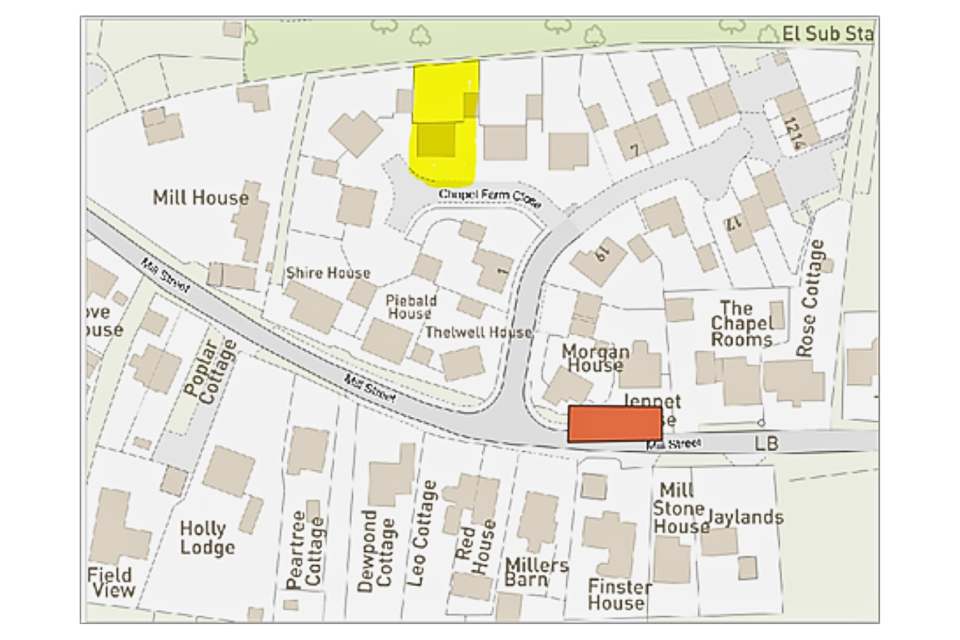
Address: 4 Chapel Farm Close.
Charge description: tree preservation order (TPO) for 1 lime and 1 oak tree.
Issue: polygon is on part of Jennet House and the road of Mill Street.
Error type: fail – spatial – wrong location.
Error comment: polygon is on part of Jennet House and the road Mill Street where it should be on 4 Chapel Farm Close.
Highlighter yellow is the correct location the polygon should be.
Example 2:
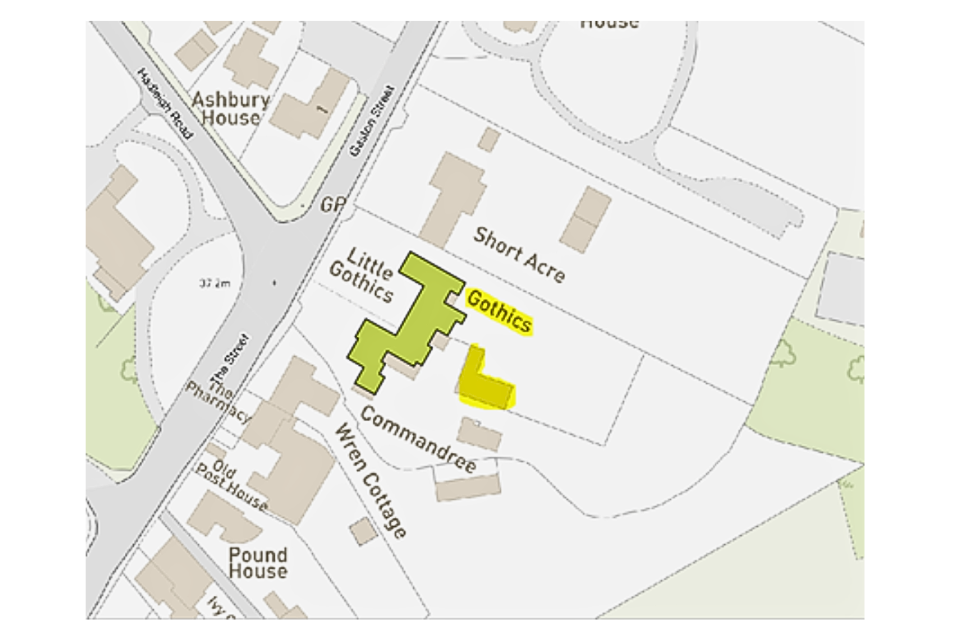
Address: Commandree, Little Gothics, The Gothics.
Charge description: Commandree, Little Gothics, The Gothics.
Issue: polygon is only on Commandree and Little Gothics and has missed The Gothics, which is highlighted yellow.
Error type: fail – spatial – poly does not cover enough
Error comment: polygon only covers 2 out of the 3 buildings, needs to also cover The Gothics.
Example 3:
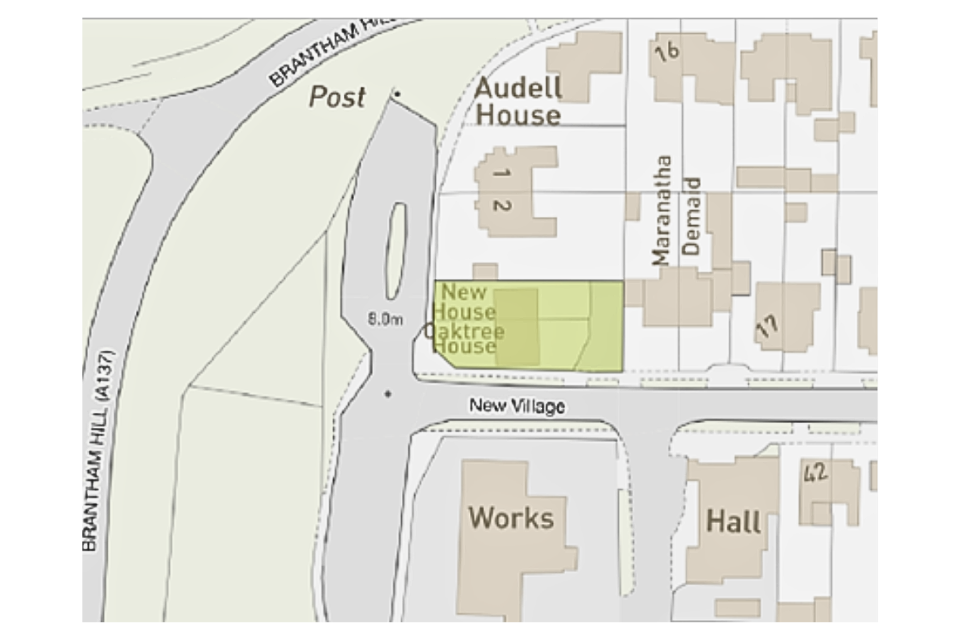
Address: New House, Cattawade Street, Brantham.
Charge description: miscellaneous provisions.
Issue: polygon covers both New House and Oaktree House.
Error type: fail – spatial – poly covers too much.
Error comment: polygon is also covering Oaktree House and the charge address.
Example 4:
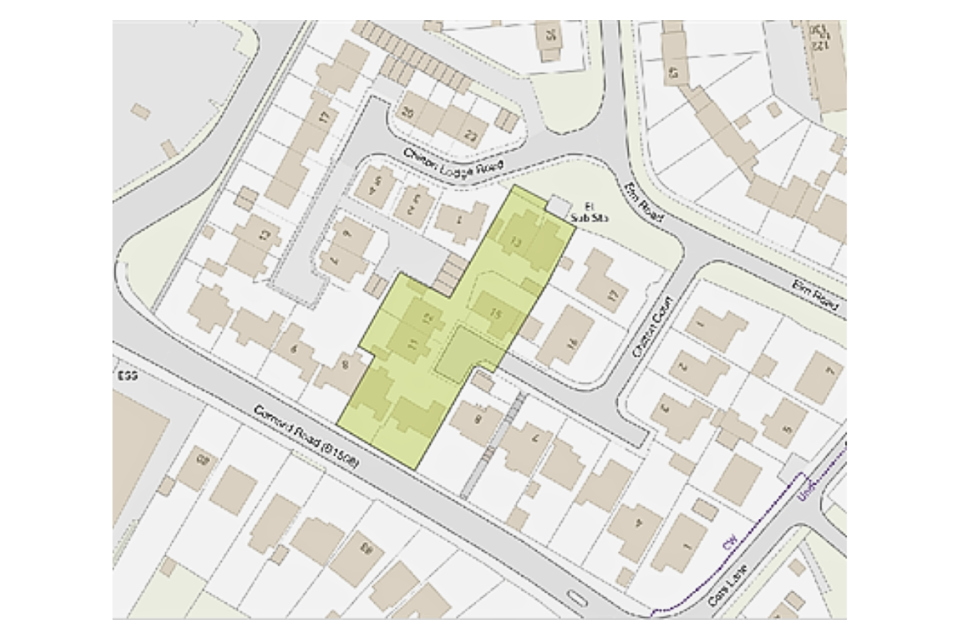
Address: 12 Chitton Court.
Charge description: single-story extension.
Issue: polygon is covering 9-15 Chitton Road.
Error type: fail – spatial – polygon covers too much.
Error comment: address and supplementary info are both for number 12. The polygon is covering 9-15 when polygon should only cover number 12.
Example 5:
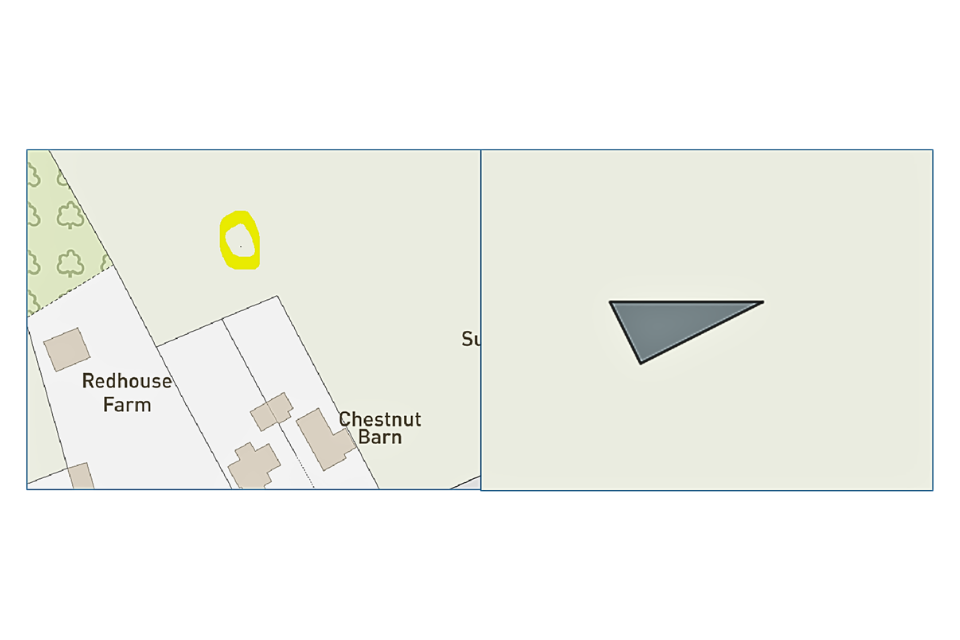
Address:</b> Land East of Red House Farm, The Street, Aldham.
Charge description:</b> Planning.
Issue:</b> When zoomed in QGIS software, we can see the above triangle. The other picture is zoomed out and the spot in the middle of the yellow circle is the triangle.
Error type:</b> fail – spatial – poly does not cover enough.
Error comment:</b> polygon is a very small triangle.
Example 6
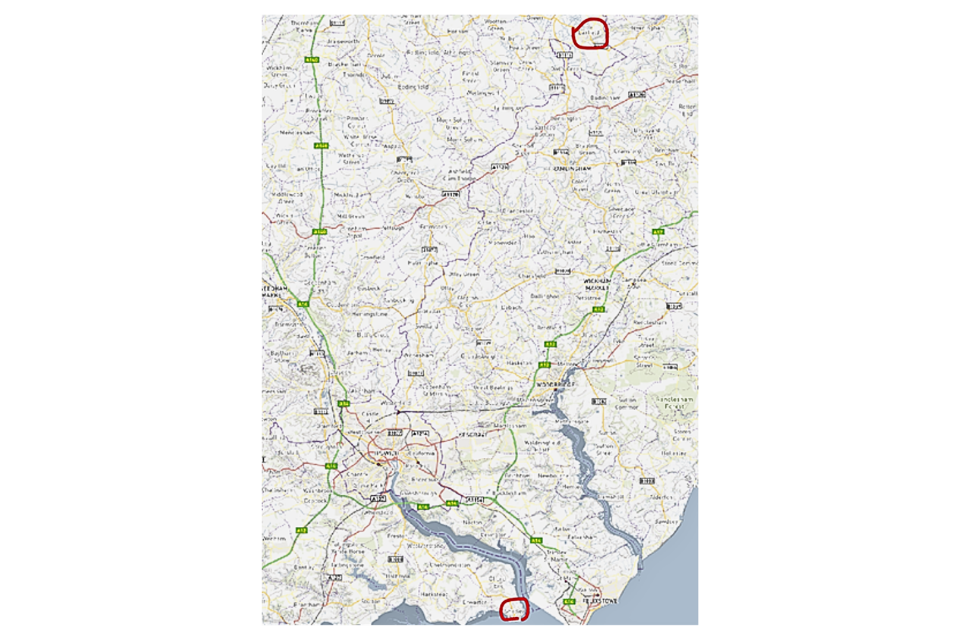
Address: 8 Felgate Close, Laxfield, Eye, Suffolk, IP13 8FF.
Charge description: 2 oak trees.
Issue: another polygon is attached in the wrong location.
Error type: fail – spatial another polygon attached.
Error comment: There is a poly on number 8 Felgate Close and another on Shotley Gate. The Shotley Gate polygon needs to be removed.
Plans
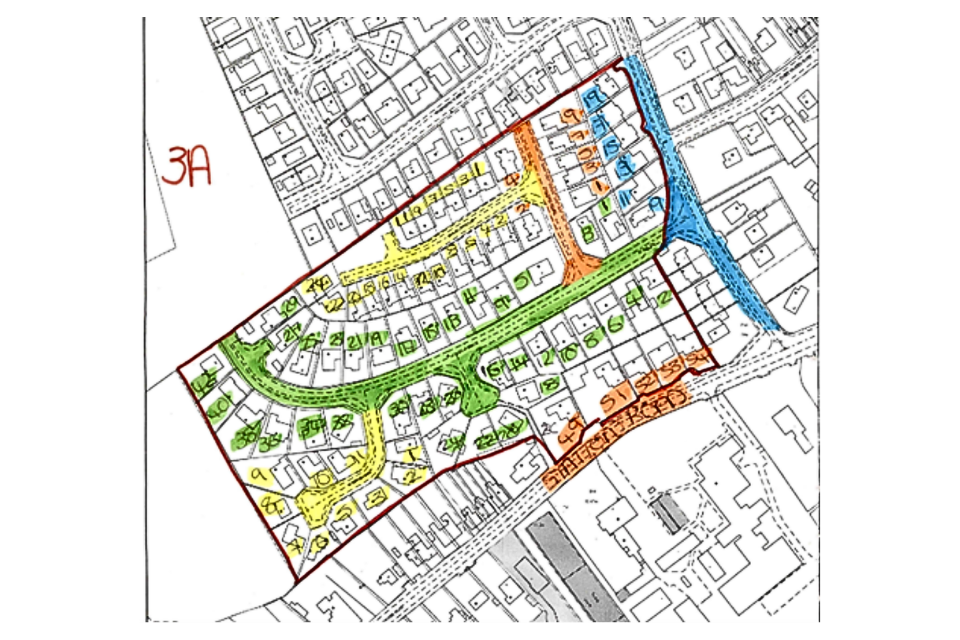
If you are looking at plans it must match what your polygon looks like. If the capture is sensible and has snapped to the boundary that will pass. If the polygon is in the wrong location or does not match the local authority (LA) plan it will fail.
Lines
Unless the line is a valid line, this is an automatic fail.
Examples of correct lines are:
- electric lines
- water pipes
Points
Points will fail unless classified as a valid point.
Examples of valid points are:
- trees
- signs
- post boxes
- telegraph poles
- lamp post
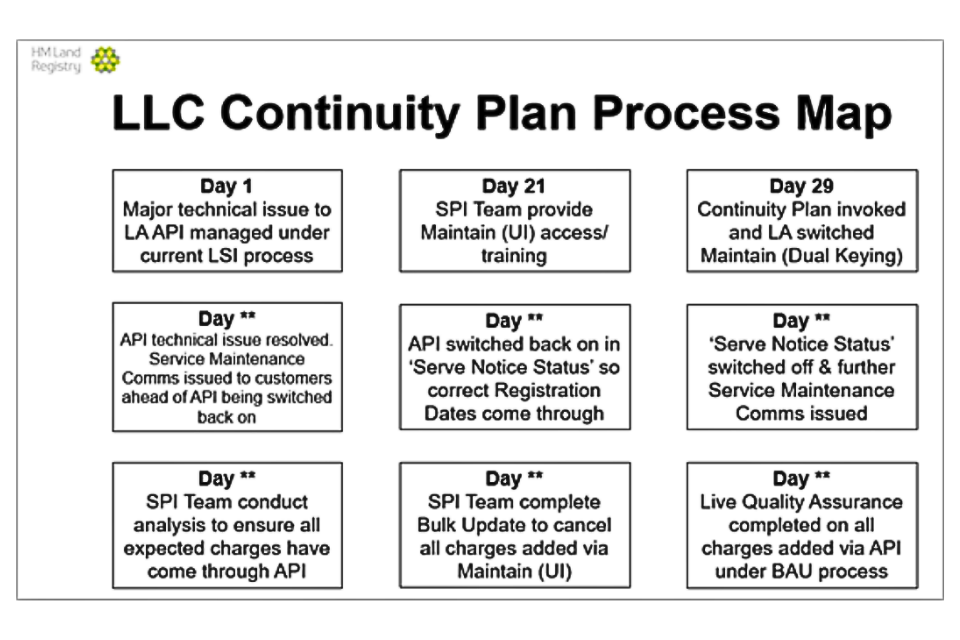
15. Live Service Major Technical Incident Management Process
Initial steps to take for local authorities (LA) and other originating authorities (OOA) when facing a major technical incident (day 1):
- First, identify whether the issue is related to the incumbent supplier or the API
- Consider if the LA/OOA can resolve issue immediately themselves.
- If it is a supplier issue, the LA/OOA must raise it with the incumbent supplier help desk and notify the HMLR Relationship Manager.
- If the issue is API related, the LA/OOA must raise it directly with the HMLR Relationship Manager and HMLR Service Desk (0300 006 0400) isservicedesk@landregistry.gov.uk.
If an identified issue relates to the incumbent supplier, the following must be considered:
- Can the incumbent suppler resolve the issue themselves in timely manner?
- If the incumbent supplier cannot resolve the issue, raise it with the HMLR Relationship Manager and HMLR Service Desk (0300 006 0400) isservicedesk@landregistry.gov.uk.
Steps taken by the Service Performance and Integration team (Day 1-xx)
- The issue is received by the Service Performance and Integration (SPI) team.
- The Relationship Manager gathers as much information as possible and records the issue on the live service issues log.
- The Relationship Manager notifies live service management of the major technical incident.
- Live service management will consider wider implications and await an update from the HMLR Service Desk if the LA/OOA have logged the issue.
- SPI team refers to the Tiger Team via standard processes.
- The Relationship Manager will manage the progress of the live service incident with an action plan and ensure engagement with all key stakeholders.
- Investigation and resolution activities are to be undertaken until the incident is resolved.
Example of LLC continuity plan following major technical incident:
16. Changes to register update method by local authorities in live service
During migration, local authorities (LA) choose their preferred method of updating the register in live service. This may be through an incumbent supplier Application Programming Interface (API), the Maintain Local Land Charges (LLC) user interface (UI), or a combination of both. After going live, an LA may decide to change how they update the register.
HM Land Registry (HMLR) may be notified of the proposed changed by a number of parties, including the LA, the existing incumbent supplier, the incoming incumbent supplier or another relevant party.
If a change is agreed, a meeting will be arranged to:
- establish the timelines of the change.
- confirm there is a project plan in place.
- agree who will act the project manager and who is responsible for the activities outlined in the project plan.
- check whether contracts been signed.
- identify any immediate requirements from HMLR.
-
set out the required actions moving forward.
- Once the LA and incumbent supplier have signed a contract, HMLR will arrange a further meeting with the LA and supplier to discuss next steps. Actions may include:
- confirming that previously agreed timescales remain in scope.
- assigning actions and lead activities at the meeting where possible.
- agreeing timeframes for actions to be completed.
- confirming proposed timeframes for providing data extracts.
The process will then continue as follows:
- the developer team provides an initial data extract in line with the plan
- the LA stops adding charges to the current system on an agreed date.
- the existing API is to be disabled with the supplier.
- a final data extract is supplied; requiring input from HMLR Betamax team and TDM.
- the LA/supplier provides a final extract for quality assurance within the agreed timeframe.
- the SPI team provides a JSON web token.
- the API will be switched on as scheduled, and executed with time allowed for any errors that may arise.
- the LA goes live with new system/API connection.
- live service conducts early live support checks.
- the SPI team returns to business as usual once checks are completed and any errors resolved.
17. Service updates
Recent and historic live service updates are published on GOV.UK. This page is refreshed whenever service updates are distributed by email, to ensure you always have access to the latest information in one place.
18. Jargon explained
| JARGON | Description |
|---|---|
| Agile | A method of project management that uses collaborative efforts to evolve solutions which achieve its goals. |
| AO | Authority obligations |
| API | Application Programming Interface (often used in relation to the Maintain service) |
| BA | Business analyst |
| BAU | Business as usual |
| CIL | Community Infrastructure Levy |
| COPSO | Council of Property Search Organisations |
| CST | Chief Secretary to the Treasury |
| D&T | Digitisation and transformation |
| DAD | Data analysis dashboard |
| DM | Delivery Manager |
| DP | Data protection |
| DPIA | Data Protection Impact Assessment |
| DPO | Data Protection Officer |
| DPS | Departmental Security Officer |
| DRO | Departmental Record Officer |
| E2E | End to end |
| ED&I | Equality, diversity and inclusion |
| EE | Early engagement |
| EIR | Environmental Information Regulations 2004 |
| ESC | External services cell |
| EXB | HMLR Executive Board |
| FOI | Freedom of Information |
| FTP | File transfer protocol |
| FY | Financial year |
| FY Q1 | April, May, and June |
| FY Q2 | July, August, and September |
| FY Q3 | October, November, and December |
| FY Q4 | January, February, and March |
| GDPR | General Data Protection Regulation |
| GIS | Geographic Information System |
| GMPP | Government Major Projects Portfolio |
| GUI | Graphical User Interface (often used in relation to the Maintain service) |
| HO | Handover |
| IA | Impact assessment |
| IAAP | Independent assurance and approval plan |
| IAO | Information Asset Owner |
| IAR | Information Asset Register |
| ICFC | Investment, Commercial and Finance Committee |
| ICO | Information Commissioner’s Office |
| IPA | Infrastructure & Projects Authority |
| KIM | Knowledge and Information Management |
| KPI | Key performance indicator |
| LDPG | Local digitisation practice guide |
| LEPs | Local enterprise partnerships |
| LLC entry | A charge entered in an LLC Register that continues to exist as a charge |
| LON | Light obstruction notice |
| LPI | Land and Property Identifiers |
| MAP | Migration Assurance Process |
| MI | Management Information |
| Microfiche | A flat piece of film containing microphotographs of pages from a newspaper, catalogue, or other document |
| MPM | Managing public money |
| MSDP | Migration Services Delivery Partners |
| NLIS | National Land Information Service |
| NSG | National Street Gazetteer |
| OAs | Originating authorities |
| OCG | Organised criminal gangs |
| OGD | Other government departments |
| ONS | Office for National Statistics |
| OOA | Other originating authority |
| PAI | Positional accuracy improvement |
| PAON | Primary addressable objects name |
| PD | Programme Director |
| PIA | Privacy Impact Assessment |
| PM | Programme or Project Manager |
| PMO | Project Management Office |
| POAP | Programme plan on a page |
| PPM | Portfolio Project Management |
| PQ | Parliamentary questions |
| PSC | Personal search company |
| RAG | Red, amber, green |
| SAF | Spend approval form |
| SAON | Secondary addressable objects name |
| SAR | Subject access request |
| SIM | Search of the Index Map |
| SLA | Service level agreement |
| SME | Subject matter expert |
| SOP | Standard operating procedure |
| SR | Spending review |
| SRA | Solicitors Regulation Authority |
| SRO | Senior Responsible Officer |
| TAP (HMT) | Treasury approval point (HM Treasury) |
| TD | Transformation Directorate |
| UPRN | Unique property reference number |
| USRN | Unique street reference number |
| NLP | Natural language processing |
| PII | Personal identifiable information |
Suppliers
| JARGON | Description |
|---|---|
| Acolaid | Idox product - legacy application for which there will be no API Integration |
| Agile/IEG4 | An Incumbent Supplier |
| API | Application Programming Interface - this is what the incumbents build to enable the LA system to interface to the Maintain Service API |
| APP | Civica product |
| Arcus Global | An Incumbent Supplier |
| Assure | NEC (Northgate) product |
| CCN | Contact change note - where a change is required to the contact/MSA between HMLR and the supplier |
| Data import | A service provided by the Incumbent Suppler, typically loading transformed data into a local authority’s environment |
| DE | Data extract/data extraction |
| DEF Software | An Incumbent Supplier |
| DEIS | Data exchange and integration strategy |
| DP | Data protection |
| DPIA | Data protection impact assessment |
| FastCharges | Civica product (not covered by development agreement) |
| IDOX | An Incumbent Supplier |
| IDOX Cloud | IDOX product (previously Tascomi) |
| ILAP | Northgate Product |
| JWT | Json web token – used to validate payloads being sent to API |
| LA incumbent | Software suppliers who are delivering solutions/services to LAs |
| M3 | Northgate product |
| MSA | Master Service Agreement |
| MSDP | Migration Services Delivery Partner |
| MSS | Migration Services Supplier (used interchangeably with MSDP) |
| NEC | An Incumbent Supplier |
| Northgate | An Incumbent Supplier now known as NEC |
| Order Form | Form to raise order with Idox/NEC |
| PDM | Performance and delivery management meeting |
| PO | Purchase order |
| Proforma | IDOX form to LAs which outlines the requirements of HMLR to manually extract data from the LAs that use Acolaid for development control, land charges, tree preservation orders and historic environment listing details |
| SFTP | Secure file transfer protocol |
| SOW | Statement of work- to raise an order with IEG4, DEF,Arcus |
| Swiftsearch | Agile Applications product |
| TLC | IDOX product |
| TOR | Terms of Reference (ODXO Internal LA Form) |
| Uniform | IDOX product |
Stakeholders
| STAKEHOLDER | FULL NAMES |
|---|---|
| BEIS | Department for Business, Energy and Industrial Strategy |
| DPMSG | Digital Property Market Steering Group - a coalition of government and industry partners founded in 2023 to help the property market work better for all by accelerating the adoption of digital technology, while ensuring it is transparent, secure and consumer friendly, through collaboration and innovation across the sector. |
| Founding members: Law Society, Conveyancing Association (CA), Council for Licensed Conveyancers, The Society of Licensed Conveyancers, Solicitors Regulation Authority, Royal Institution of Chartered Surveyors, Chartered Institute of Legal Executives (CILEX), CILEx Regulation, Council of Property Search Organisations, Propertymark, Building Societies Association, UK Finance, and HM Land Registry. | |
| GSC | Geospatial Commission |
| GCS | Government Communication Service |
| GDS | Government Digital Service |
| HMT | HM Treasury |
| LAs | Local authorities |
| LGA | Local Government Association |
| MHCLG | Ministry of Housing, Communities and Local Government |
| TPO | Transformation Portfolio Office or tree preservation order |
| UKGI | UK Government Investments Limited |
| WLGA | Welsh Local Government Association |
Ad hoc
| JARGON | Description |
|---|---|
| AddressBase | Ordnance Survey’s dataset of addressable properties |
| (the) legal document | The document or other instrument which comprises the charge or in connection with which the charge came into existence. |
| (the) Local Land Charges Rules 2018 | The secondary legislation that will replace the current LLC Rules 1977 for the relevant LA area when the Chief Land Registrar assumes the LLC function for that area. |
| Basic Land and Property Unit | Defined in the BS 7666 address standard part 2, as an area of land in uniform property rights or, in the absence of such ownership evidence or where required for administration purposes, inferred from physical features, occupation or use. Each BLPU has a unique property reference number (UPRN), a spatial reference and one or more land and property identifiers (LPI). |
| BLPU | Basic Land and Property Unit - defined in the BS 7666 address standard part 2, as an area of land in uniform property rights or, in the absence of such ownership evidence or where required for administration purposes, inferred from physical features, occupation or use. |
| BS 7666 | Specifies a standard format for holding details on every property and street. The standard does not differentiate between commercial or residential properties, between occupied, developed or vacant land, between urban or rural or between postally addressable properties and non-postally addressable entities such as communications masts. Similarly, it does not differentiate between publicly or privately maintained streets. |
| Business Change team | A set of people responsible for supporting the business process change required in LAs and other originating authorities so they can undertake the necessary activities to keep the LLC Register up to date once the new HMLR service is live. It is also responsible for the change required within HMLR to ensure it can support users of the live service. |
| Business e-Services | Also known as the HMLR portal is a secure website for our professional customers to access Business e-services that is available from 6.30am to 11pm every day. |
| Business Gateway | Customers who are professional users can also apply to access services using Business Gateway. This will allow you to access services automatically from a case management system as a B2B link. This channel is often used by high-volume customers. |
| Code Lists/registers | A single, authoritative register, or directory, of specific information, which is open, available and maintained by a designated custodian, which may be used to populate specific attributes within the LLC Register service. |
| Collaboration Agreement | A document describing how HMLR and a LA will work together on the transfer of the LLC Register from the authority to HMLR in terms of (i) objectives, (ii) collaboration, (iii) governance (iv) roles and responsibilities (v) data sharing and (vi) licensing. |
| Community Infrastructure Levy | A planning charge introduced by the Planning Act 2008 as a tool for LAs in England and Wales to help deliver infrastructure to support the development of their area. |
| CON29 | A form of enquiries devised by the Law Society used to make further enquiries of the council on non-LLC matters containing 64 components. Also known to form part of a full search or LA search in conjunction with the LLC1 search. |
| CON29M / CON29DW | Mining / drainage and water searches: CON29M is submitted to the Coal Authority; CON29DW goes to the relevant water and sewerage undertaker for the property. |
| CON29R/CON29O | Required and optional questions, forming part of the CON29 search – also submitted to the relevant LA. |
| Conceptual consistency | Measurement of adherence to/compliance with conceptual schema. If the conceptual schema explicitly describes rule, these rules shall be followed. Violations against the rules can be for example, invalid placement of features (geometries) within a defined tolerance, duplication of features and invalid overlap of features. |
| Conceptual data model | A high level or coarse data model to describe data within a business area of interest (for example I am interested in LLC administrative and environmental data; and the datasets. |
| Conceptual schema | Rules and relationships defined by the UML data model. |
| Consultations | The formal process for public consultation that was undertaken on the primary legislation changes and on The LLC Rules 2018. |
| Data assessment | An assessment of LA data to gain a better understanding of readiness and ability to meet the requirements of migration. |
| Data Capture & Management Team – Data Group | Responsible for creating and maintaining LLC data specification, creating and delivering the Quality Assurance (QA) Gateway 2 Formative data assessment of LA data and HMLR business rules, carrying out comparison of search results delivered within each migrated LA and the same searches completed using the HMLR service, feedback to LAs and digitisation and transformation supplier to drive continual improvement. |
| Data capture suppliers | As part of the overall migration, HMLR requires a DCS to provide data capture services for those LAs that hold some or all of their LLC Registers in physical formats such as paper or microfiche. DCS will scan an individual LA’s LLC documents to enable them to be migrated to the HMLR LLC Register to subsequently be processed by digitisation and transformation suppliers. |
| Data cleansing | An internal process within a LA to ensure that an LLC Register is complete and accurate (regardless of data format). |
| Data extract (DE) supplier(s) | Supplier who provides data extract services for data held in LA LLC Registers. The DE supplier will provide copies of the relevant LA’s LLC data to enable its migration to the HMLR LLC Register. |
| Data preparation and extraction | Preparation of data within a LA to ensure it is fit for the process of digitisation; (for example converting the data into the required format to hand over to HMLR’s digitisation and transformation supplier(s)). |
| Data relationship document(s) | A simple abstraction to describe business data and the third-party data used as part of the data creation or capture process. Can be a simple diagram or a matrix depending upon preference. A diagram is good for simple relationships whilst a matrix can be useful to describe more detailed relationships between features. |
| Digital local authority | A LA where the LLC data is held as structured data items that reside in fixed fields within a record. These items can be extracted by machine without human intervention or the need for software to recognise the items as they are always held in a pre-defined place (for example a spatial database with map layers that holds associated charge data in a relational database structure). |
| Digital practice guide (DPG) | Guidance to define the overall approach to digitisation and transformation of spatial and textual data for migration of the LLC Register from LAs to HMLR. |
| Digitisation | The process of converting non-digital records into a digital form. |
| Digitisation and transformation supplier(s) | The process of converting non-digital records into a digital form and (where required) converting digital records in to the format that is required to enable the data to be imported into the new HMLR LLC Register. |
| Digitisation and transformation supplier(s) | The digitisation and transformation supplier(s) will work as part of the programme to ensure the digitisation of 326 LA LLC registers for migration to a single HMLR LLC Register in accordance with the LLC data standard and strategy. |
| Dip sampling | Testing of a statistically significant sample of records, one record at a time. The sampling methodology will align with the ISO 19157 standard. |
| Domain consistency | Attribute values must fall within certain range or assume only certain pre-defined values. The domain describes the values that must be entered for that attribute, the domain is a list (described in the feature catalogue), a code list (referenced in the feature catalogue), or an enumeration list (referenced in the feature catalogue). |
| Electronic local authority | A LA where the LLC data is held in an electronic form. This category includes LLC data held in Word documents, scanned paper records, Excel spreadsheets and microfilm images (microfiche). Although held electronically, data items cannot be reliably extracted automatically by machine without either human intervention or the need for additional software to validate the nature of the item (for example optical character recognition). |
| Environmental Information Regulations 2004 (EIR 2004) | Regulations that implement the European Council directive on public access to environmental information in the UK. They require public authorities to proactively make available environmental information and entitle members of the public to request environmental information from public authorities. |
| Extraction | The process of providing records from the current system in a format which can be handed to the digitisation and transformation supplier(s), once prepared. |
| Features catalogue | A feature is an abstract of a business phenomenon or object. A features catalogue contains definitions / descriptions of features in a data set. The features catalogue makes the data descriptions in the logical data model more accessible to those less familiar with data models. |
| Garner’s LLC (14th edition), by J. E Boothroyd | the standard reference book on LLCs. |
| Geometry ID | A single line, point or polygon stored and displayed as part of the LLC Register service, reflecting the full or partial extent of a single LLC record, as defined by the local registering authority (where an existing LLC is digitised and transformed into the LLC Register service) or the originating authority (where a newly created LLC is registered in LLC Register service) . |
| Geometry ID | A unique reference associated to each land interest geometry for the entirety of its life cycle. |
| Go-live date | The date on which responsibility for LLC searches will be transferred from the LA to HMLR. |
| Go-live information pack | Documents LA readiness for go live providing a summary of critical information to inform decision to serve notice. |
| Government Digital Service | GDS is part of the Cabinet Office. Their job is digital transformation of government. They are a centre of excellence in digital, technology and data, collaborating with departments to help them with their own transformation. They work with them to build platforms, standards, and digital services. |
| Handover pack | Provides information regarding the transfer of a LA LLC register to HMLR’s centralised LLC Register and the support that will be available in live service. |
| Hosting service supplier | The provision of a cloud-based service on which to run the centralised digital HMLR LLC Register. |
| Hybrid local authority | A LA where the LLC data consists of a combination of both digital data and non-digital data (which is either in electronic or paper format). This split may apply to a single LLC record or to the full set of records. (For example, structured LLC data items associated with a paper map or digital map layers representing extents associated with charge data in a Word document or Excel spreadsheet.) This category must be used where any LA is using paper or electronic data, as part of the search process (even if this is a paper map on a wall), but not where they hold paper or electronic data purely for data validation purposes. |
| Import | The process of loading transformed records from the digitisation partner systems to the LLC Register service. |
| Inactive LLC entry (also known as deactive) | A charge remaining in an LLC Register that has been cancelled, or that has ceased to have effect or has ceased to be a charge. |
| Incumbent supplier(s) | The supplier who currently provides a digital service for data held in LA LLC registers. |
| Land and property identifiers | The LPI is the address of the BLPU in a standard format that uniquely identifies the BLPU in relation to a street as defined and held in the National Street Gazetteer (NSG). The principal components of the LPI are the UPRN from the BLPU, the Unique Street Reference Number (USRN) from the NSG and sufficient elements from the hierarchy of Primary and Secondary Addressable Objects (PAOs and SAOs) necessary to uniquely identify the BLPU. |
| Land description | Textual description of the land affected by the LLC as described by the local registering authority (where an existing LLC is digitised and transformed into the LLC Register service) or the OA (where the newly created LLC is registered in LLC Register service). |
| Large scale Ordnance Survey map | Ordnance Survey map produced at 1/1250 or 1/2500 scale. |
| Light obstruction notice (LON) | Light obstruction notices, once registered, create notional obstructions to the access of light received by a building (‘dominant land’) over the land of another (‘servient land’). If not challenged successfully within strict time limits, the dominant landowner may lose an existing right of light. |
| LLC entry | A charge entered in an LLC Register that continues to exist as a charge. |
| LLC entry | The particulars of registration for a local land charge entered in an LLC register containing details such as a description of the charge, the originating authority, the place where relevant documents may be inspected and the date of registration. |
| LLC record | The location where a charge entry or entries is/are noted, which has a unique reference. A non-digital LA (paper) may have 10,000 LLC records which consist of index cards where each card holds one or more charge entries, referenced by individual addresses. A digital authority or a non-digital authority (electronic) may have a polygon or Word document that contains reference to one or more charge entries relating to a Unique Property Reference Number (UPRN). |
| LLC register part | The part of the register as defined in LLC Rules 1977 rule 3 from which the LLC was migrated – this attribute is only populated for digitised/transformed records. |
| LLC Register service | The LLC Register is to be kept by the Chief Land Registrar of each LLC entered in an LLC register before the registrar assumed the LLC function for that LA area and of each LLC subsequently registered for land in that area. The new LLC Register will be a single, digital register. The LLC Register service provides a new centralised, digital LLC Register that is available to the end user. HMLR will create a centralised, digital LLC Register, comprising: A spatial database for storing LLC extents and attributes including associated text; A user interface for applying to register, vary or cancel charges and Application programming interfaces (APIs) for applying to register, vary or cancel charges. |
| LLC registers | The LLC registers kept for each LA area contain the particulars of registration for each LLC entry and identify the extent of the land affected by each charge. |
| LLC1 form | Search form used to provide applicants with details of entries on the LLC register in respect of the property(s) being searched in local authority areas that have not yet transferred to HMLR. An LLC1 search can be carried out in respect of all parts of the LLC register, or just single parts. |
| Local business rules | A document created by HMLR detailing agreed modifications to the LA data that will be applied during digitisation and transformation to meet HMLR specification. |
| Local digitisation practice guide | Guidance to define specific business rules for digitisation and transformation of spatial and textual data that apply to an individual local authority. |
| Local Government Association | The national voice of local government, working with councils to support, promote and improve local government. |
| Local Land Charges Institute | The nationally recognised representative body for LLCs. |
| Logical data model | A detailed representation of an organisation’s data and the relationships between that data, independent of any technology, described in business language. |
| Migration authority | The process of transferring the data included in the current LLC Registers held by the 326 English local authorities to HMLR’s LLC Register Service. |
| Migration authority | The name of the LA from which the LLC was migrated; one per LLC – this attribute is only populated for digitised/transformed records. |
| Mobilisation plan | Plan to be developed by the successful digitisation and transformation suppliers, to ensure that they are adequately resourced and have processes in place to undertake the work on their relevant ‘lots’, in line with the agreed migration approach. |
| Multiplicity | Represents the number of times the specified attribute can legitimately be entered against each individual LLC. |
| National Land Information Service | NLIS is a government initiative encouraging LAs to modernise systems to deliver LLC searches electronically. NLIS provides ready-made internet-based infrastructure that allows LAs search requests to be submitted and responded to online. |
| New burdens | The key definition of a new burden is a change in activity which generates net additional cost that could lead to an increase in council tax if it were not additionally funded by central Government. |
| Notice period | Under paragraph 40 of Schedule 5 to the Infrastructure Act 2015 the date on and after which Parts 1 and 3 to Schedule 5 will have effect in relation to the area of that local authority and on and after which the Chief Land Registrar will assume the statutory LLC function for that LA. |
| Originating authority (OA) | The body by whom the charge is brought into existence or by whom it is enforceable in coming into existence. The OA is most often a LA but there are many other non-LA OAs. |
| Paper local authority | A LA where the LLC data is held in a non-digital or paper format. This category includes paper documents, index cards and any record that must be physically inspected. |
| Particulars of registration | The particulars that must be entered in the LLC Register in relation to the type of charge concerned (for example description of the charge, the OA, the place where relevant documents may be inspected and the date of registration). |
| Personal search company | The statutory right conferred by the Local Land Charges Act 1975 to search in an LLC register. |
| Personal search company | Company that carries out personal searches (usually alongside other conveyancing searches). Search results are generally provided to solicitors and other conveyancers that have requested the search company to carry out the search. |
| Private beta | The objective of the beta phase, as defined in the GDS Design Manual, https://www.gov.uk/service-manual/phases/beta.html “is to build a fully working prototype which you test with users. You’ll continuously improve on the prototype until it’s ready to go live, replacing or integrating with any existing services. A private beta is made available to a closed group of users to allow the service to develop prior to a publicly available beta.” |
| Product review and approval matrix | A document that highlights the level that a product should be reviewed and approved at. |
| Public beta | The objective of the beta phase, as defined in the GDS Design Manual, https://www.gov.uk/service-manual/phases/beta.html “is to build a fully working prototype which you test with users. You’ll continuously improve on the prototype until it’s ready to go live, replacing or integrating with any existing services. A public beta is made open to everyone. It can exist alongside an existing version of the service.” |
| Pugsley | The reference book on CON29. |
| Quality assurance | The processes through which the LLC Programme will assure itself, LAs and other stakeholders that: all data is migrated to the new HMLR LLC Register and to the appropriate quality level; LA LLCs meet the requirements of the LLC Rules 2018 at QA Gate 1; Digitisation and transformation suppliers, data capture suppliers and data extraction suppliers deliver contractual requirements; suppliers meet the specification of data migration and the data meets the requirements of QA Gate 2; data quality in register is maintained at acceptable levels. |
| Quality requirements | Describes the extent to which a feature must conform to its specification to meet the corporate need. Data content described in the features catalogue; Conformance levels described by the acceptable quality level (AQL); Measures to describe how a record is classified - whether conforming or not (meaning passes or fails an audit). |
| Register service supplier / provider | The LLC Register service provider will be responsible for providing strategic guidance, technical skills, and resources to assist HMLR teams in delivering the LLC Register service. The LLC Register service provider will take the output from the alpha service delivery phase, and work with HMLR teams to complete the digital interface (API) and LLC Register for assessment to public beta stage. |
| Registering authority | The authority responsible for registering LLCs affecting land in their area. The registering authorities are currently LAs, but this will cease to be the case as responsibility for LLCs for LA areas incrementally transfers to HMLR. The Chief Land Registrar is now the registering authority for LAs whose data has been transferred to the LLC Register. |
| Rule 7 | Rule 7 of the Local Land Charges Rules 2018, which allows, where the particulars of a charge are entered in another statutory register, for registration of a charge by the entry in the LLC Register of a reference to the particulars contained in that other register (for example planning charges referenced in the LLC Register). |
| S106 agreement | 1977 |
| Statement of requirements | Document that details the programme requirements for the LLC supplier services in conjunction with any reference documentation. |
| Statutory provision | The act (local or national) and section of the act under which the charge is created and may be contained in a statutory instrument. For example, Section 106 Town & Country Planning Act 1990 (as amended). |
| Tactical comms grid | Document that tracks all communication requirements for the programme. |
| Test strategy | Document to describe the testing approach of LLC products and processes. |
| Transformation | The process of converting cleansed and quality checked records in digital form to a format that is required for the data to be able to be imported into the new LLC Register. |
| Tree preservation order | An order commonly abbreviated made by a local planning authority to protect specific trees, groups of trees or woodlands in the interests of amenity. |
| Unique Property Reference Number | The UPRN is the unique identifier for every spatial address in Great Britain. It provides a comprehensive, complete, consistent identifier throughout a property’s life cycle – from planning permission through to demolition. The UPRN contains no attribution or information (for example coordinate position) about the property, nor can information be derived from either the allocated number or the process by which it is allocated. |