
Forestry Commission annual report and accounts 2025 to 2026
Updated 30 September 2026
Applies to England

© Crown copyright 2026
This publication is licensed under the terms of the Open Government Licence v3.0 except where otherwise stated. To view this licence, visit nationalarchives.gov.uk/doc/open-government-licence/version/3 or write to the Information Policy Team, The National Archives, Kew, London TW9 4DU, or email: psi@nationalarchives.gov.uk.
Where we have identified any third party copyright information you will need to obtain permission from the copyright holders concerned.
This publication is available at https://www.gov.uk/government/publications/forestry-commission-annual-report-and-accounts-2025-to-2026/forestry-commission-annual-report-and-accounts-2025-to-2026
Overview
This performance report overview provides:
- the Chief Executive’s view on our performance over the past year
- information on our background, vision, strategic objectives, activities and resource
- a performance summary
Foreword by Barbara, Baroness Young of Old Scone, Chair
It is a privilege to introduce my first annual report and accounts as Chair of the Forestry Commission. Since joining earlier this year, I have been struck by the professionalism, depth of expertise and strong sense of public purpose. This report reflects a year of solid delivery in a demanding environment for woods, trees and forestry and the wider public sector.
The Forestry Commission has continued to meet its statutory responsibilities and strategic objectives, with multifunctional woodland creation and stewardship at the centre of our work.
During the year, 5,250 hectares of new woodland were created, reflecting sustained delivery by Forest Services, Forestry England and our partners.
In working towards all our strategic objectives, we combine the direct role of Forestry England in managing the nation’s forests, the grant giving, regulation and outreach roles of Forest Services, all based on the excellent evidence of Forest Research. Together with our partners in the public and the private sector we delivered a wide range of public benefits, including biodiversity recovery, climate change reduction, timber production, health and wellbeing benefits and a strong contribution to growth, the economy and jobs.
Our people are central to this success. Colleagues received national recognition through the King’s Honours, while the inaugural Forestry Commission Awards celebrated excellence in leadership, innovation and technical capability. These achievements speak to the quality of expertise across the organisation and the commitment colleagues bring to their work every day.
We also strengthened our operational and scientific foundations. Forest Research achieved record commercial income, reflecting growing demand for robust evidence and innovation. Forestry England secured gold in its Visit England assessment, underlining the consistently high-quality experience provided to millions of visitors. Together, this progress reinforces the Forestry Commission’s role as a trusted, expert delivery body.
All of this has been delivered in a highly constrained financial environment. Like much of the public sector, the Forestry Commission faces sustained pressure to do more with fewer resources. Difficult choices have been required, with a clear focus on prioritisation and protecting frontline delivery. I have been impressed by the resilience and collaboration with which colleagues have responded, maintaining standards while adapting to constraint.
We have also taken steps to address longstanding pay challenges. Changes made this year will improve fairness and reduce inconsistencies, particularly around progression. While issues remain, this represents progress within the constraints of the wider government pay framework, which continues to limit flexibility in addressing market pressures and progression.
Climate change continues to present escalating risks, from wildfires and extreme weather to pests and diseases. Events this year again highlighted the professionalism of our response teams and the importance of long-term resilience planning. The increasing evidence of biodiversity loss reinforces the urgency of this work.
Productive forestry must also be better recognised within policy and delivery. Sustainable timber production is critical to carbon reduction, economic growth and resilience, and we will continue to work with Defra and partners to ensure its value is reflected in national strategies.
This year marks an important transition in our governance, with several new commissioners joining the board alongside my appointment as Chair. I would also like to thank Sir William Worsley for his leadership and lasting contribution.
As financial pressures intensify, it is vital that we communicate clearly and confidently the national value of woods, trees and forestry. The Forestry Commission is well placed to meet the challenges ahead and continue delivering in a complex and changing environment, and I thank colleagues across the organisation for their dedication and professionalism.
Purpose and activities of the organisation
Who we are
The Forestry Commission provides the government’s forestry expertise and is responsible for protecting, improving and expanding England’s woodlands, connecting more people with forests, woods and trees and promoting their full value. We are helping to meet society’s biggest challenges with thriving trees, woods and forests.
We are a non-ministerial government department with a royal charter, supported by two agencies: Forest Research and Forestry England. We are part of the wider Defra group of departments and agencies responsible for environmental protection, food production and standards, agriculture, fisheries and rural communities. Our work tangibly contributes to the delivery of Defra’s outcomes and the government’s priorities and missions.
The Forestry Commission and its agencies perform distinct but related and complementary functions. Together, we are responsible for:
- managing the nation’s forests
- protecting the health of trees from pests and diseases including work across Great Britain
- providing world-leading research and analysis
- promoting forestry training, forestry careers and sustainable forest management
- advising and supporting woodland owners and land managers including through grant
- regulating forestry in England
The core of the Forestry Commission comprises the Commissioners’ Office – responsible for supporting the Commission and both its agencies with work on parliamentary matters, open information, data protection and governance – and what is known internally as ‘Forest Services’.
Forest Services supports and regulates forestry in England and provides government’s forestry and woodland expertise. This is done by encouraging and supporting landowners and the sector to protect, improve, expand and connect people with England’s trees, woods and forests. This part of the Forestry Commission is also responsible for protecting tree health across Great Britain as part of the UK Plant Health Service by agreement with the Great Britain devolved administrations. Covering the whole of England (and Great Britain, for plant health matters), this resource is spread thinly with efficiency and innovation becoming increasingly important to our delivery as demand on Forest Services’ functions and expertise continues to grow. There are 526 (2024-25: 564) people in Forest Services.
Forestry England is an agency of the Forestry Commission and a public corporation which manages England’s beautiful, diverse and productive nations forests. It is the single largest land manager and provider of recreation in England, with over 254,000 hectares (2024-25: 254,000ha) and is the largest provider of home-grown sustainably produced timber in England, selling over 0.9 million tonnes per year (2024-25: over 1.1 million tonnes). This is one third of the English grown annual supply. There are more than 1,300 (2024-25: 1,300) people in Forestry England.
The nation’s forests are managed to balance multiple aims: carbon capture, flood prevention, providing a positive impact on our physical and mental health, looking after significant areas to conserve and improve biodiversity and contributing to the UK’s timber security. The natural capital benefits our forests and diverse landscapes bring to society as determined by the published Forestry England natural capital accounts 2024-25, have a net present value of £109.2 billion at 31 March 2025.
Forest Research is Great Britain’s principal organisation for forestry and tree related research and is internationally renowned for the provision of evidence and scientific services in support of sustainable forestry. The team operates across Great Britain by agreement with the devolved administrations. There are 434 (2024-25: 420) people in Forest Research.
Sustainability and climate
The Forestry Commission strategy sets out our support to meet the government commitment to achieve net zero and includes actions that support nature recovery, biodiversity, as well as actions specific to climate change adaptation. These priorities are interwoven with the positive impacts on people and the economy that our work leading sustainable forest management delivers. During 2025-26, the Forestry Commission assessed the implications of phase 3 of HM Treasury’s Task Force on Climate-related Financial Disclosure (TCFD) implementation requirements. The outcome of this assessment is set out in the TCFD section of this report.
Forestry England, (including on behalf of Forest Services and the Commissioner’s office), and Forest Research maintain environmental management systems (EMS) to deliver the organisation’s environmental policy and requirements of the ‘Greening Government Commitments’ (GGC). Our sustainability performance update for this year follows the GGC framework and is set out within the performance section of this report.
The Forestry Commission’s activities take place in rural and semi-rural environments. We seek to ensure that the impact of our activities supports UK environmental policy and the United Nations (UN) SDGs by balancing social, economic and environmental needs whilst supporting the transition to net zero in line with government policy.
The Forestry Commission published the Climate change adaptation fourth round report in January 2025. This comprehensive resource details which of the 61 priority risks and opportunities set out in the 2022 UK Climate Change Risk Assessment are relevant to Forestry alongside our mitigating actions.
The UN global goals
The UN sustainable development goals (SDGs) are a roadmap of 17 interlinked social, economic and environmental objectives to deliver global sustainable development by securing the rights and well-being of everyone on a healthy planet. The SDGs listed below and the following section shows how the Forestry Commission’s strategic goals support a number of the SDGs.
- No poverty.
- Zero hunger.
- Good health and wellbeing.
- Quality education.
- Gender equality.
- Clean water and sanitation.
- Affordable and clean energy.
- Decent work and economic growth.
- Industry, innovation and infrastructure.
- Reduced inequalities.
- Sustainable cities and communities.
- Responsible consumption and production.
- Climate action.
- Life below water.
- Life on land.
- Peace, justice and strong institutions.
- Partnership for the goals.
Our priorities
Our key strategic goals
- More trees, more diverse species, growing and thriving.
- Better managed woodland, protected and improving.
- Bigger benefits for nature, climate, people and the economy.
Delivery of our objectives 2025-26
This annual report summarises the performance of the Forestry Commission. Forest Research accounts are consolidated within this report and are also published separately. As a public corporation, Forestry England’s accounts are not consolidated. You can read all of our annual report and accounts. This section of the report provides an overview of the work of the Forestry Commission in 2025-26, against its 3 strategic goals.
Performance analysis
Read our complete range of key performance indicators for Forest Services.
Some key indicators are reported in this report; together they show our contribution to expanding, protecting, improving and connecting trees and woodlands in England. The indicators reflect our strong commitment to play our part in supporting the delivery of the government’s plans as set out in the Environment Act 2021 and Environment Improvement Plans published in 2023 and 2025. The indicators enable monitoring of our key aspirations to plant more trees and increase the area of woodland in England. They also help us monitor progress in bringing more woodlands into management and protecting our treescape from pests and diseases.
During 2025-26, delivery of the Forestry Commission’s objectives was characterised by 3 key themes:
- continued expansion of woodland creation and grant-supported activity
- strengthening of operational delivery capacity and workforce capability
- increasing pressure from climate change, biosecurity risks, and wider fiscal constraints
These themes are reflected across delivery during the year, with woodland creation, operational capability and environmental resilience forming the core areas of performance reported below. The organisation maintained a strong focus on delivery against its statutory responsibilities and government priorities, while adapting to a more constrained and complex operating environment. This delivery performance is reflected in the financial results for the year, as set out in the financial review.
Current tree pests and pathogens
Eight-toothed spruce bark beetle (Ips typographus)
Ips typographus is a destructive pest that affects spruce and some other conifer trees. If unchecked, this pest poses a serious risk to UK’s spruce-based forestry and timber industries. This pest is under official control (eradication).
Sweet chestnut blight (Cryphonectria parasitica)
Sweet chestnut blight is a destructive disease of sweet chestnut trees caused by the fungus Cryphonectria parasitica. Since 2011, the disease has been found at a small number of sites in England, which are subject to statutory control measures. This pathogen is under official control (eradication and containment).
Oak processionary moth (Thaumetopoea processionea)
The oak processionary moth (OPM) was first identified in London in 2006, and has since spread to some surrounding counties in south east England. The caterpillars of OPM infest oak trees, eating their leaves and weakening the tree making it vulnerable to other threats. OPM are also a hazard to human and animal health as their hairs can cause itchy rashes, eye and throat irritations. This pest is under official control (eradication and containment).
Ash dieback (Hymenoscyphus fraxineus)
Ash dieback is present in most parts of the United Kingdom and continues to spread. Forestry Commission provides guidance, advice and support to landowners including via the tree health pilot.
Ramorum Disease (Phytophthora ramorum)
Phytophthora ramorum is a highly destructive, algae-like organism which has been found in most regions of the United Kingdom, but it is more often reported in wetter, western regions. This pathogen affects a range of plant species, with its most significant impact being on larch populations. This pathogen is under official control (eradication and containment).
More trees, more diverse species, growing and thriving
This year we have built on the increased rate of tree planting seen in 2024-25, when 7,164ha of new tree planting was undertaken in England. Of this, 5,765ha was woodland creation (the establishment of new woodland areas) and 1,399ha was planting outside woodland (including trees in landscapes such as farmland, urban settings and along rivers).
In 2025-26, overall tree planting activity continued and was 6,386ha, reflecting both continued woodland creation and planting outside woodland.
Woodland creation accounted for 5,250ha of this activity in 2025-26 (2024-25: 5,765ha). Overall whilst significant effort has been made, the delivery trajectory of 7,500ha per year by 2025 is not yet being met, as identified in the National Audit Office’s March 2026 report on the Nature for Climate Fund programme. That report recognised the significant increase in woodland creation achieved, while highlighting the ongoing challenge of sustaining and further scaling delivery to meet longer-term targets.
The England Woodland Creation Offer (EWCO) remained the primary delivery mechanism contributing 2,364ha of new woodland in 2025-26 (2024-25: 2,098ha). A total of 3,123 EWCO agreements were issued, with the Woodland Creation Fast Track programme processing 92% of offers within 12 weeks against a target of 80%.
The future pipeline was also strengthened with over 11,456ha of prospective planting identified through new leads. Delivery is expected to continue to increase, supported by a strong pipeline of identified planting opportunities, ongoing investment in delivery capacity and continued engagement with landowners and delivery partners. Sustained progress will be required to meet longer-term woodland creation ambitions.
Public access agreements increased significantly during the year, with 129 agreements in 2025-26 compared to 44 in 2024-25, reflecting continued demand for accessible woodland creation.
Environmental outcomes remained broadly positive with 48% of applications contributing to water quality objectives against a 50% target. Applications relating to flood risk mitigation reached 21% against a 30% target. This reflects changes to eligibility criteria introduced in 2024-25 which reduced the available area for intervention.
The Tree Production Innovation Fund delivered to plan, with round 4 opening in April and with all year-end claims for 2024-25 completed. This reflects consistent engagement with sector partners and a developing pipeline of innovation activity.
Seed Sourcing Grant delivery progressed, with all 13 end of year claims completed and round 4 performing as expected. This steady progress is helping to strengthen the seed supply chain and enhance resilience in domestic tree production.
Tree Production Capital Grant (TPCG) exceeded expected levels. We processed 67 TPCG applications in 2025-26 (higher than any other round to date) and awarded 34 agreements valued at £1.93 million, with all prior year claims paid. Preparations for the next round are underway, indicating continued demand from the sector.
Forestry England’s woodland creation programme continued to expand, with land acquisitions totalling 1,012ha across 11 sites, exceeding the target of 900ha. This provides additional capacity to support future planting. 735ha of new woodland were planted by 31 March 2026, and 764ha completed by the end of the 2025-26 planting season, exceeding the year’s target of 746ha.
Recruitment activity remained strong, with apprenticeships continuing to be significantly oversubscribed. Approximately 90% of Development Woodland Officers are progressing through training as expected, above the national average completion rate of around 70% for degree-level apprenticeships. The programme continues to attract a broad range of applicants, including from non-governmental organisations and private sector employers. Demand remains high with the forthcoming cohort attracting approximately 100 applications for each position, demonstrating continued interest in forestry careers. This strengthening of workforce capability supports increased delivery across woodland creation and associated programmes.
Performance risk: ambitious tree targets
There is a risk that the scale and pace of woodland expansion required to meet the statutory 2050 canopy target of at least 16.5% is not achieved. Long‑term economic incentives remain insufficient to secure sustained landowner investment, alongside constrained workforce capacity and variable engagement. Progress is further limited by opposition to land use change and the need to balance woodland creation with food production, nature recovery, infrastructure projects etc. If these constraints persist, planting rates will remain below those required, undermining delivery of statutory commitments and wider climate objectives.
New planting of woodland in England
| 2021-22 | 2,255ha |
| 2022-23 | 3,128ha |
| 2023-24 | 4,554ha |
| 2024-25 | 5,765ha |
| 2025-26 | 5,250ha |
Better managed woodland, protected and improving
Regulatory activity remained high during the year, reflecting increasing demand across enforcement, plant health and environmental protection functions. Demand for woodland management planning also remained strong. We reviewed 713 woodland management plans, 69% of which were processed within the 35-day service standard. Whilst this is below the expected level, it reflects increased demand and volume or wider regulatory activity.
The proportion of woodland in England that is sustainably managed remains at 57% (2024-25: 57%), with levels broadly unchanged in recent years. This indicates the ongoing challenge of increasing active management in line with the ambitions set out in the Environmental Improvement Plan (EIP) 2025.
The number of pest and disease risks remains significant. Over the longer term, 3 additional tree pests and diseases became established in England in the 2016-25 10-year period, consistent with the previous 10-year period. There are now 419 pests identified as tree risks on the UK Plant Health Risk Register, 14 (3%) of which are considered high priority as at 31 March 2026.
The number of pest and disease outbreaks under active management remained stable, with 3 outbreaks as at 31 March 2026, consistent with recent years.
Regulatory compliance remains high, with unauthorised felling representing 0.10% (2024-25: 0.20%) of known activity (without a Forestry Commission granted felling licence) in the year to 31 March 2026. During the year, 52 cases of illegal felling were investigated.
Achieving government objectives for net zero, nature recovery, economic growth and biodiversity requires an increase in the area of woodland under active management. The Forestry Commission’s Woodlands into Management Forestry Innovation Fund continued to support the development and testing of approaches to improve woodland condition, resilience and levels of active management. However, woodland management remains less economically viable than alternative land uses for many land managers, which continues to act as a constraint on progress.
Forest Research launched their ‘Sustaining Ambition’ 5-year strategy in 2025-26 aligned to the Forestry Commission Strategy and Defra outcomes framework. They are working with the Forestry Commission, Defra and the devolved administrations to refresh the science and innovation strategy (SIS), ensuring the maintenance of our core capability and that future science is customer- and stakeholder-focused and appropriately funded.
Forest Research continues to deliver their core programme work alongside project activities and outbreak response capabilities. Forest Research continues to provide consistent, authoritative and transparent data that supports policy development, operational planning, and sector wide decision making through key publications such as ‘Forestry facts and figures’ and ‘Timber price indices’.
The Forestry Commission has also joined the Catchment Sensitive Farming partnership, strengthening cross-sector collaboration and enhancing its role in integrated land and water management, supporting improved water quality, soil health and reduced flood risk.
These regulatory and management activities are supported by evidence and analysis provided by Forest Research. Work is underway to review and refresh the SIS for forestry in Great Britain, which sets the framework for forestry research and evidence across England, Scotland and Wales. Progress during the year included engagement with partners across government to identify priorities and inform the development of the next phase of the strategy, which is expected to be published in 2026.
Forestry facts and figures and Timber Price Indices were published during the year, providing consistent, authoritative and transparent data to support policy development, regulatory decision-making and operational planning across the sector
Performance risk: our changing climate
There is a risk that accelerating climate change and biosecurity threats undermine the resilience of England’s trees and woodlands. This would limit their ability to deliver carbon sequestration, biodiversity recovery, sustainable timber and wider public benefit. The increasing frequency and severity of extreme weather, pests and diseases may exceed national response capacity, leading to widespread tree loss across public and private woodlands. This would result in significant economic and natural capital damage, alongside long‑term reputational harm. Managing this risk requires sustained mitigation and adaptation, working with Defra and partners through the UK Plant Health Service.
Proportion of woodland in England sustainably managed
| 2020 | 59% |
| 2021 | 58-59% |
| 2022 | 58% |
| 2023 | 58% |
| 2024 | 58% |
| 2025 | 57% |
| 2026 | 57% |
Bigger benefits for nature, climate, people and the economy
The Forestry Commission continues to promote a natural capital approach, recognising the economic, environmental, and social value of trees, woods and forests. The forestry sector in England contributes approximately £711 million in gross value added (GVA) in 2024 (2023: £603 million) based on external economic estimates, demonstrating its role in supporting economic growth and wider public benefit. This reflects growth in sector activity and market conditions during the year and supports the Forestry Commission’s objective of delivering greater economic benefit from trees, woods and forests.
GVA is a measure of the economic value generated by goods and services produced within the sector, including timber production, land management and associated supply chains. This highlights the sector’s contribution to the economy alongside its wider environmental and social benefits.
Programmes to improve access, health outcomes and environmental resilience continue to contribute to broader government objectives, including those set out in the EIP.
The Forestry Commission continues to improve the connection between people and trees and woodlands by increasing the quantity, quality and permanence of access to woodland. This supports EIP commitments to improve access to nature and reduce physical and social barriers. In 2024-25, 30% of adults in England visited a woodland or forest, consistent with recent years.
Forestry England sites received an estimated 326 million visitors over the year, demonstrating the continued importance of the public forest estate as a national asset for recreation and wellbeing. Participation has broadened through targeted access and inclusion initiatives, with the proportion of visitors from ethnic minority backgrounds and those with a disability exceeding national population benchmarks based on 2021 census data.
Delivery of the Woodland Water Code has progressed in line with planned programme milestones, with key methodological components and mapping tools now established. Draft methods and rules, together with calculators for water quality, water flow and water temperature, have been developed and tested. Two steering groups were convened during the year, reflecting strong cross-sector collaboration and the development of a robust, science-based framework. The Forestry Commission has completed its planned role, and responsibility now sits with Defra to determine next steps and take the programme forward.
Work continues with Defra to determine the future implementation of the code, including its potential role in enabling private investment to support water-related environmental benefits from woodland creation.
The Grey squirrel policy statement was published on 29 January 2026, setting out government actions over the next 5 years to manage the impacts of grey squirrels. This was followed by the Deer impacts policy statement for England, published on 20 February 2026, which sets out a long-term framework to reduce the impacts of wild deer on environmental, social and economic objectives.
Volunteering continues to make a significant contribution to delivery. A total of 266,291 volunteering hours were recorded during the year, exceeding the target of 210,000 hours. In addition, 12,703 hours of unpaid work were contributed, exceeding the target of 9,000 hours. Improvements to reporting processes are underway and are expected to provide a more complete picture of the contribution made by volunteers across the forestry sector.
The Confederation of Forest Industries award winning Trees to Timber campaign launched in March 2025, supported public engagement by raising awareness of UK-grown timber, sector innovation and opportunities for woodland creation and management. This forms part of wider efforts to improve understanding of forestry’s role in delivering economic and environmental outcomes.
Performance risk: inability to demonstrate and sustain the full social and economic value of forestry
There is a risk that the Forestry Commission is unable to consistently demonstrate, sustain and scale the social, economic and wellbeing value delivered by trees, woods and forests. Rising demand for access, increasing reliance on natural capital and private finance mechanisms and uncertainty over future public funding place pressure on infrastructure, evidence and governance. If benefits are not clearly evidenced and sustained, opportunities to improve public health, attract private investment and maintain long‑term public and policy support for forestry may be reduced.
GVA from domestic forestry
| 2020 | £582 million |
| 2021 | £534 million |
| 2022 | £685 million |
| 2023 | £603 million |
| 2024 | £711 million |
Note: The GVA from domestic forestry in England statistics have been revised by the Office for National Statistics since last issue.
Rooted in results: Forestry Commission performance
- 5,250ha of new planting of woodland in England in 2025-26
- 733ha of new planting of woodland supported by Forestry England in 2025-26
- 0.10% proportion of known tree felling in England carried out without Forestry Commission approval
- £109.2 billion total natural capital value of the nation’s forests
- 326 million number of visits per annum to the nation’s forests managed by Forestry England
- £711 million GVA added of the forestry sector to the economy in England in 2024
- 3 additional tree pests and diseases becoming established in the 2016-25 year period
- 92% Woodland Creation Fast Track offers processed within 3 weeks
- 11,456ha prospective planting added to pipeline
- 129 public access agreements
- 48% EWCO agreements contributing to water quality
- 21% EWCO agreements contributing to countering flood risk
Alleged illegal felling (AIF)
The following are not key performance indicators; however, we do track and report on the number of AIF cases for the year:
Reports of alleged illegal felling figures continue their trend of rising in England, although as a proportion of legal felling activity they remain extremely low. While the absolute numbers of alleged illegal felling reports continue their upward trend, it is unclear whether this is a result of additional illegal activity, or whether tree felling controls have become more well known among the public owing potentially to high profile cases such as Sycamore Gap, or Plymouth and Sheffield City street trees which result in more reports being made to the Forestry Commission.
What is clear is that the number of felling licences that have been applied for and granted continues to rise, which keeps the proportion of felling which is alleged to have been illegal as a consistently small percentage of overall felling rates.
| Inhouse investigations | 2025-26 | 2024-25 |
|---|---|---|
| AIF reports | 822 | 775 |
| Restocking notices issued | 99 | 49 |
| Enforcement notices issued | 116 | 43 |
| Formal warnings issued | 26 | 25 |
| Active cases still pending a Forestry Commission decision | 227 | 134 |
| Defra counter fraud and investigation services referrals | 2025-26 | 2024-25 |
|---|---|---|
| Cases currently under investigation | 67 | 72 |
| Prosecutions | 3 | 3 |
| Formal cautions issued | 0 | 0 |
| Cases closed without action | 22 | 4 |
| Criminal investigations concluded with Crown Prosecution service rejection | 0 | 0 |
Financial review
The Forestry Commission’s financial position remains stable overall, with net expenditure increasing in line with expanded delivery, while assets, liabilities and cashflow continue to be managed within agreed funding allocations.
Following the spending review, budget allocations for 2025-26 were confirmed through phase 1 in early 2025, with multi-year settlements to 2028-29 agreed later in 2025. These allocations support the Forestry Commission’s contribution to government priorities, including woodland creation, land management reform and tree health. While these settlements include embedded efficiency expectations, they provide a clear and stable framework for delivery over the current period, albeit within tight fiscal constraints requiring continued prioritisation of activity and careful management of delivery capacity.
During 2025-26, the Forestry Commission continued to deliver against its corporate plan objectives, delivering its planned programmes within available funding and maintaining financial control through active management of workforce and delivery within agreed funding allocations. Overall financial performance during the year provides assurance that the organisation remains financially sustainable and well placed to deliver its statutory responsibilities and strategic priorities within the current spending review period.
In recent years, the Forestry Commission has expanded delivery significantly over the period in response to government priorities, particularly through Nature for Climate activity and increased demand for forestry research and evidence. This growth reflects policy‑driven delivery rather than organisational expansion for its own sake and has been actively managed to ensure affordability and alignment with available funding.
Balancing delivery requirements with financial constraints remained challenging in 2025-26, requiring difficult prioritisation decisions to protect core delivery and statutory responsibilities. In Forest Services, the operational budget reduced following phase 1 of the spending review. In response, the organisation took early action to reduce reliance on temporary staffing, ensuring that planned activity remained affordable within confirmed funding levels. This approach demonstrates active financial management and a sustained focus on matching capacity to funding delivery.
While funding beyond the current spending review period remains subject to future government decisions, the clarity now available over the medium term has enabled the Forestry Commission to begin more structured work on efficiency, effectiveness and longer‑term planning within agreed funding assumptions.
Comparison with prior years
The table below summarises the Forestry Commission’s consolidated financial performance over the past five years:
| Consolidated | 2025-26 (£) | 2024-25 (£) | 2023-24 (£) | 2022-23 (£) | 2021-22 (£) |
|---|---|---|---|---|---|
| Operating income | 21,501 | 19,005 | 18,184 | 16,900 | 15,589 |
| Staff costs | 58,806 | 56,368 | 50,932 | 38,006 | 31,432 |
| Other operating expenditure | 186,967 | 150,957 | 123,906 | 76,018 | 71,060 |
| Net operating expenditure | 224,272 | 188,320 | 156,654 | 97,124 | 86,903 |
Net operating expenditure has increased significantly over the period, rising from £87 million in 2021-22 to £224 million in 2025-26. This reflects a substantial increase in delivery activity, driven primarily by growth in grant funding for woodland creation and related programmes supported through Defra funding, including the Nature for Climate Fund. Growth accelerated from 2023-24 onwards, reflecting the scaling up of grant programmes.
Operating income continues to be generated largely through the Memorandum of Understanding (MoU) for Forest Research. During 2025-26, Forest Research maintained strong performance in securing external funding, supporting the expansion of research activity across multiple priority areas. This reflects sustained demand for high‑quality forestry research and evidence across government and the wider sector. Operating income remains modest relative to total expenditure, reflecting the Forestry Commission’s role as a primarily publicly funded delivery body.
Staff costs have increased over recent years, rising from £31 million in 2021-22 to £59 million in 2025-26. This reflects the scaling up of delivery capacity required to meet commitments under the Nature for Climate Fund and expanded research and development activity within Forest Research. While staffing costs increased during the year, workforce levels were actively managed, including a reduction in temporary capacity, to ensure affordability. The organisation continues to focus on maintaining the right balance of capability and capacity as delivery patterns become more established. Staff cost growth has been proportionate to delivery expansion and remains lower than growth in programme expenditure over the same period.
Other operating expenditure is largely comprised of woodland creation grants paid to land managers and direct funding provided to Forestry England. Since the introduction of Nature for Climate funding, expenditure in this category has increased significantly over the past five years, from £71 million in 2021-22 to £191 million in 2025-26. In 2025-26, expenditure increased again compared to the prior year, driven primarily by increased woodland creation grant activity and direct support to Forestry England. This category represents the largest component of expenditure and the primary driver of overall cost growth.
While overall expenditure has continued to increase in 2025-26, the composition of grant activity has begun to stabilise, with some areas of activity reducing or levelling off compared to earlier years. This reflects a transition from rapid expansion towards a more established and targeted delivery profile.
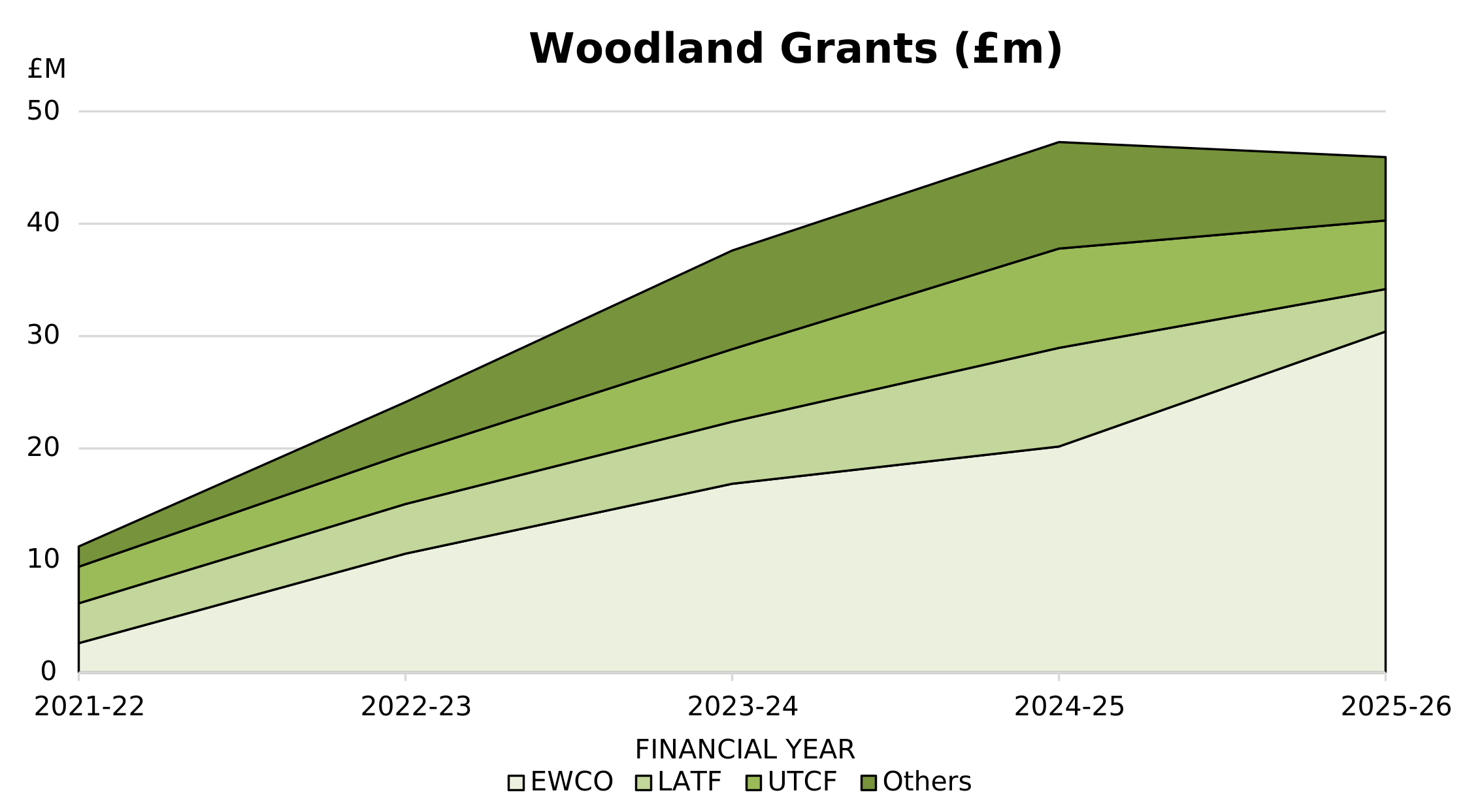
Woodland grants overview.
Further details on these grants are at note 2.1 to these accounts. Funding provided to Forestry England reflects its role as the principal delivery body for managing the public forest estate and supporting Nature for Climate Fund activity, including land acquisition for planting and essential estate investment. This support continued through 2025-26 to assist Forestry England in managing the impacts the of challenging trading conditions. Forestry England is an executive agency of the Forestry Commission and, as a public corporation, prepares and publishes its own annual report and accounts.
Following a period of significant growth in grant‑related activity, the Forestry Commission now expects delivery to move towards a more consistent and predictable level of expenditure. Future recruitment and resource deployment are anticipated to align more closely with steady‑state levels of grant activity, with an increased emphasis on optimisation, efficiency and effective use of existing capability. This approach supports delivery confidence while retaining flexibility to adapt as future funding and policy priorities evolve, including anticipated changes from 2026-27.
The balance sheet reflects increased accrued expenditure liabilities, primarily associated with multi‑year woodland creation grants. This is an expected feature of the Forestry Commission’s grant‑based delivery model and demonstrates strong uptake by land managers. While these commitments have reduced reserves, funding to meet associated liabilities has been agreed. These movements reflect the accounting recognition of multi‑year commitments rather than underlying financial pressure. These liabilities do not pose a risk to delivery in 2026-27 or to the Forestry Commission’s ability to discharge its statutory functions, including woodland management, tree health protection and forestry research. Cashflow and funding arrangements remain in place to meet obligations as they fall due.
For clarity, this annual report and accounts covers the activities of Forest Services and the Commissioners’ Office (together comprising the core Forestry Commission) and Forest Research. Forestry England, as a public corporation, is reported separately.
Honours
The following Forestry Commission nominees were successful in the King’s Birthday Honours:
- Mariella Marzano, OBE, for services to forestry
- Martin O’Vastar, MBE, for services to forestry
And the King’s New Year Honours:
- Josephine Lavell, MBE, for services to forestry
Sustainability review
The Forestry Commission works in partnership with others to support sustainable forest and land management, while also seeking to manage and reduce its own environmental impacts across its operations.
The sustainability data presented in this report covers Forest Research, Forest Services and the Commissioners’ Office, providing a collective view of environmental performance across the organisation.
Core Forestry Commission does not independently occupy buildings. As a result, building related energy and resource consumption is recorded by landlords and is not apportioned by organisational use. A significant proportion of this space is located within Forestry England buildings, and the associated environmental impacts are therefore captured within Forestry England’s reporting.
Forest Research do own and occupy buildings as part of their estate; their values are consolidated into the tables below.
| Emissions by source and scope (tCO2e) | 2025-26 baseline | 2024-25 actual | 2023-24 actual | 2022-23 actual | 2021-22 actual |
|---|---|---|---|---|---|
| Scope 1 – direct emissions | 542 | 716 | 599 | 506 | 404 |
| Built estate | 117 | 156 | 162 | 286 | 259 |
| Natural gas | 117 | 156 | 162 | 283 | 259 |
| Heating oil | - | - | - | 3 | - |
| F-gas | 129 | 94 | 14 | 3 | 23 |
| Fleet vehicles (including company cars) | 296 | 466 | 423 | 217 | 123 |
| Scope 2 – energy indirect emissions | 303 | 373 | 330 | 292 | 266 |
| Location-based | 305 | 345 | 307 | 277 | 272 |
| Market-based | - | 29 | 25 | 24 | 5 |
| Onsite renewable energy generation | (2) | (1) | (2) | (9) | (12) |
| Scope 3 – other indirect emissions (where measured) for business travel | 400 | 461 | 537 | 453 | 206 |
| Personal car | 146 | 169 | 156 | 180 | 136 |
| Hire car | 135 | 189 | 183 | 157 | 51 |
| Domestic flight | 40 | 30 | 84 | 44 | 10 |
| International flight | 36 | 39 | 71 | 47 | 4 |
| National rail | 38 | 33 | 41 | 24 | 6 |
| Regular taxi | 5 | 1 | 2 | 1 | - |
| Consumption by source | 2025-26 | 2024-25 | 2023-24 | 2022-23 | 2021-22 | |
|---|---|---|---|---|---|---|
| Scope 1 | ||||||
| Natural gas | kwh | 578,835 | 855,130 | 966,465 | 1,547,913 | 1,414,920 |
| £000 | 41 | 68 | 60 | 66 | 47 | |
| Heating oil (burning oil) | kwh | - | - | - | 10,630 | - |
| £000 | - | - | - | 1 | - | |
| Fleet vehicles (including CAPES leased vehicles) | km | 1,942,618 | 2,133,458 | 2,522,637 | 1,408,838 | 869,308 |
| £000 | 412 | 454 | 11 | 54 | 283 | |
| F-gas | kgCO2e | 47 | 31 | 11 | 2 | - |
| Scope 2 | ||||||
| Electricity – green tariff | kwh | 1,732,063 | 1,591,756 | 1,456,197 | 1,314,507 | 1,180,249 |
| £000 | 514 | 504 | 381 | 289 | 197 | |
| Renewable generation | kwh | 10,705 | 5,080 | - | 42,915 | 43,674 |
| Scope 3 | ||||||
| Non-fleet road vehicles (personal and hire car) | km | 1,731,063 | 2,112,092 | 2,599,632 | 1,983,176 | 1,102,709 |
| £000 | 380 | 452 | 533 | 481 | 163 | |
| Personal car | km | 834,170 | 1,063,245 | 1,684,055 | 1,159,378 | 792,674 |
| £000 | 209 | 280 | 328 | 297 | 107 | |
| Hire car | km | 896,893 | 1,048,847 | 915,577 | 823,797 | 310,035 |
| £000 | 170 | 172 | 205 | 184 | 56 | |
| Public transport | km | 1,385,726 | 1,695,035 | 1,421,713 | 1,130,291 | 224,359 |
| £000 | 328 | 395 | 404 | 194 | 62 | |
| Light rail/tram | km | 1,309 | 779 | 2,102 | 686 | 200 |
| £000 | 1 | 1 | 1 | 0 | 0 | |
| London Underground | km | 1,221 | 3,327 | 3,537 | 2,256 | 351 |
| £000 | 1 | 2 | 1 | 1 | 0 | |
| Taxi | km | 13,107 | 8,732 | 9,552 | 2,568 | 1,520 |
| £000 | 11 | 13 | 17 | 5 | 2 | |
| Bus | km | 7,942 | 14,786 | 6,433 | 1,542 | 500 |
| £000 | 8 | 5 | 4 | 1 | 0 | |
| Ferry | km | 6,497 | 943 | 2,237 | 2,021 | 412 |
| £000 | 2 | 2 | 5 | 2 | 1 | |
| Domestic flight | km | 173,490 | 202,214 | 206,828 | 180,373 | 40,424 |
| £000 | 44 | 39 | 80 | 48 | 11 | |
| International flight | km | 322,962 | 420,138 | 259,888 | 266,408 | 22,185 |
| £000 | 34 | 32 | 28 | 29 | 3 | |
| National rail | km | 856,933 | 1,044,116 | 930,724 | 674,438 | 158,768 |
| £000 | 226 | 301 | 267 | 108 | 44 | |
| International rail | km | 2,263 | - | 412 | - | - |
| £000 | 1 | - | 1 | - | - | |
| Waste (excluding sewage) | tonnes | 622 | 702 | 175 | 119 | 76 |
| £000 | 97 | 109 | 89 | 42 | 33 | |
| Recycled | tonnes | 593 | 672 | 167 | 111 | 69 |
| Incinerated with energy recovery | tonnes | 9 | 5 | 3 | 5 | 0 |
| Incinerated without energy recovery | tonnes | - | - | 2 | - | - |
| Landfill | tonnes | 3 | 23 | 1 | 1 | 1 |
| Hazardous | tonnes | 17 | 2 | 2 | 2 | 7 |
| Sewage | tonnes | 482 | 527 | 531 | 461 | 451 |
| Water consumption (mains) | m3 | 21,180 | 11,774 | 12,863 | 13,358 | 7,146 |
| £000 | 66 | 39 | 33 | 30 | 11 | |
| Office | m3 | 4,236 | 2,355 | 2,573 | 2,672 | 1,429 |
| Non-office | m3 | 16,944 | 9,419 | 10,290 | 10,686 | 5,717 |
| Paper use | reams | 167 | 347 | 295 | 288 | 200 |
| Total estate energy (scope 1 and 2) | kwh | 3,014,124 | 2,441,806 | 2,422,662 | 2,830,135 | 2,551,495 |
| Total heat energy from fossil fuels (gas and oil) | kwh | 578,835 | 855,130 | 966,465 | 1,558,543 | 1,414,920 |
Sustainability report
The Forestry Commission executive board continues to oversee delivery of sustainability objectives across the organisation. During 2025-26, this has included:
- supporting increased awareness and uptake of the Woodland Carbon Code, contributing to the development of natural capital markets
- progressing towards transition to ISO 14001:2015 and recertification, strengthening environmental management systems
- working with Forestry England to support the publication of a net zero strategy ‘Our Clean Future’ aligned to Forestry England’s objectives
- supporting renewable energy and sustainable wood fuel within the rural sector, contributing to wider net zero and decarbonisation objectives
These activities support delivery of wider government sustainability objectives and contribute to strengthening environmental performance across the organisation.
Cooperation and governance
The Forestry Commission works with partners where buildings are shared to enable them to report on greenhouse gas emissions, waste management and use of resources as required by government reporting and regulatory requirements. Consideration of climate change impacts is embedded in governance and decision‑making processes.
Sustainable business in core Forestry Commission is overseen by the Director of Estates and the Sustainable Business team in Forestry England. They are responsible for formulating and championing the Forestry Commission’s environmental policy and delivery through our integrated EMS. Forestry Commission does not have a Chief Sustainability Officer and the Director of Estates is the Senior Responsible Owner for the GGCs. Performance against the commitments is reported to the Forestry England executive team.
Forestry England’s strategy for the nation’s forests ‘Growing the Future’ sets a target of meaningfully reducing our direct emissions whilst better measuring our indirect emissions. Growing the Future set an ambition to reduce greenhouse gas emissions on our way to being net-zero by 2030. We continue to strive for net zero and have now set a target to achieve operational net zero by 2040.
Performance against Greening Government Commitments 2025-30
The Forestry Commission reports sustainability in line with GGCs. Forestry England, Forest Services and Commissioners’ Office provide combined reporting against GGCs. Forest Research report their GGC commitments separately. This reporting year represents a new baseline, providing a more accurate reflection of Forestry Commission consumption.
The evaluation of Forestry England’s, Forest Services’ and the Commissioners’ Office’s combined performance on each of the commitments is as follows:
Mitigating climate change: working towards net zero by 2050
Consideration of climate change impacts is embedded in all governance and key decision by the Forestry Commission; it is also considered in performance management.
Forestry England’s operational emissions performance for 2025-26 has shown a reduction in emission from the previous year, providing a stable foundation from which to continue driving reduction.
Whilst energy consumption across the built estate has increased this year, we have seen corresponding emissions reduce. Demonstrating that changes in consumption are being partially offset by the continued use of renewable electricity and renewable generation.
Our recently published property strategy sets a clear direction, aligning the management of our estate with Forestry England’s near-term ambition for the estate to reach net zero by 2035. Through our strategic asset management plans, we are identifying and prioritising opportunities to improve energy efficiency, reduce energy demand and costs and increase on site renewable energy generation.
In 2025-26, we continued to invest in a mix of renewable energy generation and energy storage solutions, building resilience and reducing future operational emissions. Targeted improvements have also been made to enhance the energy performance of key sites, including the new seed processing centre at Delamere and the operations yard at Haldon. These investments demonstrate our ongoing commitment to improving the sustainability and efficiency of our estate while supporting our long-term net zero goals.
Our sustainable travel policy aligns with the Office for Zero Emission Vehicles requirements, setting a clear direction for the transition of our fleet towards zero emission vehicles. Over the past year, we have taken further steps to modernise and consolidate our fleet, introducing lower emission vehicles where suitable alternatives are available. As a result, 18% of our fleet is now classified as ultra-low or zero emission. Alongside this, we have continued to expand our network of electric vehicle charging points across the estate, strengthening the foundations for future transition.
We recognise that transitioning our fleet presents practical challenges, particularly given the nature of our operations. Our rural operating environment also means that access to public charging infrastructure remains limited.
In addition, our structured 5-year asset replacement cycle means that some vehicles will remain in service beyond the 2027 target date for sound financial and operational reasons. Despite these constraints, we are continuing to plan and prepare for a phased transition, ensuring we are ready to accelerate change as technology and infrastructure evolve.
Forestry England recognises that travel is essential to delivering its objectives, while also contributing to greenhouse gas emissions and having implications for cost, safety, health and wellbeing. During the year, the organisation introduced a revised sustainable travel policy, supporting staff to make lower carbon and more efficient travel choices.
Minimising waste and promoting resource efficiency
Forestry England generates waste through its offices, forests and operational sites. Whilst our total volume of reported waste has increased this year, we continue to work closely with our main contractor to improve performance. Key drivers for the increase were reported compostable waste from our nursery and volumes of general waste reported by operational sites. A key focus is increasing the proportion of waste that is recycled and reducing the amount sent to landfill, supporting our wider environmental ambitions.
Alongside this, we are continuing to support colleagues in understanding their role in effective waste management. This includes maintaining strong regulatory compliance, embedding sustainable procurement practices and applying circular economy principles to reduce waste at source and make better use of resources.
We have also reported separately on sewage generated from recreation facilities across our forests. This remains our largest waste stream and represents a significant operational cost.
Procuring sustainable products and services
As part of our net zero strategy, Forestry England has committed to achieving net zero emissions by 2040, including tackling the indirect emissions associated with our supply chain. As a first step, we have undertaken a comprehensive analysis of our organisational spend to estimate our full supply chain emissions, providing a robust baseline from which to drive improvement.
Building on this, we are developing a sustainable procurement plan, informed by a maturity matrix aligned with ISO principles. This plan will set out a structured pathway for embedding sustainability across our procurement activities. It includes actions to raise awareness of supply chain emissions within the organisation, and to prioritise the most material categories by working closely with buyers and strengthening engagement with our suppliers.
A key ambition is to increasingly embed sustainability into our procurement processes. This includes strengthening the use of sustainability performance as a supplier selection criterion and building clear sustainability requirements into contract delivery. In doing so, we aim to influence behaviours across our supply chain and support the transition to lower carbon goods and services.
In line with our environmental policy statement, guidance for our buyers promotes a whole life cycle approach to procurement and aligns with Government Buying Standards where these are relevant. This supports more informed decision making and helps to ensure that environmental impacts are considered from sourcing through to end of life.
We are already applying these principles in practice. Our providers of customer food outlets are required to follow sustainable operating principles. We also maintain clear standards for the materials we use. All timber products procured by Forestry England must be certified as originating from legal and sustainable sources, including those used in construction projects and temporary works. We actively support the Grown in Britain initiative to promote the use of sustainable UK timber.
Alongside this, we are exploring practical opportunities to reduce the use of fossil fuel based materials. Trials are underway to identify alternatives to plastic products such as signs, tree shelters and Christmas tree netting, with a focus on reducing reliance on virgin plastics and increasing opportunities for reuse and recycling.
Together, these actions reflect a growing and increasingly strategic approach to sustainable procurement, supporting our ambition to significantly reduce supply chain emissions as part of our journey to net zero by 2040.
Nature recovery and biodiversity action planning and adapting to climate change
The Forestry Commission already delivers a range of programmes supporting biodiversity and nature recovery, whilst our core business managing the nation’s forests drives environmental sustainability and consideration of adaptation to projected climate impacts. In January 2025, we published our fourth adaptation reporting power report, which provides an updated assessment of risks to our functions and a programme of measures to address those risks.
We are also working to draw together under one strategic framework the breadth of our ongoing environmental work with our emerging emissions reduction work. We are developing an Environmental Sustainability Strategy and Climate Change Adaptation Strategy building on existing sustainability and adaptation activity. These strategies will continue to support proportionate alignment with TCFD‑related reporting requirements and integration of climate considerations within existing governance, risk management and delivery processes.
Reducing environmental impacts from ICT and digital
Forestry England’s IT team is reducing the environmental impacts of its service. This complements and aligns with the IT strategy (2023-26). The programme focuses on architecting IT and technology solutions with sustainability principles in mind. It has key focus areas, with links to the wider aims of Defra, GGC, Information and Communications Technology (ICT) and digital services strategies and Forestry England/Forestry Commission values.
- developing regular reporting on the departments environmental impact
- reporting an annual ICT and digital footprint (as part of Forestry England’s annual carbon footprint)
- working with supply chains and third parties to reduce the impact of IT services (including scope 3 emissions)
- a key focus on waste management
- promoting ‘responsible digital citizens’
The workstreams for these focus areas require some project work before becoming business as usual. Critical to these workstreams is linking with colleagues across the organisation so they are understood and implemented.
There are essential frameworks and requirements that IT must have to provide its service. Whilst sustainability will not be the only consideration in scoping IT products and services, it will form one part of the central decision-making process and guiding principles. This applies to services that IT implement as a part of its core offering, as well as those on behalf of other business areas.
Reporting requirements from the TCFD
The Forestry Commission reports in line with HM Treasury’s TCFD‑aligned disclosure requirements, applying a proportionate approach consistent with its size, functions and risk profile. Climate-related metrics are primarily reported through the GGC framework, including emissions (scope 1, scope 2 and partial scope 3), energy consumption and resource efficiency.
Climate-related risks are intrinsic to the Forestry Commission’s delivery model and are therefore embedded within core operational and strategic risks, rather than managed as a standalone category. The organisation’s approach to managing climate-related risk forms part of its overall risk management framework and is overseen through established governance and assurance processes.
During 2025-26, the Forestry Commission undertook an assessment of the implications of phase 3 of HM Treasury’s TCFD implementation requirements. The assessment considered physical, transition and government‑specific climate‑related risks and their potential impacts on both performance reporting and the financial statements.
The assessment concluded that climate‑related risks do not constitute a standalone principal risk. Instead, they are embedded within existing principal risks, including forest resilience, biosecurity and funding pressures arising from extreme weather events. No material financial reporting implications were identified as a result of climate‑related risks. In particular, climate change was not assessed as giving rise to impairment indicators, valuation uncertainty, provisions or going concern considerations within the reporting period.
The Forestry Commission reports against the TCFD pillars of governance, risk management, metrics and targets. Further details are set out within the governance statement and environmental sustainability sections of this report. This approach is aligned with HM Treasury’s TCFD implementation requirements and reflects a proportionate application of the framework.
The board considers climate-related risks as part of established governance, risk management and strategic planning processes, including implementation of the ‘Thriving for the Future’ (2023-28) strategy. Climate-related risks are incorporated within existing organisational frameworks and oversight arrangements. The executive team manages these risks through business planning, operational delivery and major programmes, including woodland creation, natural capital and biodiversity management, with climate considerations integrated throughout delivery.
Richard Stanford CB MBE
Accounting Officer
Forestry Commission
30 June 2026
Accountability report
Corporate governance
The corporate governance report sets out the Forestry Commission’s key accountabilities to Parliament, as set out in chapter 5 of part 15 of the Companies Act 2006 and schedule 7 of SI 2008 No 410 and amended by the HM Treasury’s financial reporting manual (FReM).
It comprises the directors’ report, the statement of Accounting Officer’s responsibilities and the governance statement. It provides assurances on how the organisation has managed risks and issues.
The corporate governance report explains the Forestry Commission’s governance structures and how they support the achievement of its objectives.
Director’s report
Relationship with Defra and the wider Defra group
Defra ministers who had responsibility for the Forestry Commission during the year were:
- Steve Reed OBE MP, Secretary of State until 5 September 2025
- Emma Reynolds MP, Secretary of State from 5 September 2025
- Mary Creagh CBE MP, Parliamentary Under Secretary of State for Nature
Our board
- Baroness Young of Old Scone, Chair
- Neil Sachdev, Non-Executive Commissioner
- Jennie Price, Non-Executive Commissioner
- Paul Brannen, Non-Executive Commissioner
- Jo Bradwell, Non-Executive Commissioner
- Hillary Alison, Non-Executive Commissioner
- Sandy Storrie, Non-Executive Commissioner
- Ross Murray, Non-Executive Commissioner
- Kate Cheetham, Non-Executive Commissioner
- Richard Stanford, Executive Commissioner
Peter Latham served as a Non-Executive Commissioner on the Board of Commissioners until the end of his contract on 30 September 2025: he was replaced on 1 December 2025 by Paul Brannen.
Chair and Chief Executive
Sir William Worsley served as Chair between 10 February 2020 and 9 February 2026. Barbara, Baroness Young of Old Scone has been Chair since 10 February 2026. Richard Stanford, Chief Executive Officer, was appointed chief executive officer within the Forestry Commission on 9 August 2021.
Significant interests held by board members
A register of interests of all board members is maintained by the Forestry Commission and published on GOV.UK.
There have been no potential or actual conflicts of interest reported in this year.
Personal data related incidents
There were no reportable personal data related incidents reported for the Forestry Commission in 2025-26 (2024-25: nil).
Supplier payment policy
The Forestry Commission complies with the government’s better payment practice code. Unless otherwise stated in the contract, payment is made within 5 days of receipt of goods and services or the presentation of a valid invoice, whichever is the later.
In 2025-26, 91.51% (2024-25: 96.8%) of invoices for core Forestry Commission and 91.17% (2024-25: 97.3%) of invoices of the Forestry Commission including Forest Research were paid within the statutory 30 days or agreed due date. This reflects a reduction in the use of Government Procurement Cards, with a greater proportion of payments processed through accounts payable systems, which has increased overall processing times.
Arrangements for handling complaints on payment performance are notified to suppliers in contracts.
During the year late payment interest and charges of £788 were incurred (2024-25: nil).
Auditors
The Forestry Commission’s accounts are audited by the Comptroller and Auditor General under the Government Resources and Accounts Act 2000. The audit fee was £113,200 (2024-25: £108,000). In addition, the notional fee for the audit of the Forest Research Agency was £69,640 (2024-25: £66,450). These fees may be subject to increase due to additional work performed on grants. No fees were charged for other services (2024-25: nil).
Statement of the Accounting Officer’s responsibilities
Under section 5, subsection 7 of the Government Resources and Accounts Act 2000, HM Treasury has directed the Forestry Commission to prepare accounts for each financial year. The accounts are prepared on an accruals basis and must give a true and fair view of the state of affairs and of the income and expenditure, changes in taxpayers’ equity, and cash flows of the department for the financial year.
The Chief Executive of the Forestry Commission has designated the Chief Executive of Forest Research as Accounting Officer for Forest Research activities and the associated assets, liabilities and cash flows reported within these accounts. This designation does not detract from the Forestry Commission Chief Executive Officer’s overall responsibility as Accounting Officer for the department’s consolidated accounts.
The Chief Executive of Forestry England is separately designated as Accounting Officer for Forestry England’s activities and associated assets, liabilities and cash flows. Forestry England prepares and publishes its own annual report and accounts and is not included within these consolidated accounts. The relationship between the Accounting Officers, together with their respective responsibilities, is set out in the Defra/Forestry Commission framework document.
In preparing the accounts, the Accounting Officer is required to comply with the requirements of the government FReM and in particular to:
- observe the accounts direction issued by HM Treasury, including the relevant accounting and disclosure requirements, and apply suitable accounting policies on a consistent basis
- make judgements and estimates on a reasonable basis and prepare the annual report and accounts so that they are fair, balanced and understandable
- state whether applicable accounting standards as set out in the government FReM have been followed, and disclose and explain any material departures in the accounts
- prepare the accounts on a going concern basis
The responsibilities of an Accounting Officer (including responsibility for the propriety and regularity of the public finances for which an Accounting Officer is answerable, for keeping proper records and for safeguarding the Forestry Commission’s assets) are set out in ‘Managing Public Money’ published by HM Treasury.
The Accounting Officer is required to confirm that the annual report and accounts as a whole are fair, balanced and understandable, taking personal responsibility for the judgements required to ensure this.
So far as the Accounting Officer is aware, there is no relevant audit information of which the auditors are unaware. The Accounting Officer has taken all the steps that he ought to have taken to make himself aware of any relevant audit information and to establish that the auditors are aware of that information.
Governance statement
Introduction and scope of responsibility
Richard Stanford has been appointed by the Principal Accounting Officer of Defra as Accounting Officer for the Forestry Commission. He is responsible for maintaining a sound system of governance, risk management and internal control across the Forestry Commission. This statement describes how these responsibilities have been discharged and in accordance with the principles set out in Managing Public Money and relevant HM Treasury guidance.
This statement covers the Forestry Commission, comprising Forest Services and the Commissioners’ Office, and fully complies with the corporate governance code where relevant and applicable to the Forestry Commission. In addition, our agencies Forestry England and Forest Research publish separate governance statements within their annual reports.
The purpose of the governance framework
The governance framework comprises the systems and processes, and culture and values, by which the Forestry Commission is directed, controlled and led. It enables the Forestry Commission to monitor the achievement of its strategic objectives and to consider whether those objectives have led to the delivery of appropriate, cost-effective outcomes which are also compliant with the law and with policy.
The system of internal control is a significant part of that framework and is designed to manage risk to a reasonable level. It cannot eliminate all risk and can therefore only provide reasonable and not absolute assurance of effectiveness. The system of internal control is based on an ongoing process designed to identify and prioritise the risks to the achievement of the Forestry Commission’s policies, aims and objectives. Evaluating the likelihood of those risks being realised and the impact should they be realised, and to manage them efficiently, effectively and economically.
The governance framework has been in place at the Forestry Commission throughout 2025-26 up to the date of the production of the annual report and accounts and accords with HM Treasury guidance.
The governance framework
The Forestry Commission is a non-ministerial government department and has a royal charter, dated 25 March 1920, which makes the entire organisation a single legal entity. It is headed by a board of commissioners. The Forestry Commissioners are appointed by Royal Warrant and may regulate their own procedure under the provisions in the Forestry Act 1967.
The Forestry Act 1967 (as amended) and the Forestry Act 1979 set out the principal legislative framework within which the Forestry Commission operates. The forestry commissioners are established by statute and derive their powers primarily from the Forestry Acts but also from other legislation such as the Environmental Impact Assessment (Forestry) (England and Wales) Regulations 1999. Under the Plant Health Act 1967, the commissioners are the competent authority for the protection of forest trees and timber from attack by pests and diseases.
The Forestry Commission activities in Scotland ceased in April 2019 on completion of devolution. The Forestry Commission activities in Wales became part of Natural Resources Wales in April 2013 and the Forestry Commission has never operated in Northern Ireland. However, some activities (research and plant health) continue to be delivered cross border on behalf of the Great Britain devolved administrations under an MoU.
Only international forestry policy is reserved but the Forestry Commission continues to operate some cross-border functions, such as biosecurity at the UK border and forestry research, which are co-funded with the devolved administrations. Defra is responsible for forestry policy in England.
As required under section 2(3) of the Forestry Act 1967, the commissioners have appointed a national committee. However, no activities have been delegated to it, and it is not expected to meet. They have instead, through administrative action, delegated relevant and appropriate functions to the sub-boards of the delivery arms of the Forestry Commission namely Forestry England, Forest Services and Forest Research. Officials from Defra and the devolved administrations act as members of the sub-boards where appropriate. Overall responsibility, however, remains with the board of commissioners.
How we operate
The governance structure in operation throughout 2025-26 is outlined below and shows the most numerous interactions between the groups. Further information on the Forest Research board and the Forestry England board can be found in their respective annual report and accounts.
The governance is formed of:
Board of commissioners
National committee
Executive board*
Forestry England board
Forest Services board
Forest Research board
Audit and risk assurance committee
**The executive board draws upon the executive leadership of all parts of the Forestry Commission to take strategic decisions on common issues.
Forest Services, Forestry England and Forest Research each have their own executive leadership team and governing board comprising commissioners, non-executive directors and executive staff. These individual boards make decisions specific to each organisation. The Forestry Commission executive board is a group of executive staff from the Forestry Commission and its agencies, providing direction for collective decisions and sharing of knowledge and policy. The board of forestry commissioners provides a collective overview and steer to the Forestry Commission and its agencies. This governance framework allows us to monitor our objectives and consider whether those have led to the delivery of appropriate and cost-effective outcomes that are compliant with law and policy.
Forestry commissioners
The board of commissioners consists of a chair and up to ten other members appointed by His Majesty the King or Her Late Majesty the Queen. The board of commissioners met in July 2025 and January 2026.
Find further information on the board of commissioners and their responsibilities.
The Forest Services board
This board is appointed by the Forestry Commissioners to enable them, as ‘the appropriate forestry authority’ in England to discharge their duties and exercise their powers set out in the Forestry Act 1967 and other relevant legislation, including the Plant Health Act 1967. The board also provides leadership for Forest Services by supporting, guiding, constructively challenging and directing the Forest Services executive team in the development and delivery of its strategy.
The Forest Services board will share information as appropriate with the Forestry England board, the Forest Research board and the Forestry Commission executive board, ensuring collaboration and cooperative working on matters that require decision, resolution or co-ordinated action across the Forestry Commission.
John Lockhart served as a Non-Executive Director to the Forest Services board until the end of his contract on 31 July 2025: this position was not replaced in 2025-26. The Forest Services board met in July, October 2025, February and March 2026.
Find further information about the Forest Services board, including membership, attendance and their main duties.
Details of the Forestry England board are included within their own annual report and accounts and are also available on the Forestry England website. Details of the Forest Research board are set out in their own annual report and accounts and are also available on the Forest Research website.
The Forestry Commission executive board
The Forestry Commission executive board, which is chaired by the Forestry Commission Chief Executive Officer, has the shared purpose to champion forests and forestry in England and beyond. The executive board brings the executive leadership of all parts of the Forestry Commission together to take strategic decisions on matters where Forestry England, Forest Services and Forest Research can achieve more by taking a common approach.
The Forestry Commission executive board met in June, September, December 2025, January and March 2026.
Read more about the Forestry Commission executive board, including membership and attendance.
Audit and Risk Assurance Committee (ARAC)
All Forestry Commission entities are covered by a single ARAC which advises the Board of Commissioners, the Forestry England, Forest Services and Forest Research boards, and Accounting Officers for the Forestry Commission, Forestry England and Forest Research.
Through its work, the ARAC provides independent assurance to the Forestry Commission board on those key activities that support the achievement of the Forestry Commission’s objectives. The Forestry Commission has a risk register which is reviewed by the executive board and is overseen annually by the ARAC. Assurance is also provided through the findings from work carried out by the Government Internal Audit Agency (GIAA). The ARAC operates in accordance with the principles contained in HM Treasury’s ARAC handbook.
A register of interests of all ARAC members is maintained by the Forestry Commission and published on GOV.UK, which also includes further details of ARAC members, activities and meetings.
There have been no potential or actual conflicts of interest reported in this year.
Summary of the ARAC 2025-26
During the year, the committee discussed a wide range of issues, detailed below:
- annual report and accounts
- internal and external audit
- risk management
- security
- fraud and whistleblowing
- governance and assurance frameworks
Specific activities and matters considered in 2025-26 included:
- deep dives on cyber security, health and safety and near misses, data protection, environmental, social and governance reporting and the Forestry Commission’s emerging strategy for using AI, and the associated risks
- the definition and reporting of ‘major incidents’ within the Forestry Commission.
- an external report by the Civil Service Commission into recruiting practices across government agencies. This concluded that improvements to Forestry Commission practice are necessary
- alignment with Cabinet Office functional standards
- the ongoing plan to complete actions arising from the departmental security health check
ARAC membership:
- Two commissioners
- Two non-executives
One of whom must have recent relevant financial experience, drawn from across the 3 boards.
In attendance:
- internal auditors from the Government Internal Audit Agency
- external auditors from the National Audit Office
- the Accounting Officers
- senior executives from across the Forestry Commission
Right of attendance is extended to the Director, Natural Environment, Trees and Landscape, Defra.
During 2025-26 the ARAC met 5 times. The 4 quarterly meetings (June, September, December, March) were supplemented by one additional meeting, to consider issues regarding the annual reporting and accounts of all 3 entities.
Forestry and Woodland Advisory Committees (FWACs)
Forestry and Woodland Advisory Committees provide strategic advice, expertise and challenge to the Forestry Commission on implementing forestry and woodlands policy in England as well as advocating and championing forestry interests and woodland partnership working.
There are currently 9 separate regional FWACs across England, each consisting of up to 11 individuals drawn from a range of sector interests. The term of office for FWAC Chairs and members is for a term of 3 years, although there is the possibility of reappointment for a further term subject to satisfactory performance.
Chairs and members are appointed as individuals and not as representatives of a particular organisation. While acting as an independent Chair or member, individuals are allocated to one of 3 main fields of interest that comprise the expert membership of the committee:
- forest industry and land ownership
- social, access and environment expertise
- local communities, economy and government interest
William Robinson Gravetye Charity
These accounts disclose at (note 17 to the accounts) the William Robinson Gravetye Charity (Registered Charity 1136242). William Robinson was renowned for his wild and natural gardening, died in 1935 and bequeathed the freehold of his estate, the Gravetye Estate in West Sussex, in trust to the nation. The trust property consists of cottages, farmland, agricultural buildings, lakes and a hotel and its substantial (240ha) of woodland.
Task Force on Climate-Related Financial Disclosures
Climate-related risks and opportunities are embedded within the Forestry Commission’s core operational and strategic risks and are reported within the performance report.
Performance
All of the committees and boards have linkages through shared membership. Each sub-board provides a non-executive commissioner or director as a member of the ARAC. This ensures a breadth of knowledge and understanding of the organisation and forestry issues, which enhances the contribution made by non executives and thus the effectiveness of all the committees. Each board and committee receive relevant reports from the other committees and the non executives play an active part in agreeing and selecting items for inclusion in agendas.
The Forestry Commission ARAC has been assessed as being in line with requirements for public sector bodies as per HM Treasury guidance.
Review of effectiveness
The Accounting Officer has responsibility for conducting, at least annually, a review of the effectiveness of the governance framework. The review is informed by the work of internal audit, the agency Accounting Officers and the executive managers across the Forestry Commission who have responsibility for the development and maintenance of the governance, risk management and control framework, and comments made by the external auditors in their management letter and other reports.
Annual assurance statements are produced by senior executive managers from across the Forestry Commission, with content supported by the results of the annual programme of GIAA audit assignments, and effectiveness reviews conducted by the sub-boards and the ARAC.
The GIAA Head of Internal Audit for the Forestry Commission has prepared a suite of audit reports and assurance statements for the Forestry Commission, Forestry England and Forest Research throughout 2025-26. These are summarised in an annual opinion and performance report which provides an overall ‘moderate’ [footnote 1] opinion on the adequacy and effectiveness of the framework of governance, risk management and control. Plans to ensure continuous improvement of the framework are in place.
The Forestry Commission continues to apply the principles of HM Treasury’s code of good practice for corporate governance in the context of its own circumstances as a non-ministerial department. The ARAC also reviews its effectiveness annually in line with best practice and HM Treasury’s audit committee handbook.
During the year, the Forestry Commission commissioned an externally facilitated board effectiveness review, covering the board of commissioners, executive board, Forestry England, Forest Services and Forest Research boards and the ARAC. The review concluded that governance arrangements are generally effective, with a positive and constructive board culture, but identified opportunities to further strengthen effectiveness. These include simplifying aspects of the governance structure, improving clarity of roles and decision-making responsibilities, enhancing the alignment and forward planning of board activity, strengthening the visibility of cross-organisational risks at board level and improving the quality and consistency of board information.
An action plan has been agreed to address these recommendations, with clear ownership and delivery timescales. Initial actions have commenced in 2026-27, including work to enhance board reporting, forward planning and governance processes, and to consider potential changes to board and committee structures.
No material governance or control weaknesses have been identified through this process. The Accounting Officer is satisfied that, based on the range of assurance sources outlined above, the Forestry Commission’s governance and internal control arrangements were operating effectively during the year and continue to be strengthened through a programme of ongoing improvement.
Whistleblowing
The Forestry Commission is committed to ensuring a high standard of conduct in all that it does and has a duty to identify and remedy any area of malpractice. This is achieved by encouraging a culture of openness, where employees feel confident and able to raise any matters of concern. The Forestry Commission has a dedicated whistleblowing officer and network of nominated officers in the 3 organisations. The policy and procedures are kept under constant review and after each significant case. There were no cases of whistleblowing reported in 2025-26.
Risk management
The Forestry Commission’s risk management policy reflects its commitment to effective risk management, adopting best practice in the identification, evaluation and control of risks. Risk management is recognised as an essential function in ensuring the organisation achieves its aims and objectives, supported by our agreed risk appetite statement, which provides a clear framework for informed and proportionate decision‑making.
Our risk management policy and processes are designed to comply with HM Treasury’s orange book principles, ensuring a structured and consistent approach to assessing and managing risk across the organisation. Further development of this framework is planned through the introduction and completion of the corporate governance and assurance document, which will enhance transparency, reinforce assurance arrangements and provide a more integrated view of risk, controls and governance.
Fraud and error
The Forestry Commission maintains a counter fraud, bribery and corruption strategy, supported by a policy and fraud response plan. These arrangements provide a strong framework for the prevention, detection and management of fraud and error. Instances identified during 2025-26 were limited in scale, were not material to the financial statements, and were appropriately managed in line with established procedures, including investigation and recovery activity.
Complaints
The Forestry Commission is committed to maintaining high standards of transparency, accountability and customer service. Our complaints process ensures concerns are addressed promptly, fairly and in line with our statutory obligations, with insights from complaints used to strengthen governance and improve service delivery. In 2025-26 the Forestry Commission received 53 complaints.
Key drivers included:
*people’s passion for the green spaces they visit *local disputes on land management decisions * the continued challenge of making balanced decisions based within a regulatory framework
Read the Forestry Commission complaints procedure.
Modelling and quality assurance
A sensible and proportionate approach to quality assurance has been adopted across the Forestry Commission, incorporating a programme of management audits for the application of policy and procedures guidance with summary reports provided for senior management and the ARAC.
Government functional standards
The Forestry Commission applies the government functional standards mandated for central government bodies. These standards provide a framework for effective governance, risk management, assurance and the delivery of value for money.
Compliance with functional standards is overseen by the executive committee, supported by senior functional leads, with assurance provided to the ARAC.
Assessment of compliance is informed by a combination of internal self-assessments, reviews undertaken by central government functions where applicable, and internal audit work carried out by GIAA. This complements the wider governance, risk and assurance framework described within this accountability report.
The Forestry Commission has assessed its compliance across Forestry England, Forest Services and Forest Research. Overall, the organisation considers that it meets the majority of mandatory requirements across the standards, with established governance and assurance arrangements in place. Where areas for improvement have been identified, these are being addressed through agreed actions and continuous improvement activity.
Ministerial direction
No ministerial directions were received during the year.
Significant governance and risk issues
The key performance risks associated with delivery of the Forestry Commission’s 3 strategic goals are set out within the performance report. This section summarises other significant governance, assurance and enabling risks that cut across the organisation’s activities and require ongoing management.
Grants
The delivery of woodland creation through grant schemes carries inherent operational and financial risks. These arise from the multi‑year nature of planting activity, the timing of claims across planting seasons, the potential for non‑delivery of approved planting and the need for incentives to remain competitive with alternative land uses.
In most cases, woodland creation grants are paid in arrears once planting has been completed and claims have been validated and, where necessary, inspected. This significantly mitigates the risk of fraud and error. Where advance payments are made, expenditure is managed in line with section 31 of the Local Government Finance Act 2003 and supported by appropriate assurance and inspection processes.
The Forestry Commission continues to strengthen its grant policies, systems and controls through a proportionate, risk‑based approach. Compliance with the government functional standard for grants remains strong, supported by ongoing engagement across the Defra group.
EWCO is considered by management to carry the highest‑risk grant scheme in the current portfolio, reflecting the level of financial incentive provided and the diversity of claimants. Other schemes, largely delivered through local authorities, carry lower inherent risk.
Sampling of approximately 11% of EWCO claims relating to planting activity since inception indicates a risk that around 2.42% of claims may relate to incomplete planting. Applying this risk to the unpaid claim received population of £8.9 million, this equates to a potential risk of £0.2 million. These findings continue to be reviewed, remedial actions are being implemented where appropriate, and any confirmed cases of fraud or error will be reported. Management considers that the potential value of error identified to date is not material to the accounts.
The continued increase in grant volume and value reinforces the importance of robust systems, data quality and assurance processes. The embedding of the grant management system remains a critical dependency for effective grant oversight; failure to fully embed this system would present operational and reputational risks. The scale and complexity of grant delivery also places ongoing pressure on system capacity, including digital infrastructure, inspection capability and specialist expertise, requiring continued active management.
Pay
Pay remains a significant workforce governance risk for the Forestry Commission. Civil Service pay controls continue to constrain the organisation’s ability to address structural pay challenges, particularly given labour market pressures and higher pay rates for comparable roles elsewhere in the forestry sector.
During the year, management worked with recognised trade unions to target the 3.75% pay award, improving outcomes for lower‑paid staff and narrowing pay bands. While progress has been made, there remains a risk that the organisation may be unable to attract and retain sufficient specialist capability to deliver government commitments over the medium term without further reform.
Vacancy management is monitored in‑year against funded programmes. Investment in workforce development has remained a priority, including leadership development initiatives and entry routes that continue to attract high levels of interest.
Limited legal powers of the Forestry Commission
There is a risk that the Forestry Commission’s statutory powers, set out primarily in the Forestry Act 1967, do not fully align with contemporary forestry practices and delivery models. While recent legislative changes, including provisions introduced through the Planning and Infrastructure Act 2025, have modernised elements of the framework, further legislative or non‑legislative reform may be required to ensure continued alignment with evolving environmental, economic and policy objectives.
Security
The Forestry Commission continues to strengthen its approach to cyber, information, physical and personnel security. Governance is provided through the security risk management forum. During the year, the organisation completed its departmental security health check and a number of GovAssure cyber assessments, providing assurance against government security standards. The organisation remains alert to the evolving threat landscape and continues to strengthen controls and incident readiness.
Wider circumstances and future challenges
The Forestry Commission continues to operate within a complex and uncertain external environment. Beyond the performance and governance risks reported elsewhere, a number of wider circumstances shape the context in which statutory duties and strategic objectives must be delivered.
Sustained public spending constraint remain a defining feature of the operating environment. Delivering statutory functions and government priorities within tight fiscal parameters will continue to require prioritisation, efficiency and careful balancing of investment across delivery activities.
Demand for skilled forestry, scientific and land management expertise continues to grow across the sector, increasing pressure on workforce capacity more generally. Sustaining organisational resilience will depend on effective workforce planning, development pathways and the ability to adapt to changing labour market conditions.
External economic and geopolitical uncertainty is also contributing to operational pressure. Volatility in fuel, energy and other input costs has implications for supply chains, contracting, estate operations and visitor services, reinforcing the importance of adaptive planning and operational resilience.
Clear and stable policy signals for land managers are critical to supporting long‑term decisions on woodland creation and management. The Forestry Commission will continue to work closely with Defra to provide clarity on incentives, regulation and delivery pathways, supporting balanced outcomes across woodland expansion, food production, nature recovery and sustainable timber supply. Delivery relies on effective coordination across Defra group and wider government systems, creating interdependencies that, while actively managed, are not wholly within the Forestry Commission’s direct control.
Sustaining Forest Research’s pan‑Great Britain contribution remains an ongoing challenge, requiring careful management of funding, capability and partnerships to ensure continued delivery of high‑quality evidence and innovation.
Longer‑term environmental pressures, including climate change and biosecurity threats, continue to shape the forestry operating landscape and will remain a significant contextual factor for planning and delivery.
Across all these areas, the Forestry Commission will continue to work with Defra, delivery partners and stakeholders to manage uncertainty, adapt to changing circumstances and remain well positioned to deliver its statutory responsibilities and strategic objectives.
Overall, governance arrangements operated effectively during the year, supporting appropriate oversight of risk, assurance and delivery.
Remuneration and staff report
The remuneration and staff report sets out the Forestry Commission’s remuneration policy for directors, reports on how that policy has been implemented and sets out the amounts awarded to directors. It also provides details on remuneration and staff that Parliament and others see as important to accountability, as set out in chapter 6 of the Companies Act 2006 and SI 2013 No. 1981 and amended by HM Treasury’s FReM.
Remuneration report
Employment contracts
The Constitutional Reform and Governance Act 2010 requires Civil Service appointments to be made on merit on the basis of fair and open competition. The recruitment principles published by the Civil Service Commission specify the circumstances when appointments may be made otherwise.
Unless otherwise stated below, the senior staff covered by this report hold appointments which are open-ended. Early termination, other than for misconduct, would result in the individual receiving compensation as set out in the Civil Service Compensation Scheme.
Find further information about the work of the Civil Service Commission.
Non-executives are generally appointed as office holders for a fixed term of 3 years with a maximum notice period of one month. Contracts are renewable for further fixed terms if both parties agree. In the event of early termination, for whatever reason, there is no provision for compensation.
Details of the contracts for non-executives and senior staff who do not have open-ended appointments who served during the year are set out below:
| Name | Date contract ended | Current contract end date | Unexpired term (months from 31 March 2026) |
|---|---|---|---|
| Sir William Worsley | 09/02/2026 | - | |
| Baroness Barbara Young | 09/02/2030 | 47 | |
| Peter Latham | 30/09/2025 | - | |
| Hilary Allison | 31/03/2026 | - | |
| Neil Sachdev | 30/11/2027 | 20 | |
| Jennie Price | 31/03/2027 | 12 | |
| Sandy Storrie | 31/03/2026 | - | |
| John Lockhart | 31/07/2025 | - | |
| Ross Murray | 31/03/2026 | - | |
| Jo Bradwell | 18/02/2027 | 10 | |
| Kate Cheetham | 31/03/2028 | 24 | |
| Paul Brannen | 30/11/2028 | 32 |
Remuneration policy
Fees for non-executive commissioners and members who are not Forestry Commission or Defra employees, and remuneration for senior civil servants, are determined in accordance with guidelines prescribed by the Cabinet Office. The performance pay reviews for senior staff grades are undertaken by Defra within the stipulated Cabinet Office guidelines with the aim of paying any agreed senior civil servant pay award in autumn. The reviews and moderation are undertaken across the Defra group based on performance reviews, position in the salary range and cross group moderation.
Remaining board members receive annual salaries paid in accordance with the standard Forestry Commission staff pay agreement negotiated through collective bargaining with the recognised trade unions. Their performance is monitored and reviewed through the performance management system of the Forestry Commission.
Remuneration (salary, benefits in kind and pensions) – subject to audit
The following sections provide details of the remuneration and pension interests of the civil servants who are members of the Forestry Commission executive board and the Forest Services board.
| Salary (£000) | Bonus payments (£000) | Benefits in kind (to the nearest £100) | Pension benefits (to nearest £1,000) | Total (£000) | |
|---|---|---|---|---|---|
| Richard Stanford – Chief Executive Officer | |||||
| 2025-26 | 150-155 | - | - | 59 | 210-215 |
| 2024-25 | 145-150 | 0-5 | - | 58 | 210-215 |
| Derrick Osgood – Director of Finance and Corporate Governance | |||||
| 2025-26 | 95-100 | 5-10 | - | 32 | 135-140 |
| 2024-25 | 85-90 | 0-5 | - | 79 [Note 3] | 170-175 |
| Jo Ridgeway [Note 1] – HR Director | |||||
| 2025-26 | 5-10 | - | - | 2 | 10-15 |
| 2024-25 | 65-70 | - | - | 27 [Note 4] | 95-100 |
| Anna Brown – Director Forest Services | |||||
| 2025-26 | 85-90 | 0-5 | - | 31 | 125-130 |
| 2024-25 | 80-85 | 0-5 | - | 48 | 135-140 |
| Lisa Brooks [Note 2] – Chief Operating Officer Forest Services | |||||
| 2025-26 | 35-40 | - | 38 | 75-80 | |
| 2024-25 | - | - | - | - | - |
Note 1: until 30 April 2025. Full year equivalent salary £70-75,000. Further details of the HR Directors exit package £101,000, including compensation for loss of office payment of £18,800, are provided in the staff report.
Note 2: term commenced 13 October 2025. Full year equivalent salary £85-90,000.
Note 3: updated value for 2024-25 is £49,000, as per capita report.
Note 4: updated value for 2024-25 is £24,000, as per capita report.
The value of pension benefits accrued during the year is calculated as (the real increase in pension multiplied by 20) less (the contributions made by the individual). The real increase excludes increases due to inflation or any increase or decrease due to a transfer of pension rights.
The salary and pension entitlements of the following members of the Forestry Commission executive board are disclosed as follows:
Forest Research:
- James Pendlebury, Chief Executive
- Bianca Ambrose-Oji, Chief Scientist
- Paula Rice, Director of Finance and Corporate Services
Forestry England:
- Mike Seddon, Chief Executive
- Tristram Hilborn, Chief Operating Officer
- Amanda Grist, Chief Financial Officer
The salary and pension entitlements of the members of the Forest Research board and Forestry England board are borne and disclosed in each of the agencies’ annual report and accounts 2025-26.
Salary
‘Salary’ includes gross salary, overtime, recruitment and retention allowances and any other allowance to the extent that it is subject to UK taxation. This report is based on accrued payments made by the Forestry Commission and thus recorded in these accounts.
Benefits in kind
The monetary value of benefits in kind covers any benefits provided by the Forestry Commission and treated by HM Revenue and Customs as a taxable emolument.
Disclosure of salary, pension and compensation information for 2025-26 – subject to audit
| Name | Accrued pension at pension age at 31 March 2026 and related lump sum (£000) | Real increase (decrease) in pension and related lump sum at pension age (£000) | Cash Equivalent Transfer Value (CETV) at 31 March 2026 (£000) | CETV at 31 March 2025 (£000) [Note] | Real increase (decrease) in CETV (£000) |
|---|---|---|---|---|---|
| Richard Stanford | 15-20 | 2.5-5 | 271 | 208 | 45 |
| Derrick Osgood | 40-45 plus a lump sum of 95-100 | 0-2.5 plus a lump sum of 0 | 846 | 802 | 21 |
| Jo Ridgeway | 15-20 | 0-2.5 | 275 | 273 | 2 |
| Anna Brown | 30-35 plus a lump sum of 65-70 | 0-2.5 plus a lump sum of 0 | 633 | 577 | 20 |
| Lisa Brooks | 25-30 plus a lump sum of 65-70 | 0-2.5 plus a lump sum of 2.5-5 | 639 | 583 | 33 |
Note: opening balances for pension disclosures for some members are not consistent with the closing balances reported in the prior year. This is due to the availability in 2025-26 of more up to date data relevant to the calculation of the prior year benefits.
Accrued pension benefits included in this table for any individual affected by the public service pensions remedy have been calculated based on their inclusion in the legacy scheme for the period between 1 April 2015 and 31 March 2022, following the McCloud judgment.
The public service pensions remedy applies to individuals that were members, or eligible to be members, of a public service pension scheme on 31 March 2012 and were members of a public service pension scheme between 1 April 2015 and 31 March 2022. The basis for the calculation reflects the legal position that impacted members have been rolled back into the relevant legacy scheme for the remedy period and that this will apply unless the member actively exercises their entitlement on retirement to decide instead to receive benefits calculated under the terms of the Alpha scheme for the period from 1 April 2015 to 31 March 2022.
Civil Service pensions
Pension benefits are provided through the Civil Service pension arrangements. Before 1 April 2015, the only scheme was the Principal Civil Service Pension Scheme (PCSPS), which is divided into a few different sections – classic, premium and classic plus provide benefits on a final salary basis, whilst nuvos provides benefits on a career average basis. From 1 April 2015 a new pension scheme for civil servants was introduced – the Civil Servants and Others Pension Scheme or Alpha, which provides benefits on a career average basis. All newly appointed civil servants, and the majority of those already in service, are in Alpha.
The PCSPS and Alpha are unfunded statutory schemes. Employees and employers make contributions (employee contributions range between 4.6% and 8.05%, depending on salary). The balance of the cost of benefits in payment is met by monies voted by Parliament each year. Pensions in payment are increased annually in line with the Pensions Increase legislation. Instead of the defined benefit arrangements, employees may opt for a defined contribution pension with an employer contribution, the partnership pension account.
In Alpha, pension builds up at a rate of 2.32% of pensionable earnings each year, and the total amount accrued is adjusted annually in line with a rate set by HM Treasury. Members may opt to give up (commute) pension for a lump sum up to the limits set by the Finance Act 2004. All members who switched to Alpha from the PCSPS had their PCSPS benefits ‘banked’, with those with earlier benefits in one of the final salary sections of the PCSPS having those benefits based on their final salary when they leave Alpha.
The accrued pensions shown in this report are the pension the member is entitled to receive when they reach normal pension age, or immediately on ceasing to be an active member of the scheme if they are already at or over normal pension age. Normal pension age is 60 for members of classic, premium and classic plus, 65 for members of nuvos, and the higher of 65 or state pension age for members of Alpha. The pension figures in this report show pension earned in PCSPS or Alpha – as appropriate. Where a member has benefits in both the PCSPS and Alpha, the figures show the combined value of their benefits in the two schemes but note that the constituent parts of that pension may be payable from different ages.
When the government introduced new public service pension schemes in 2015, there were transitional arrangements which treated existing scheme members differently based on their age. Older members of the PCSPS remained in that scheme, rather than moving to Alpha. In 2018, the Court of Appeal found that the transitional arrangements in the public service pension schemes unlawfully discriminated against younger members.
As a result, steps are being taken to remedy those 2015 reforms, making the pension scheme provisions fair to all members. The public service pensions remedy is made up of two parts. The first part closed the PCSPS on 31 March 2022, with all active members becoming members of Alpha from 1 April 2022. The second part removes the age discrimination for the remedy period, between 1 April 2015 and 31 March 2022, by moving the membership of eligible members during this period back into the PCSPS on 1 October 2023. This is known as ‘rollback’.
For members who are in scope of the public service pension remedy, the calculation of their benefits for the purpose of calculating their Cash Equivalent Transfer Value and their single total figure of remuneration, as of 31 March 2025 and 31 March 2026, reflects the fact that membership between 1 April 2015 and 31 March 2022 has been rolled back into the PCSPS. Although members will in due course get an option to decide whether that period should count towards PCSPS or alpha benefits, the figures show the rolled back position i.e., PCSPS benefits for that period.
The partnership pension account is an occupational defined contribution pension arrangement which is part of the Legal & General Mastertrust. The employer makes a basic contribution of between 8% and 14.75% (depending on the age of the member). The employee does not have to contribute but, where they do make contributions, the employer will match these up to a limit of 3% of pensionable salary (in addition to the employer’s basic contribution). Employers also contribute a further 0.5% of pensionable salary to cover the cost of centrally provided risk benefit cover (death in service and ill health retirement).
Further details about the Civil Service pension arrangements can be found on the Civil Service Pensions website.
Cash Equivalent Transfer Values
A CETV is the actuarially assessed capitalised value of the pension scheme benefits accrued by a member at a particular point in time. The benefits valued are the member’s accrued benefits and any contingent spouse’s pension payable from the scheme. A CETV is a payment made by a pension scheme or arrangement to secure pension benefits in another pension scheme or arrangement when the member leaves a scheme and chooses to transfer the benefits accrued in their former scheme. The pension figures shown relate to the benefits that the individual has accrued as a consequence of their total membership of the pension scheme, not just their service in a senior capacity to which disclosure applies.
The figures include the value of any pension benefit in another scheme or arrangement which the member has transferred to the Civil Service pension arrangements. They also include any additional pension benefit accrued to the member as a result of their buying additional pension benefits at their own cost.
CETVs are worked out in accordance with The Occupational Pension Schemes (Transfer Values) (Amendment) Regulations 2008 and do not take account of any actual or potential reduction to benefits resulting from lifetime allowance tax which may be due when pension benefits are taken.
Real increase in CETV
This reflects the increase in CETV that is funded by the employer. It does not include the increase in accrued pension due to inflation, contributions paid by the employee (including the value of any benefits transferred from another pension scheme or arrangement) and uses common market valuation factors for the start and end of the period.
Remuneration of non-executives – subject to audit
The non-executive Forestry Commissioners received the following remuneration for their services during the year ended 31 March 2026.
| Name | 2025-26 fees (£000) | 2025-26 expenses (£000) | 2024-25 fees (£000) | 2024-25 expenses (£000) |
|---|---|---|---|---|
| Sir William Worsley [Note 1] | 45 | 2 | 60 | 1 |
| Baroness Barbara Young [Note 2] | 8 | - | - | - |
| Hilary Allison [Note 3] | 12 | 2 | 12 | 1 |
| Julia Grant [Note 4] | - | - | 7 | 1 |
| Neil Sachdev [Note 5] | 12 | - | 4 | - |
| Peter Latham [Note 6] | 6 | 1 | 12 | 2 |
| John Lockhart [Note 7] | 3 | 1 | 8 | 1 |
| Jennie Price | 12 | 2 | 12 | 1 |
| Sandy Storrie [Note 3] | 14 | 2 | 12 | 1 |
| Ross Murray [Note 3] | 12 | 1 | 12 | 1 |
| Jo Bradwell | 12 | - | 12 | - |
| Kate Cheetham [Note 8] | 12 | - | - | - |
| Paul Brannen [Note 9] | 4 | 1 | - | - |
Note 1: commissioner term ended 9 February 2026, full year equivalent fees £41,000.
Note 2: commissioner term started 10 February 2026, full year equivalent fees £41,000.
Note 3: commissioner term ended 31 March 2026.
Note 4: commissioner term ended 31 October 2024, 2024-25 full year equivalent fees £12,000.
Note 5: commissioner term started 1 December 2024, 2024-25 full year equivalent fees £12,000.
Note 6: commissioner term ended 30 September 2025, full year equivalent fees £12,000.
Note 7: commissioner term ended 31 July 2025, full year equivalent fees £12,000.
Note 8: commissioner term started 1 April 2025.
Note 9: commissioner term started 1 December 2025, full year equivalent fees £12,000.
The expenses disclosed above include all expenses, whether taxable or non-taxable, incurred and reclaimed while travelling on Forestry Commission business.
Fair pay disclosure – subject to audit
Reporting bodies are required to disclose the relationship between the remuneration of the highest-paid director in their organisation and the lower quartile, median and upper quartile remuneration of the organisation’s workforce.
The banded remuneration of the highest paid director of the Forestry Commission in the financial year 2025-26 was £150-155,000 (2024-25: £145-150,000).
In 2025-26, no (2024-25: nil) employees received remuneration in excess of the highest-paid director. Remuneration ranged from £24,000 to £154,000 (2024-25: £24,000 to £149,000).
| 25th percentile | Median | 75th percentile | |
|---|---|---|---|
| 2025-26 | |||
| Salary (£) | 33,854 | 37,537 | 40,388 |
| Pay and benefits (£) | 33,854 | 37,537 | 40,388 |
| Pay ratio | 4.50 | 4.06 | 3.78 |
| 2024-25 | |||
| Salary (£) | 32,089 | 35,922 | 39,135 |
| Pay and benefits (£) | 32,089 | 35,922 | 39,135 |
| Pay ratio | 4.60 | 4.11 | 3.77 |
The 2025-26 figures include agency staff costs, net of average agency fees, following a change in fair pay disclosure reporting requirements issued by HM Treasury; such costs are not included in the 2024-25 comparative amounts. Accordingly, the figures for the two financial years are not directly comparable due to this change in the basis of reporting.
The percentage change from 2024-25 of the highest paid director is 3.25% (from 2023-24: 5.0%). The average percentage change from 2024-25 in respect of the employees as a whole is 5.2% (from 2023-24: 4.52%).
Pay ratios have remained the same in 2025-26, with the fractional variation due to the nature of the banded calculation used for the highest paid director. This is to be expected with special class status and the rest of the civil service both getting a 5% pay increase.
Total remuneration includes salary, non consolidated performance-related pay and benefits-in-kind. It does not include severance payments, employer pension contributions and the cash equivalent transfer value of pension.
Staff report
Average number of persons employed (full-time equivalent) – totals subject to audit
| Directors and senior civil servants | Permanently employed staff | Others | 2025-26 total | 2024-25 total | |
|---|---|---|---|---|---|
| Core | |||||
| Male | 2 | 263 | 10 | 275 | 289 |
| Female | 2 | 233 | 15 | 250 | 275 |
| Total | 4 | 496 | 25 | 525 | 564 |
| Forest Research | |||||
| Male | 1 | 166 | 55 | 222 | 225 |
| Female | 2 | 137 | 73 | 212 | 195 |
| Total | 3 | 303 | 128 | 434 | 420 |
| Consolidated | 7 | 799 | 153 | 959 | 984 |
There are 7 senior civil servants; 3 are employed at band 2, and 4 at band 1.
Read our Forestry Commission gender pay gap report 2023-24, and further detail is available below.
Staff costs – subject to audit
Staff costs comprise staff employed by core Forestry Commission and staff employed within Forest Research.
| Permanently employed staff (£000) | Others (£000) | 2025-26 total (£000) | 2024-25 total (£000) | |
|---|---|---|---|---|
| Core | ||||
| Wages and salaries | 20,055 | 3,596 | 23,651 | 23,694 |
| Social security costs | 2,756 | 436 | 3,192 | 2,543 |
| Other pension costs | 5,737 | 984 | 6,721 | 6,750 |
| Agency and temporary staff | - | 698 | 698 | 690 |
| Total net staff cost | 28,548 | 5,714 | 34,262 | 33,677 |
| Forest Research | ||||
| Wages and salaries | 12,845 | 4,017 | 16,862 | 15,838 |
| Social security costs | 1,770 | 505 | 2,275 | 1,725 |
| Other pension costs | 3,639 | 1,135 | 4,774 | 4,496 |
| Agency and temporary staff | - | 633 | 633 | 631 |
| Total net staff cost | 18,254 | 6,290 | 24,544 | 22,690 |
| Total net staff cost | 46,802 | 12,004 | 58,806 | 56,367 |
The PCSPS and the Civil Servant and Other Pension Scheme – known as Alpha are unfunded multi employer defined benefit schemes but the Forestry Commission is unable to identify its share of the underlying assets and liabilities. The scheme actuary valued the PCSPS as at 31 March 2020. Details can be found in the resource accounts of the Cabinet Office: Civil Superannuation.
For 2025-26, employers’ contributions of £11,362,000 were payable to the PCSPS (2024-25: £11,157,000) at 28.97% of pensionable pay for all salary bands.
The scheme actuary reviews employer contributions usually every 4 years following a full scheme valuation. The contribution rates are set to meet the cost of the benefits accruing during 2025-26 to be paid when the member retires and not the benefits paid during this period to existing pensioners.
Employees can opt to open a partnership pension account, a stakeholder pension with an employer contribution. Employers’ contributions of £80,000 (2024-25: £69,000) were paid to one or more of the panel of three appointed stakeholder pension providers. Employer contributions are age-related and ranged from 8% to 14.75%.
Employers also match employee contributions up to 3% of pensionable earnings. In addition, employer contributions of £700 (2024-25: £800), 0.5% of pensionable pay, were payable to the PCSPS to cover the cost of the future provision of lump sum benefits on death in service and ill health retirement of these employees.
Contributions due to the partnership pension providers at the balance sheet date were £8,000. Contributions prepaid at that date were £nil.
Ill-health retirement
No employee retired early on ill health grounds (2024-25: one); the total additional accrued pension liabilities in the year amounted to £nil (2024-25: £nil).
Sickness absence data
| Year | Working days lost per staff year |
|---|---|
| 2025-26 | 5.6 |
| 2024-25 | 6.0 |
| 2023-24 | 5.7 |
Our vision is that everyone working with the Forestry Commission remains safe and well and our woodlands are safe and enjoyable places to visit. We remain committed to the Forest Industry Safety Accord and have representatives on the steering group and the 8 working groups including managing safety, electricity, haulage and forest training.
Accidents and reportable incidents
The Forestry Commission places health and safety at the core of its people policies and operational practices. A structured programme of work is underway to further strengthen the organisation’s health and safety culture and to promote an environment of psychological safety, enabling staff to confidently report concerns, incidents and near misses.
The associated action plan includes improvements to physical working conditions, enhancements to systems and software, and the delivery of targeted training. These measures are designed to support staff and managers in understanding, embedding and sustaining the principles underpinning the programme.
Staff turnover
In 2025-26, Forest Services and Commissioners’ Office had a staff turnover percentage of 11.45% (2024-25: 12.80%), Forest Research had a staff turnover of 16.80% (2024-25: 15.74%). Recruitment and retention is a key risk area particularly across Forest Research activities. Actions have been targeted to reduce turnover where possible. The respective Forestry Commission boards continue to monitor the effectiveness of these actions.
| Reason for leaving [Note] | 2025-26 | 2024-25 |
|---|---|---|
| End of fixed term contract | 1.77% | 3.81% |
| Redundancy | 0.16% | - |
| Retirement | 1.29% | 0.61% |
| Resignation | 4.19% | 1.98% |
| Resignation – less than 2 years | 1.45% | 3.20% |
| Transfer | 2.10% | 2.29% |
| Other | 0.48% | 0.91% |
Note: Forest Services and Commissioners’ Office data only.
People strategy
Following the conclusion of the Forestry Commission people strategy in March 2025, activity during 2025-26 focused on embedding people priorities into the Forestry Commission corporate plan and strengthening delivery through clearer governance and assurance. This approach ensures that workforce activity is clearly aligned to organisational outcomes, statutory responsibilities and delivery priorities, and reflects a more mature and integrated approach to managing people related change.
A key development was the establishment of the Forestry Commission people board. The board provides strategic oversight, assurance and prioritisation of people activity across the organisation, strengthening governance and enabling clearer alignment between people initiatives and corporate plan commitments. This has improved transparency, decision making and control, ensuring that activity is sequenced and resourced appropriately and focused on areas of greatest organisational need.
Leadership development
Leadership development continues to be a core enabler of Corporate Plan delivery, supporting effective decision making, accountability and collaboration across the organisation. The Forestry Commission Professional Manager Programme (PMP) remains a central component of the leadership offer for middle managers, with sustained engagement and strong demand.
In parallel, the Senior Leadership Programme (SLP) continued to build strategic leadership capability at senior levels, supporting leaders to operate effectively across organisational boundaries and to lead change with confidence. An agile approach to design and evaluation has been maintained across leadership programmes, ensuring continuous improvement and a strong focus on application of learning in the workplace.
Collectively, leadership development activity supports delivery confidence and helps mitigate risks associated with inconsistent leadership practice, change delivery and organisational performance.
Forestry Commission People Recognition Scheme
The Forestry Commission People Recognition Scheme continued to reinforce organisational values and celebrate the contribution of colleagues across the organisation. The scheme plays an important role in recognising behaviours and achievements that support delivery of the corporate plan, collaboration across teams and the effective use of public resources.
The first Forestry Commission Awards were introduced with great success, receiving 219 nominations. The awards event brought together colleagues from across the Forestry Commission, representing a diverse range of roles. The awards provided an opportunity to celebrate excellence, innovation and collaboration across the organisation, strengthening a shared sense of pride and connection.
During the year, work progressed on developing a more consistent, Forestry Commission wide approach to recognition, building on existing practice and engagement across the organisation. This work supports a shared organisational identity and ensures recognition activity is inclusive, transparent and aligned to organisational priorities.
Diversity and Inclusion
Everyone who works for the Forestry Commission is unique. We are committed to creating an inclusive culture where all colleagues feel valued, respected and able to contribute their perspectives and reach their full potential.
For the third consecutive year, our median gender pay gap remains at 0%, meaning the middle female salary is equivalent to the middle male salary. The mean gender pay gap reduced from 2.96% to 1.88%, reflecting continued progress toward greater pay parity.
Based on data as of 31 March 2025, women represent 46.7% of the Forestry Commission workforce, maintaining near parity across the organisation.
Our diversity and inclusion work continues to be cited as examples of good practice within the Civil Service and wider. During 2025–26, activity focused on strengthening governance, embedding equality into decision making, and sustaining an inclusive culture through visible leadership, consistent communications and strong staff engagement.
The everyone belongs board, now firmly embedded in its third year, continued to provide oversight, assurance and accountability for equality, diversity and inclusion activity.
Key highlights during the year included:
- strengthening protections against bullying, harassment and discrimination, aligned with the Worker Protection Act 2023
- introduction of a refreshed Equality Impact Assessment (EqIA) process, supported by a new policy, updated guidance and training and a standardised EqIA form aligned to Defra
- ongoing investment in inclusive capability, through continued delivery of ‘Creating an inclusive workplace’ training as an ongoing training opportunity open to all, as well as being a core element of the PMP and SLP programmes, and enhancement of the equality, diversity and inclusion learning and resources page on the intranet with new videos, research and guidance
- strong and sustained staff network activity played a central role in awareness activity linked to Pride Month, Windrush Day, Armed Forces Day and Disability Pride Month
- targeted action to improve disability inclusion, including a disability inclusion survey, staff focus groups and a manager confidence survey, ensuring lived experience and management capability directly inform future priorities and action planning
- active contribution to Defra and Civil Service policy development, with the Diversity and Wellbeing Manager working with Defra Group equality, diversity and inclusion leads to co create the new Defra staff networks policy, launched in February 2026 with supporting communications, briefings and training for managers and network leads
- diverse talent and leadership development, with participation in Defra’s Aspire ethnic minority development programme and the Catapult social mobility development programme with 7 mentees and 3 mentors taking part from the Forestry Commission
This sustained and joined up focus on equality, diversity and inclusion has helped maintain and strengthen positive staff perceptions of fairness, respect and inclusion, building on improvements seen in recent staff engagement survey results.
Workplace wellbeing
Workplace wellbeing remains a core priority for the Forestry Commission. This year activity focused on strengthening mental health capability, improving access to support, and reinforcing wellbeing networks across the organisation. Mental health training for both staff and managers was refreshed and promoted to support earlier, more confident conversations about mental ill health. In total, 78 staff completed the two day ‘Mental health first aid’ (MHFA) training, a further 100 staff attended MHFA in house training, and 277 staff completed one day ‘Stress and mental health awareness’ training.
We successfully transitioned to new Employee Assistance Programme and occupational health providers, improving access to timely clinical and advisory support for staff and managers. The annual health assessments programme was relaunched, achieving 83% compliance, and the flu vaccination programme was updated and positively received.
Working in partnership with the Forestry Commission trade unions
During the year, significant joint work was undertaken by the Forestry Commission and the Forestry Commission trade unions to review and update the recognition agreement. This collaborative work strengthened the framework for collective bargaining and consultation, reinforcing shared principles of openness, trust and constructive engagement and supporting earlier, better informed discussion of strategic and workforce issues.
The work is contributing to a refreshed and more effective approach to the operation of staff councils as the key forums for collective bargaining, underpinned by the updated draft recognition agreement and a jointly agreed code of behaviours. The revised recognition agreement is currently progressing through final review ahead of signature.
Expenditure on consultancy – subject to audit
During the year Forestry Commission (including Forest Research) incurred £54,000 on consultancy services related to the provision of bespoke board effectiveness review (2024-25: £6,000).
Expenditure on agency and temporary staff – subject to audit
Costs incurred on agency and temporary staff including inward secondments by the Forestry Commission (including Forest Research) during the period total £1,346,000 (2024-25: £1,283,000).
Compensation for loss of office – subject to audit
During the year to 31 March 2026, one member of staff, who held the position of HR Director, left the organisation under voluntary redundancy arrangements (2024-25: nil). The individual received total compensation of £101,000, comprising an exit package of £82,400 and compensation in lieu of notice payment of £18,800 (2024-25: nil).
One member of staff left under compulsory redundancy terms due to the end of a fixed term contract after more than 2 years’ service in the year to 31 March 2026 at a total cost of £7,756 (2024-25: £19,871).
| Exit package cost bands | Number of compulsory redundancies 2025-26 | Number of compulsory redundancies 2024-25 | Number of other departures agreed 2025-26 | Number of other departures agreed 2024-25 | Total number of exit packages 2025-26 | Total number of exit packages 2024-25 |
|---|---|---|---|---|---|---|
| <£10,000 | 1 | 1 | - | - | 1 | 1 |
| £10,001-£25,000 | - | 1 | - | - | - | 1 |
| £25,001-£50,000 | - | - | - | - | - | - |
| £50,001 - £75,000 | - | - | - | - | - | - |
| £75,001 - £100,000 | - | - | - | - | 1 | - |
| £100,001 - £125,000 | - | - | 1 | - | - | - |
| Total number of exit packages | 1 | 2 | 1 | - | **2 | 2 |
| Total cost (£000) | 8 | 20 | 101 | - | 109 | 20 |
Reporting of Civil Service and other compensation schemes – exit packages – subject to audit
Redundancy and other departure costs have been paid in accordance with the provisions of the Civil Service Compensation Scheme, a statutory scheme made under the Superannuation Act 1972. Exit costs are accounted for in full in the year of departure. Where the department has agreed early retirements, the additional costs are met by the department and not by the Civil Service pension scheme.
Off-payroll engagements
Defra are required to disclose information in their annual report and accounts relating to the review of tax arrangements of public sector employees. Information relating to off payroll engagements for the Forestry Commission and Forest Research is reported below for consistency with Defra’s annual report and accounts.
Table 1: Highly paid off-payroll worker engagements as at 31 March 2026, earning £245 per day or greater
| Number of existing engagements as of 31 March 2026 | 10 |
|---|---|
| Of which… | |
| Number that have existed for less than one year at time of reporting | 3 |
| Number that have existed for between one and two years at time of reporting | 2 |
| Number that have existed for between two and 3 years at time of reporting | 3 |
| Number that have existed for between 3 and 4 years at time of reporting | 2 |
| Number that have existed for 4 or more years at time of reporting | - |
Table 2: All highly paid off-payroll workers engaged at any point during the year ended 31 March 2026, earning £245 per day or greater
| Number of off-payroll workers engaged during the year ended 31 March 2026 | 10 |
|---|---|
| Of which… | |
| Not subject to off-payroll legislation | 3 |
| Subject to off-payroll legislation and determined as in-scope of IR35 | 7 |
| Subject to off-payroll legislation and determined as out-of-scope of IR35 | - |
| Number of engagements reassessed for compliance or assurance purposes during the year | - |
| Number of engagements that saw a change to IR35 status following review | - |
Table 3: For any off-payroll engagements of board members, and/or, senior officials with significant financial responsibility, between 1 April 2025 and 31 March 2026
| Number of off-payroll engagements of board members, and/or, senior officials with significant financial responsibility, during the financial year | - |
| Total number of individuals on payroll and off payroll that have been deemed ‘board members, and/or senior officials with significant financial responsibility’, during the financial year. This figure should include both on-payroll and off-payroll engagements | 35 |
Parliamentary accountability and audit report – subject to audit
Losses and special payments – subject to audit
Total losses and special payments for the Forestry Commission (including Forest Research), across 106 payments is £513,000 (2024-25: 103 payments, £146,000). The losses were a result of road traffic accidents, stock write off, abortive costs relating to a building development project and cancellation of a contract.
There have been no reportable gifts made or received.
Fees and charges – subject to audit
The Forestry Commission has complied with the cost allocation and charging requirements set out in HM Treasury and Office of Public Sector Information guidance.
Remote contingent liabilities – subject to audit
In addition to contingent liabilities reported within the meaning of International Accounting Standards (IAS) 37, the Forestry Commission also reports liabilities for which the likelihood of a transfer of economic benefit in settlement is too remote to meet the definition of contingent liability. There are currently no remote contingent liabilities.
Government functional standards
See governance statement for statement of compliance with the government functional standards.
Richard Stanford CB MBE
Accounting Officer
Forestry Commission
30 June 2026
The certificate and report of the Comptroller and Auditor General to the House of Commons
Opinion on financial statements
I certify that I have audited the financial statements of the Forestry Commission and its group for the year ended 31 March 2026 under the Government Resources and Accounts Act 2000.
The financial statements comprise the Forestry Commission and its group’s:
- consolidated statement of financial position as at 31 March 2026
- consolidated statement of comprehensive net expenditure
- consolidated statement of cash flows and consolidated statement of changes in taxpayers’ equity for the year then ended
- the related notes including the significant accounting policies
The financial reporting framework that has been applied in the preparation of the group financial statements is applicable law and UK adopted international accounting standards.
In my opinion, the financial statements:
- give a true and fair view of the state of the Forestry Commission and its group’s affairs as at 31 March 2026 and their net operating expenditure for the year then ended
- have been properly prepared in accordance with the Government Resources and Accounts Act 2000 and HM Treasury directions issued thereunder
Opinion on regularity
In my opinion, in all material respects, the income and expenditure recorded in the financial statements have been applied to the purposes intended by Parliament and the financial transactions recorded in the financial statements conform to the authorities which govern them.
Basis for opinions
I conducted my audit in accordance with International Standards on Auditing (UK) (ISAs UK), applicable law and Practice Note 10 Audit of Financial Statements and Regularity of Public Sector Bodies in the United Kingdom (2024). My responsibilities under those standards are further described in the auditor’s responsibilities for the audit of the financial statements section of my certificate.
Those standards require me and my staff to comply with the Financial Reporting Council’s Revised Ethical Standard 2024. I am independent of the Forestry Commission and its group in accordance with the ethical requirements that are relevant to my audit of the financial statements in the UK. My staff and I have fulfilled our other ethical responsibilities in accordance with these requirements.
I believe that the audit evidence I have obtained is sufficient and appropriate to provide a basis for my opinion.
Conclusions relating to going concern
In auditing the financial statements, I have concluded that the Forestry Commission and its group’s use of the going concern basis of accounting in the preparation of the financial statements is appropriate.
Based on the work I have performed, I have not identified any material uncertainties relating to events or conditions that, individually or collectively, may cast significant doubt on the Forestry Commission and its group’s ability to continue as a going concern for a period of at least 12 months from when the financial statements are authorised for issue.
My responsibilities and the responsibilities of the Accounting Officer with respect to going concern are described in the relevant sections of this certificate.
The going concern basis of accounting for the Forestry Commission and its group is adopted in consideration of the requirements set out in HM Treasury’s government FReM, which requires entities to adopt the going concern basis of accounting in the preparation of the financial statements where it is anticipated that the services which they provide will continue into the future.
Other information
The other information comprises information included in the annual report but does not include the financial statements and my auditor’s certificate and report thereon. The Accounting Officer is responsible for the other information.
My opinion on the financial statements does not cover the other information and, except to the extent otherwise explicitly stated in my certificate, I do not express any form of assurance conclusion thereon.
My responsibility is to read the other information and, in doing so, consider whether the other information is materially inconsistent with the financial statements or my knowledge obtained in the audit, or otherwise appears to be materially misstated.
If I identify such material inconsistencies or apparent material misstatements, I am required to determine whether this gives rise to a material misstatement in the financial statements themselves. If, based on the work I have performed, I conclude that there is a material misstatement of this other information, I am required to report that fact.
I have nothing to report in this regard.
Opinion on other matters
In my opinion the part of the remuneration and staff report to be audited has been properly prepared in accordance with HM Treasury directions issued under the Government Resources and Accounts Act 2000.
In my opinion, based on the work undertaken in the course of the audit:
- the parts of the accountability report subject to audit have been properly prepared in accordance with HM Treasury directions issued under the Government Resources and Accounts Act 2000
- the information given in the performance and accountability reports for the financial year for which the financial statements are prepared is consistent with the financial statements and is in accordance with the applicable legal requirements
Matters on which I report by exception
In the light of the knowledge and understanding of the Forestry Commission and its group and their environment obtained in the course of the audit, I have not identified material misstatements in the performance and accountability reports.
I have nothing to report in respect of the following matters which I report to you if, in my opinion:
- adequate accounting records have not been kept by the Forestry Commission and its group or returns adequate for my audit have not been received from branches not visited by my staff
- I have not received all of the information and explanations I require for my audit
- the financial statements and the parts of the accountability report subject to audit are not in agreement with the accounting records and returns
- certain disclosures of remuneration specified by HM Treasury’s government FReM have not been made or parts of the remuneration and staff report to be audited is not in agreement with the accounting records and returns
- the governance statement does not reflect compliance with HM Treasury’s guidance
Responsibilities of the Accounting Officer for the financial statements
As explained more fully in the statement of Accounting Officer’s responsibilities, the Chief Executive as Accounting Officer is responsible for:
- maintaining proper accounting records
- providing the Comptroller and Auditor General with access to all information of which management is aware that is relevant to the preparation of the financial statements such as records, documentation and other matters
- providing the Comptroller and Auditor General with additional information and explanations needed for his audit
- providing the Comptroller and Auditor General with unrestricted access to persons within the Forestry Commission and its group from whom the auditor determines it necessary to obtain audit evidence
- ensuring such internal controls are in place as deemed necessary to enable the preparation of financial statements to be free from material misstatement, whether due to fraud or error
- preparing financial statements which give a true and fair view and are in accordance with HM Treasury directions issued under the Government Resources and Accounts Act 2000
- preparing the annual report, which includes the remuneration and staff report, in accordance with HM Treasury directions issued under the Government Resources and Accounts Act 2000
- assessing the Forestry Commission and its group’s ability to continue as a going concern, disclosing, as applicable, matters related to going concern and using the going concern basis of accounting unless the Accounting Officer anticipates that the services provided by the Forestry Commission and its group will not continue to be provided in the future
Auditor’s responsibilities for the audit of the financial statements
My responsibility is to audit, certify and report on the financial statements in accordance with the Government Resources and Accounts Act 2000.
My objectives are to obtain reasonable assurance about whether the financial statements as a whole are free from material misstatement, whether due to fraud or error, and to issue a certificate that includes my opinion. Reasonable assurance is a high level of assurance but is not a guarantee that an audit conducted in accordance with ISAs UK will always detect a material misstatement when it exists. Misstatements can arise from fraud or error and are considered material if, individually or in the aggregate, they could reasonably be expected to influence the economic decisions of users taken on the basis of these financial statements.
Extent to which the audit was considered capable of detecting non-compliance with laws and regulations, including fraud
I design procedures in line with my responsibilities, outlined above, to detect material misstatements in respect of non-compliance with laws and regulations, including fraud. The extent to which my procedures are capable of detecting non-compliance with laws and regulations, including fraud is detailed below.
Identifying and assessing potential risks related to non-compliance with laws and regulations, including fraud
In identifying and assessing risks of material misstatement in respect of non-compliance with laws and regulations, including fraud, I:
- considered the nature of the sector, control environment and operational performance including the design of the Forestry Commission and its group’s accounting policies, key performance indicators and performance incentives
- inquired of management, the Forestry Commission’s head of internal audit and those charged with governance, including obtaining and reviewing supporting documentation relating to the Forestry Commission and its group’s policies and procedures on:
- identifying, evaluating and complying with laws and regulations
- detecting and responding to the risks of fraud
- the internal controls established to mitigate risks related to fraud or non-compliance with laws and regulations including the Forestry Commission and its group’s controls relating to the Forestry Commission and its group’s compliance with the Forestry Act 1967, Government Resources and Accounts Act 2000 and Managing Public Money
- inquired of management, the Forestry Commission’s head of internal audit and those charged with governance whether:
- they were aware of any instances of non-compliance with laws and regulations
- they had knowledge of any actual, suspected or alleged fraud
- discussed with the engagement team including the component team how and where fraud might occur in the financial statements and any potential indicators of fraud
As a result of these procedures, I considered the opportunities and incentives that may exist within the Forestry Commission and its group for fraud and identified the greatest potential for fraud in the following areas: revenue recognition, posting of unusual journals, complex transactions, bias in management estimates and fraud and error within the grants schemes expenditures. In common with all audits under ISAs UK, I am required to perform specific procedures to respond to the risk of management override.
I obtained an understanding of the Forestry Commission and group’s framework of authority and other legal and regulatory frameworks in which the Forestry Commission and group operate. I focused on those laws and regulations that had a direct effect on material amounts and disclosures in the financial statements or that had a fundamental effect on the operations of the Forestry Commission and its group.
The key laws and regulations I considered in this context included the Forestry Act 1967, Government Resources and Accounts Act 2000, Managing Public Money, grant expenditure legislation, the Supply and Appropriation (Main Estimates) Act 2025, employment law, pensions legislation and tax legislation.
I considered Forestry Commission’s estimate of the risk of fraud and error within the scheme expenditure population.
Audit response to identified risk
To respond to the identified risks resulting from the above procedures:
- I reviewed the financial statement disclosures and testing to supporting documentation to assess compliance with provisions of relevant laws and regulations described above as having direct effect on the financial statements
- I enquired of management, the Audit and Risk Assurance Committee and legal counsel concerning actual and potential litigation and claims
- I reviewed minutes of meetings of those charged with governance and the board, and internal audit reports
- I addressed the risk of fraud through management override of controls by testing the appropriateness of journal entries and other adjustments; assessing whether the judgements on estimates are indicative of a potential bias and evaluating the business rationale of any significant transactions that are unusual or outside the normal course of business
- other audit procedures responsive to the risk of fraud and irregularity within grant schemes expenditure
I communicated relevant identified laws and regulations and potential risks of fraud to all engagement team members and remained alert to any indications of fraud or non-compliance with laws and regulations throughout the audit.
Read f further description of the auditor’s responsibilities for the audit of financial statements.
Other auditor’s responsibilities
I am required to obtain sufficient appropriate audit evidence to give reasonable assurance that the expenditure and income recorded in the financial statements have been applied to the purposes intended by Parliament and the financial transactions recorded in the financial statements conform to the authorities which govern them.
I communicate with those charged with governance regarding, among other matters, the planned scope and timing of the audit and significant audit findings, including any significant deficiencies in internal control I identify during my audit.
Report
I have no observations to make on these financial statements.
Gareth Davies
Comptroller and Auditor General
3 July 2026
National Audit Office
157-197 Buckingham Palace Road
Victoria
London
SW1W 9SP
Financial statements
Consolidated statement of comprehensive net expenditure
for the year ended 31 March 2026
| Note | 2025-26 core (£000) | 2025-26 consolidated (£000) | 2024-25 core (£000) | 2024-25 consolidated (£000) | |
|---|---|---|---|---|---|
| Revenue from contracts with customers | 3 | (2,346) | (21,501) | (1,754) | (19,005) |
| Other operating income | 3 | - | - | - | - |
| Total operating income | (2,346) | (21,501) | (1,754) | (19,005) | |
| Staff costs | 2 | 34,262 | 58,806 | 33,677 | 56,368 |
| Other costs | 2 | 63,177 | 80,781 | 66,516 | 82,186 |
| Rentals under operating leases | 2 | - | - | 79 | 79 |
| Forest Research programme costs | 2 | 32,749 | - | 26,574 | - |
| Forestry England costs | 2 | 101,022 | 101,022 | 60,557 | 60,557 |
| Non-cash costs | 2 | 1,891 | 5,164 | 1,975 | 8,134 |
| Total operating expenditure | 233,101 | 245,773 | 189,378 | 207,324 | |
| Net operating expenditure | 230,755 | 224,272 | 187,624 | 188,319 | |
| Other comprehensive expenditure | |||||
| Net (gain)/loss on revaluation of property, plant and equipment | 4 | - | (1,329) | - | (830) |
| Net gain on revaluation of intangible assets | 5 | - | - | - | - |
| Net (gain)/loss on revaluation of investment | 6 | - | - | - | 44 |
| Comprehensive net expenditure for the period | 230,755 | 222,943 | 187,624 | 187,533 |
All income and expenditure is derived from continuing operations.
These accounts show core which comprises Commissioners Office and Forest Services only and consolidated which is the total of Commissioners Office, Forest Services and Forest Research.
Differences between programme costs amounts disclosed in Forest Research and Forestry Commission are due to immaterial adjustments.
The notes to the financial statements form part of these accounts.
Consolidated statement of financial position s at 31 March 2026
| Note | 31 March 2026 core (£000) | 31 March 2026 consolidated (£000) | 31 March 2025 core (£000) | 31 March 2025 consolidated (£000) | |
|---|---|---|---|---|---|
| Non-current assets | |||||
| Property, plant and equipment | 4 | 39 | 50,595 | 377 | 44,903 |
| Intangible assets | 5 | 2,218 | 2,241 | 2,506 | 2,540 |
| Investment in associate | - | - | - | 31 | |
| Trade receivables, financial and other assets | 7 | - | 9 | 5 | 28 |
| Total non-current assets | 2,257 | 52,845 | 2,888 | 47,502 | |
| Current assets | |||||
| Inventories | - | - | - | - | |
| Trade receivables, financial and other assets | 7 | 3,906 | 7,896 | 5,196 | 9,448 |
| Cash and cash equivalents | 8 | 11,344 | 19,179 | 19,797 | 24,389 |
| Total current assets | 15,250 | 27,075 | 24,993 | 33,837 | |
| Total assets | 17,507 | 79,920 | 27,881 | 81,339 | |
| Current liabilities | |||||
| Trade payables, financial and other liabilities | 9 | (51,818) | (56,835) | (77,705) | (81,678) |
| Finance lease liabilities | 12 | (40) | (48) | (40) | (42) |
| Provisions | 11 | (835) | (835) | (930) | (930) |
| Total current liabilities | (52,693) | (57,718) | (78,675) | (82,650) | |
| Total assets less current liabilities | (35,186) | 22,202 | (50,794) | (1,311) | |
| Non-current liabilities | |||||
| Trade payables, financial and other liabilities | 9 | - | - | - | - |
| Finance lease liabilities | 12 | - | (23) | (40) | (40) |
| Provisions | 11 | - | - | - | - |
| Total non-current liabilities | - | (23) | (40) | (40) | |
| Total assets less total liabilities | (35,186) | 22,179 | (50,834) | (1,351) | |
| Taxpayers’ equity | |||||
| General fund | (35,186) | 3,985 | (50,834) | (18,240) | |
| Revaluation reserve | - | 18,194 | - | 16,889 | |
| Total taxpayers’ equity | (35,186) | 22,179 | (50,834) | (1,351) |
Richard Stanford CB MBE
Accounting Officer
Forestry Commission
30 June 2026
The notes to the financial statements form part of these accounts.
Consolidated statement of cash flows for the year ended 31 March 2026
| Note | 31 March 2026 core (£000) | 31 March 2026 consolidated (£000) | 31 March 2025 core (£000) | 31 March 2025 consolidated (£000) | |
|---|---|---|---|---|---|
| Cash flows from operating activities | |||||
| Net operating expenditure | (230,755) | (224,272) | (187,624) | (188,319) | |
| Adjustment for non-cash transactions | 2 | 1,891 | 5,164 | 1,975 | 8,134 |
| Decrease in inventories | - | - | - | 9 | |
| (Increase)/decrease in trade receivables, financial and other assets | 7 | 1,295 | 1,571 | (682) | 1,504 |
| Increase/(decrease) in trade payables, financial and other liabilities | 9 | (25,887) | (25,125) | 13,233 | 12,112 |
| Disposal of finance lease liabilities | - | - | (423) | (423) | |
| Less movement in Defra supply creditor | 9 | 5,210 | 5,210 | (7,771) | (7,771) |
| Less movement in receivables not passing through the OCS | - | - | - | ||
| Use of provisions | 11 | (124) | (124) | (99) | (99) |
| Net cash outflow from operating activities** | (248,370) | (237,576) | (181,391) | (174,853) | |
| Cash flows from investing activities | |||||
| Purchase of property, plant and equipment | 4 | (196) | (7,740) | (298) | (7,538) |
| Purchase of intangible assets | 5 | (952) | (952) | (756) | (756) |
| Proceeds on disposal of non-current assets | 494 | 494 | 427 | 436 | |
| Net cash outflow from investing activities | (654) | (8,198) | (627) | (7,858) | |
| Cash flows from financing activities | |||||
| Funding from Defra | 265,000 | 265,000 | 207,150 | 207,150 | |
| Repayment of prior year Defra creditor | (24,389) | (24,389) | (16,618) | (16,618) | |
| Payment of principal portion of leases liabilities | 12 | (40) | (47) | (43) | (50) |
| Net cash inflow from financing activities | 240,571 | 240,564 | 190,489 | 190,482 | |
| Net (decrease)/increase in cash and cash equivalents | (8,453) | (5,210) | 8,471 | 7,771 | |
| Cash and cash equivalents at the beginning of the period | 8 | 19,797 | 24,389 | 11,326 | 16,618 |
| Cash and cash equivalents at the end of the period | 8 | 11,344 | 19,179 | 19,797 | 24,389 |
The notes to the financial statements form part of these accounts.
Consolidated statement of changes in taxpayers’ equity for the year ended 31 March 2026
| Note | General fund (£000) core | Revaluation reserve core (£000) | Taxpayers’ equity core (£000) | General fund consolidated (£000) | Revaluation reserve consolidated (£000) | Taxpayers’ equity consolidated (£000) | |
|---|---|---|---|---|---|---|---|
| Balance at 31 March 2024 | (46,449) | - | (46,449) | (13,238) | 16,119 | 2,879 | |
| Net Defra funding | 182,761 | - | 182,761 | 182,761 | - | 182,761 | |
| Notional charges | |||||||
| Auditors’ remuneration | 2 | 108 | - | 108 | 174 | - | 174 |
| Defra corporate services | 2 | 370 | - | 370 | 370 | - | 370 |
| Comprehensive net expenditure for the year | (187,624) | - | (187,624) | (187,533) | - | (187,533) | |
| Net gain on revaluation of : | |||||||
| Property, plant and equipment | 4 | - | - | - | (830) | 830 | - |
| Financial asset | 44 | (44) | |||||
| Intangible assets | 5 | - | - | - | - | - | - |
| C Cure investment | - | - | - | - | - | - | |
| Realised element of revaluation reserve | - | - | - | 10 | (10) | - | |
| Balance at 31 March 2025 | (50,834) | - | (50,834) | (18,240) | 16,889 | (1,351) | |
| Net Defra funding | 245,821 | - | 245,821 | 245,821 | - | 245,821 | |
| Notional charges | |||||||
| Auditors’ remuneration | 2 | 113 | - | 113 | 183 | - | 183 |
| Defra corporate services | 2 | 469 | - | 469 | 469 | - | 469 |
| Comprehensive net expenditure for the year | (230,755) | - | (230,755) | (222,943) | - | (222,943) | |
| Net gain on revaluation of: | |||||||
| Property, plant and equipment | 4 | - | - | - | (1,329) | 1,329 | - |
| Financial asset | - | - | - | - | - | ||
| Intangible assets | 5 | - | - | - | - | - | - |
| C Cure investment | - | - | - | - | - | - | |
| Realised element of revaluation reserve | - | - | - | 24 | (24) | - | |
| Balance at 31 March 2026 | (35,186) | - | (35,186) | 3,985 | 18,194 | 22,179 |
The notes to the financial statements form part of these accounts.
Notes to the accounts
Note 1: Statement of accounting policies
These financial statements have been prepared on a going concern basis and in accordance with the accounts direction issued by the Secretary of State and the 2025-26 FReM issued by HM Treasury. The FReM applies International Financial Reporting Standards (IFRS) as interpreted for the public sector. The Forestry Commission accounting policies have been selected based on a judgement of the most appropriate treatment to the particular circumstances of the entity to ensure a true and fair view. The particular policies selected by the Forestry Commission are described below. They have been applied consistently in dealing with items considered material in relation to the accounts.
The preparation of financial statements in conformity with IFRS requires the use of certain critical accounting estimates. It also requires management to exercise its judgement in the process of applying the accounting policies. The areas involving a higher degree of judgement or complexity, or areas where assumptions and estimates are significant to the financial statements are disclosed in note 2.
In line with HM Treasury’s financial reporting guidance, the information presented in these financial statements assumes that Forestry Commission will continue to provide existing services in the future, with no legislation changes currently expected.
The statement of financial position at 31 March 2026 shows taxpayer’s equity (being the consolidated general fund) of £4 million (at 31 March 2025: £18.2 million). This significant movement is driven by lower grant accruals. In common with other public bodies across government, the future funding for our liabilities will be sourced from our parent department (Defra funding formed 99% of our 2025-26 funding). Parliament approves this funding annually.
The Forestry Commission’s funding for 2026-27 is included within the Defra estimates which have already been approved by Parliament. Based on the above information and due to the FReM adaptation, that the Forestry Commission is providing funded statutory services, it has been considered appropriate to adopt a going concern basis for the preparation of these financial statements.
1.1 Accounting convention
These accounts have been prepared under the historical cost convention modified to account for the revaluation of property, plant and equipment, inventories and available-for-sale financial assets.
1.2 Basis of consolidation
The core Forestry Commission delivery and management units called Forest Services and Commissioners’ Office, are consolidated with Forest Research, an executive agency of the Forestry Commission. Forestry Commission core as disclosed relates to the transactions of Forest Services and the Commissioners’ Office only, including contractual payments and funding to Forest Research. These transactions between entities within the consolidation boundary (intragroup transactions) have been eliminated from the consolidated accounts. Grants that include an element of co-financing from the European Union are accounted for by Defra.
The nation’s forests in England are managed by Forestry England, an executive agency of the Forestry Commission, which has been classified by the Office for National Statistics as a public corporation. As a public corporation, the assets (including the nation’s forests), liabilities, income and expenditure of Forestry England are not consolidated in the accounts of Forestry Commission or Defra. Forestry England produces its own annual report and accounts. Forestry England is therefore not included within these consolidated financial statements, but is referenced elsewhere in this annual report to provide a complete picture of the Forestry Commission’s overall activity.
1.3 Funding to Forest Research and Forestry England
Forest Research and Forestry England receive funding from the Forestry Commission which is accounted for through the statement of comprehensive net expenditure in accordance with IAS 20 accounting for government grants and disclosure of government assistance as applied according to the government financial reporting manual.
1.4 Public corporation dividend from Forestry England
Forestry England pays a dividend to the Forestry Commission, reflecting the expected rate of return on funding provided. The dividend rate has been agreed with HM Treasury and is set at zero percent whilst Forestry England is loss-making. If Forestry England makes a surplus before revaluation gains on biological assets, HM Treasury’s real rate of 3.5 per cent will apply. No dividend has been paid in 2025-26 (2024-25: nil).
1.5 Employee benefits
Pensions
Past and present employees are covered by the provisions of the PCSPS. PCSPS is an unfunded, defined benefit, contributory, public service occupational pension scheme. Forestry Commission accounts for the PCSPS scheme as a defined contribution plan and recognises the expected cost of these elements on a systematic and rational basis over the period during which it benefits from the employee’s services by payment to the PCSPS of amounts calculated on an accruing basis.
Liability for payment of future benefits is a charge on the PCSPS. In respect of the defined contribution schemes, Forestry Commission recognises the contributions payable for the year. Prepaid contributions are recognised as an asset to the extent that a cash refund or a reduction in the future payments is available.
Performance pay
The performance pay review for the senior staff grades is undertaken by Defra within the stipulated Cabinet Office guidelines with the aim of paying any agreed senior civil servant pay award in autumn. Any base pay increases awarded will be backdated to the pay settlement date of 1 April. The reviews and moderation are undertaken across the Defra group based on performance reviews, position in the salary range and cross group moderation.
1.6 Contingent liabilities
Forestry Commission discloses contingent liabilities in accordance with IAS 37. Where applicable, it also discloses, for Parliamentary reporting and accountability purposes, certain statutory and non statutory contingent liabilities where the likelihood of an outflow of economic benefits is remote, but which have been reported to Parliament in accordance with the requirements of HM Treasury’s Managing Public Money.
Where the time value of money is material, contingent liabilities required to be disclosed under IAS 37 are stated at discounted amounts. Where applicable, amounts reported to Parliament are separately noted.
Non-IAS 37 remote contingent liabilities are reported in the accountability report, where any have been identified. Non-IAS 37 contingent liabilities are not reported in the contingent liability note to the financial statements.
1.7 Value of non-financial assets
In accordance with the Royal Institute of Chartered Surveyors (RICS) Valuation – Global Standards (‘Red Book Global Standards’), Forest Research and Forestry Commission measures in-use, operational assets at current value in existing use, which is interpreted as existing use value as defined by the Red Book Global Standards at each reporting date.
Existing use value is determined as the amount for which a property should exchange on the valuation date between a willing buyer and a willing seller in an arm’s length transaction after proper marketing and where the parties had acted knowledgeably, prudently and without compulsion, assuming that the buyer is granted vacant possession of all parts of the asset required by the business, and disregarding potential alternative uses and any other characteristics of the asset that would cause its market value to differ from that needed to replace the remaining service potential at least cost.
Forest Research and Forestry Commission use valuation techniques that are appropriate in the circumstances and for which sufficient data is available, maximising the use of relevant observable inputs and minimising the use of unobservable inputs.
Where market evidence is absent or existing use value cannot be reliably extrapolated from the evidence available, the depreciated replacement cost method is used for valuation purposes.
1.8 Property, plant and equipment
Legal ownership of all land and buildings is vested in the Secretary of State together with the legal ownership of timber which is accounted for by Forestry England. Legal ownership of other tangible assets is vested in the Forestry Commissioners and accounted for in the Forestry Commission, Forest Research and Forestry England as appropriate. Where the Forestry Commission is the principal beneficial user of assets owned by the Secretary of State these are treated as property, plant and equipment assets of the Forestry Commission.
Other land (non-forest estate)
Non-forest land is shown at existing use value. Professionally qualified staff members employed by Forestry England undertake a full revaluation of non-forest land at 5 yearly intervals coinciding with that for the nation’s forests following the principles set out in the RICS Red Book, and value on the basis of existing use value, if existing use value is not available market value, depreciated replacement cost or discounted cash flow, is used as appropriate under the RICS standards. The work of internal chartered surveyors is reviewed by independent external valuers.
A full valuation took place as at 31 March 2023. The next full valuation is due to take place as at 31 March 2028.
Dwellings and other buildings
Dwellings and other buildings are shown at existing use value.
Professionally qualified staff employed by Forestry England (on behalf of Forest Research) undertake a full revaluation of dwellings and other buildings at 5 yearly intervals coinciding with that for the nation’s forests and other land following the principles set out in the RICS Red Book and valuing as appropriate under the RICS standards for determining existing use value. Suitably qualified external valuers review the work of internal professional valuers. A full valuation took place on 31 March 2023 and independent external valuers reviewed the valuations.
During intervening years between the 5 yearly full valuations, indices provided by independent external valuers are used to reflect the value of dwellings and other buildings. The indices provided are forest district specific and are based on independent external valuers knowledge of the market to support properties valued at market value. Additional indices are provided for depreciated replacement cost valued properties based on the Building Cost Information Service all-in tender price Index.
Northern Research Station main building and externals were revalued by Savills, Chartered Surveyors, in March 2024 following completion of the major refurbishment works. Alice Holt lodge and externals were revalued by Savills, Chartered Surveyors, in March 2025 following completion of the major refurbishment works.
The threshold for capitalisation of buildings is £10,000.
Subsequent expenditure
Subsequent costs are included in the asset’s carrying amount or recognised as a separate asset, as appropriate, only when it is probable that future economic benefits associated with the item will flow to Forest Research or Forestry Commission and the cost of the item can be measured reliably. The carrying amount of the replaced part is derecognised. All other repairs and maintenance are charged to the statement of comprehensive net expenditure during the financial period in which they are incurred.
Non-current assets held for sale
Non-current assets are reviewed regularly to ensure that they continue to contribute positively to policy and business objectives. Assets that no longer provide the required level of contribution are considered for disposal by senior management. Decisions to sell such assets, including surplus properties, consider a number of factors including the social and environmental effects as well as marketability.
Non-current assets are classified as assets held for sale when their carrying amount is to be recovered principally through a sale transaction and a sale within 12 months of the reporting date is considered to be highly probable. Non-current assets held for sale are stated at the lower of carrying amount and fair value less costs to sell.
Vehicles, machinery and equipment (VME)
Forestry Commission does not own any VME. VME held by Forestry England is shown at existing use value. Assets are revalued every 5 years by professionally qualified staff employed by Forestry England. In the intervening years between professional valuations, values are restated using indices provided by the Office for National Statistics. The normal threshold for capitalisation of plant and machinery is £3,000.
Office machinery and equipment (OME)
The Forestry Commission does not own any OME. OME held by Forestry England and Forest Research is shown at existing use value. Values are restated to current value each year using indices provided by the Office for National Statistics. The normal threshold for capitalisation of OME assets is £2,000.
Assets under construction
Assets under construction held by Forest Research and Forestry Commission are carried at the costs directly attributable to bringing the asset to the location and condition necessary for it to be capable of operating in the manner intended by management. Assets under construction are transferred to the appropriate property, plant and equipment category when completed and ready for use.
Revaluation reserve
Increases in the carrying amount arising on revaluation of property, plant and equipment are credited to the revaluation reserve. Decreases that offset previous increases of the same asset are charged against the revaluation reserve directly in equity; all other decreases are charged to the statement of comprehensive net expenditure. Each year the difference between depreciation based on the revalued carrying amount of the asset charged to the statement of comprehensive net expenditure and depreciation based on the asset’s original cost is transferred from the revaluation reserve to the general fund.
1.9 Depreciation
Land (nation’s forests and non-forest land), together with the value of trees not apportioned to biological assets, is not depreciated.
Assets under construction are not depreciated until the asset under construction is capable of operating in the manner intended by management.
Depreciation is provided on all other tangible fixed assets at rates calculated to write off the valuation, less estimated residual values, of each asset evenly over its expected useful life. Asset lives are as follows:
| Asset | Life of asset |
|---|---|
| Lease premium | Unexpired term of the lease |
| Freehold buildings | Over 1 to 60 years |
| Buildings held under a finance lease | Lesser of unexpired term of lease and 60 years |
| Plant and machinery | Over 3 to 16 years |
| Plant and machinery held under a finance lease | Lesser of unexpired term of lease and 16 years |
| Scientific equipment | Over 5 to 20 years |
| Information technology | Over 4 to 20 years |
The assets’ residual values and useful lives are reviewed and adjusted if appropriate at each reporting date.
An asset’s carrying amount is written down immediately to its recoverable amount if the asset’s carrying amount is greater than its estimated recoverable amount.
Gains and losses on disposals are determined by comparing the proceeds with the carrying amount and are recognised within the statement of comprehensive net expenditure.
When revalued assets are sold, the amounts included in the revaluation reserve are transferred to the general fund.
1.10 Intangible non-current assets
Intangible non-current assets are defined as identifiable non-monetary assets without physical substance. These comprise software licences and internally developed information technology software, including assets under construction.
Acquired computer software licences are initially capitalised on the basis of the costs incurred to acquire and bring to use the specific software, and subsequently revalued to depreciated replacement cost. Acquired computer software licences are amortised over their estimated useful lives dependent upon the period of the licence.
The Forestry Commission expenditure on research activities is written off to the statement of comprehensive net expenditure as incurred.
Capitalisation of internally developed software is contingent on fulfilment of the criteria noted in IAS 38 intangible assets and includes capitalisation of internal IT employee costs on projects. Internally developed software assets are valued at depreciated replacement cost and amortised over an estimated useful economic life of 7 years.
1.11 Assets leased to customers
In accordance with IFRS 16, assets leased to external parties are classified as either operating leases or finance leases. A lease is classified as a finance lease if it transfers substantially the risks and rewards incidental to ownership of the underlying asset. A lease is classified as an operating lease if it does not transfer substantially all the risks and rewards incidental to ownership of the underlying asset. The classification of a lease depends on the substance of the transaction rather than the legal form and considers:
- whether the lease transfers ownership of the asset at the end of the lease term
- if the lessee has an option to purchase the asset at a price that is expected to be sufficiently lower than the fair value at the date the option becomes exercisable
- whether the lease term is for the major part of the economic life of the asset even if legal title is not transferred
- at inception date, whether the present value of future lease payments is substantially all of the fair value of the asset
- if an asset is of such a specialised nature that only the lessee can use it without major modification
1.12 Government grants receivable
Grants from the government are accounted for in accordance with IAS 20 as adapted by the FReM.
The Forestry Commission receives funding directly from Defra, which is credited to reserves in accordance with IAS20, as adapted by the FReM. Any unused cash balances at the end of each accounting period are returned to Defra, in accordance with the terms of the framework agreement and are disclosed as amounts payable to the Defra supply creditor in note 9.
1.13 Directly funded grants payable
Planting and non-planting grants are administered by the Forestry Commission to mitigate climate change, deliver nature recovery and provide wider environmental and social benefits. Most of the Forestry Commission administered grants are in relation to the promotion of tree planting, with smaller non-planting grants available for woodland maintenance and plant health. Planting grants also provide an opportunity for some applicants to apply for an additional establishment grant in order for a tree to reach a certain level of maturity. This is paid annually across the term of the establishment (post planting) if certain criteria and deadlines are met.
Grants payable to individuals and bodies by the Forestry Commission in accordance with its statutory powers and duties are accounted for as post planting applications are received except in relation to payments to local authorities through the Local Authorities Treescape Fund (LATF). LATF grant determinations are provided through Section 31 agreements through the Local Government Act 2003. On grant award the local authority is paid 50% of the planting grant, and subsequently on receipt of a valid grant claim form by the applicant, up to 50% of the remaining value is accrued. Payments on the remaining balance, and any subsequent maintenance elements are made after a qualified assessment of the claim(s) and adjusted accordingly.
The liability for a claim from an individual or organisation that has a live grant agreement with the Forestry Commission, irrespective of compliance checks, exists from the receipt of the checked claim when an accrual is raised.
The claim will then be reviewed by the grants team against a defined checklist for all claims. Some of these claims may also be subject to a separate inspection. Should checks (and inspection where applicable) be compliant against these checks, payment will be made to the claimant.
No provision is made in the financial statements for the future cost of grant offers made but not yet approved for payment, although they are quantified in note 14.
1.14 Subsidiaries, joint ventures and available for sale financial assets
Investments held in subsidiaries, associates or joint ventures that are outside the consolidation boundary, and where the Forestry Commission does not exercise in-year budgetary control, are accounted for in accordance with HM Treasury’s FReM.
Where such an investment is in another public sector entity it is reported at historical cost less any impairment. Where an investment is in another entity it is accounted for following the requirements of IAS 39.
An IFRS 10 assessment of the William Robinson Gravetye Charity has been carried out and concluded that the Forestry Commission should not consolidate the charity, but be accounted for under IAS 28 and disclosed under IFRS 12.
1.15 Inventories
Consumable materials and supplies are stated at the lower of current cost and net realisable value. Net realisable value is based on estimated selling prices, less further costs expected to be incurred to completion and disposal.
1.16 Revenue recognition
Operating income relates directly to the operating activities of the Forestry Commission. Revenue from contracts with customers is accounted for in accordance with the 5-stage model set out in IFRS 15 and is recognised when performance obligations are satisfied.
1.17 Leases
The Forestry Commission has elected not to recognise right-of-use assets and lease liabilities for short-term lease that have a lease term of 12 months or less and leases of low-value assets. Forest Research recognises the payments associated with these leases as an expense on a straight-line basis over the lease term.
1.18 Provisions
The Forestry Commission provides for present legal and constructive obligations which are of uncertain timing or amount at the reporting date on the basis of the best estimate of the expenditure required to settle the obligation. Where the effect of the time value of money is significant, the estimated risk-adjusted cash flows are discounted using the real rate set by HM Treasury. The increase in the provision due to passage of time is recognised in the statement of comprehensive net expenditure.
Provision for bad and doubtful debts is made on a sliding scale according to age as follows:
| 0-6 months overdue | No provision |
| 6-12 months overdue | 20% provision |
| 12-15 months overdue | 50% provision |
| 15+ months overdue | 75% provision |
Additional provision of up to 100% is made in specific cases, where recovery of the debt is deemed extremely unlikely.
1.19 Value added tax (VAT)
The Forestry Commission is registered for VAT. To comply with the government accounting regulations and normal commercial practice, income and expenditure shown in the statement of comprehensive net expenditure is net of VAT. These accounts report any VAT due to or from HM Revenue and Customs at the year end as a receivable or payable in the statement of financial position. Irrecoverable VAT is charged to the statement of comprehensive net expenditure in the year in which it is incurred.
1.20 Foreign currency transactions
Functional and presentation currency
Items included in the financial statements are measured using the currency of the primary economic environment in which the Forestry Commission operates (‘the functional currency’). The functional currency and the presentational currency of the financial statements is Great Britain pounds sterling.
Transactions and balances
Foreign currency transactions are translated into the functional currency using the exchange rates prevailing at the dates of the banking transactions or valuation where items are remeasured. Foreign exchange gains and losses resulting from the settlement of such transactions and from the translation at year-end exchange rates of monetary assets and liabilities denominated in foreign currencies are recognised in the statement of comprehensive net expenditure.
1.21 Impairment of non-financial assets
Assets that are subject to depreciation and amortisation are reviewed for impairment whenever events or changes in circumstances indicate that the carrying amount may not be recoverable.
An impairment loss is recognised for the amount by which the asset’s carrying amount exceeds its recoverable amount. The recoverable amount is the higher of an asset’s fair value less costs to sell and value in use. Where an asset is not held for the purpose of generating cash flows, value in use is assumed to equal the cost of replacing the service potential provided by the asset, unless there has been a reduction in service potential.
For the purposes of assessing impairment, assets are grouped at the lowest levels for which there are separately identifiable cash flows (cash-generating units). Non-financial assets that suffer impairment are reviewed for possible reversal of the impairment at each reporting date.
1.22 Financial assets
Classification
The Forestry Commission classifies its financial assets in the following categories – at fair value through profit or loss and loans and receivables. The classification depends on the purpose for which the financial assets were acquired. Management determines the classification of its financial assets at initial recognition.
Financial assets at fair value through profit or loss
Financial assets at fair value through profit or loss comprise derivatives. Assets in this category are classified as current assets. The Forestry Commission does not trade in derivatives and does not apply hedge accounting.
Loans and receivables
Loans and receivables are recognised initially at fair value and subsequently measured at amortised cost using the effective interest method, less provision for impairment. A provision for impairment of loans and receivables is calculated using the expected credit loss model as specified by IFRS 9. The carrying amount of the asset is reduced through the use of an allowance account, and the amount of the loss is recognised in the statement of comprehensive net expenditure.
When a loan or receivable is uncollectible, it is written off against the allowance account. Subsequent recoveries of amounts previously written off are credited in the statement of comprehensive net expenditure.
Available-for-sale financial assets
Available-for-sale financial assets are non-derivatives that are either designated in this category or not classified in any of the other categories. They are included in non-current assets unless management intends to dispose of the investment within 12 months of the reporting date. Available for sale financial assets comprise investments.
Recognition and measurement
Financial assets are recognised when the Forestry Commission becomes party to the contractual provisions of the financial instrument. Financial assets are derecognised when the rights to receive cash flows from the asset have expired or have been transferred and the Forestry Commission has transferred substantially all risks and rewards of ownership.
1.23 Cash and cash equivalents
Cash and cash equivalents include cash in hand and current balances held by the Government Banking Service and other short-term highly liquid investments with original maturities of 3 months or less.
1.24 Financial liabilities
Classification
The Forestry Commission classifies its financial liabilities in the following categories: at fair value through profit or loss and other financial liabilities. The classification depends on the purpose for which the financial liabilities were issued. Management determines the classification of its financial liabilities at initial recognition.
Other financial liabilities
Other financial liabilities are included in current liabilities, except for maturities greater than 12 months after the reporting date. These are classified as non-current liabilities. The Forestry Commission’s other financial liabilities comprise trade and other payables in the statement of financial position.
Recognition and measurement
Financial liabilities are recognised when the Forestry Commission becomes party to the contractual provisions of the financial instrument. A financial liability is removed from the statement of financial position when it is extinguished, that is when the obligation is discharged, cancelled or expired.
Financial liabilities at fair value through profit or loss
Financial liabilities carried at fair value through profit or loss are initially recognised at fair value, and transaction costs are expensed in the statement of comprehensive net expenditure.
Financial liabilities carried at fair value through profit or loss are subsequently measured at fair value. Gains or losses arising from changes in the fair value are presented in the statement of comprehensive net expenditure.
Other financial liabilities
Other financial liabilities are recognised initially at fair value and subsequently measured at amortised cost using the effective interest method.
1.25 Effective in these financial statements
IFRS 17 insurance contracts replaces IFRS 4 insurance contracts and is included in the FReM for mandatory implementation from 2025-26. It establishes the principles for the recognition, measurement, presentation and disclosure of insurance contracts within the scope of this standard.
A full assessment of the standard has been undertaken; Forestry Commission and Forest Research have no contracts that are in scope of IFRS 17.
All IFRS, interpretations and amendments effective at 31 March 2026 have been adopted in these statements.
1.26 Effective for future financial years
IAS 8 accounting policies, changes in accounting estimates and errors, requires disclosures in respect of new IFRS, amendments and interpretations that are, or will be applicable after the reporting period. There are a number of IFRS, amendments and interpretations that have been issued by the IAS board that are effective for future reporting periods. Those with relevance to the Forestry Commission are outlined below. None have been adopted early.
The following standards will be applied upon formal adoption in the FReM.
IFRS 18 will replace IAS 1 presentation of financial statements and is effective for annual reporting periods beginning on or after the 1 January 2027 in the private sector. The impact of IFRS 18 on the public sector is still being assessed, and a decision has not yet been taken on an implementation date.
IFRS 19 allows eligible subsidiaries to apply IFRS accounting standards with reduced disclosure requirements and is effective for annual reporting periods beginning on or after the 1 January 2027 in the private sector. The impact of IFRS 19 on the public sector is still being assessed, and a decision has not yet been taken on an implementation date.
1.27 Significant judgements and estimation uncertainty
The preparation of financial statements requires management to make judgements, estimates and assumptions that affect the reported amounts of assets and liabilities, disclosures of contingent assets and liabilities and the reported amount of income and expenditure. All estimates are based on knowledge of current facts and circumstances, assumptions concerning past events and forecasts of future events and actions. Where appropriate, the relevant notes to the accounts provide further detail on estimation techniques.
Grant accruals are recognised when the grant claim form is received, as per the grant accruals policy.
Non-current assets are valued at depreciated replacement cost, and, as described in note 1.7. Scientific equipment and OME are revalued using indices. An appropriate Office for National Statistics indicia is applied to the gross book and depreciation amounts to arrive at the indexed carrying value.
Forest Research accounts for assets under construction at cost while projects are in progress, with expenditure transferred to the relevant fixed asset category once the asset is complete and brought into operational use. At the point of transfer, the asset is reviewed to ensure that the capitalised costs meet the required accounting criteria and that there are no indicators of impairment. Following transfer, assets are subject to regular valuation process and impairment assessments.
Where the valuation of a completed asset is lower than its carrying value, any impairment is assessed in accordance with the applicable accounting framework. For specialised assets, impairment charges can arise as a result of the existing use value methodology and the lack of comparable market assets, rather than as an indication that expenditure was inappropriate, overcapitalised, or has failed to deliver operational benefits.
Note 2: Staff and other costs
| Note | 2025-26 core (£000) | 2025-26 consolidated (£000) | 2024-25 core (£000) | 2024-25 consolidated (£000) | |
|---|---|---|---|---|---|
| Staff costs | |||||
| Wages and salaries | 23,651 | 40,510 | 23,694 | 39,554 | |
| Social security costs | 3,192 | 5,468 | 2,543 | 4,271 | |
| Other pension costs | 6,721 | 11,497 | 6,750 | 11,253 | |
| Agency and temporary staff | 698 | 1,331 | 690 | 1,290 | |
| Staff costs total | 34,262 | 58,806 | 33,677 | 56,368 | |
| Other costs | |||||
| Travel and subsistence | 1,363 | 2,780 | 1,616 | 3,083 | |
| Staff transfers | 4 | 14 | 3 | 22 | |
| Corporate services charges | 3,723 | 3,723 | 3,219 | 3,219 | |
| Computer costs | 74 | 3,939 | 105 | 3,616 | |
| Accommodation and office services | 196 | 2,899 | 61 | 2,716 | |
| Communication | 54 | 156 | 84 | 210 | |
| Training | 88 | 359 | 112 | 374 | |
| Losses and compensation | 67 | 46 | 107 | 136 | |
| Legal expenses | 73 | 189 | 174 | 257 | |
| Partnerships and publicity | 9,385 | 18,347 | 11,405 | 18,492 | |
| Private woodland grants | 2.1 | 45,925 | 45,925 | 47,286 | 47,286 |
| Research and development | - | - | - | - | |
| Other expenditure | 2,225 | 2,404 | 2,344 | 2,775 | |
| Other costs total | 63,177 | 80,781 | 66,516 | 82,186 | |
| Rentals under operating leases | |||||
| Land and buildings | - | - | 79 | 79 | |
| Plant and machinery | - | - | - | - | |
| Rentals under operating leases total | - | - | 79 | 79 | |
| Forest Research costs | |||||
| Programme costs | 32,749 | - | 26,574 | - | |
| Forest Reseach costs total | 32,749 | - | 26,574 | - | |
| Forestry England costs | |||||
| Forestry England costs | 11,510 | 11,510 | 13,128 | 13,128 | |
| Forestry England capital costs | 89,512 | 89,512 | 47,429 | 47,429 | |
| Forestry England costs total | 101,022 | 101,022 | 60,557 | 60,557 | |
| Non-cash costs | |||||
| Depreciation | 39 | 2,858 | 39 | 2,636 | |
| Amortisation | 413 | 424 | 433 | 444 | |
| Impairment of property, plant and equipment | - | - | - | 3,482 | |
| Impairment of investment | - | 31 | - | (6) | |
| Loss on disposal of property, plant and equipment | - | 342 | (4) | 5 | |
| Loss on disposal of intangibles | 828 | 828 | - | - | |
| Finance lease interest | - | - | - | - | |
| Provisions | |||||
| Provided in year | 50 | 50 | 1,029 | 1,029 | |
| Not required and written back | (21) | (21) | - | - | |
| Unwinding of discount | - | - | - | - | |
| Notional charges | |||||
| Auditors’ remuneration | 113 | 183 | 108 | 174 | |
| Defra corporate services | 469 | 469 | 370 | 370 | |
| Non-cash costs total | 1,891 | 5,164 | 1,975 | 8,134 | |
| Total | 233,101 | 245,773 | 189,378 | 207,324 |
Further analysis of staff costs is located in the staff report.
2.1 Woodland grants
| Private woodland grants | 2025-26 core (£000) | 2025-26 consolidated (£000) | 2024-25 core (£000) | 2024-25 consolidated (£000) |
|---|---|---|---|---|
| England Woodland Creation Offer | 30,415 | 30,415 | 20,151 | 20,151 |
| Local Authority Treescapes Fund | 3,770 | 3,770 | 8,771 | 8,771 |
| Urban Tree Challenge Fund | 6,123 | 6,123 | 8,887 | 8,887 |
| Woods into Management | - | - | 2,467 | 2,467 |
| Tree Production Innovation Fund | 1,256 | 1,256 | 2,479 | 2,479 |
| Tree Production Capital Grant | 1,720 | 1,720 | 2,531 | 2,531 |
| Smaller grant schemes | 2,641 | 2,641 | 2,000 | 2,000 |
| Total | 45,925 | 45,925 | 47,286 | 47,286 |
Future commitments for these grant schemes are in note 14.
See the performance report for further details on grants.
Note 3: Income
| Revenue from contracts with customers | 2025-26 core (£000) | 2025-26 consolidated (£000) | 2024-25 core (£000) | 2024-25 consolidated (£000) |
|---|---|---|---|---|
| Forest Research MoU income from: | ||||
| Scotland | - | 4,079 | - | 4,079 |
| Wales | - | 907 | - | 907 |
| Other charges to public sector forestry bodies in: | ||||
| Scotland | 823 | 3,703 | 856 | 3,318 |
| England | 197 | 1,542 | 191 | 1,850 |
| Wales | 183 | 1,429 | 190 | 1,085 |
| Other charges total | 1,203 | 11,660 | 1,237 | 11,239 |
| Project and partnership income | 802 | 749 | 256 | 220 |
| EU income | - | 219 | - | 165 |
| Other income | 341 | 8,873 | 261 | 7,381 |
| Other operating income | - | - | - | - |
| Rental income | - | - | - | - |
| Total | 2,346 | 21,501 | 1,754 | 19,005 |
Note 4: Property, plant and equipment
2025-26:
| Land (£000) | Buildings (£000) | Plant and machinery (£000) | Assets under construction (£000) | Total (£000) | |
|---|---|---|---|---|---|
| Cost or valuation | |||||
| At 1 April 2025 | 1,790 | 48,979 | 13,823 | 5,501 | 70,093 |
| Additions | 36 | 101 | 1,238 | 6,683 | 8,058 |
| Reclassifications | - | 1,963 | 835 | (2,798) | - |
| Disposals | - | (495) | (193) | (275) | (963) |
| Revaluation | 58 | 1,398 | 758 | - | 2,214 |
| Impairment | - | - | - | - | - |
| At 31 March 2026 | 1,884 | 51,946 | 16,461 | 9,111 | 79,402 |
| Depreciation | |||||
| At 1 April 2025 | 22 | 17,836 | 7,332 | - | 25,190 |
| Charged in year | 7 | 1,515 | 1,336 | - | 2,858 |
| Reclassifications | - | - | - | - | - |
| Disposals | - | - | (126) | - | (126) |
| Revaluation | - | 523 | 362 | - | 885 |
| At 31 March 2026 | 29 | 19,874 | 8,904 | - | 28,807 |
| Carrying value | |||||
| At 31 March 2025 | 1,768 | 31,143 | 6,491 | 5,501 | 44,903 |
| At 31 March 2026 | 1,855 | 32,072 | 7,557 | 9,111 | 50,595 |
| Asset financing | |||||
| Owned | 1,824 | 32,031 | 7,557 | 9,111 | 50,523 |
| Leased | 31 | 41 | - | - | 72 |
| Total | 1,855 | 32,072 | 7,557 | 9,111 | 50,595 |
| Asset ownership | |||||
| Core | - | 39 | - | - | 39 |
| Forest Research | 1,855 | 32,033 | 7,557 | 9,111 | 50,556 |
| Total | 1,855 | 32,072 | 7,557 | 9,111 | 50,595 |
2024-25:
| Land (£000) | Buildings (£000) | Plant and machinery (£000) | Assets under construction (£000) | Total (£000) | |
|---|---|---|---|---|---|
| Cost or valuation | |||||
| At 1 April 2024 | 1,735 | 41,864 | 11,936 | 9,976 | 65,511 |
| Additions | - | 80 | 812 | 6,646 | 7,538 |
| Reclassifications | - | 10,097 | 1,029 | (11,121) | 5 |
| Disposals | - | (458) | (204) | - | (662) |
| Revaluation | 55 | 878 | 250 | - | 1,183 |
| Impairment | - | (3,482) | - | - | (3,482) |
| At 31 March 2025 | 1,790 | 48,979 | 13,823 | 5,501 | 70,093 |
| Depreciation | |||||
| At 1 April 2024 | 15 | 16,250 | 6,158 | - | 22,423 |
| Charged in year | 7 | 1,373 | 1,256 | - | 2,636 |
| Reclassifications | |||||
| Disposals | - | (36) | (186) | - | (222) |
| Revaluation | - | 249 | 104 | - | 353 |
| At 31 March 2025 | 22 | 17,836 | 7,332 | - | 25,190 |
| Carrying value | |||||
| At 31 March 2024 | 1,720 | 25,614 | 5,778 | 9,976 | 43,088 |
| At 31 March 2025 | 1,768 | 31,143 | 6,491 | 5,501 | 44,903 |
| Asset financing | |||||
| Owned | 1,766 | 31,064 | 6,491 | 5,501 | 44,822 |
| Leased | 2 | 79 | - | - | 81 |
| Total | 1,768 | 31,143 | 6,491 | 5,501 | 44,903 |
| Asset ownership | |||||
| Core | - | 79 | - | 298 | 377 |
| Forest Research | 1,768 | 31,064 | 6,491 | 5,203 | 44,526 |
| Total | 1,768 | 31,143 | 6,491 | 5,501 | 44,903 |
Land and buildings were valued as at 31 March 2023 by professionally qualified staff employed by the Forestry Commission. The results of this valuation were also subject to professional review by Savills, Chartered Surveyors. The next full valuation will be as at 31 March 2028. In the intervening years, the assets are revalued using the indices detailed in note 1.7.
Forest Research assets were revalued as at 31 March 2025, using indexation alongside professional review by Savills, Chartered Surveyors, on one building project.
Capital estates project within assets under construction classification includes the work in progress of £7.58 million at Alice Holt and £1.04 million at Northern Research Station.
Depreciation expense above has been charged in other operating expenditure in the consolidated statement of comprehensive net expenditure.
Within the results above, the following represent right-of-use assets held under lease agreements.
| Land (£000) | Buildings (£000) | Plant and machinery (£000) | Assets under construction (£000) | Total (£000) | |
|---|---|---|---|---|---|
| Cost or valuation | |||||
| At 1 April 2025 | 24 | 197 | 155 | - | 376 |
| Additions | 36 | - | - | - | 36 |
| Disposals | - | - | - | - | - |
| Depreciation | |||||
| At 1 April 2025 | 22 | 117 | 155 | - | 294 |
| Disposals | - | - | - | - | - |
| Charged in year | 7 | 39 | - | - | 46 |
| At 31 March 2026 | |||||
| Cost or valuation | 60 | 197 | 155 | - | 412 |
| Depreciation | (29) | (156) | (155) | - | (340) |
| Carrying value | 31 | 41 | - | - | 72 |
| Asset ownership | |||||
| Core | - | 41 | - | - | 41 |
| Forest Research | 31 | - | - | - | 31 |
| Total | 31 | 41 | - | - | 72 |
| Land (£000) | Buildings (£000) | Plant and machinery (£000) | Assets under construction (£000) | Total (£000) | |
|---|---|---|---|---|---|
| Cost or valuation | |||||
| At 1 April 2024 | 24 | 655 | 155 | - | 834 |
| Additions | - | - | - | - | - |
| Disposals | - | (458) | - | - | (458) |
| Depreciation | |||||
| At 1 April 2024 | 15 | 114 | 155 | - | 284 |
| Disposals | - | (36) | - | - | (36) |
| Charged in year | 7 | 39 | - | - | 46 |
| At 31 March 2025 | |||||
| Cost or valuation | 24 | 197 | 155 | - | 376 |
| Depreciation | (22) | (117) | (155) | - | (294) |
| Carrying value | 2 | 80 | - | - | 82 |
Note 5: Intangible assets
| Software licences (£000) | Internally developed (£000) | Assets under construction (£000) | Total (£000) | |
|---|---|---|---|---|
| Cost or valuation | ||||
| At 1 April 2025 | 126 | 13,264 | - | 13,390 |
| Additions | - | - | 952 | 952 |
| Reclassifications | - | (517) | 517 | - |
| Disposals | - | (1,508) | - | (1,508) |
| Revaluation | - | - | - | - |
| Impairment | - | - | - | - |
| At 31 March 2026 | 126 | 11,239 | 1,469 | 12,834 |
| Amortisation | ||||
| At 1 April 2025 | 92 | 10,757 | - | 10,849 |
| Charged in year | 11 | 413 | - | 424 |
| Disposals | - | (680) | - | (680) |
| Revaluation | - | - | - | - |
| At 31 March 2026 | 103 | 10,490 | - | 10,593 |
| Carrying value | ||||
| At 31 March 2025 | 34 | 2,507 | - | 2,541 |
| At 31 March 2026 | 23 | 749 | 1,469 | 2,241 |
| Asset financing | ||||
| Owned | 23 | 749 | 1,469 | 2,241 |
| Finance leased | - | - | - | - |
| Total | 23 | 749 | 1,469 | 2,241 |
| Asset ownership | ||||
| Core | - | 749 | 1,469 | 2,218 |
| Forest Research | 23 | - | - | 23 |
| Total | 23 | 749 | 1,469 | 2,241 |
| Software licences (£000) | Internally developed (£000) | Assets under construction (£000) | Total (£000) | |
|---|---|---|---|---|
| Cost or valuation | ||||
| At 1 April 2024 | 126 | 12,508 | - | 12,634 |
| Additions | - | 756 | - | 756 |
| Reclassifications | - | - | - | - |
| Disposals | - | - | - | - |
| Revaluation | - | - | - | - |
| Impairment | - | - | - | - |
| At 31 March 2025 | 126 | 13,264 | - | 13,390 |
| Amortisation | ||||
| At 1 April 2024 | 81 | 10,324 | - | 10,405 |
| Charged in year | 11 | 433 | - | 444 |
| Disposals | - | - | - | - |
| Revaluation | - | - | - | - |
| At 31 March 2025 | 92 | 10,757 | - | 10,849 |
| Carrying value | ||||
| At 31 March 2024 | 45 | 2,184 | - | 2,229 |
| At 31 March 2025 | 34 | 2,506 | - | 2,540 |
| Asset financing | ||||
| Owned | 34 | 2,506 | - | 2,540 |
| Finance leased | - | - - | - | |
| Total | 34 | 2,506 | - | 2,540 |
| Asset ownership | ||||
| Core | - | 2,506 | - | 2,506 |
| Forest Research | 34 | - | - | 34 |
| Total | 34 | 2,506 | - | 2,540 |
Note 6: Financial instruments
| Consolidated | Loans and receivables 31 March 2026 (£000) | Available for sale 31 March 2026 (£000) | Total 31 March 2026 (£000) | Loans and receivables 31 March 2025 (£000) | Available for sale 31 March 2025 (£000) | Total 31 March 2025 (£000) |
|---|---|---|---|---|---|---|
| Financial assets | - | - | - | - | 31 | 31 |
| Trade and other receivables (excluding prepayments) | 3,725 | - | 3,725 | 4,267 | - | 4,267 |
| Cash and cash equivalents | 19,179 | - | 19,179 | 24,389 | - | 24,389 |
| Less provision for impairment | (2) | (2) | (2) | (2) | ||
| Total assets | 22,902 | - | 22,902 | 28,654 | 31 | 28,685 |
| Consolidated | Other financial liabilities 31 March 2026 (£000) | Total31 March 2026 (£000) | Other financial liabilities 31 March 2025 (£000) | Total 31 March 2025 (£000) |
|---|---|---|---|---|
| Finance lease liabilities | 71 | 71 | 82 | 82 |
| Trade and other payables (excluding statutory liabilities) | 35,827 | 35,827 | 56,310 | 56,310 |
| Total liabilities | 35,898 | 35,898 | 56,392 | 56,392 |
As the cash requirements of the Forestry Commission are met through the estimate process, financial instruments play a more limited role in creating and managing risk than would apply to a non-public sector body. The majority of financial instruments relate to contracts to buy non-financial items in line with the Forestry Commission expected purchase and usage requirements and the Forestry Commission is therefore exposed to little credit, liquidity or market risk.
Note 7 Trade receivables, financial and other assets
| Core 31 March 2026 (£000) | Consolidated 31 March 2026 (£000) | Core 31 March 2025 (£000) | Consolidated 31 March 2025 (£000) | |
|---|---|---|---|---|
| Amounts falling due within one year | ||||
| Trade receivables | 83 | 2,176 | 142 | 2,884 |
| Provision for impairment | (2) | (2) | (2) | (2) |
| Trade receivables – net | 81 | 2,174 | 140 | 2,882 |
| VAT receivable | 139 | 139 | 78 | 78 |
| Other receivables | 17 | 24 | 13 | 18 |
| House purchase and other loans to employees | 2 | 5 | 1 | 2 |
| Prepayments and accrued income | 3,667 | 5,554 | 4,964 | 6,468 |
| Total trade receivables | 3,906 | 7,896 | 5,196 | 9,448 |
| Amounts falling due after more than one year | ||||
| House purchase and other loans to employees | - | 5 | 2 | 2 |
| Prepayments and accrued income | - | 4 | 3 | 26 |
| Total amount falling due after more than one year | - | 9 | 5 | 28 |
| Total current and non-current | 3,906 | 7,905 | 5,201 | 9,476 |
The carrying amounts of trade and other receivables are a reasonable approximation of their fair value.
Of the group trade receivables, £152,000 were past due but not impaired as of 31 March 2026 (2024-25: £177,000). These relate to a number of customers for whom there is no recent history of default.
Note 8: Cash and cash equivalents
| Core 2025-26 (£000) | Consolidated 2025-26 (£000) | Core 2024-25 (£000) | Consolidated 2024-25 (£000) | |
|---|---|---|---|---|
| At 1 April (start of financial year) | 19,797 | 24,389 | 11,326 | 16,618 |
| Net change in balances | (8,453) | (5,210) | 8,471 | 7,7771 |
| At 31 March (end of financial year) | 11,344 | 19,179 | 19,797 | 24,389 |
| Core 31 March 2026 (£000) | Consolidated 31 March 2026 (£000) | Core 31 March 2025 (£000) | Consolidated 31 March 2025 (£000) | |
|---|---|---|---|---|
| Held at | ||||
| Government Banking Service | 11,344 | 19,179 | 19,797 | 24,389 |
| Commercial banks and in hand | - | - | - | - |
| Total | 11,344 | 19,179 | 19,797 | 24,389 |
Note 9: Trade payables and other current liabilities
| Core 31 March 2026 (£000) | Consolidated 31 March 2026 (£000) | Core 31 March 2025 (£000) | Consolidated 31 March 2025 (£000) | |
|---|---|---|---|---|
| Amounts falling due within one year | ||||
| Trade payables | 1,118 | 2,209 | 3,537 | 4,262 |
| Other payables | 691 | 695 | 711 | 719 |
| VAT payable | - | 1,207 | - | 407 |
| Other taxation and social security | 628 | 622 | 578 | 572 |
| Accruals | 30,202 | 31,544 | 48,490 | 50,342 |
| Contract liabilities | - | 1,042 | - | 736 |
| Payments received on account | - | 337 | - | 251 |
| Defra supply creditor | 19,179 | 19,179 | 24,389 | 24,389 |
| Amounts falling due after more than one year | ||||
| Deferred income | - | - | - | - |
| Total current and non-current | 51,818 | 56,835 | 77,705 | 81,678 |
The carrying amounts of trade and other payables are a reasonable approximation of their fair value.
The large accrual value at 31 March 2025 is driven by grant payment accruals to £25.3 million due in the following financial year.
The Defra supply creditor value represents the actual cash holdings at 31 March 2026 which is a liability to be returned to Defra in 2026-27.
The carrying amounts of trade and other payables are denominated in the following currencies:
| Currency | 31 March 2026 (£000) | 31 March 2025 (£000) |
|---|---|---|
| Pounds sterling | 56,800 | 81,491 |
| Euro | 35 | 187 |
| US dollar | - | - |
| New Zealand dollar | - | - |
| Total | 56,835 | 81,678 |
Note 10: Contract balances
| 31 March 2026 (£000) | 31 March 2025 (£000) | |
|---|---|---|
| Contract assets | - | - |
| Contract liabilities | 1,042 | 823 |
All income disclosed within contact liabilities is expected to be received in the coming year.
Note 11: Provisions for liabilities and charges
| Core early departures (£000) | Core other (£000) | Core total (£000) | Consolidated early departures (£000) | Consolidated other (£000) | Consolidated total (£000) | |
|---|---|---|---|---|---|---|
| Balance at 31 March 2025 | 83 | 847 | 930 | 83 | 847 | 930 |
| Provided in year | 27 | 23 | 50 | 27 | 23 | 50 |
| Not required written back | - | (21) | (21) | - | (21) | (21) |
| Utilised in year | (110) | (14) | (124) | (110) | (14) | (124) |
| Unwinding of discount | - | - | - | - | - | - |
| Balance at 31 March 2026 | - | 835 | 835 | - | 835 | 835 |
| Expected timing of discounted cash flows | ||||||
| Not later than one year | - | 835 | 835 | - | 835 | 835 |
| Later than one year and not later than 5 years | - | - | - | - | - | - |
| Later than 5 | - | - | - | - | - | - |
| Total | - | 835 | 835 | - | 835 | 835 |
Note 12: Commitments under leases
Finance leases
Obligations under finance leases fall due as follows:
| Core 31 March 2026 (£000) | Consolidated 31 March 2026 (£000) | Core 31 March 2025 (£000) | Consolidated 31 March 2025 (£000) | |
|---|---|---|---|---|
| Land and buildings | ||||
| Not later than one year | 40 | 48 | 40 | 42 |
| Later than one year and not later than 5 years | - | 23 | 40 | 40 |
| Later than 5 years | - | - | - | - |
| Interest element | - | - | - | - |
| Present value of obligations | 40 | 71 | 80 | 82 |
| Plant and machinery | ||||
| Not later than one year | - | - | - | - |
| Later than one year and not later than 5 years | - | - | - | - |
| Later than 5 years | - | - | - | - |
| Interest element | - | - | - | - |
| Present value of obligations | - | - | - | - |
| Amounts falling due within one year | 40 | 48 | 40 | 42 |
| Amounts falling due after one year | - | 23 | 40 | 40 |
| Present value of obligations | 40 | 71 | 80 | 82 |
Reconciliation of liabilities arising from finance leases is as follows:
| Core 31 March 2026 (£000) | Consolidated 31 March 2026 (£000) | Core 31 March 2025 (£000) | Consolidated 31 March 2025 (£000) | |
|---|---|---|---|---|
| At 1 April 2025 | (80) | (82) | (546) | (555) |
| Finance lease additions | - | (36) | - | - |
| Finance lease disposals | - | - | 423 | 423 |
| Finance lease interest | - | - | (1) | (1) |
| Payment of lease liabilities | 40 | 47 | 44 | 51 |
| At 31 March 2026 | (40) | (71) | (80) | (82) |
Note 13: Capital commitments
There were contracted capital commitments of £1,317,062 at 31 March 2026 (2024-25: £435,759) for an entomology and pathology quarantine laboratory at Forest Research.
Note 14: Other financial commitments
| Core 31 March 2026 (£000) | Consolidated 31 March 2026 (£000) | Core 31 March 2025 (£000) | Consolidated 31 March 2025 (£000) | |
|---|---|---|---|---|
| Not later than one year | 19,711 | 19,711 | 34,718 | 34,718 |
| Later than one year but not later than 5 years | 58,858 | 58,858 | 52,017 | 52,017 |
| Later than 5 years | 45,070 | 45,070 | 32,137 | 32,137 |
| Total | 123,639 | 123,639 | 118,872 | 118,872 |
The commitments in the table above represent the signed commitment values for grant payments for the grant schemes detailed in note 2.1. All in year grant payments and accruals are excluded from this figure.
Note 15: Contingent liabilities disclosed under IAS 37
The Woodland Carbon Guarantee is a £50 million scheme that aims to help accelerate woodland planting rates and develop the domestic market for woodland carbon for the permanent removal of carbon dioxide from the atmosphere.
It provides the option to sell captured carbon in the form of verified carbon credits, called Woodland Carbon Units, to the government for a guaranteed price every 5 or 10 years up to 2055-56. If preferred, credits can be sold on the open market rather than to the government.
The Forestry Commission’s liabilities under the Woodland Carbon Guarantee are contingent on others deciding to exercise their rights to sell the Woodland Carbon Units to the government. The discounted limit of this liability under the Woodland Carbon Guarantee at 31 March 2026 is £8.7 million (2024-25: £10.5 million). This contingent liability is included in the Defra main supply estimates with a £11.1 million limit of liability and, if realised, will be funded as part of the Defra spending review process.
Contingent staff – exit costs
The Forestry Commission employs a number of staff on fixed term appointments with future contract end dates. In certain circumstances, individuals may become eligible for compensation on contract exit following a minimum period of continuous service, calculated in accordance with Civil Service exit terms and subject to an overall cap.
Whether any such payments arise is dependent on future events, including whether individuals remain in post until contract expiry or are redeployed into alternative roles. Based on past experience, an outflow of economic benefits in respect of these arrangements is considered possible but not probable at the reporting date.
Accordingly, no provision has been recognised in accordance with IAS 37. The maximum potential exposure at 31 March 2026 is estimated at £390,000, representing the upper limit of compensation that could arise if all eligible contracts were to terminate without redeployment.
Greencroft
Following a High Court ruling involving the Forestry Commission, the case is subject to reconsideration. Based on current legal advice, an outflow of economic benefits is considered possible but not probable at the reporting date and therefore does not meet the recognition criteria for a provision under IAS 37.
The maximum potential exposure at 31 March 2026 is £35,000, which has been disclosed as a contingent liability. The final outcome will be determined by future events outside the Forestry Commission’s control.
Note 16: Operating lease receivables
| Core 31 March 2026 (£000) | Consolidated 31 March 2026 (£000) | Core 31 March 2025 (£000) | Consolidated 31 March 2025 (£000) | |
|---|---|---|---|---|
| Not later than one year | - | 5 | - | 5 |
| Later than one year but not later than 5 years | - | 20 | - | 20 |
| Later than 5 years | - | 33 | - | 38 |
| Total | - | 58 | - | 63 |
Note 17: Investment in the William Robinson Gravetye Charity
The Forestry Commission is the sole member of the William Robinson Gravetye Charity (registered Charity 1136242), incorporated in the UK on 11 April 2009, with no changes in arrangements since this date. Whilst the Forestry Commission is the sole member of the entity, non-consolidation is aligned with the requirements of IFRS 10. The Forestry Commission appoints the trustees but has no direct control over day-to-day activities.
Furthermore, there are no financial benefits, cost savings or other economic interests or risks arising from the charity pertaining to the Forestry Commission. Whilst the Forestry Commission could exercise its control in extreme circumstances through the removal of trustees, this has not been tested, and the charity operates with minimum oversight.
The total net assets for the William Robinson Gravetye Charity for 2025-26 were £10,347,233. The accounts for 2025-26 have not yet been ratified but are not considered to result in a material difference this valuation. There are no contingent liabilities relating to the Forestry Commission’s interest in the William Robinson Gravetye Charity.
Note 18: Consolidated related-party transactions
The Forestry Commission’s agency Forestry England is regarded as a related party. During the year, The Forestry Commission provided an annual subsidy and other grant income of £101,022,000 to Forestry England, no income was outstanding for payment as at 31 March 2026 (2024-25 £60,557,000).
In addition, the Forestry Commission has had various material transactions with other government departments and other central government bodies. The main entities within government with which the Forestry Commission has had dealings are High Speed 2 Ltd, GIAA and Defra.
Other than transactions with Bradford Farming LLP, there were no other material related party transactions in year. The following information is provided for completeness: all transactions were carried out at arm’s length.
Woodland grants
The Forestry Commission administers a variety of woodland grant schemes. The following payments were made in relation to these schemes:
| Recipient | 2025-26 (£000) | 2024-25 (£000) |
|---|---|---|
| William Robinson Gravetye Charity [Note 1] (Peter Latham, trustee) | - | 4 [Note 1] |
| Hovingham Farms (Sir William Worsley, partner) | 0 [Note 2] | 0 [Note 2] |
| Bradford Rural Estates Ltd (Ross Murray, director) | 1,200 [Note 3] | 13 [Note 3] |
| Norbury Park (Jo Bradwell, partner) | - [Note 4] | 28 [Note 4] |
Note 1: See the staff report and note 17 to the financial statements. In addition to the payments shown above, the following amounts were received by related parties through other schemes administered within the wider Defra group. These transactions are not included in the Forestry Commission accounts.
Note 2: £73,000 Defra grants received in 2025-26, Sustainable Farming Incentive, Environmental Entry Level Stewardship and Mid-Tier Stewardship, £159,000 in 2024-25.
Note 3: £9,000 Defra Countryside Stewardship grant received in 2025-26, £9,000 Defra Countryside Stewardship grant received in 2024-25.
Note 4: £281,000 Defra Rural Payments received in 2025-26, £163,000 Defra Rural Payments received in 2024-25.
James Latham PLC
Peter Latham, non-executive commissioner, is a retired Chair of James Latham PLC a timber distribution company. Transactions in year are as follows:
| 2025-26 (£000) | 2024-25 (£000) | |
|---|---|---|
| Sales | - | 2 |
There were no sales invoices outstanding as at 31 March 2026 (2024-25: £nil).
University of Birmingham
Jo Bradwell, non-executive commissioner, is a member of the Birmingham Institute of Forest Research at the University of Birmingham. Transactions in year are as follows.
| 2025-26 (£000) | 2024-25 (£000) | |
|---|---|---|
| Purchases | 111 | - |
Others
Some members of the Forestry Commission executive board and the Forest Services board are also members of the Forestry England board and are directors or trustees of organisations for which Forestry England had transactions throughout the year. Details of these transactions can be found in the Forestry England annual report and accounts 2025-26.
Key management compensation
Key management personnel are deemed to be the members of the Forestry Commission executive board and the Forest Services board.
Refer to the remuneration report for further details of remuneration of the Forestry Commission executive board and the Forest Services board.
Note 19: Events after 31 March 2026
In accordance with the requirements of IAS 10, events after 31 March 2026 are considered up to the date on which the accounts are authorised for issue by the Accounting Officer. The authorised for issue date is the date of the Comptroller and Auditor General’s audit certificate.
There were no reportable events after the end of the reporting period.
-
GIAA definition of moderate – some improvements are required to enhance the adequacy and effectiveness of the framework of governance, risk management and control. ↩