Culture and heritage capital - Valuing social cohesion: a scoping study
Published 24 September 2026

© Crown copyright 2026
This publication is licensed under the terms of the Open Government Licence v3.0 except where otherwise stated. To view this licence, visit nationalarchives.gov.uk/doc/open-government-licence/version/3 or write to the Information Policy Team, The National Archives, Kew, London TW9 4DU, or email: psi@nationalarchives.gov.uk.
Where we have identified any third party copyright information you will need to obtain permission from the copyright holders concerned.
This publication is available at https://www.gov.uk/government/publications/culture-and-heritage-capital-valuing-social-cohesion-a-scoping-study/culture-and-heritage-capital-valuing-social-cohesion-a-scoping-study
1. Executive summary
The Department for Digital, Culture, Media and Sport (DCMS) commissioned Alma Economics to conduct scoping research on potential methodologies to monetise the value of social cohesion.
This research is part of the Culture and Heritage Capital (CHC) Programme, led by the Department for Digital, Culture, Media and Sport (DCMS) and the UKRI Arts and Humanities Research Council (AHRC), in partnership with DCMS’ arm’s-length bodies: Arts Council England (ACE), the British Film Institute (BFI), Historic England, and the National Lottery Heritage Fund.
The CHC programme aims to better account for the market and non-market benefits generated by creative, cultural and heritage assets through conceptualising culture and heritage assets as a form of capital that generates services which create a flow benefit for individuals and wider society. The CHC Programme is developing new methods, practical tools, and an evidence bank to ensure that the full economic, social, cultural and environmental benefits of culture, the creative industries and heritage are included in appraisals (social cost-benefit analysis (SCBA)) and evaluations.
A core challenge of this research (and measuring and monetising social cohesion more broadly) is navigating the risk of double counting within SCBA. Because existing use and non-use valuation studies may already implicitly capture elements of social cohesion, a clear analytical boundary must be established. Specifically, this research aims to address a three-part challenge:
- Deconstruction: The study aims to determine exactly if, and to what extent, existing use and non-use values already encompass social cohesion.
- Gap Analysis: If overlap exists, the study aims to identify how to isolate and value any “missing” dimensions of social cohesion not currently captured within existing use and non-use values, without double counting.
- Integration: If no overlap exists, the study aims to identify the most robust methodologies to introduce and quantify social cohesion as a distinct variable within the SCBA framework.
This scoping work will support the development of quantitative evidence to substantiate social cohesion in the culture and heritage sector, informing future public investment decisions. As the specific measurement and valuation of social cohesion is an emergent research area, the current research provides an important early step in understanding the feasibility of valuation of social cohesion and the extent to which it can be incorporated into a SCBA framework.
Methodology and approach
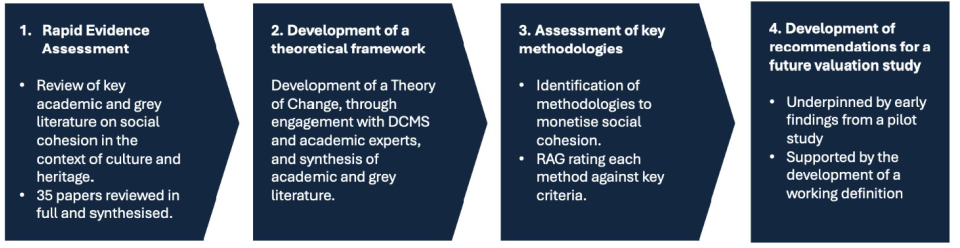
To understand the feasibility of valuing social cohesion for culture and heritage, we deployed the following methodological steps:
Figure 1: Key methodological steps
Key findings
Findings from the literature
The quality of the evidence base we reviewed as part of the Rapid Evidence Assessment was mixed, with most studies relying on cross-sectional analysis of large-scale survey data or qualitative evidence gathered through interviews. The headline findings from the evidence review included:
- There is no universally agreed definition of social cohesion. While all the definitions we found captured social connectedness between individuals, the specific elements of each definition were often influenced by the context or specific goals of the organisation providing the definition.
- Culture and heritage generate social cohesion through a range of mechanisms. The literature converged around four broad mechanisms: (i) shared identity and belonging, (ii) facilitation of social networks, (iii) solidification of shared norms and values, and (iv) provision of space for socialisation and social mixing.
- Social cohesion is associated with positive outcomes at different levels of society. The literature indicates that social cohesion can manifest at different societal levels, including at the micro-level (i.e., strengthening connections with friends or other direct connections), the meso-level (i.e., strengthening relationships at the neighbourhood or local community level), and at the macro-level (i.e., improving sense of attachment and belonging at the national level).
- There have been very few attempts to monetise the value of social cohesion as an isolated outcome. The review identified limited attempts to monetise a loss or gain of social cohesion-related outcomes, both in general and for culture and heritage specifically, with only one paper explicitly monetising social capital. There is, however, a large body of literature estimating the total welfare of culture and heritage assets and services, which could partially capture social cohesion, even if it is not directly attributed as a driver of value.
Based on the insights developed through the Rapid Evidence Assessment, development of a theoretical model, and pilot study, a suggested definition of social cohesion – which is applicable to culture and heritage – is described below:
“Social cohesion describes the strength and quality of relationships, trust, and connectedness between individuals, communities, institutions, and wider society. It encompasses the extent to which people feel they belong, participate, and cooperate across social groups and institutions. Social cohesion operates at multiple levels: at the micro level through relationships between individuals; at the meso level through engagement with local communities, organisations, and places; and at the macro level through individuals’ relationships with wider society, its institutions, culture, and systems of governance.”
Theoretical framework for social cohesion of culture & heritage
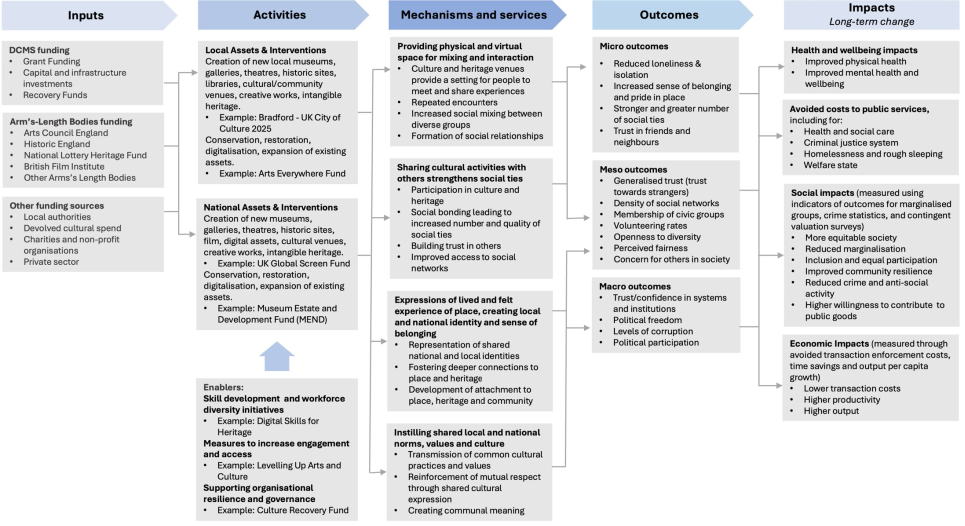
We developed a Theoretical Framework for how social cohesion manifests from policies designed to enhance culture and heritage assets in the UK. This model consisted of:
- Inputs, activities, and enablers. Funding from DCMS, Arm’s Length Bodies, and other sector stakeholders supports the creation, conservation, restoration, digitalisation, and expansion of local and national culture and heritage assets in the UK. Social cohesion then flows from these assets and the services they provide, which are further enhanced by a series of enabling initiatives, including workforce and diversity programmes, measures to promote engagement and access, and policies that support organisational resilience and governance.
- Mechanisms and services. Causal mechanisms are the means through which activities (culture and heritage assets) influence social cohesion-related outcomes and impacts. Key mechanisms highlighted in our Theoretical Framework include (i) interactions, both physical and virtual, leading to, (ii) sharing cultural activities with others to strengthen social ties, (iii) providing expressions of lived experience of place, creating local and national identity and a sense of belonging, and (iv) instilling shared local norms, values, and culture.
- Outcomes and impacts. These causal mechanisms ultimately connect social cohesion to a range of positive outcomes at different levels in society, which then manifest as a series of impacts. More immediate outcomes of social cohesion include increased trust in neighbours, participation in civic and social groups, and greater levels of political engagement. In the longer term, the Theoretical Framework describes how improvements in these factors can lead to enhanced health and wellbeing, avoided public service costs, and socio-economic benefits. The full Theoretical Framework is provided below:
Figure 2. Theoretical framework for CHC social cohesion
Approaches to valuing social cohesion
Following the development of our Theoretical Framework, we assessed six valuation methods in terms of their monetisability, their robustness in isolating and measuring social cohesion, their data and resource requirements, and the scope of the social cohesion impacts the method is able to measure. Key takeaways from our assessment, supplemented with findings from our pilot study, included:
- Social cohesion is inherently challenging to monetise and value. While stated preference methods may capture some aspects of social cohesion, there are inherent challenges in its monetisation and valuation, meaning that any method must be applied cautiously. Specific challenges include overlapping indicators (leading to potential double counting), respondents having different perceptions of social cohesion, and some outcomes (e.g., sense of belonging or trust) being non-monetisable in isolation. Pilot study participants associated a range of different outcomes with social cohesion, and provided a range of definitions, supporting the idea it is a complex and multidimensional concept.
- The existing suite of valuation method options for culture and heritage assets and services at least partially capture social cohesion. Social cohesion can materialise from culture and heritage assets and services as both use and non-use value, and therefore to varying extents can be captured by existing valuation methods. Contingent valuation, discrete choice experiments, and wellbeing valuation can all, in principle, be set up to capture both of these elements of social cohesion within the welfare valuations they provide. Coin allocation exercises asking respondents to provide information on their drivers of value following the willingness to pay questions were included in the pilot study. Notably, the three social cohesion-related dimensions, social interaction between different groups, belonging and shared identity, and trust, respect, and social cooperation, together accounted for approximately 30% of total allocations on average. This suggests that social cohesion represents a substantial component of the value respondents derive from library services, although it is only one of several important sources of value.
- No single valuation method is a best fit for the monetisation and valuation of social cohesion in all circumstances. The most suitable methodology to value social cohesion will depend on the type of outcomes being valued, the availability of data, and the specific aims of the valuation exercise. As noted above, when conducting valuations of whole or marginal changes to culture and heritage assets and services, stated preference methods (such as contingent valuation, discrete choice experiments) and wellbeing valuation are well-placed to capture many of the dimensions of social cohesion. While valuing social cohesion at the outcome level remains more complex, some benefit streams can still be monetised using methods such as avoided costs analysis.
- Qualitative methods can provide crucial context and insight into potential drivers of value. Given social cohesion is challenging to measure as a standalone benefit stream, all valuation methods identified can benefit from supplementary qualitative research to provide additional insight into underlying drivers of value. This was partially evidenced through the pilot study, where follow-ups, such as open-ended questions and coin allocations, provided additional insight on more nuanced elements, such as respondents’ varied drivers of value and conceptualisations of social cohesion.
Recommendations for future research
The following recommendations represent guidance for practitioners when attempting to value social cohesion from culture and heritage:
- Recommendation 1: Consider the specific context, use-case, and rationale for the valuation study when determining which method to use. Social cohesion manifests in different ways depending on the type of asset or service being valued. The chosen valuation methodology should therefore be guided by the asset or service being valued and the specific aims of the valuation exercise, rather than applying one method uniformly in all cases.
- Recommendation 2: When eliciting valuations for culture and heritage assets and services, this should be paired with qualitative research to attribute value specifically to social cohesion. The pilot study illustrated how follow-up questions and deliberative exercises – including coin allocations and ranking questions – can be used to apportion top-down valuations across different drivers of value, such as dimensions of social cohesion. Open-ended qualitative questions were found to provide additional insight into definitions and comprehension of social cohesion. We anticipate that in-depth qualitative research methods, such as interviews and focus groups, can also play a valuable role in facilitating a better understanding of how and why different dimensions of social cohesion are perceived to materialise.
- Recommendation 3: Consider adding information on social cohesion mechanisms and outcomes into descriptions of culture and heritage when eliciting valuations from the public. Where valuations of culture and heritage assets and services are elicited directly from members of the public (for example, when implementing stated preference methods), researchers should consider adding designated text or visual aids to prompt respondents to factor potential social cohesion benefits into their valuations. The addition of supplementary information on social cohesion outcomes to the descriptions posed to respondents of the pilot study did not markedly change the willingness to pay elicited for local libraries, although we cannot rule out that such prompting could lead to more reliable valuations for other types of culture and heritage asset, particularly where the links between the underlying asset and social cohesion are less direct or obvious.
We also propose a set of avenues for future research, in response to evidence gaps identified through the scoping research:
- Recommendation 4: New qualitative research should be explored to understand how and why social cohesion manifests from culture and heritage, and the extent to which it is captured by existing valuation methods. While the pilot provided high-level insights into how the members of the public perceive social cohesion, the evidence base would benefit from new qualitative research to explore which elements or outcomes of social cohesion are most salient to individuals, to further validate causal links identified in the Theoretical Framework and provide new insights into how social cohesion influences individual valuations for different types of culture and heritage assets and services.
- Recommendation 5: Conduct causal research linking provision of culture and heritage assets and services to improvements in outcomes related to social cohesion. Development of robust causal analysis to quantify the link between engagement with different types of culture and heritage assets and services and social cohesion would strengthen understanding of the specific dimensions of social cohesion that it generates.
- Recommendation 6: Explore development of methods for valuing social cohesion as an outcome. While most studies we identified attempted to value specific assets or services and attribute some of that value to social cohesion, we found limited evidence in the way of previous research that seeks to elicit a value for social cohesion as an explicit outcome using bottom-up analysis. Future research should explore methods for valuing social cohesion as a standalone outcome. One such approach to doing this in future could be developing a standardised scale for social cohesion, which could then be used as the basis for self-assessment of social cohesion by members of the public, allowing evaluators to measure and monetise impact on a comparable basis, similar to the use of WELLBYs. The pilot study found that individuals had difficulties interpreting and valuing changes in social cohesion as a broad concept, suggesting a decomposed scale may be more appropriate.
2. Introduction and background
The Department for Digital, Culture, Media and Sport (DCMS) has commissioned Alma Economics to conduct scoping research on potential methodologies to monetise the value of social cohesion in the context of culture and heritage.
This is a part of its Culture and Heritage Capital (CHC) programme, which aims to better account for the market and non-market benefits generated by creative, cultural and heritage assets through conceptualising culture and heritage assets as a form of capital that generates services which create a flow benefit for individuals and wider society. The CHC Programme is developing new methods, practical tools, and an evidence bank to ensure that the full economic, social, cultural and environmental benefits of culture, the creative industries and heritage are included in appraisals (social cost-benefit analysis (SCBA)) and evaluations.
This scoping work will support the development of quantitative evidence to substantiate social cohesion in the culture and heritage sector, informing future public investment decisions.
Specifically, the research aims to address the following questions:
1. How is social cohesion defined in the context of culture and heritage, and what are its sub-components and dimensions?
2. Through which causal mechanisms do culture and heritage assets and services enhance social cohesion?
3. What outcomes does social cohesion lead to, and can they be measured in isolation?
4. What methodologies can be used to monetise the value of social cohesion?
5. How do monetised values of social cohesion interact with other forms of value? (e.g., subjective wellbeing)
6. What are the risks of implementing these methodologies? (e.g., double counting)
Overall, the specific measurement and valuation of social cohesion is an emergent research area, with a limited number of existing studies. Therefore, the current research provides an important early step in understanding the feasibility of valuation of social cohesion and the extent to which it can be incorporated into an SCBA-framework. A core challenge of this research (and measuring and monetising social cohesion more broadly) is navigating the risk of double counting within SCBA. Because existing use and non-use valuation studies may already implicitly capture elements of social cohesion, a clear analytical boundary must be established. Specifically, this research aims to address a three-part challenge:
- Deconstruction: The study aims to determine exactly if, and to what extent, existing use and non-use values already encompass social cohesion.
- Gap Analysis: If overlap exists, the study aims to identify how to isolate and value any “missing” dimensions of social cohesion not currently captured within existing use and non-use values, without double counting.
- Integration: If no overlap exists, the study aims to identify the most robust methodologies to introduce and quantify social cohesion as a distinct variable within the SCBA framework.
Methodology and approach
In order to comprehensively assess potential methodologies to monetise social cohesion, we used a mixed-methods approach, comprised of multiple elements. Details on each phase of the methodology are provided below.
Rapid evidence assessment
To review the literature on social cohesion in the context of culture and heritage, we applied a flexible rapid evidence assessment (REA) methodology. As a first step in the research, we developed a search protocol outlining the search terms, inclusion, and exclusion criteria to guide our review. Search terms were then applied to academic databases determined by the research team to be the most relevant.
Following the academic search, the team sifted the results of the searches to develop a reading list, assessing papers on (i) their relevance to the research questions, (ii) their methodological quality, and (iii) their adherence to a set of inclusion and exclusion criteria established in our search protocol. In addition to academic literature, we also used sources from the grey literature to fill in key gaps. Grey literature papers were identified through snowballing, the use of targeted search terms, and steers from DCMS on key sources and academics.
Each paper was then assigned a quality score, using a bespoke evaluation framework. In total, 35 papers were included in our review. Key findings from the REA are provided in Chapter 3.
Development of a theoretical framework
Drawing on insights from the REA, we developed and refined a Theoretical Framework for social cohesion, which articulates the mechanisms through which culture and heritage investment manifests as social cohesion. We used a Theory of Change framework to depict the mechanisms through which culture and heritage can impact social cohesion, and other wider outcomes and impacts that may flow from social cohesion.
Following the initial development of our Theoretical Framework, we refined our model through a scoping workshop with DCMS, and through feedback from academics in the sector with specific expertise in social and community cohesion, and its relationship to culture and heritage. More detail on our approach to development of the Theoretical Framework is provided in Chapter 4.
The Theoretical Framework, REA, and results from the pilot informed the development of a definition of social cohesion.
Methodological assessment
Based on the insights from the REA and our Theoretical Framework, we identified and assessed approaches to measuring social cohesion for the culture and heritage sector. For each methodology included, we assessed their strengths and limitations, data and resource requirements, and how they could be applied to social cohesion. Following our initial review of methodologies, we used a Red Amber Green (RAG) rating approach to assess each methodology against key criteria to determine their overall suitability for monetising social cohesion. The assessment considered four criteria: monetisability, robustness in isolating and measuring social cohesion, data and resource requirements, and the scope of impacts captured.
Development of recommendations for a future valuation study
Following our methodological assessment and drawing on all research strands, we developed two sets of recommendations to guide future work on the monetisation and valuation of social cohesion. The first set of recommendations aimed to inform a future valuation study of social cohesion specifically and could be applied relatively easily within stated preference studies of culture and heritage assets or services. The second set of recommendations was more speculative and focused on broader research activities to close the evidence gaps identified during the scoping study.
Pilot study of valuation of social cohesion
A pilot study was undertaken to test the feasibility of using a contingent valuation survey to develop a monetised estimate of the value that people place on social cohesion in the context of culture and heritage. The survey explored two distinct approaches:
- An asset-based approach, through which values were elicited for a specific cultural asset (a local library, with respondents then asked to attribute this value to different drivers, including social cohesion).
- An outcome-focused approach, through which respondents were asked to value changes in social cohesion using a general social cohesion scale, where changes in the scale represented changes in the over level of social cohesion in the UK.
The survey also included additional questions exploring respondents’ understanding of social cohesion, attitudes towards their local community, library use, and perceptions of the relationship between culture, heritage and social cohesion. Coin allocation exercises were used to better understand the factors underlying respondents’ valuations.
The pilot was disseminated through the online recruitment platform Prolific to a sample of UK adults. A total of 500 respondents participated, resulting in 496 valid responses for analysis. The primary objective was to test different survey designs and valuation approaches rather than to produce definitive monetary estimates of the value of social cohesion.
Structure of the report
The remainder of the report is structured as follows:
- Chapter 4 sets out key findings from the REA.
- Chapter 5 provides detail on key UK-based datasets and indicators available to measure social cohesion and its component parts.
- Chapter 6 outlines key methodologies for monetisation of social cohesion.
- Chapter 7 provides our assessment of key methodologies, RAG-rating them against four key criteria: monetisability, robustness in isolating and measuring social cohesion, data and resource requirements, and the scope of impacts able to be measured.
- Chapter 8 provides a summary of findings from the pilot study, including respondents’ perception of social cohesion in the UK, and willingness to pay for social cohesion in general and in the context of a specific cultural asset.
- Chapter 9 provides key takeaways from the research and recommendations for future valuations of social cohesion.
Additional detail on indicators identified in UK-focused datasets to measure social cohesion and full findings from the REA are provided in Appendices A and B, respectively.
3. What does the literature say about social cohesion in the context of culture and heritage?
In order to inform the scoping study, we conducted a rapid evidence assessment (REA) to synthesise the baseline evidence on how social cohesion is defined, the role of culture and heritage in strengthening social cohesion, and existing efforts to value or monetise social cohesion. This chapter provides key findings from the REA, with the full literature review provided in Appendix B.
Overall, we reviewed 35 papers in detail as part of this REA. Generally, the quality of the evidence was mixed in terms of methodological rigour, with most papers relying on regression or cross-sectional analysis of large-scale survey data or qualitative evidence collected through interviews. Most papers were not able to make causal claims, or test formal hypotheses related to mechanisms through which culture and heritage influence social cohesion. The literature concerning the monetisation of social cohesion was also very limited in scale, with only a few examples of stated preferences methods being applied.
How is social cohesion defined?
Generally, there was no consensus in the literature as to the definition of social cohesion. While all definitions identified broadly related to the social connections between people, specific elements were influenced by the context or organisational priorities of the organisation putting forward the definition. Some definitions (e.g., that of the OECD) were found to have a greater focus on outcomes, prioritising measurable elements such as sense of trust, belonging, and participation, while others placed stronger emphasis on a society’s institutions and the ability of a society to minimise polarisation, inequality, and social disparities. A few studies also acknowledged the fact that social cohesion is not a directly observable concept, and can only be measured through its various dimensions, with commonly cited dimensions including sense of belonging, inclusion, diversity, respect for social rules, and civic participation, among others.
Based on the insights developed through the REA, Theoretical Framework, and pilot survey, a suggested definition of social cohesion – which is also applicable to culture and heritage – is described below:
“Social cohesion describes the strength and quality of relationships, trust, and connectedness between individuals, communities, institutions, and wider society. It encompasses the extent to which people feel they belong, participate, and cooperate across social groups and institutions. Social cohesion operates at multiple levels: at the micro level through relationships between individuals; at the meso level through engagement with local communities, organisations, and places; and at the macro level through individuals’ relationships with wider society, its institutions, culture, and systems of governance.”
A fuller discussion of how social cohesion is defined in the literature is provided in Appendix B.
Through what mechanisms does culture and heritage influence social cohesion?
Our review found that culture and heritage impact social cohesion through a range of often interconnected mechanisms. It should be noted that several of these mechanisms or drivers could also be considered outcomes, as social cohesion was identified as both an effect and a cause. While some studies formally tested mechanisms and others relied on theorised pathways, the literature converges around four broad categories of mechanism:
- Shared identity and belonging: Evidence from diverse contexts, including historic places,** large-scale cultural festivals, and local heritage and cultural groups, suggests that culture and heritage can strengthen feelings of connection, trust, and shared identity. Importantly, some studies suggest that this effect does not depend solely on repeated or close interaction; even one-off or symbolic experiences, such as attendance at festivals or engagement with historic sites, can generate collective emotion and shared meaning. These shared identities often sustain longer-term commitment, reinforce belonging, and maintain collective memory, thereby strengthening cohesion.
- Facilitation of social networks: The literature also demonstrates that participation in cultural activities generates opportunities to create new ties and deepen existing ones, linking individuals who might not otherwise interact. For example, research by Cebula and Perchla-Włosik (2023) showed that different forms of cultural consumption are associated with distinct types of social capital: engagement in ‘high culture’ (e.g., theatre, opera) is linked to access to instrumental resources such as job connections or financial support, while participation in ‘popular culture’ (e.g., sport, music, television) supports expressive ties such as friendships and lifestyle-based networks. The authors posited that cultural tastes act as “interactional hooks,” whereby discussing cultural preferences, people recognise the identity, status, group membership, and shared preferences of their social network. Similarly, Philip et al. (2022) demonstrated that culturally grounded community programmes strengthen peer relationships and intergenerational bonds through shared practices and knowledge transmission.
- Solidification of shared norms and values: Culture and heritage assets and services can also foster social cohesion through reinforcement of shared norms, values, and cultural identities. Participation in heritage-related groups allows people to socialise, co-create historical narratives, and engage with traditions. This is exemplified through the work of Beel et al. (2017), who found that members of a local Scottish historical community developed stronger local connections and a greater sense of collective identity through these shared heritage experiences.
- Provision of space for socialisation and social mixing: Culture and heritage assets, along with well-designed physical environments, promote social cohesion by facilitating interaction between diverse groups. Historic sites, museums, parks, and high streets essentially act as social infrastructure where people can meet and build shared trust. The literature reviewed found that features such as participatory programmes, high-quality amenities, and certain physical attributes increase opportunities for repeated encounters and social engagements, strengthening community bonds.
What outcomes does social cohesion lead to?
Our review of the literature found social cohesion was associated with a range of varied outcomes. The literature suggests social cohesion can manifest at different societal levels, including at the micro level (e.g., individuals engaging with friends or other direct connections), the meso level (e.g., an individual’s relationship with their neighbourhood or local community), and at the macro level (e.g., an individual’s relationship with the wider society or the state):
- At the micro level, social cohesion is most commonly reflected in interpersonal trust and the strength of social ties, with individuals reporting closer relationships and greater levels of cooperation in communities where cohesion is higher.
- At the meso level, social cohesion is captured through civic participation, associational and group memberships, and attitudes toward diversity, with engagement in voluntary or communal activities fostering repeated interactions and collective support.
- At the macro level, social cohesion extends to “vertical” relationships with broader society and institutions, including trust in government, the justice system, and public organisations, as well as perceptions of political freedom and legitimacy.
Beyond first-order outcomes (e.g., those that flow immediately from social cohesion such as trust or feelings of belonging), social cohesion also generates second-order benefits that extend to wider community and social outcomes. More cohesive societies are associated with improved wellbeing, including mental health, self-esteem, and overall quality of life. There is also evidence that suggests social cohesion increases individuals’ willingness to contribute to public goods, such as environmental protection or community renewal projects, through mechanisms like social trust and network engagement. However, similar to the literature regarding outcomes and drivers, most studies remain correlational, making it difficult to disentangle cause and effect, and thus introducing potential for reverse causality[footnote 1].
Methodologies to measure and monetise the value of social cohesion
Our review identified that social cohesion outcomes are largely measured through the use of survey-based indicators. These can be either:
- Perceptual, referring to individuals’ perceptions of social cohesion. These are typically collected through surveys, where respondents answer a series of closed-ended questions using scales or a limited set of response options, or
- Behavioural, examining actual behaviours within a society rather than relying solely on individuals’ perceptions or attitudes. This often involves survey responses in which participants report on specific behaviours or experiences, such as the number of close social ties or number of civic associations or formal groups to which they belong.
Several studies used composite scales combining both behavioural and perceptual indicators. Whilst composite indicators have the benefit of capturing multiple dimensions of social cohesion, they often do not then causally assess specific dimensions of social cohesion. Some outcomes or dimensions are also more well-covered than others. The indicators identified in the reviewed papers effectively capture certain dimensions of social cohesion, including trust in other community members, sense of belonging, and participation. However, fewer indicators were used to assess other important aspects, such as mobility or inequality.
While many of the papers identified in the REA measured social cohesion using the indicators described, attempts to monetise social cohesion were identified as a key gap. This is likely partly because social cohesion cannot be fully captured by a single indicator. The review identified one paper explicitly monetising social capital, using a compensating surplus approach to measure the income required to compensate an individual for a change in the level of trust or connectedness with others. Fujiwara et al. (2013) also used the wellbeing valuation approach to monetise the value of aspects of civil society, including not being able to meet up with friends (-£17,300 p.a.), high trust in society (£15,900 p.a.), and living in an unsafe neighbourhood (-£33,700 p.a.). A small number of studies have also applied stated preference techniques that can explicitly monetise social cohesion. These include Green et al. (2004), who used contingent valuation to monetise the loss of social capital associated with the termination of leases for hunting clubs in New York state, and Kinghorn and Willis (2008), who used choice experiments to assess opportunities for development of social capital in the context of the Discovery Museum in North-East England.
Our review identified relatively few studies exploring the relationship between social cohesion and other forms of value, with most focusing on subjective wellbeing. However, no papers identified specifically examined the interactions between monetised values of social cohesion and other forms of value such as use values, personal wellbeing, or educational outcomes.
4. Conceptual framework
Rationale
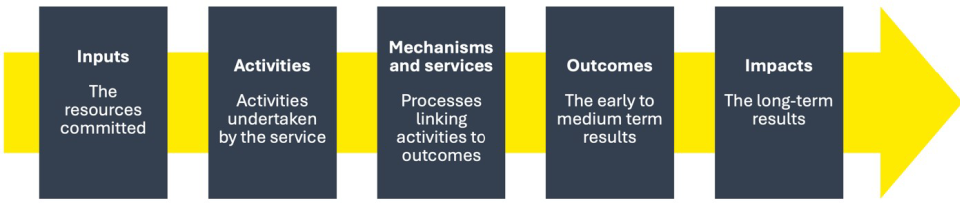
This chapter outlines the Theoretical Framework used to conceptualise how investment in culture and heritage assets can contribute to social cohesion and generate longer-term societal impacts. To structure this framework, we utilise a Theory of Change, a commonly used tool for defining and illustrating the relationships between key elements, including inputs, activities, causal mechanisms, outcomes, and longer-term impacts.
Figure 3: Components of a theory of change
At present, there is no widely established theoretical framework that systematically sets out how culture and heritage assets enhance social cohesion. As a result, the social benefits associated with cultural and heritage investment may be overlooked or insufficiently captured in economic appraisal and SCBA, potentially leading to an underestimation of their wider social value and a misallocation of public funding. To better account for the market and non-market benefits generated by cultural and heritage assets, DCMS has developed the Culture and Heritage Capital (CHC) framework. This approach conceptualises culture and heritage assets as a form of capital that generates benefits for individuals and wider society, which can be quantified, monetised, and incorporated into economic appraisals.
Developing a Theory of Change represents an important first step towards monetising the benefits of social cohesion in line with the CHC framework. It helps to clarify the key dimensions of social cohesion, the mechanisms through which investment in cultural and heritage assets enhances social cohesion, and the potential impacts that can be measured. In doing so, the Framework supports the development of a shared understanding amongst policymakers and researchers, clarifying relevant pathways, outcomes, and impacts. The framework also helps to identify specific facets of social cohesion that are most appropriate for measurement and monetisation within policy appraisal.
As with any conceptual framework, the Theory of Change represents a simplified model of complex social processes. The relationships described should therefore be understood as a necessary simplification of the pathways through which social cohesion may be generated, rather than a comprehensive explanation. In particular, the model cannot fully capture the complexity of these processes, such as feedback loops, interactions between different elements, or the full range of social cohesion outcomes that culture and heritage assets may produce.
Evidence underpinning the theoretical framework
Our Framework is grounded in evidence from the REA, which examined how cultural and heritage assets contribute to social cohesion and generate subsequent second-order impacts. The REA findings were supplemented with additional publicly available grey literature evidence and expert input from academics. Where gaps persisted, logical reasoning was applied to complete the pathways.
Inputs and activities
Evidence on inputs, activities, and enablers was initially identified during the scoping phase of the research and further supported by publicly available sources on culture and heritage funding and initiatives. We reviewed materials from DCMS and its Arm’s Length Bodies, including the British Film Institute (BFI), Historic England, Arts Council England, and the National Lottery Heritage Fund. This involved examining available online content such as news articles and press releases regarding funded projects and initiatives to build a comprehensive understanding of funding streams for cultural and heritage assets, the types of activities supported, and the key enabling factors. Overall, there was a substantial and robust body of evidence in the public domain that informed these three components of the Theoretical Framework.
Mechanisms and services
The REA identified a range of studies examining potential mechanistic pathways through which cultural and heritage-related inputs and activities may contribute to social cohesion outcomes. Where evidence gaps remained, these were addressed through logical reasoning. Overall, the studies examined were generally correlational and did not support strong causal claims. In some cases, reverse causality is a possibility, making it unclear whether the relationship runs from the activities to the outcomes or from the outcomes to the activities. For example, while increased social mixing may enhance a sense of belonging, it is equally plausible that a stronger sense of belonging encourages greater social mixing. The correlational nature of the evidence does not allow for clear determination of causal direction. In the absence of high-quality causal evidence, the Theoretical Framework is especially valuable as it provides a structured, explicit explanation of how and why an intervention is expected to work, relying on structured logic and reasoning.
Outcomes and impacts
The REA also identified numerous indicators that have been used within the literature to measure the different aspects of social cohesion. The literature provided an extensive list of outcomes through which social cohesion can manifest, drawing from both theoretical frameworks and empirically measured indicators.
Finally, the REA highlighted potential channels through which social cohesion may generate longer-term, second-order impacts. Similar to the mechanisms identified above, the evidence linking social cohesion to these further impacts is largely correlational and does not establish robust causality. As such, issues like reverse causality or omitted variable bias may be present, and causal links cannot be definitively confirmed.
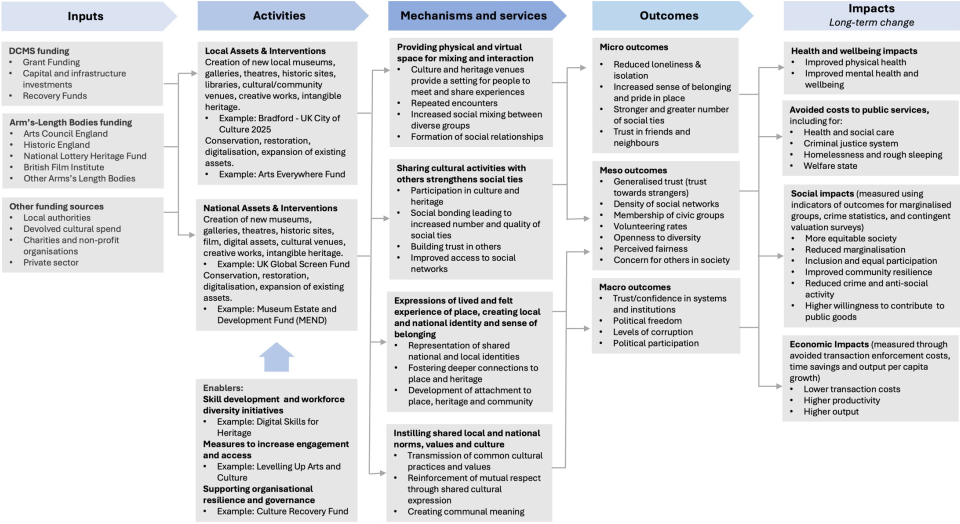
Figure 4: Theory of change: culture + heritage and social cohesion
Narrative discussion of theory of change
Figure 4 above presents our Theoretical Framework, outlining the inputs and activities, the mechanisms and services that translate these activities into outcomes, and ultimately the second-order impacts.
Inputs
Inputs refer to the funding sources within the UK culture and heritage sector. This includes direct funding from DCMS, such as grants, capital investment, and recovery funds. Additional funding is channelled through various arm’s-length bodies of DCMS, including Arts Council England, Historic England, the National Lottery Heritage Fund, and the British Film Institute. The framework also recognises funding sources beyond DCMS’s remit, such as local authority funding, devolved cultural spending, private sector investment, and contributions from charities and NGOs.
Activities
These inputs support a range of activities, which can be broadly categorised into funding for local and national assets and services. These activities encompass both top-down initiatives led by central government and bottom-up efforts driven by local authorities and community organisations. The nature and scope of these activities can also vary considerably across the UK, reflecting differences in regional, city, town, and community resources and capacities. Across these levels, support focuses on two primary objectives. Firstly, it enables the creation of new culture and heritage assets, such as the construction of museums or the establishment of cultural events. Secondly, it supports the maintenance and improvement of existing assets and services, including restoration work, digitalisation, and expansion.
Enablers
An important additional component of the Theoretical Framework is the set of enablers that enhance the effectiveness of activities in generating social cohesion outcomes. These encompass initiatives aimed at skills development and workforce diversity, as well as efforts to enhance organisational resilience and governance. They also include measures to remove barriers to participation in culture and heritage, promoting broader engagement and improved access.
Mechanisms and services
The activities detailed above feed into a set of mechanisms and services that explain how investment in the creation, renovation, and expansion of culture and heritage assets contribute to social cohesion. These mechanisms are grouped into four categories:
- Interactions, both physical and virtual, contributing to shared experiences, and relationship formation.
- Facilitating shared cultural participation, which helps build social ties, trust, and access to networks.
- Enabling the expression of lived experiences of place, thereby fostering identity and a sense of belonging at local and national levels.
- Promoting shared norms, values, and cultural practices, reinforcing mutual respect and understanding.
The mechanisms and services identified in the Theoretical Framework align closely with the services typology outlined in DCMS’ Culture and Heritage Capital framework. The CHC framework describes Services as actions, processes, attributes or qualities that lead to benefits, both directly or indirectly, perceived and experienced by society. Services can be produced directly from an asset or combined with other capitals, such as human capital, through production.
Outcomes
These mechanisms lead to a range of outcomes relating to different aspects of social cohesion. These have been grouped into three levels: micro, meso, and macro.
- Micro level outcomes occur at the individual level and include reduced isolation, increased trust in friends and neighbours, a stronger sense of belonging, and expanded social ties.
- Meso level outcomes operate at the community or neighbourhood level, including generalised trust, volunteering rates, openness towards others, and participation in civic organisations.
- Macro level outcomes relate to national-level indicators, such as political participation, trust in institutions, and broader measures of governance, including levels of corruption and political freedom.
Impacts
Finally, the Framework identifies longer-term, second-order impacts that arise partly through improved social cohesion. These impacts, which consist of both financial and non-financial benefits, are grouped into four key categories:
- Enhanced physical and mental health and wellbeing.
- Costs avoided through lower demand for public services, including health and social care, criminal justice, homelessness support, and welfare systems.
- Wider social benefits, such as a more equitable and inclusive society, lower levels of crime and marginalisation, increased willingness to contribute to public goods, and stronger community resilience.
- Economic impacts, including lower transaction costs and increased productivity and economic output.
5. Indicators to measure social cohesion
As identified through the REA, social cohesion is a variable that is not directly observable or measurable. Rather, it is a multidimensional concept that encompasses one’s sense of belonging, trust in others, or engagement with their local community. Because of the multi-dimensional nature of social cohesion, a first step in its measurement is the development of quantifiable metrics or indicators that can capture otherwise unobservable or abstract concepts. These indicators play a critical role in translating these abstract concepts into observable and quantifiable variables, enabling both empirical analysis and policy evaluation.
This is particularly important in valuation contexts, where approaches such as stated preference methods or wellbeing valuation rely on clearly defined and measurable aspects of social cohesion in order to estimate its monetary value. The robustness of these estimates therefore depends critically on the clarity and relevance of the indicators used to construct credible valuation scenarios. The following chapter provides detail on key UK-focused datasets that include indicators for the measurement of social cohesion, aligned to those identified in the Theoretical Framework.
Datasets to measure social cohesion
A wide range of datasets have been used in the literature to measure social cohesion and related concepts. These include the International Social Survey Programme, the European Social Survey, the Afrobarometer Survey, the Current Population Survey, and the World Values Survey, amongst others. Most of the datasets identified in the literature are cross-sectional, rather than longitudinal, and capture observations at the individual level. Most datasets also rely on a core module of questions included every year, along with other questions that vary across years or waves. Below, we focus on four UK-focused datasets identified to be the most relevant for measurement of social cohesion within a UK context. We have included a high-level summary of their strengths, weaknesses, and what indicators they cover. Specific variables included within each dataset are detailed in Appendix A.
Key takeaways
While there are several useful secondary data sources for measuring social cohesion, coverage of indicators is mixed, with no single dataset identified in the UK robustly capturing all outcomes. This is unsurprising, given the inherently broad and multidimensional nature of social cohesion, which spans outcomes ranging from individual experiences (e.g., loneliness) to system-level characteristics (e.g., trust in the government). Instead, the datasets differ in their areas of strength. For example, the Community Engagement Survey (CES) contains a wide range of micro-level indicators, capturing most relevant individual-level outcomes, but offers limited coverage of macro-level dimensions. In contrast, the British Social Attitudes survey includes few micro-level measures but provides detailed indicators on political participation and trust in political institutions within the UK.
Across all datasets, several important indicators are consistently absent; these are:
- Trust in friends
- Political freedom
- Levels of corruption
- Density of social networks
The lack of measures capturing trust in friends, as distinct from trust in neighbours (which is included in Understanding Society and the CES), likely reflects an implicit assumption that friendships are conditional on trust, reducing the perceived need to measure it explicitly. The omission of measures of corruption or a direct question on political freedom is expected, as such topics are either sensitive or beyond the direct knowledge of respondents. In empirical research, these dimensions are typically incorporated using external data sources, such as the Corruption Perceptions Index or Freedom House indicators. Finally, none of the datasets examined in detail includes measures of social network density. By definition, this requires information on both actual and potential social ties, and respondents are unlikely to have sufficient knowledge to report the latter reliably, making such questions impractical in standard surveys and interviews.
Overall, among the datasets considered, Understanding Society is a strong option for many use cases. It provides extensive coverage of key micro- and meso-level outcomes, benefits from a large sample size, and, crucially, is longitudinal. This allows researchers to analyse changes in social cohesion over time, which is particularly important given that many outcomes, such as generalised trust, evolve over time and are unlikely to respond immediately to interventions or policy changes. However, for research specifically focused on macro-level dimensions of social cohesion, the British Social Attitudes Survey (BSA) may be more appropriate than other measures with a macro-focus, such as the European Social Survey (ESS). The BSA has a longer time series, is conducted more frequently, and includes a larger UK sample. Moreover, its questions on institutional trust are grounded in the UK context, whereas the ESS adopts more generalised formulations.
In addition to the indicators included within administrative datasets, there are also several well-established and psychometrically validated indicators and scales used largely taken from the environmental psychology literature that measure key outcomes associated with social cohesion, including felt-experience, sense of belonging, and pride of place. While we do not include a full review of such scales in our scoping study, any future valuation study should aim to rely on such validated measures to ensure alignment with the academic literature.
UK Household Longitudinal Survey (Understanding Society)
The UK Household Longitudinal Survey (UKHLS), commonly known as Understanding Society, is a longitudinal study covering approximately 40,000 households across the UK. Data collection for Understanding Society first began in 2009 and has been conducted for 15 waves since. It is a panel dataset, with each wave of data collection lasting approximately two years. UKHLS was preceded by the British Household Panel Survey, which first started data collection in 1991. Data from Understanding Society is available through the UK Data Service. While some data is accessible to all registered researchers, access to some indicators (e.g., any identifiable information) requires a more in-depth application process. Key indicators covered by UKHLS, and mapped to our Theoretical Framework, are described below:
- Micro-level indicators: Understanding Society has a wide range of indicators corresponding closely to micro-level outcomes presented in our Theoretical Framework. Specifically, key outcomes covered include reduced loneliness and social isolation, and a sense of belonging. A key gap identified within Understanding Society was a question assessing the number of social ties an individual has.
- Meso-level indicators: Understanding Society also has a number of indicators that can be used to assess the meso-outcomes presented in our Theoretical Framework. These include measurement of generalised trust, membership in civic groups or organisations, openness to diversity, and perceived fairness.
- Macro-level indicators: Generally, macro-level indicators are less well-covered by Understanding Society. While political participation is covered in the survey, we identified no other indicators mapping to macro-level outcomes.
DCMS Community and Engagement Survey
The DCMS Community Engagement Survey (CES) is a cross-sectional survey of individuals aged 16 and over in England. Introduced in 2025, it replaces both the Participation Survey and the Community Life Survey, combining their content into a single integrated survey instrument. As a relatively new survey, detailed information on its sample size is limited; however, it is expected to be substantial, given that the surveys it replaces had large samples (approximately 175,000 for the Community Life Survey and 33,000 for the Participation Survey in 2025/26). The CES is designed to explore how individuals engage with their communities, as well as with culture, media, and live sport, and includes questions on social networks, relationships with the local community, and participation in civic activities and volunteering. While the CES is a promising resource for measuring social cohesion, its relative newness means there may be issues or challenges with its use that have not yet been addressed. Key indicators covered by the CES and mapped to our Theoretical Framework are detailed below:
- Micro-level indicators: The CES includes a range of indicators closely aligned with micro-level outcomes included in our Theoretical Framework, including loneliness and social isolation, sense of belonging, social ties, and trust in neighbours.
- Meso-level indicators: Given the focus of the CES on community engagement, there are a large number of questions assessing individuals’ participation in civic and community groups, and their perception of their local area. Although there are several questions on individuals’ participation in voluntary or leisure activities, there is a lack of questions assessing generalised trust.
- Macro-level indicators: There is a lack of questions on macro-level outcomes in CES. The most relevant questions concern engagement with local politics. However, beyond these questions, there are no questions corresponding to broader political participation or the respondent’s trust in institutions. Furthermore, there are no indicators assessing political freedom or corruption.
In summary, whilst the CES comprehensively covers micro-level and meso-level indicators, there could be scope for greater inclusion of macro-level indicators, such as trust in the government or other institutions. However, some elements (such as political corruption, institutional legitimacy, etc.) may not be able to be accurately captured by individual-level responses, as respondents may not have a sense of these components.
European Social Survey
The European Social Survey (ESS) is a cross-sectional survey aiming to collect data on the attitudes, beliefs, and behaviours of people across Europe. The ESS has been collected once every two years since 2002 and includes 11 total waves of data collection. Thirty-nine countries across Europe have participated in at least one wave, with the UK participating in every wave so far. One potential downside is that because the ESS does not focus solely on the UK, the sample size is smaller than other datasets detailed in this chapter, potentially reducing statistical power and limiting the ability to conduct subgroup analyses. Details on key indicators and their alignment to outcomes in our Theoretical Framework are provided below:
- Micro-level indicators: While the ESS contains a measure of loneliness, as well as questions allowing researchers to infer the strength and density of an individual’s social ties, there are also some notable gaps. For example, the ESS question covering sense of belonging focuses specifically on feelings of attachment to large and abstract entities such as one’s nation or Europe, rather than to their immediate neighbourhood. A further limitation is that there are no questions asking for respondents’ trust in friends and neighbours.
- Meso-level indicators: There are several questions in the ESS assessing respondents’ values and attitudes, but a lack of questions about participation in civic or community groups.
- Macro-level: There are a wide range of macro-level indicators in ESS that correspond to outcomes in our Theoretical Framework. Compared to Understanding Society and the CES, the ESS includes a richer set of macro-level variables, particularly relating to trust in political systems and public institutions. In addition to standard measures of political participation, such as voting behaviour, the ESS captures broader forms of civic and political engagement. It also includes questions that elicit respondents’ perceptions of the quality of the political system and the extent to which they believe their participation can lead to meaningful change. These features make the ESS particularly valuable for analysing the institutional and political dimensions of social cohesion.
British Social Attitudes Survey
The British Social Attitudes Survey (BSA) is an annual, repeated cross-sectional individual-level survey that captures trends and changes in public views on social and political issues. The BSA has been conducted annually since 1983, reaches approximately 4,000 individuals every year, and includes 300+ questions on a range of political and social topics. While some modules have been updated more recently, core questions are typically included every year, making it a key resource for tracking longer-term trends or correlations between outcomes and indicators. BSA data is also easily accessible for registered users of the UK Data Service. One key weakness of the BSA is that it is a cross-sectional dataset, meaning that the researcher cannot control for fixed effects over time, which could influence measurement of outcomes. Key indicators as mapped to our Framework include:
- Micro-level indicators: Due to the BSA’s broader focus on attitudes and political opinions, it has a stronger focus on meso- and macro-level outcomes, as compared to micro-level outcomes, with few micro-level indicators included.
- Meso-level indicators: A variety of meso-level outcomes were captured by indicators included in the BSA. While generalised trust, membership in civic groups, and perceived fairness are all represented, recent waves of the BSA lack indicators capturing density of social networks, volunteering rates, or concern for others in society.
- Macro-level indicators: The BSA covers a variety of macro-level indicators related to trust in the UK’s political system and on political participation. The BSA survey includes several questions on trust in different aspects of the political system, including the Parliament, as well as individual politicians. Furthermore, it provides a high level of detail on political participation, including interest in politics and participation in specific types of political activities. Like most datasets reviewed, it does not cover indicators on political freedom and corruption.
6. Valuation and monetisation methods
Introduction
As social cohesion is a broad and multi-dimensional concept, robust and transparent valuation requires clarity both about what is being valued, and how it is measured. A clear distinction is also needed between the levels of valuation: methods can seek to value social cohesion as a whole, aggregating across multiple impacts at once, or specific elements of social cohesion, such as reduced loneliness and social isolation, or wellbeing. Social cohesion may also overlap with other forms of value (e.g., subjective wellbeing). Therefore, a robust method for measurement and monetisation also needs to consider the risk of potentially double-counting benefit streams.
As with many other benefits without a market price that cultural and heritage assets generate, social cohesion can be overlooked in traditional economic appraisals. To fully capture the value generated by culture and heritage, including the benefits to social cohesion, it is essential to evaluate these assets within a framework that accounts for both market and non-market benefits.
Social cohesion within existing frameworks
Before considering methods for valuing social cohesion, we sought to position social cohesion within the existing valuation frameworks for culture and heritage. Mapping social cohesion to existing frameworks is important because it has implications for which methods can be applied and how. For example, understanding the extent to which social cohesion generates value for users versus non-users of culture and heritage has implications for methodology choice, with some methods generally less well-suited to capturing non-use value (e.g., hedonic pricing).
Mapping social cohesion to the CHC framework
The CHC Framework conceptualises culture and heritage assets as “stocks” which generate “flows” of services and benefits over time. Social cohesion is thus considered by the CHC Framework to be one such flow of value, representing a welfare outcome for society that can arise from interventions which create, enhance, or sustain culture and heritage assets. The framework also describes the challenges involved in assigning value to culture and heritage, above all the absence of market prices, and then proceeds to set out a range of non-market valuation methods that look beyond market prices to measure the full value of culture and heritage.
The Total Economic Value (TEV) framework complements CHC by providing an established approach for conceptualising and valuing the market and non-market benefits generated by culture and heritage assets. Applying a TEV lens allows the welfare value associated with social cohesion to be classified according to the ways in which individuals and society derive benefits from culture and heritage, including through direct use, indirect use, and non-use values. As such, the CHC Framework helps locate social cohesion within the pathway through which value is created, while TEV provides a structure for understanding the nature of that value. In short, the TEV framework sets out all of the channels through which social cohesion can create value for individuals in society.
Depending on the specific outcome, social cohesion maps to different types of value within the TEV framework. We posit that many dimensions of social cohesion can be considered to be indirect use value, given social cohesion benefits often manifest indirectly, regardless of any direct use. Other benefits, particularly the micro benefits described in the Theoretical Framework, can manifest more directly (i.e., as direct use value). Non-use value can also flow from social cohesion insofar as people value that others in society may benefit from the social cohesion flowing from culture and heritage assets and services. These mappings are discussed in more detail below.
About the TEV framework
The TEV framework estimates a resource’s total value by combining use and non-use values, capturing both tangible and intangible benefits. Widely applied in UK culture and heritage through DCMS’ Culture and Heritage Capital approach, it uses non-market valuation methods to quantify benefits without market prices. TEV provides a holistic assessment of the welfare generated by culture and heritage.
The TEV framework distinguishes between use value and non-use value. Use value refers to the benefits individuals derive from directly or indirectly interacting with a cultural or heritage asset or service, such as visiting a site or experiencing it through other means. In contrast, non-use value reflects the value individuals place on an asset even if they never directly use or engage with it. The types of use and non-use value are:
Use value:
- Direct use value: benefits from actively using or visiting an asset or service.
- Indirect use value: benefits that are derived from culture or heritage assets and services that are not used directly (e.g., local pride, community cohesion).
- Option value: the value of having the option to use the asset or service in the future.
Non-use value:
- Altruism value: satisfaction from others being able to benefit from the asset or service.
- Bequest value: value of preserving the asset or service for future generations.
Direct use value
At the micro-level, social cohesion can manifest more immediately and directly as a result of culture and heritage mechanisms that drive it. For example, museums, libraries, and cultural events can provide opportunities to meet like-minded individuals, helping to reduce loneliness and foster shared experiences. In this way, the value arises directly to “users” through the act of participation and the interpersonal interactions that culture and heritage settings facilitate.
Indirect use value
Some elements of social cohesion generated by culture and heritage can also be considered indirect use value. In these cases, individuals passively generate value for themselves through their interactions and engagement with assets and services, rather than as a result of direct engagement. For example, heritage sites, museums, and cultural activities create opportunities for shared experiences, where even individuals who do not directly engage may benefit from the resulting greater levels of community cohesion. This represents indirect use value.
Non-use value
Social cohesion can also be argued to be a form of non-use value, to the extent people derive value from the existence of culture and heritage because of social cohesion (existence value) or value its contribution in terms of social cohesion to current (altruism) and future generations (bequest). For example, individuals may value that others in society can use a local library as a community space to meet and socialise with others, even if they do not use the library themselves. Individuals may also value the existence of the library for its contribution to generating social cohesion for society, regardless of their use of it.
When thinking of social cohesion at the national level, everyone may be a “user” of social cohesion, but these users will also hold some non-use value. In other words, everyone benefits from social cohesion through participation in social life, but people may also derive value from the fact that others also benefit from social cohesion. Therefore, the overlap between non-use value and indirect value becomes blurry, given many people may benefit from the second-order benefits of social cohesion, even if they are not directly involved in socialisation.
Overarching approaches to valuation
A core challenge when valuing social cohesion is navigating the potential for overstating or understating its value. Double-counting of benefits within SCBA is a material risk given ambiguous analytical boundaries between some dimensions of social cohesion, which may result in more than one method picking up the same aspects of social cohesion. There is also a risk that the established valuation methods used to measure use and non-use value do not pick up all dimensions of social cohesion, leading to undervaluation. There are two general approaches one can take to valuing social cohesion for culture and heritage. These include:
- An unconstructed, or “top-down,” approach whereby one seeks to value the welfare change of a culture and heritage intervention and then attributes that value to social cohesion. If there are significant barriers to measuring the individual components of social cohesion, perhaps due to the infeasibility of deriving robust causal estimates or issues with overlaps across key components, then an unconstructed approach may be more appropriate. However, attributing overall welfare to social cohesion can also be a challenging exercise.
- A constructed, or “bottom-up,” approach whereby one seeks to (i) value individual elements of social cohesion (e.g., trust), or (ii) value outcomes related to social cohesion, such as reduced crime, and then aggregates them to arrive at a full value of social cohesion. A constructed approach may be more appropriate where there is little overlap between the components of social cohesion, as well as other drivers of value, allowing each constituent part to be measured individually without overstating value. The ability of analytical methods to derive robust causal impact estimates for each driver of value will also be a key factor when determining feasibility.
In addition to taking double-counting into consideration, the suitability of these approaches will depend on the context of the valuation (including the nature of the asset or service being valued), the aim of the valuation exercise, the availability of data, and the ability of methods to apportion to aggregate value across dimensions of social cohesion.
Social cohesion may already be embedded within broader welfare measures or proxied through related intermediate outcomes such as trust or perceived community belonging. Therefore, valuation approaches do not capture social cohesion directly and instead capture wider values in which social cohesion may be one component. The choice between top-down and bottom-up approaches therefore determines whether social cohesion is treated as an implicit element of total welfare change or as a construct to be decomposed into measurable components.
Constructed versus unconstructed approach
A key distinction in approaching the valuation of social cohesion is between constructed and unconstructed approaches. This framework provides an overarching structure for understanding how different methods can be applied.
Unconstructed “top-down” valuation
Within the unconstructed approach, the value of a welfare change of a culture and heritage asset, service, or intervention is measured, with supplementary analysis required to attribute value to social cohesion specifically. Methods for unconstructed valuation of culture and heritage include contingent valuation and wellbeing valuation, wherein valuation scenarios can be framed as for the entire CHC asset or service, rather than breaking it into its constituent parts. Other methods such as discrete choice experiments or avoided costs analysis are less well-suited to unconstructed valuation as they require direct analysis of component parts of outcomes of social cohesion or specific elements of culture and heritage.
A key limitation of the unconstructed valuation approach is that it relies on the assumption that individuals can meaningfully understand and value their preferences for social cohesion as part of culture and heritage assets. Based on that assumption, the analyst can then extract the components of value related to social cohesion from the total value of the asset, which could also include value attached to elements such as enjoyment, beauty, and learning. Because social cohesion is an abstract concept, respondents may create their preferences on the spot, rather than revealing pre-existing ones. Similarly, the unconstructed approach assumes that respondents can cognitively value social cohesion as a whole. However, as social cohesion is an umbrella term used to describe a series of related but differing drivers of value, respondents may have different interpretations of the valuation scenario. As social cohesion overlaps with related concepts such as subjective wellbeing, it is not fully clear if people are able to isolate their valuations of social cohesion specifically.
Constructed “bottom-up” valuation
Contrary to unconstructed valuation, constructed valuation is a two-step process, focused on estimating values for specific components and outcomes identified in the Theoretical Framework associated with social cohesion, rather than the broader concept of social cohesion itself. To apply constructed valuation, researchers first need to quantitatively estimate the changes in the relevant social cohesion component or outcome. This would require an experimental or quasi-experimental method to establish the causal impact on key outcomes of any changes in social cohesion. The changes in those outcomes could then be valued using an established valuation method, or unit costs from existing methods.
Whilst the constructed valuation approach solves some of the problems related to the abstract and intangible nature of social cohesion, there are other risks associated with the outcomes-based approach to valuation of social cohesion:
- There is an increased risk of double-counting as many outcomes in the Theoretical Framework are interrelated. If each outcome is valued separately using unit costs or willingness to pay estimates, the same underlying benefit may be counted multiple times across different pathways.
- There is similarly a risk of embedding effects with bottom-up valuation, whereby individuals may assign similar values to the broad concept of “social cohesion” and any of its constituent parts. This poses a risk of overstating the value of social cohesion once aggregated, with the sum of valuations of components of social cohesion exceeding valuation of social cohesion as a whole.
- The constructed approach requires robustly identified causal pathways that link social cohesion to its resulting outcomes and impacts. Therefore, constructed valuation risks embedding strong, uncertain causal assumptions into the valuation exercise. If the set of theoretical outcomes being measured is incomplete, or there is insufficient causal evidence to support the connection to outcomes, the resulting valuation will be biased or partial.
Monetisation methods
The following section presents a detailed assessment of common non-market valuation methodologies, with a focus on their potential application to valuing the social cohesion benefits generated by culture and heritage assets.
Potential methods for measuring social cohesion
Given that many social cohesion benefits are non-market in nature and lack observable prices, specialised approaches are required to value the full range of benefits associated with culture and heritage assets. These methods seek to quantify and monetise both market and non-market outcomes. This, in turn, could then be incorporated into SCBA to support more informed and effective policy appraisal.
Methods used to measure social and cultural impacts, including those capturing social cohesion, must therefore go beyond market-based metrics and account for intangible benefits such as indirect use value and non-use value. The approaches outlined below illustrate a range of techniques that have been applied to capture both use and non-use values within the CHC framework[footnote 2].
These methods are generally grouped into two categories: stated preference techniques, which use primary data to elicit individuals’ valuations in relation to hypothetical scenarios, and revealed preference techniques, which infer valuations from actual behaviours (i.e., prices paid) or outcomes (e.g., subjective wellbeing). In addition to stated and revealed preference techniques, several other methods can help improve understanding of the benefits of social cohesion generated by culture and heritage assets, including qualitative methods and avoided costs analysis.
It is therefore important to assess each method’s advantages and drawbacks, and to evaluate how effectively they can capture social cohesion benefits alongside its key limitations. For each approach, we outline the key implementation steps in this specific context, identify the primary data requirements, and discuss the main limitations. We assessed the following six methods:
1. Contingent valuation
2. Discrete choice experiments
3. Wellbeing valuation
4. Revealed preference (hedonics and travel cost method)
5. Avoided cost analysis
6. Qualitative methods
A general consideration across stated preference approaches particularly is the potential for overlap between the values elicited for social cohesion and broader use and non-use values that may already be captured elsewhere in an appraisal. Respondents may not distinguish neatly between the social cohesion benefits of a cultural or heritage asset and other benefits they derive from its existence, use, or non-use value. As a result, some portion of the value estimated through discrete choice experiments, contingent valuation, or wellbeing valuation may reflect benefits that are already captured under more general value categories. Careful survey design, including clear framing of the valuation task and follow-up questions on respondents’ motivations, can help assess the extent of this overlap, although it may not be possible to eliminate it entirely. While the pilot survey provides some indication of the scope of this issue with regard to contingent valuation, additional testing should be done using additional methods and asset categories.
Method 1. Contingent valuation
Contingent valuation is a survey-based method used to estimate the monetary value that people place on non-market goods, including intangible benefits such as social cohesion. In a contingent valuation survey, respondents are asked to consider a hypothetical scenario and indicate how much they would be willing to pay to gain, or willing to accept to give up, a specific change in a good or service.
Numerous studies have applied contingent valuation in the culture and heritage sector, for example, Arber et al. (2023), Bakhshi, Michel, and Bezzano (2024), and Alma Economics (2026), as well as others included within DCMS’ CHC Portal. However, there are few studies focusing specifically on valuing social cohesion. Of the papers identified within the REA, Green, Grijalva, and Kroll (2004) offer the most relevant example as they used a contingent valuation to value membership in a hypothetical hunting club, interpreting part of its value as reflecting social capital. Other relevant literature includes the British Film Institute’s 2023 study on the economic value of cinema venues, which found that cinemas that operate as a “social hub” elicit a higher willingness to pay value than other types of cinemas.
Application to social cohesion
The first stage of a contingent valuation study involves presenting a hypothetical scenario in which a specific change is made to a cultural or heritage asset or service, specifically one which is intended to enhance social cohesion. This scenario can be designed to elicit respondents’ total willingness to pay for the good, capturing its total value to respondents, including social cohesion as one component. Alternatively, the contingent valuation approach can focus on willingness to pay for particular changes likely to generate additional social cohesion. As a result, contingent valuation is consistent with both constructed and unconstructed approaches, depending on the formulation of the survey and questions. Examples of such changes include:
- Introducing a new local cultural festival.
- Maintaining or restoring a museum exhibit that fosters a shared sense of identity and belonging.
- Constructing a new community arts centre or museum.
- Expanding the set of activities run by a museum or arts centre to include additional community engagements or more outreach.
To avoid respondents overlooking social cohesion during vait may be beneficial to clearly explain how the asset or service is expected to enhance social cohesion, for instance, by fostering trust, promoting interaction between different groups, or strengthening a sense of belonging. However, a careful balance must be struck between offering enough explanation of social cohesion benefits, while not providing too much information as to generate a potentially biased response.
Whilst there is clear precedent of using contingent valuation to elicit use and non-use value associated with culture and heritage, the extent to which contingent valuation fully elicits indirect use value – which reflects many social cohesion outcomes – is less clear. Given indirect use value manifests less directly and through complex mechanisms, even if respondents are primed to do so, it may be that they only value these benefits to the extent that they are appreciative of these benefits, which may not be the case in reality. While the pilot study provided some indication that willingness to pay estimates do account for indirect use values, this finding should be tested further.
A payment vehicle and elicitation format should then be selected to determine how much respondents would be willing to pay for the hypothetical changes. Once individual or household willingness to pay estimates are collected, they can hypothetically be aggregated to the relevant population level to derive the total value of the asset, including its contribution to social cohesion.
Data and resource requirements
A contingent valuation study requires primary data collection through a carefully designed survey. Ideally, the survey should use a representative sample of the UK population, with a minimum of 250-500 respondents per valuation scenario, depending on the survey design (Lawton et al., 2020). The survey should include a willingness to pay or willingness to accept scenario along with an appropriate elicitation format.
In addition to the valuation questions, the survey should collect demographic and attitudinal information to identify the factors that influence willingness to pay. This may include age, gender, education, household composition, income, and socioeconomic status, as these characteristics can affect both the ability and willingness to pay. Attitudinal questions could also explore respondents’ engagement with cultural or heritage assets, their perceptions of social cohesion, and their interest in the specific good or service being valued.
Strengths and limitations
| Strengths | Limitations |
| ● Can be tailored to measure the full spectrum of value under the CHC Framework, including direct use, indirect use, and non-use values. ● Can directly elicit willingness to pay for assets or services that enhance social cohesion, producing monetary estimates for use in SCBA. ● Simple and intuitive for respondents, as individuals are asked how much they would pay in a given scenario. ● Responses can be aggregated from individuals or households to estimate population-level value. ● Flexibility to capture a range of hypothetical interventions generating social cohesion, such as funding for festivals or restoring historic sites. |
● Respondents may struggle cognitively to assign monetary values to social cohesion, as it is an intangible, abstract, and relatively unfamiliar concept. ● Lack of consensus on what constitutes social cohesion can lead to varied interpretations, meaning that respondents may not all be valuing the same underlying concept. ● Hypothetical bias, strategic bias, or protest responses may prevent respondents from revealing their true preferences for social cohesion. ● If measuring components of an asset, willingness to pay may not scale proportionally to the whole-asset level due to “embedding” effects, as people may inadvertently evaluate the general idea presented rather than the precise quantity. ● Social cohesion benefits are intertwined with other benefits from culture or heritage assets, making it hard to isolate willingness to pay estimates for social cohesion alone. ● The way a scenario is described, including context and payment method, can significantly influence willingness to pay estimates. |
Method 2. Discrete choice experiments
In a discrete choice experiment, respondents are presented with a series of hypothetical scenarios and asked to choose their preferred option from varied sets of bundles of attributes or characteristics relating to an asset or service. By including a price or cost option within the bundle, the trade-offs that respondents make can be used to estimate the monetary value they place on each attribute.
Whilst DCEs have seen less application in the valuation of culture and heritage assets than contingent valuation, some notable examples exist (see Kinghorn and Willis, 2008; Lawton et al., 2023; Collwill, Milne, and Sajeev, 2025).
Application to social cohesion
In the context of valuing the social cohesion generated by culture and heritage assets, implementing a discrete choice experiment would begin by identifying a specific asset or service believed to produce such benefits. This can then be broken down into distinct characteristics, or attributes, that capture the aspects thought to foster social cohesion or related outcomes. Similar to contingent valuation, depending on the design of the study, discrete choice experiments can support both constructed and unconstructed approaches.
In line with existing applications of discrete choice experiments for culture and heritage, attributes could be selected to value elements of assets or services – in this context, particularly those that are expected to generate social cohesion. Potential attributes in the context of social cohesion could therefore include:
- Frequency of group talks or guided tours at a museum.
- Number/quality of spaces designed to encourage social interaction.
- Proportion of exhibits reflecting local or national identity.
- Frequency/type of community events hosted per year.
- Access to a greater diversity of participants.
- Opportunities for volunteering or co-creation of exhibitions or programming.
An alternative configuration could explore asking people to select their preferences between outcomes generated by social cohesion, although there is limited precedent of such an approach (perhaps due to the abstract and hypothetical nature of the task of choosing between such outcomes).
By analysing respondents’ choices among different bundles of these attributes, it is then possible to estimate the marginal willingness to pay for changes in each attribute. Willingness to pay estimates can then be aggregated across the relevant population to provide an overall monetary value for the social cohesion generated by a particular cultural or heritage asset.
To strengthen the validity of the results, the discrete choice experiment can be supplemented with qualitative follow-up questions to confirm that respondents’ preferences are driven by the social cohesion benefits associated with the attributes.
Data and resource requirements
Data for a discrete choice experiment is typically collected through surveys of the target population for the valuation (often the general public). A survey should aim for a representative sample of the target population, with a recommended minimum. of 500 respondents per sample (Lawton et al., 2020).
The survey should provide detailed information on the current provision of the cultural or heritage asset, as well as clear descriptions of potential changes or scenarios to be valued. Each attribute in the discrete choice experiment should have at least two levels, and the experiment typically includes between five and eight attributes to capture different characteristics of the asset. To allow for the estimation of monetary values, the experiment must include a cost or price attribute, such as a donation, tax increase, or entry fee.
In addition to the choice experiment itself, the survey should also collect information on respondents’ usage and engagement with the asset, for example, how frequently they visit or participate in related events. Surveys also typically aim to capture respondents’ attitudes and perceptions towards the asset and cultural or heritage activities, as well as their socio-demographic characteristics, including age, gender, income, and education. This supplementary information helps contextualise the discrete choice experiment responses and allows for analysis of differences in preferences across population subgroups. In the context of valuing the social cohesion generated by different potential attribute changes, it may also be valuable to include follow-up questions that ask respondents to explain their choices. This can help clarify the extent to which their decisions are driven by social cohesion, as opposed to other aspects of the change.
Strengths and limitations
| Strengths | Limitations |
| ● Can assign monetary values to marginal changes to cultural and heritage assets or services that generate social cohesion, or marginal changes to social cohesion itself. ● Use of choice cards more closely replicates real-life decisions of respondents than being asked directly for willingness to pay. This can help to mitigate hypothetical bias. ● By observing trade-offs between attributes of culture and heritage assets, discrete choice experiments can identify and measure the importance of specific aspects of social cohesion relative to other values. ● Using different attribute combinations across choice sets helps reduce measurement error and enhances the accuracy of preference estimates. |
● Discrete choice experiments require respondents to evaluate and trade-off multiple attributes simultaneously. This challenge is heightened for social cohesion, given its abstract and multi-dimensional nature. ● Hypothetical and strategic bias mean that respondents’ choices may not fully reflect their true preferences over aspects of social cohesion. ● The wording and presentation of attributes can influence how respondents interpret information and make decisions. ● Discrete choice experiments are sensitive to the selection of attributes and levels. Omitting relevant attributes or specifying unrealistic ranges can introduce bias into the findings. ● Discrete choice experiments are normally more costly than contingent valuation studies given more resource-intensive analysis and larger sample size requirements. |
Method 3. Wellbeing valuation
The wellbeing valuation approach estimates the monetary value of non-market goods by examining how changes in these goods affect individuals’ subjective wellbeing relative to income. Using data on income, subjective wellbeing, and social cohesion indicators, it can be used to estimate how much income would be required to compensate an individual for a change in social cohesion while keeping their level of wellbeing constant, thereby providing a monetary valuation of social cohesion. The wellbeing valuation approach is used in a number of social capital valuation studies (see Mentzakis, 2011; Orlowski and Wicker, 2015; Powdthavee, 2008).
Application to social cohesion
In the context of estimating the value of social cohesion, the first step would be to identify variables that capture aspects of social cohesion linked to culture and heritage. These could include indicators such as reduced loneliness or increased trust in neighbours, friends, or institutions. Wellbeing can then be regressed on these measures to estimate the impact that social cohesion has on life satisfaction. The resulting coefficients can be monetised by calculating the amount of additional income required to achieve the same change in wellbeing as a one-unit increase in a given social cohesion indicator. As wellbeing valuation provides a monetary estimate of the overall level of social cohesion in society, rather than isolating the proportion attributable to specific elements, it is consistent with constructed valuation.
Alternatively, the focus can be placed directly on engagement with cultural and heritage assets. In this approach, wellbeing is regressed on measures of cultural engagement, which can then be monetised in the same way. This allows for an estimation of the broader benefits of cultural engagement but does not isolate its specific contribution to social cohesion.
Data and resource requirements
The wellbeing valuation method requires large datasets containing measures of both subjective wellbeing, some measure of the degree of social cohesion (e.g., degree of trust, level of prosocial engagement, etc.) and income, along with various socio-demographic variables that could affect wellbeing.
Wellbeing valuation can be conducted using both longitudinal and cross-sectional data, although longitudinal data are generally more robust for identifying causal relationships and reducing bias. Ideally, panel data tracking individuals over time would allow for fixed effects estimation to control for unobserved sources of variation in respondent characteristics, which would otherwise affect estimates. Data sources with cross-sectional data, on the other hand, will likely suffer from endogeneity, whereby observed associations between higher social cohesion and wellbeing may reflect reverse causality (e.g., happier people make more friends) or confounding factors.
We have identified two UK-based datasets that would allow for wellbeing valuation of social cohesion: Understanding Society and the Community and Engagement Survey (previously the Community Life Survey) (DCMS, 2025; UK Data Service, 2025).
In the absence of secondary or administrative data, wellbeing valuation could also be applied using primary data collected through surveys. In this case, at a minimum, surveys would need to include (i) a set of demographic or control variables that could affect levels of income or social cohesion, (ii) a standardised measure of life satisfaction, and (iii) a measure of social cohesion or a related outcome.
Strengths and limitations
| Strengths | Limitations |
| ●Allows for the measurement and monetisation of intangible non-market benefits such as social cohesion. ● Provides a monetary value per unit of wellbeing improvement that can be directly incorporated into cost–benefit analyses. ● By being based on real experiences and reported behaviour rather than hypothetical scenarios, the compensating variation approach is able to overcome the hypothetical bias. ● Often utilises secondary data with large sample sizes for greater reliability. |
● Isolating the wellbeing impact of marginal changes to individual culture and heritage assets or services is challenging, particularly where the true wellbeing impact may be small or temporary, or if the intervention is limited in scope. In such cases, the potential for measurement error can be high. ● As wellbeing changes from culture and heritage assets can be influenced by many factors beyond social cohesion (e.g., personal enjoyment), care must be taken to ensure regressions include suitable control variables to avoid biasing results. ● Even with rich survey data, causal claims require quasi-experimental or experimental designs, which may not always be feasible. For example, reverse causality may occur where trust can predict wellbeing and higher levels of wellbeing can, in turn, foster greater interpersonal trust. ● Subjective wellbeing measures, such as life satisfaction, can be influenced by question framing, individual response styles, or temporary factors like mood, weather, or life events, introducing short-term fluctuations unrelated to underlying wellbeing. |
Method 4. Revealed preference methods
Revealed preference methods use analysis of observed behaviours to produce valuations of non-market goods, including (i) the hedonic pricing method and (ii) the travel cost method.
Hedonic pricing
The Hedonic Pricing Method (HPM) relies on the assumption that market products can be broken down into a number of characteristics. Hedonic pricing is most commonly applied to property values – wherein the price is determined by structural characteristics (e.g., size of the house), socioeconomic characteristics, and environmental characteristics. Researchers can then estimate the extent to which those characteristics affect price by modelling property prices as a set of explanatory variables.
Application to social cohesion
In the context of cultural and heritage assets, neighbourhoods with assets that promote community interaction may be more desirable, which can be reflected in higher property prices. The hedonic pricing method can in theory then be used to at least partially estimate the monetary value of social cohesion by incorporating measures of social cohesion as predictors of housing values in the regression model. However, whilst proxies such as access to museums, cultural centres, or participation in community events could also identify value associated with social cohesion, these are also likely to pick up alternative drivers of value. Commonly used proxies, such as property prices, only capture the value to the owners of the underlying asset and are therefore unlikely to capture less direct dimensions of social cohesion (i.e., dimensions of social cohesion that are unlikely to be captured within market prices, such as indirect use and non-use value). We therefore expect that even with access to high-quality data to implement hedonic pricing for a culture and heritage asset, the approach would not be suitable for capturing social cohesion in its entirety.
Our evidence review found one study applying the hedonic pricing method to the context of social cohesion. Colmbo and Stanca (2014) used combined micro-level data on house prices and three indicators of social cohesion (time spent with friends, participation in associations, and frequency of going out for leisure activities), finding that individuals were willing to pay a positive and significant monetary price to live in cities where time spent with friends is higher.
Data requirements
In order to apply the hedonic pricing method to the context of social cohesion using house price data (as is the most common method), the following data would be required:
- Housing data: This would include price or rental data (e.g., sale prices, listing prices, or rental rates), and physical characteristics of the property (e.g., size, number of bedrooms, type), to help isolate the effect of social cohesion from other features that also affect price. In the UK, these variables are available in the HM Land Registry’s Price Paid Data.
- Neighbourhood/environmental data: This would include neighbourhood quality indicators such as crime rates, access to green space and other local amenities, and public transport links. These allow us to control for location-based factors that may influence price. Some of this data is present in administrative datasets such as Understanding Society.
- Indicators of social cohesion: This would likely include micro or meso-level indicators of social cohesion, as these are most likely to be tied to a specific neighbourhood location, such as neighbourhood trust, number of friendships or social ties, and participation in civic or community organisations.
- Demographic controls: This could include gender, age, ethnicity, household income, etc., in order to control for other personal factors that could influence price.
A key data requirement is ensuring that all variables are place-specific. By matching all these location-based attributes to the property, postcode or lower super output area (LSOA), we ensure that our hedonic model captures the effect of social cohesion and other contextual factors on housing prices accurately. Many relevant demographic and social cohesion variables are captured within Understanding Society. However, accessing the dataset at the postcode, address, or LSOA level requires secure access and approval by the ONS.
Strengths and limitations
| Strengths | Limitations |
| ● Effective at estimating a monetary value for place-based cultural assets, including their role as physical spaces for social mixing and interaction that support social cohesion. ● Based on real market transactions rather than hypothetical survey responses, which helps to reduce certain forms of bias. |
● Hedonic pricing, using data on house prices or land values, can only capture value attributed to homeowners, leading to likely underestimation of social cohesion. Non-use value is typically not captured by the hedonic pricing method. ● Hedonic pricing requires quantifiable proxies or indicators for social cohesion. These proxies are often imperfect and may only capture limited parts of social cohesion or conflate it with other neighbourhood characteristics. ● As with other methods considered, there are also potential causality issues: it may be the case that social cohesion drives higher prices, or that higher property prices attract more cohesive residents. This introduces potential endogeneity bias, skewing valuation estimates. ● Hedonic pricing requires large, detailed datasets including market prices, locational or environmental attributes, and indicators capturing social cohesion. |
Travel cost method
The travel cost method is a well-established method for valuing place-based non-market goods. The travel cost method is most commonly applied for valuation of environmental and heritage sites. Visitors to these sites are surveyed on details about their travel time, from where they have travelled and the price they paid to travel, which provides a proxy for their willingness to pay. Average willingness to pay for a given proximity to the asset can then be derived by analysing how visit frequency declines with increasing travel distance or time.
Application to social cohesion
We found no evidence of the travel cost method being applied to valuation of social cohesion. Social cohesion and its components are not typically tied to a single fixed location, and as a result, the travel cost method cannot be used to value social cohesion in isolation. In principle, however, it could be applied indirectly through the valuation of physical spaces associated with social cohesion outcomes, such as parks or community centres, although this would likely pick up other drivers of value in addition to social cohesion. For instance, if certain locations encourage community interaction, group activities, or shared experiences, a greater willingness to travel to these sites may capture benefits related to social cohesion. However, the place-based nature of the travel cost method may lead to an underestimation of social cohesion; for example, there may be substantial social cohesion benefits above the level of travel cost in a situation where an individual benefits from social cohesion but lives very close to the asset of focus.
Data requirements
To implement the travel cost method, data is required, capturing visitor numbers, admission fees, travel modes, travel times, and estimated travel costs. While this could be captured through online booking records, or supplemented with GPS data (see Historic England, 2025), in many instances this can include costly primary data collection, specific to the physical asset or service being valued. To fully understand the connection to social cohesion, surveys would also need to collect information on visitors’ motivations for attending that site or location, to understand the extent to which the visit is driven by social cohesion, rather than other elements.
Strengths and limitations
| Strengths | Limitations |
|
● Results can be expressed in monetary terms, such as per-visit or annual use values, making them readily applicable in cost–benefit analysis. ● The travel cost method overcomes hypothetical bias as it relies on data about individuals’ actual behaviour, rather than hypothetical scenarios. ● It is easy for respondents to understand and does not require cognitively challenging descriptions or prompts. |
● Travel cost method typically only captures use value, meaning the non-use and indirect use elements of social cohesion will be excluded from resulting valuations. ● As travel cost is used as a proxy for use value, it may also not capture the welfare enhancement to individuals from engaging with a culture and heritage asset (i.e., surplus welfare over and above the cost of travel). For example, an individual may derive high social benefits but incur little to no travel costs due to living close to the asset. |
Method 5. Avoided cost analysis
The avoided cost method quantifies the additional costs incurred by consumers or societies if a given service, good, or intervention did not exist. Avoided costs analysis is commonly used in health literature, where the introduction of new technologies or treatments results in direct cost savings (Salcher et al., 2017; Hurley et al., 2024), although it can also be used to assess social programmes or the costs incurred in the absence of an intervention. The avoided costs method picks up second-order effects of social cohesion (as identified in the Theoretical Framework), whereas most stated preference methods pick up first-order effects.
Avoided cost analysis compares the difference between the costs incurred under the scenario being valued, and those incurred under a clearly defined counterfactual scenario. These include both direct costs and indirect costs such as reduced crime and reduced demand for public services (e.g., criminal justice, health, social care, welfare system).
Application to social cohesion
Avoided costs analysis involves combining causal estimates of changes in specific outcomes with reductions in unit costs. In theory, improvements in social cohesion can reduce negative social outcomes such as crime, mental health challenges, or demand for social services. Through calculating the costs associated with negative outcomes that would have occurred in the counterfactual scenario where levels of social cohesion (or a specific indicator or element of social cohesion) are lower, we can provide a monetary value for increases in social cohesion.
We found no specific applications of avoided costs analysis to valuation of social cohesion. What we did find related to similar concepts such as social exclusion (e.g., Scott et al., 2001), or specific interventions or policies associated with improvements in social cohesion, such as urban parks and green spaces (Tempesta, 2015) or community legal centres (Edgerton and Partridge, 2006).
Data requirements
To apply avoided cost analysis, granular data is required to establish credible causal links between social cohesion (or the specific measure of social cohesion) and the second-order outcomes (e.g., health and wellbeing). This data would likely need to be derived from a specific impact evaluation, or quasi-experimental study.
Data would also be required on the unit costs of specific outcomes (e.g., average cost of a crime), which can draw on established unit cost databases such as the GMCA Unit Cost Database.
Strengths and limitations
| Strengths | Limitations |
| ● A key strength of the avoided cost method is its ability to capture non-use value as well as use value. Through the inclusion of broader social benefits of enhanced social cohesion, it can capture positive externalities and value that accrues beyond direct beneficiaries. ● Avoided costs can be tied to measurable indicators such as reductions in NHS expenditures or crime-related costs, which makes them easily applicable in cost–benefit analysis. ● This method aligns well with the nature of social cohesion benefits, which often revolve around the prevention of negative outcomes. |
● Only captures avoided negative outcomes in the form of benefit to the Exchequer and does not account for the positive welfare impacts of social cohesion, such as a sense of belonging or community pride. ● Establishing a causal link between the presence of a cultural or heritage asset and the avoided costs can be challenging. ● Even if causal links can be established, it is challenging to assign unit costs to some of these estimates. For example, even if an asset or service is shown to increase trust, how this translates to avoided costs is not immediately clear. ● Social cohesion impacts may take years to translate into cost reductions, meaning that application of the method in the short term could underestimate long-term value. |
Method 6. Qualitative methods
Qualitative research involves collecting and analysing non-numerical data to provide insights into why, how, and to what extent culture and heritage generate social cohesion. This can include methods such as case studies, interviews, focus groups, ethnography, and open-ended survey responses.
While qualitative methods do not directly quantify the monetary value of social cohesion and thus are insufficient as a standalone method for estimating such values, they can provide supporting evidence to attribute valuations to social cohesion specifically. As such, they can be a valuable complement to quantitative monetisation methods, particularly valuable “top down” valuation approaches where the association to social cohesion may be more theoretical without supporting evidence. For example, qualitative methods can enhance stated preference techniques, such as contingent valuation or discrete choice experiments, by incorporating follow-up questions that help determine the extent to which willingness to pay estimates reflect changes in social cohesion, rather than other types of value generated by the assets.
Strengths and limitations
| Strengths | Limitations |
| ● They capture hard-to-quantify dimensions of social cohesion—such as belonging, trust, shared identity, and community connectedness—and help identify key outcomes and drivers that can inform quantitative valuation frameworks. ● Qualitative methods use open-ended questions rather than fixed responses, generating rich, in-depth insights and allowing researchers to probe and adapt interactions to explore unexpected or particularly meaningful responses. ● They enable direct engagement with stakeholders and capture non-verbal cues, supporting more nuanced interpretation of responses. ● Qualitative approaches illuminate the mechanisms through which cultural and heritage services contribute to social cohesion, while also providing context for interpreting quantitative valuation estimates. ● Qualitative methods can also help attribute valuations to social cohesion. This is particularly beneficial for “top down” approaches, where the contribution of social cohesion to overall value may be based on theoretical links. |
● Qualitative methods do not generate values suitable for SCBA, limiting their utility for funding decisions that require monetised figures. ● Qualitative research alone is often insufficient to make population-level summaries due to the small sample size. The value of social cohesion for the respondents may not be accurate for the general population. ● Qualitative research requires researchers’ own judgement and interpretations of the themes, meaning different individuals may reach different conclusions. ● Researchers directly contact the respondents when collecting data. Therefore, the data could be subject to the researchers’ own bias, both consciously and subconsciously. |
7. Assessment of methods
The following section provides an assessment of the feasibility of the identified methods to value social cohesion for use in SCBA. Assessments were made drawing on evidence from our literature review and based on our assessment of applicability to the social cohesion Theoretical Framework. The assessment used a RAG (Red, Amber, Green) rating to systematically assess each valuation method and allow for quick visual comparison across methods. Methods were assessed against four criteria:
- Monetisability: whether monetary estimates are a direct output of the method, and whether they can be directly applied in a SCBA framework.
- Robustness in isolating and measuring social cohesion: methodological rigour of the evidence produced, the extent to which the method can handle bias, and the extent to which the method can isolate social cohesion from other drivers of value, as well as other likely risk factors such as double counting or reverse causality.
- Data and resource requirements: complexity or cost of data collection required, as well as resource or expertise required to implement or carry out the method.
- Scope of impacts: whether the method can be flexibly applied to both an asset or an outcome-based valuation, if it can be tailored to measurement of several social cohesion outcomes or indicators of interest, and if it can capture a specific type of value (e.g., welfare) that a study is trying to measure.
The following definitions guide our RAG-rating system:
- Green: Method performs well against the criterion, few limitations or concerns.
- Amber: Method performs moderately against the criterion, some limitations or challenges to address.
- Red: Method performs poorly against this criterion, significant limitations or concerns.
Following our Assessment of methods rating, Chapter 7 provides overall recommendations for the valuation of social cohesion.
Summary assessment matrix
The table below presents the RAG assessment for each method against the evaluation criteria, with more granular discussion of performance against each assessment criterion.
Table 1: Summary of methodological assessments
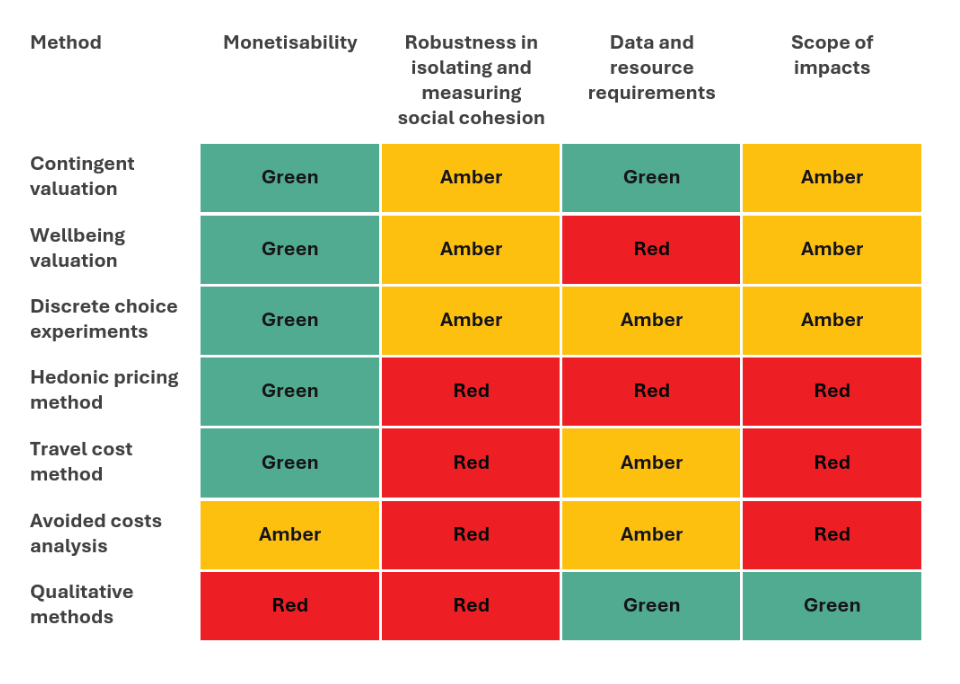
Assessment by criterion
This section provides explanations for the above RAG assessment of valuation methods against our stated criteria.
Monetisability
| Rating | Methods | Summary of assessment |
| Green | ● Contingent valuation ● Wellbeing valuation ● Hedonic pricing method ● Travel cost method ● Discrete choice experiments |
All the methods listed can, in theory, provide monetised estimates of welfare enhancement (e.g., via actual or stated willingness to pay or valuing wellbeing) that can then directly feed into SCBA. |
| Amber | ● Avoided costs analysis | While avoided costs analysis can generate monetary estimates of social benefits that can be directly fed into SCBA, these are contingent on measurable changes in outcomes that lead to reductions in costs to existing services. Because such costs are determined by market prices, they may not be observable or available for all outcomes. Further, avoided costs only measure fiscal impacts and do not directly take welfare impacts into account. |
| Red |
● Qualitative methods |
Qualitative methods cannot produce monetary estimates, although they can complement other valuation methods by providing insight into drivers of value. |
Robustness in isolating and measuring social cohesion
| Rating | Methods | Summary of assessment |
| Green | No methods were rated green for robustness in isolating social cohesion. | N/A |
| Amber | ● Contingent valuation ● Wellbeing valuation ● Discrete choice experiments |
The robustness of stated preference methods (including contingent valuation and discrete choice experiments) is limited by their vulnerability to cognitive biases, including hypothetical or anchoring biases. Further, isolating social cohesion from other drivers of value within stated preference methods is challenging without additional questions eliciting respondents’ reasoning. Careful framing and survey design are therefore necessary to mitigate the prevalence of such biases. |
| Red | ● Travel cost method ● Avoided costs analysis ● Hedonic pricing method ● Qualitative methods |
The validity of avoided cost analysis is dependent on comparison of costs in a given scenario to that of a counterfactual in which the intervention did not occur. Given the challenges to conducting robust causal studies for individual social cohesion outcomes, avoided cost analysis is unlikely to produce credible estimates for many social cohesion outcomes. Exceptions may exist for certain outcomes, for example where robust measurement of the impact of an intervention on crime levels is measurable, which can then be combined with an appropriate unit cost for crime. While revealed preference methods overcome hypothetical bias, the robustness of the travel cost method is limited by difficulties in accurately measuring the price (and opportunity cost) of a journey, while the robustness of hedonic pricing is limited by factors such as a reliance on existing market prices (which may not reflect the full scope of preferences), and individuals’ having imperfect information about amenities or externalities such as social cohesion (which may result in under- or overvaluations). Qualitative methods can provide rich, contextual insights and help elucidate mechanisms, particularly when used alongside other methods. However, their findings are inherently interpretive and context-dependent, meaning that they cannot yield generalisable, quantitatively precise valuation estimates. |
Data and resource requirements
| Rating | Methods | Summary of assessment |
| Green | ● Contingent valuation ● Qualitative methods |
Contingent valuation can be applied with relatively little resources and a low sample size, compared to other stated preference methods. Specifically, it requires a minimum sample of approximately n=500 respondents to generate robust results. Some quantitative or survey methodology expertise is needed for analysis, but it is notably simpler than the application of discrete choice experiments. Contingent valuation typically requires primary data collection, which can be more resource-intensive than reliance on administrative data. A key strength of qualitative approaches is their flexibility – methods can be tailored to fit specific resource constraints or sample size limitations. Further, analysis of qualitative data requires little specialist expertise. |
| Amber | ● Discrete choice experiments ● Travel cost method ● Avoided costs analysis |
While typically requiring a greater sample than contingent valuation, discrete choice experiments and the travel cost method can also be conducted using a relatively small survey sample, depending on the complexity of the survey design. However, generating results across both methods requires more specialised technical expertise, increasing resource requirements. Data for avoided cost analysis is sourced from causal studies linking changes in social cohesion to changes in unit costs. Without data from such studies, the method cannot be applied. If the necessary data is readily available, avoided cost analysis can be applied with relatively little specialised statistical or technical expertise. |
| Red |
● Wellbeing valuation ● Hedonic pricing |
Wellbeing valuation ideally requires detailed panel data to apply the method in its most robust form and control for potential unobserved heterogeneity. Several control variables are also needed to isolate the impact of social cohesion on wellbeing by accounting for potential confounders that may independently influence both factors. While wellbeing valuation requires econometric expertise, the required data is sometimes available in the public domain (i.e., via secondary datasets), which can reduce costs. Hedonic pricing similarly requires rich and detailed data, with both area-level and individual controls needed to isolate the impact of social cohesion. |
Scope of impacts
| Rating | Methods | Summary of assessment |
| Green | ● Qualitative methods | Because of the flexibility of qualitative methods, they can be applied to a range of impacts and indicators related to social cohesion, eliciting drivers of both use and non-use value. Qualitative methods also allow the researcher to probe with follow-ups to understand causal links and perceptions of different dimensions of social cohesion. |
| Amber | ● Contingent valuation ● Discrete choice experiments ● Wellbeing valuation |
Contingent valuation and discrete choice experiments both capture both use and non-use value. While there is significant precedent for application of both methods to valuations of specific assets and services, there are little to no applications of stated preference methods to value outcomes of social cohesion independent of specific assets or services. Both methods would also need to be combined with follow-up qualitative questions to fully attribute impacts or valuations to social cohesion. While there are some examples of wellbeing valuation to outcome-based measures of social cohesion, there is limited applicability of the method to the valuation of culture and heritage assets and services. Further, changes in culture and heritage assets and services are unlikely to generate significant changes in wellbeing, potentially leading to undervaluation. |
| Red | ● Hedonic pricing ● Travel cost method ● Avoided costs analysis |
Hedonic pricing and the travel cost method typically only capture use value. As the value of social cohesion is likely to include some non-use value, these methods may therefore undervalue social cohesion. Avoided cost analysis provides some insight into costs of any adverse outcomes avoided and captures both use and non-use values. However, it is limited to impacts that can be expressed as market costs, excluding several relevant social cohesion outcomes. |
8. Pilot study
Aims of the pilot study
The purpose of the pilot study was to explore potential methods for monetising social cohesion in the context of culture and heritage, with the findings providing valuable insight into how individuals interpret social cohesion (both in general and in the context of culture and heritage), identifying key methodological challenges, and developing promising approaches that can be developed through future research. The findings from the pilot study should be interpreted as being indicative rather than fully conclusive given the focussed nature of questioning and limited sample size. More extensive analysis would be required as a follow-up to this study to conclusively estimate the value of social cohesion.
Approach
The pilot study adopted contingent valuation as its primary method for monetising social cohesion outcomes, recognising its flexibility as an approach and ability to elicit willingness to pay for assets and services without a market price (see Chapter 6). Within the contingent valuation framework, the pilot tested several survey design features through multiple survey arms across two distinct valuation studies (described below). The survey also included cognitive questions to test respondents’ levels of understanding of the studies provided.
Study 1: outcome-based valuation
This study was designed to test several aspects of survey design. First, it examined whether respondents were able to place monetary values on changes in a social cohesion scale and subsequently attribute those values to different contributing factors. Second, the different magnitudes of change enabled testing of whether valuations increased proportionately with the size of the change in social cohesion. Finally, the inclusion of both gains and losses allowed exploration of whether respondents valued improvements in social cohesion differently from avoiding declines in social cohesion. The study included the following steps:
- Respondents were first asked to rate the level of social cohesion in their local area on a scale from 0 to 10.
- They were then presented with willingness to pay questions relating to hypothetical changes in this level of social cohesion.
- Respondents then completed a coin allocation exercise in which they allocated their stated valuation across a range of potential elements of social cohesion. These represented different dimensions of social cohesion, which allowed the exercise to explore which aspects respondents considered most important in informing their willingness to pay.
Study 2: asset based valuation
The second study adopted an asset-based approach by asking respondents to value a specific culture and heritage asset: a local library. Respondents were first asked to state their willingness to pay for the continued provision of a local library. To assess the extent to which respondents holistically considered social cohesion within their valuations, the survey was broken into two arms:
- Arm 1: Generic Prompt - Respondents were provided with a general description of library services and shown an image depicting individuals using a library. The prompt did not explicitly reference social cohesion or community-related benefits.
- Arm 2: Social Cohesion Prompt - Respondents received the same generic description used in Arm 1, alongside an additional paragraph highlighting potential social cohesion benefits of libraries, such as providing inclusive spaces for interaction, fostering community connections, and supporting community activities. The accompanying image showed people interacting and participating in activities within the library.
Cognitive questions
In addition to the two willingness to pay studies, respondents were asked a series of additional questions, primarily in closed-ended format, covering a range of related themes. These included perceptions of social cohesion and its meaning to them, attitudes towards their local community, respondents’ library use and enjoyment, and broader attitudes towards culture and heritage. Respondents were also asked to explain the reasoning behind their stated valuations of the library.
Data collection
A sample of UK adults was recruited through the online recruitment platform Prolific, with respondents receiving a small financial incentive for participating in the survey. In total, the survey was administered to 500 respondents across the different survey arms, resulting in 496 valid responses for analysis.
Key findings
Interpretations of social cohesion
Familiarity and understanding
The survey started by asking respondents about their familiarity with the term “social cohesion” and their confidence in understanding it, both measured on a five-point scale, where 0 represented “no familiarity” and 5 represented “complete familiarity”. The average reported level of familiarity was approximately 3. Further, the distribution of responses indicates that a large proportion of respondents were not familiar with the idea of “social cohesion”, with almost 10% indicating “no familiarity”.
Figure 5: Respondents level of familiarity with term “social cohesion”
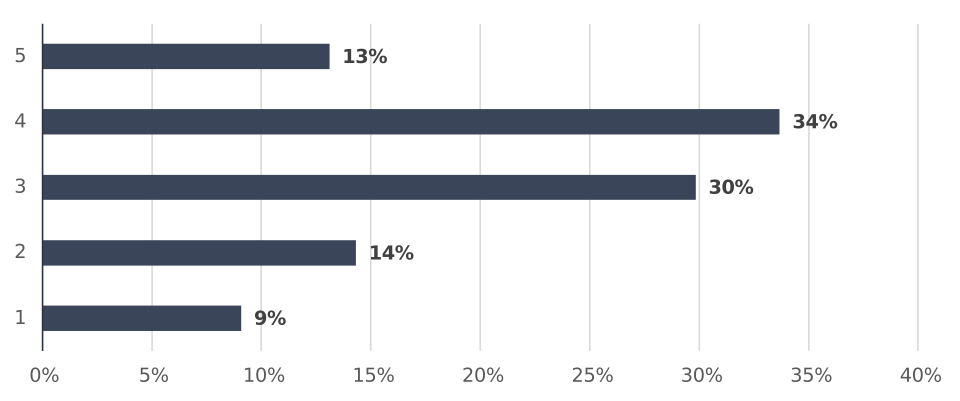
Source: Alma Economics analysis (n=496)
Respondents were then asked an open-text question to describe, in their own words, what the term “social cohesion” means to them and which outcomes they associate with it. The most common theme emerging from these responses was the association of social cohesion with the notion of people getting from different backgrounds getting along well and living harmoniously. Another prominent theme was the association of social cohesion with the notion of people working together towards shared goals, values, or interests. Other frequently mentioned themes associated with social cohesion included sense of belonging, trust in neighbours and fellow community members, and feeling connected to others within society.
We then presented respondents with a list of outcomes and asked them to select the three they most strongly associated with social cohesion. The results showed that “feeling included in one’s community” was the most frequently selected outcome, chosen by almost 60% of respondents. More than 40% also selected “feeling connected to people in their community”. Other commonly chosen outcomes included “feeling that people are treated fairly in society”, “having a sense of shared identity with others”, and “experiencing a sense of belonging”.
Perceived social cohesion
All respondents were asked to self-assess the current level of social cohesion in their local community and the UK more broadly on a scale from 0 to 10. A score of 0 was defined as a completely non-cohesive society whilst a score of 10 represented a highly cohesive society. The following descriptions were provided to respondents of different points on the scale:
- A highly cohesive society (e.g., a 10 on the scale) is one where people share strong trust, cooperation, and a sense of common identity and responsibility despite differences, where most people trust others, feel a strong sense of belonging to their community, interact positively across different social groups, support one another within their communities, and generally trust public institutions, with low levels of social conflict, discrimination, and division.
- A moderately cohesive society (e.g., a 5 on the scale) is one where people experience a mix of trust and mistrust, belonging and division. Many people feel connected to their local communities and cooperate with others, but levels of trust, shared identity, and interaction across different social groups vary considerably. Communities provide some support and opportunities for participation, but not everyone feels equally included. While social conflict, discrimination, and tensions exist, they are balanced by cooperation, mutual support, and a degree of trust in public institutions.
- A completely non-cohesive society (e.g., a 0 on the scale) is one where people have no trust in others, feel no shared identity or sense of belonging, rarely cooperate or interact across different social groups, experience fragmented and isolated communities, face high levels of conflict, discrimination, and division, and have little trust in public institutions, leading to widespread social tension and instability.
Figure 6 presents the distribution of respondents’ self-assessments of social cohesion. Responses were concentrated around the middle of the scale, with the distribution peaking at a score of 5, which was selected by approximately one-third of respondents. Most ratings fell between 3 and 6, suggesting that respondents generally perceived social cohesion to be at a moderate level. Very few respondents reported either very low levels of social cohesion (scores of 0–1) or very high levels (scores of 8–10).
Figure 6: Respondents’ self-reported baseline level of social cohesion
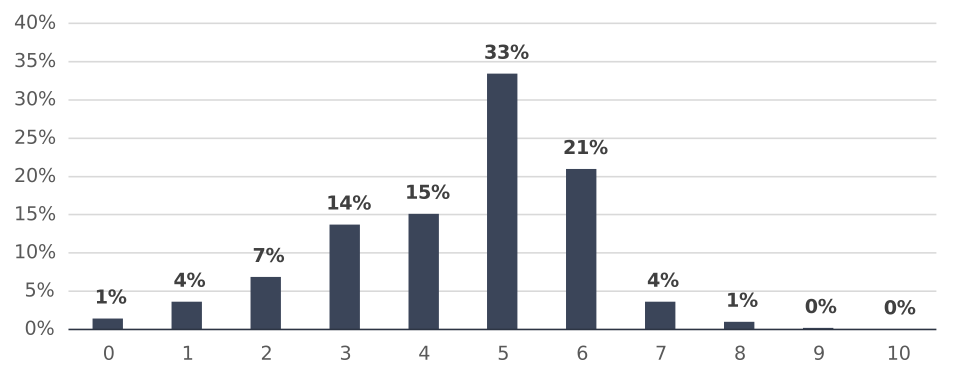
Source: Alma Economics analysis (n=496)
Despite the distribution centring around moderate levels of social cohesion on the scale, respondents generally expressed high levels of agreement with Likert-scale statements relating to social cohesion in their community (see Figure 7). A majority of respondents agreed that they feel connected to other people in their local area, that people generally trust one another, that people from different backgrounds get along well, and that people are friendly and interact with one another. Agreement was even stronger for statements relating to the importance and value of social cohesion. Around 90% of respondents agreed or strongly agreed that it is important for people to feel a sense of belonging, that they value living in a community where people support one another, and that cohesive communities contribute positively to overall wellbeing.
Figure 7: Level of agreement with statements relating to social cohesion
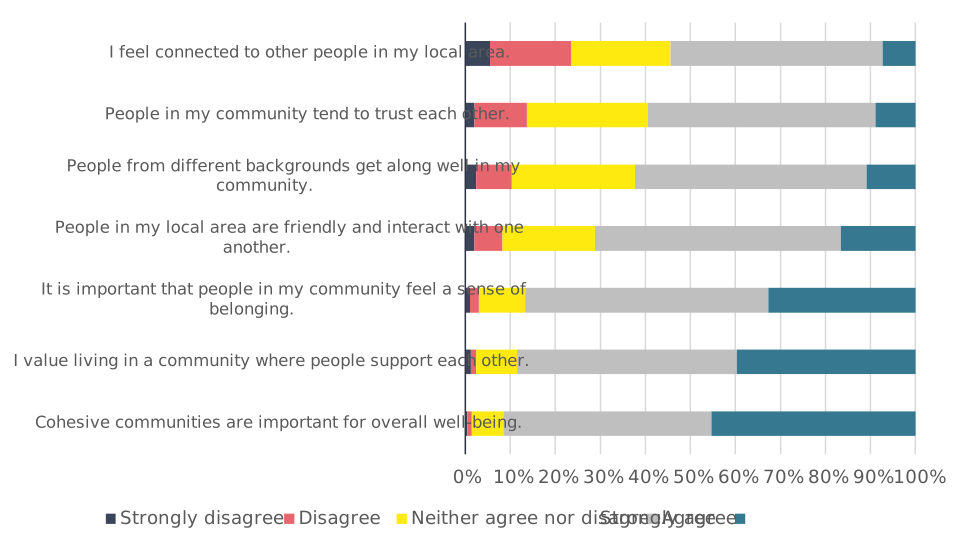
Source: Alma Economics analysis (n=496)
Findings from study 1: outcome-based valuation
Willingness to pay for social cohesion
Following the elicitation of a self-reported baseline level of social cohesion, respondents were asked two willingness to pay questions relating to hypothetical changes in their stated baseline level of social cohesion, based on the same 10-point scale. Willingness to pay values were elicited as annual household payments. Respondents were randomly allocated across four survey arms, each with a different set of increases or decreases on the 10-point social cohesion scale.
Table 2 shows that respondents expressed a positive willingness to pay both to avoid reductions in social cohesion and to secure improvements in social cohesion. Mean valuations were generally higher for larger changes than for smaller changes, suggesting that respondents were, to some extent, sensitive to the magnitude of the change being valued. This pattern was particularly evident within survey arms, where the same respondents valued changes of different magnitudes. For example, average willingness to pay for a 3-point increase (£119) was substantially higher than for a 1-point increase (£61), while average willingness to pay to avoid a 3-point reduction (£115) exceeded that for avoiding a 1-point reduction (£78). However, the relationship between the size of the change and willingness to pay was not fully linear, especially when comparing across different arms of the survey. In particular, average valuations for 4-point changes were not on average higher than those for 3-point changes. This may indicate that respondents found it difficult to distinguish between different size changes in social cohesion or to translate such differences into monetary values.
Table 2: Willingness to pay estimates for changes in social cohesion based on a 10-point social cohesion scale
| Change in level of social cohesion | Average willingness to pay | Average willingness to pay (conditional on familiarity with social cohesion) | Percent of entries where willingness to pay was zero | Sample size |
| 4-point decrease | £109.70 | £130.60 | 18% | 93 |
| 3-point decrease | £115.40 | £141.60 | 12% | 105 |
| 2-point decrease | £73.90 | £75.30 | 31% | 118 |
| 1-point decrease | £77.90 | £85.90 | 29% | 120 |
| 4-point increase | £90.20 | £94.50 | 23% | 118 |
| 3-point increase | £119.10 | £150.40 | 24% | 124 |
| 2-point increase | £61.70 | £73.30 | 30% | 122 |
| 1-point increase | £61.30 | £81.10 | 41% | 125 |
Source: Alma Economics analysis
Across all scenarios, mean willingness to pay values ranged from approximately £61 to £119. Given the varying levels of familiarity with social cohesion and a generally low level of familiarity amongst respondents, we conducted an additional sensitivity restricting the analysis to respondents who reported at least moderate familiarity with the concept of social cohesion (a familiarity score greater than 2 out of 5). This generally resulted in higher average valuations, indicating that higher confidence in the concept leads to somewhat higher valuations. The relationship between each specified point increase and average willingness to pay was not consistently linear across all data points, although this may be a function of smaller than ideal samples sizes for each arm.
Drivers of social cohesion
Following the initial willingness to pay elicitation, respondents who reported a non-zero willingness to pay were asked to complete a coin allocation exercise. This involved asking respondents to distribute 100 points across a range of different dimensions of social cohesion to understand the drivers of their valuations.
The results are presented in Figure 8. Overall, the results indicate that respondents’ willingness to pay were driven by a broad range of social cohesion outcomes rather than any single factor. All factors received at least around 8 points on average and none received more than 16. On average, “inclusion and belonging”, “trust in neighbours, and “positive intergroup relations” received the largest allocations. However, none of these dimensions accounted for more than 16 points out of 100 on average, indicating that respondents viewed the benefits of social cohesion as multidimensional.
Figure 8: Study 1: allocation of value to different elements of social cohesion
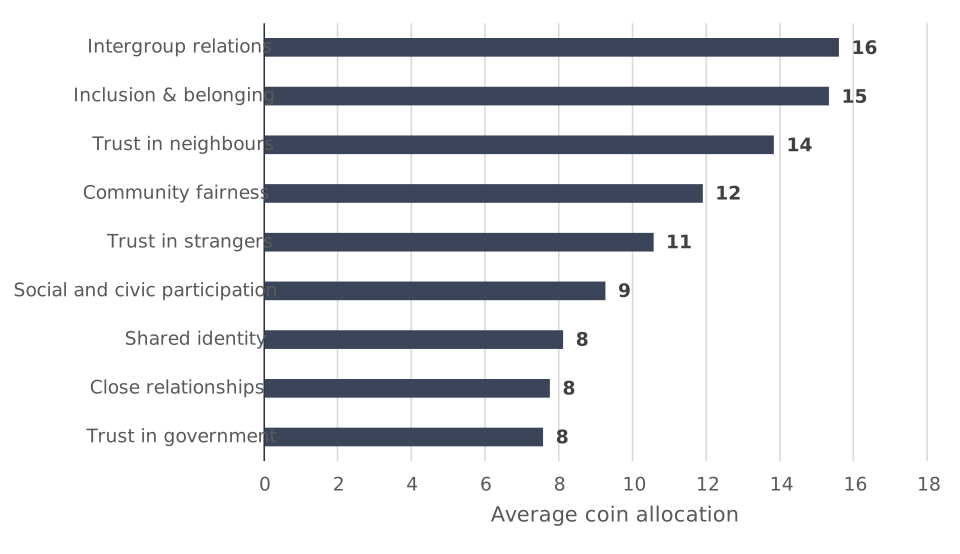
Source: Alma Economics analysis (n=384)
To assess respondents’ ability to understand and engage with the survey, we included a series of follow-up questions alongside opportunities to provide open-text feedback on any aspects of the survey that they found unclear or felt required additional information. Following each willingness to pay elicitation, respondents were asked to indicate how certain they were about their stated valuation, choosing from “very certain”, “somewhat certain”, or “not certain at all”. Across both valuation exercises, over half of respondents reported being somewhat certain of their response, while approximately 30% reported being “very certain”.
Additional feedback questions suggested that respondents generally felt able to engage with the survey. Around 26% reported that they had insufficient information to make their decision, while only 5% indicated that there was something unclear about the questions. Among those who requested additional information or clarification, the most common theme was a desire for more detail on how any additional funding would be used. Respondents also frequently requested more concrete examples of what changes in social cohesion would look like in practice and how such changes would be achieved. A smaller number of respondents indicated that information about the contributions of other individuals would have helped them make their valuation decisions.
Findings from study 2: asset-based valuation
Willingness to pay
The second valuation study sought to elicit respondents’ willingness to pay for their local library service. Respondents were randomly assigned to one of two survey arms. The first arm received a generic description of library services, providing factual information about the services and facilities typically offered by libraries. The second arm received the same description, alongside an additional prompt highlighting the potential contribution of libraries to social cohesion and associated outcomes. Respondents were then presented with a hypothetical scenario in which reductions in public funding threatened the continued operation of their local library. Respondents were asked how much extra council tax they would be willing to pay annually, on behalf of their household, to maintain library services at their current level.
Table 3 shows that average willingness to pay was very similar across the two survey arms, at approximately £22 per household per year, although formal significance testing was not undertaken. A coin allocation exercise, described below, indicated that social cohesion is captured within respondent valuations of their local library, with this result then suggesting that respondents consider social cohesion as part of their willingness to pay without need for explicit prompting around the social cohesion aspects of the library to capture this more fully. Table 3 also presents willingness to pay estimates by library usage. Respondents who reported never using their local library were classified as non-users, while all other respondents were classified as users. As might be expected, users reported substantially higher valuations than non-users, with average willingness to pay estimates approximately £15 higher per year. Nevertheless, non-users still expressed a positive willingness to pay of around £11 per household per year. This suggests the presence of non-use value, whereby individuals derive value from the continued existence of library services even if they do not personally make use of them. Generally, respondents felt a good level of certainty with their responses, with only around 2% of respondents across both arms reporting that they were not at all certain in their responses.
Table 3: Study 2: willingness to pay estimates for a local library
| Usage category | Average willingness to pay (overall) | Average willingness to pay (Generic asset description) | Average willingness to pay (social cohesion prompt) | Sample size |
| Respondents who never use the library | £10.50 | £11.80 | £9.20 | 115 |
| Respondents who use the library | £26.10 | £25.60 | £26.70 | 336 |
| Total sample (library users and non-users) | £22.10 | £22.20 | £22.10 | 451 |
Source: Alma Economics analysis
Drivers of willingness to pay (including social cohesion)
Respondents who reported a positive willingness to pay for library services were subsequently asked to complete a coin allocation exercise. This involved asking respondents to distribute 100 points across a range of potential benefits associated with local library provision, providing insight into the relative importance of different aspects of the service in driving their valuation.
The two most highly valued aspects of library provision were, personal use and enjoyment and learning and education, each receiving approximately 20 points on average. The remaining benefits generally received lower, but still meaningful allocations, with most averaging around 10 points. Notably, the three social cohesion-related dimensions, social interaction between different groups, belonging and shared identity, and trust, respect and social cooperation, together accounted for approximately 30% of total allocations on average. This suggests that social cohesion represents a substantial component of the value respondents derive from library services, although it is only one of several important sources of value.
Consistent with the overall willingness to pay results, there were only minor differences in coin allocations between the two survey arms. This suggests that explicitly highlighting the social cohesion benefits of libraries had little effect on how respondents attributed value across the different benefits of library provision.
Figure 9: Coin allocation exercise results – study 2
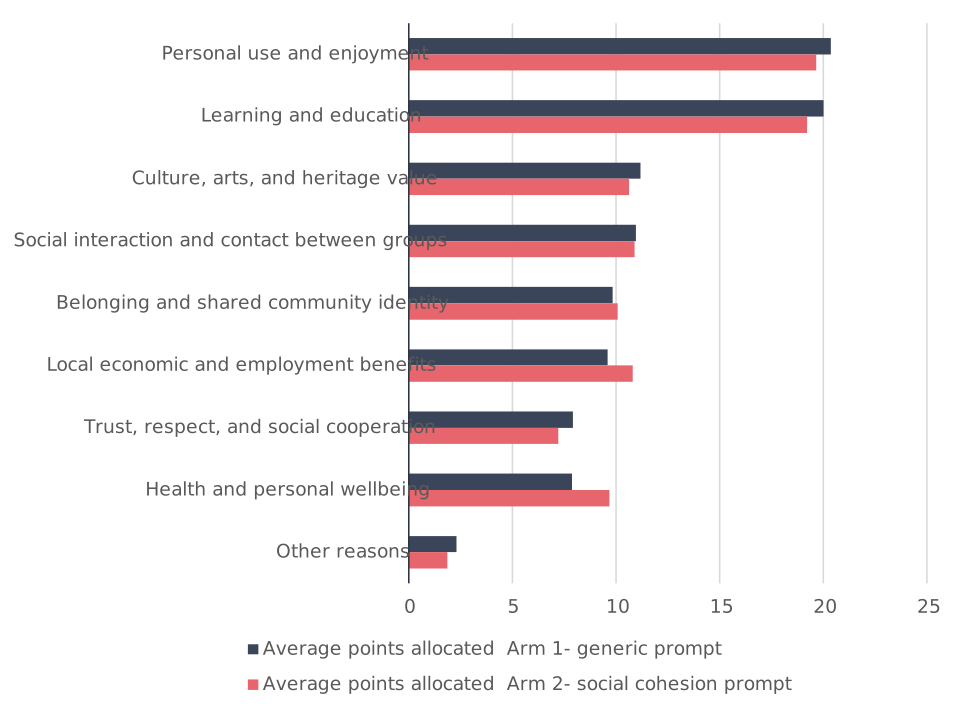
Source: Alma Economics analysis (n=344)
9. Conclusions from the research and recommendations for future valuation study
The following section summarises key takeaways from the evidence review, the Theoretical Framework, and the pilot study, and suggests areas for future research to support more robust valuation of social cohesion in the future.
Takeaways from this scoping study
Defining and measuring social cohesion
Takeaway 1: There is no unified definition of social cohesion, although definitions share elements.
Approaches to defining and measuring social cohesion were found to vary across the literature, with many studies using composite indicators to measure social cohesion. This presents challenges for the consistent quantification of social cohesion, as results may not be comparable to one another if they are comprised of different underlying elements. Despite these differences, several recurring themes were evident across definitions, particularly the importance of social trust, strong interpersonal connections, and participation in civic life.
Participants in the pilot study demonstrated mixed levels of familiarity and understanding of the concept of social cohesion, with most reporting a moderate rather than strong understanding of the term. Responses to the study’s open-text questions revealed a wide range of interpretations, encompassing themes such as social harmony, trust, belonging and shared identity and values. While certain themes emerged consistently, no single definition dominated. This suggests that social cohesion is viewed as a multidimensional concept, with value arising from a combination of interconnected outcomes rather than a single defining characteristic.
Takeaway 2: Social cohesion manifests in a broad range of outcomes and impacts, both within culture and heritage and more generally.
The evidence and theory indicate that social cohesion can be observed at different societal levels, with the type of asset or service (e.g., local versus national), as well as any enabling factors, having an effect on the specific ways in which social cohesion materialises. At the micro level, it may manifest as individuals’ reduced feelings of loneliness or a stronger sense of belonging. At the meso level, it can be seen in higher neighbourhood trust and greater concern for others in society. At the macro level, it is reflected in outcomes such as trust in institutions and increased political participation. Over time, these effects can contribute to longer-term societal benefits, including improved wellbeing, lower crime rates, and increased economic output.
Pilot study participants attributed value to a broad range of factors within the outcome-based valuation, with dimensions such as inclusion and belonging, intergroup relations, and trust receiving the highest allocations, albeit no individual factor emerged as markedly more important than the others.
Takeaway 3: There are established metrics for quantifying social cohesion, and it is well-covered by existing administrative UK-focused datasets.
Several long-running UK datasets feature questions on key components and outcomes of social cohesion. No single dataset captures the full range of outcomes across micro, meso, and macro levels, and some indicators are absent across surveys. Despite this, there are established question banks that measure aspects of social cohesion using consistent, psychometrically validated indicators and scales. These commonly include Likert agreement scales and numeric rating scales, enabling comparability across surveys and supporting alignment across research.
Valuing social cohesion
Takeaway 4: There is very little existing precedent for valuing social cohesion explicitly.
Our literature review identified very few attempts to put a monetary value on social cohesion as an isolated outcome in the context of culture and heritage specifically. There is, however, a large body of literature which seeks to estimate the total welfare of culture and heritage assets and services (e.g., by measuring wellbeing changes or willingness to pay), which in theory will at least partially capture social cohesion even if it is not directly attributed as a driver of value.
Takeaway 5: Social cohesion can manifest as use, indirect use, and non-use value, but the boundaries between the categories are not concrete.
While some outcomes of social cohesion may manifest directly as a result of interactions with culture and heritage (direct use value: e.g., providing space for socialisation, improving trust in friends and neighbours), other outcomes can accrue less immediately and in more complex ways (indirect use value: providing an expression of lived experience improving pride of place and sense of belonging). Social cohesion can also be considered to generate non-use value insofar as social cohesion is captured within existence value or people value the social cohesion generated for current (altruism) or future (bequest) citizens. An implication of this is that to fully capture social cohesion, methodologies should take both use and non-use values into account.
In the pilot study, both visitors and non-visitors of local libraries attributed part of their willingness to pay to drivers associated with social cohesion. On the face of it, this appears to suggest the existence of non-use value, whereby individuals derive value from the existence of a service even if they do not personally use it, however applying this concept to social cohesion may be more complex due to potential overlap with indirect use value, whereby people derive value from social cohesion outcomes without directly engaging with the library (i.e., by benefiting from the increased social cohesion in their local area). Based on the theory, we posit that non-visitor willingness to pay is likely to include elements of both non-use value and indirect use value, although separating these two forms of value may prove challenging in practice. This result nonetheless further emphasises the importance of capturing the value held by non-visitors to ensure social cohesion is fully captured in appraisals of culture and heritage.
Takeaway 6: Social cohesion is inherently challenging to quantify and place a monetary value on.
There are inherent challenges in quantifying and monetising social cohesion, with existing definitions tending not to be fully tractable for monetisation purposes. Social cohesion indicators can overlap, which can lead to double-counting issues, and many indicators are not directly monetisable; for example, sense of belonging or attachment to place are not directly monetisable but may be captured by methods which measure overall welfare. Other challenges include:
- Cognitive challenges. Social cohesion is an inherently diffuse and abstract concept and therefore methods relying on respondents’ ability to understand social cohesion conceptually (as well as their internal valuations of social cohesion) are vulnerable to differing understandings and conceptions of social cohesion. It is currently unclear to what extent respondents have strong priors around their preferences for social cohesion.
- Challenges measuring social cohesion robustly and in isolation from other factors. Data limitations and the often complex and indirect ways in which social cohesion manifests make it challenging to derive the robust causal estimates (e.g., using quasi-experimental or experimental approaches) required for monetising individual social cohesion outcomes. Stated preference methods are well-placed to generate estimates of total welfare (including use and non-use value), but it is not generally clear from the method alone how much of this value is attributable to social cohesion relative to other drivers of value. Indirect use value in particular poses some challenges, as individuals may be
- Issues capturing all forms of value (indirect use value and non-use value). Indirect use value presents some methodological challenges in that valuation methods may fail to fully capture it if individuals are unaware of the less direct ways in which culture and heritage enhance their welfare. For example, individuals may not be fully aware of how the contribution of a museum to societal inclusion and dialogue then goes on to benefit them in everyday life. Methods which fail to capture non-use value also risk understating the total welfare generated by social cohesion from culture and heritage.
The pilot study indicated that members of the public find it difficult both to assess the level of social cohesion and to place monetary values on changes in social cohesion. While respondents generally expressed positive views about specific aspects of social cohesion when responding to agree/disagree statements, they reported only moderate levels of social cohesion when asked to assess it using a single 0–10 scale. This contrast suggests that respondents may struggle to evaluate social cohesion as a broad, multidimensional concept, instead needing it to be broken down into specific dimensions to assess it with more certainty.
Takeaway 7: The existing suite of valuation method options for culture and heritage assets and services in theory, at least partially, capture social cohesion.
Social cohesion manifests from culture and heritage assets and services as use and non-use value, and thus to varying extents can be picked up by existing valuation methods. Stated preference methods such as contingent valuation, discrete choice experiments, and wellbeing valuation in theory capture social cohesion within their estimates of welfare. We expect that revealed preference methods, such as hedonic pricing, will only capture, at best, the direct use value elements of social cohesion. This existing toolkit of methods may benefit from further development to enhance their ability to capture and attribute value to social cohesion (see recommendations below).
Coin allocation exercises following willingness to pay questions were included to explicitly elicit drivers of value for the local library. The three social cohesion-related dimensions, social interaction between different groups, belonging and shared identity, and trust, respect and social cooperation, together accounted for approximately 30% of total coin allocations on average. This suggests that social cohesion both represents a substantial component of value respondents derive from library services and can be at least partially captured by existing stated preference approaches.
Recommendations for valuing social cohesion
Based on the findings from this scoping study, we recommend that practitioners consider the following when attempting to value social cohesion from culture and heritage:
Recommendation 1: Consider the specific context, use-case, and rationale for the valuation study when determining which method to use.
Social cohesion can be expected to manifest in different ways depending on the type of culture and heritage asset or service, as well as if that asset or service is a local or national asset. For example, local assets (such as local libraries or community centres) may have a more direct impact on social cohesion aspects such as feelings of loneliness and trust in neighbours, whilst national assets (such as the British Library or national museums) may have a more direct impact on outcomes such as sense of belonging in national society and trust in institutions. The most suitable methodology will therefore depend on the types of outcomes to be valued, as well as the aims of the valuation exercise itself. When conducting valuations of whole or marginal changes to culture and heritage assets and services, contingent valuation, discrete choice experiments, and wellbeing valuation are likely to capture many of the dimensions of social cohesion (in theory, capturing both use and non-use value). Valuing individual social cohesion outcomes is inherently more challenging, although some benefit streams can potentially be monetised using methods such as avoided costs (e.g., measuring cost savings for public finances from reduced crime or improved health outcomes).
Recommendation 2: When eliciting valuations for culture and heritage assets and services, this should be paired with qualitative research to attribute value specifically to social cohesion.
Given social cohesion is challenging to value as a standalone benefit stream, valuations will typically benefit from qualitative research alongside any estimate of overall welfare to evidence the extent to which social cohesion is a driver of value, as well as exploring how and why this value manifests. This could involve follow-up focus groups or interviews with the population of interest, or questions following any survey-based valuation to provide additional insight on the extent to which individuals are considering social cohesion in their valuations (for example, allocating points across different drivers, rankings of drivers, or open-ended text questions).
The pilot study illustrated the value of requesting supplementary information on drivers of social cohesion, including through open-ended questions and coin allocation exercises. For example, pairing the willingness to pay question with a coin allocation exercise provided a mechanism for attributing value to social cohesion and other drivers, finding that social cohesion (e.g., belonging and shared identity, social interaction) formed a smaller, but not insignificant, part of the overall value compared with other drivers such as use for personal enjoyment and information purposes.
Recommendation 3: Consider adding information on social cohesion mechanisms and outcomes into descriptions of culture and heritage when eliciting valuations from the public.
Where valuations of culture and heritage assets and services are elicited directly from members of the public (for example, when implementing a stated preference method), researchers should consider adding designated text or visual aids to prompt respondents to factor potential social cohesion benefits in their valuations. For example, this could involve providing information on the community outreach that a museum provides or facilities for socialisation provided by public libraries. Care should be taken to avoid biasing valuations by keeping any additional information factual and proportionate to the wider set of characteristics of each asset or service.
The addition of supplementary information on social cohesion outcomes to the descriptions posed to respondents of the pilot study did not markedly change the willingness to pay elicited for local libraries, although we cannot rule out that such prompting could lead to more reliable valuations for other types of culture and heritage asset, particularly where the links between the underlying asset and social cohesion are less direct or obvious.
Avenues for future research
In addition to recommendations for future valuation studies, we also propose a set of avenues for future research to strengthen the evidence base for culture and heritage social cohesion:
Recommendation 4: New qualitative research should be explored to understand how and why social cohesion manifests from culture and heritage, and the extent to which it is captured by existing valuation methods.
The pilot study provided high-level insights into how members of the public perceive social cohesion – both in general and in the context of culture and heritage – however the evidence base would benefit from new in-depth qualitative research to deepen understanding of how social cohesion manifests from culture and heritage in the UK. Qualitative research activities could include focus groups or interviews with members of the public (capturing views of both users and non-users of culture and heritage assets and services), with a focus on:
- Bolstering existing definitions by shedding light on which elements or outcomes of social cohesion are most salient to individuals,
- Further validating the causal links identified in the Theoretical Model between culture and heritage and social cohesion (and how causal pathways vary for different types of asset), and
- Providing new insight into the extent to which social cohesion is captured in individual valuations.
Recommendation 5: Conduct causal research linking provision of culture and heritage assets and services to improvements in outcomes related to social cohesion.
Development of robust causal analysis to quantify the link between engagement with culture and heritage and social cohesion would strengthen understanding of the specific dimensions of social cohesion that it generates. This could be achieved through experimental or quasi-experimental methods which exploit variation in exposure to culture and heritage assets and services to examine their effect on outcomes such as loneliness and social isolation, community trust, and feelings of belonging. Studies could utilise both primary data or existing longitudinal data (e.g., Understanding Society), depending on the specific outcomes of interest.
Recommendation 6: Explore development of methods for valuing social cohesion as an outcome.
While most studies we identified attempted to value specific assets or services and attribute some of that value to social cohesion, we found limited in the way of previous research which seeks to elicit a value for social cohesion as an explicit outcome. One such approach to doing this in future could be developing a standardised scale for social cohesion which could then be used as the basis for self-assessment of social cohesion by members of the public, allowing evaluators to measure and monetise impact on a comparable basis. Similar approaches have been adopted in other fields, where standardised outcome measures have subsequently been valued (often known as a “value tariff”), such as Wellbeing-Adjusted Life Years (WELLBYs). In the UK, the Supplementary Guidance on Wellbeing Analysis (2021) published a standardised value for a change in the WELLBY based on stated preference and health values.
The pilot study tested an example of a standardised social cohesion scale, implemented as a ten-point scale for social cohesion ranging from no cohesion to perfect cohesion. However, inconsistencies with responses to open-ended questions relating to drivers of social cohesion suggested that individuals had difficulties interpreting and valuing changes in social cohesion as a broad concept, potentially due to it including a wide-ranging set of outcomes. Future research could explore the development of a decomposed scale whereby specific components of social cohesion are measured via their own 10-point scale. A decomposed scale would likely pose additional risks around double counting and embedding effects, meaning that it should be rigorously tested before being put into use.
Appendix A. Indicators to measure social cohesion
The following Appendix provides additional detail on indicators to capture social cohesion in the UK Household Longitudinal Dataset, the DCMS Community and Engagement Survey, the European Social Survey, and the British Social Attitudes survey. While the most relevant variables have been included below, the list is not exhaustive.
UK Household Longitudinal Dataset (Understanding Society)
Table 4: Indicators captured by UKHLS (Understanding Society)[footnote 3]
| Indicator | Answer options | Theory of Change Outcome |
| How often do you feel lonely? | Hardly ever or never Some of the time Hardly ever or never |
Micro: Reduced loneliness & isolation |
| How strongly do you agree or disagree the statement: I feel like I belong to this neighbourhood | Likert scale: strongly agree to strongly disagree | Micro: Increased sense of belonging |
| Do you see friends or family at least once a month? | Yes/No ● No money for this. ● Not a priority ● Health/disability prevents this. ● Too much trouble/too tiring ● No company/help ● Not wanted ● Not relevant ● other. |
Micro: Stronger and greater number of social ties |
| I talk regularly to my neighbours | Likert scale: strongly agree to strongly disagree | Micro: Trust in friends and neighbours |
| People in this neighbourhood can be trusted | Likert scale: strongly agree to strongly disagree | Micro: Trust in friends and neighbours |
| Which organisations are you a member of? | Political party Trade unions environmental group parents’/school association tenants/residents group religious/church org voluntary services group pensioners group scouts/guides Professional group other community group social/working men’s club sports club WI/townswoman’s guild women’s group |
Meso: Civic membership |
| In the last 12 months, have you given any unpaid help or worked as a volunteer for any type of local, national or international organisation or charity? | Yes No Don’t know |
Meso: volunteering |
| How much do you agree or disagree with the following statement: Ordinary people get their fair share of the nation’s wealth. | Likert scale: strongly agree to strongly disagree | Meso: perceived fairness |
| How interested would you say you are in politics? | Very interested Fairly interested Not very interested Not at all interested |
Macro: Political participation |
| Most people around here usually vote in general elections | Likert scale: strongly agree to strongly disagree | Macro: political participation |
| Did you vote in the [July 2024] general election? | Yes No Don’t know Can’t vote |
Macro: Political participation |
DCMS Community and Engagement Survey
Table 5: Outcomes captured by the community and engagement survey
| Indicator | Answer options | Theory of Change Outcome |
| How often do you feel isolated from others? | Often Some of the time Hardly ever or never |
Micro: Reduced loneliness & isolation |
| How often do you feel lonely? | Often or always. Some of the time. Occasionally. Hardly ever. Never. Prefer not to say. |
Micro: Reduced loneliness & isolation |
| How strongly do you feel you belong to your immediate neighbourhood? | Likert scale: Very strongly to not at all strongly | Micro: Increased sense of belonging |
| Which of the following statements apply to the different connections and relationships you have with people in your life? There is at least one person in my life who… Follow-up question: And which of these people do you feel these connections with? Please cross all boxes that apply: | I share interests or experiences with. Understands what I’m going through day-to-day. Has the same values or beliefs as me. Wants the same things from life as me. I can talk to about anything without judgement. I can truly be myself with. I have a close relationship with. *Follow-up question:* My spouse, civil partner, other partner, boyfriend or girlfriend. Other family members. My friends. People I work or study with. My neighbours. People who live in my local area or community. People in my religion. People I have shared interests with (online or in person). Someone else (please write in). |
Micro: Stronger and greater number of social ties |
| Thinking about the people who live in this neighbourhood, to what extent do you believe they can be trusted? | Many of the people can be trusted. Some of the people can be trusted. A few of the people can be trusted. None of the people can be trusted. Just moved here. Don’t know. |
Micro: Trust in friends and neighbours |
| To what extent do you agree or disagree that your local area is a place where people from different backgrounds get on well together? | Definitely agree. Tend to agree. Tend to disagree. Definitely disagree. There are too few people in the local area. People in this area are all of the same background. |
Meso: Openness to diversity |
| Have you been involved with any of the following groups, clubs or organisations during the last 12 months? | Children’s education or schools. Youth or children’s activities. Education for adults. Sport or exercise. *And many other activities…* |
Meso: Membership of civic groups |
| In the last 12 months, have you done any of these things? | Been a local councillor (for local authority, town, or parish). Been a school governor. Been a volunteer special constable or volunteer at a higher rank. Been a magistrate. None of these. |
Meso: Membership of civic groups |
| Have you been involved in any of the following activities in the last 12 months? | Trying to set up a new service or amenity for local residents. Trying to stop the closure of a service or amenity. Trying to stop something else happening in my local area. Running local services on a voluntary basis (for example, childcare, youth services, parks, community centres). Organising a community event (for example, a street party). Another local issue (please write in). |
Meso: Membership of civic groups, Volunteering rates |
| In the last 12 months, have you done any voluntary or unpaid work connected to any of the following areas? | Arts Museum or gallery Heritage Libraries Sport Some other charitable area None of these |
Meso: volunteering |
| In the last 12 months have you…? Please cross all that apply | Contacted a local official such as a local councillor, MP, government official, mayor, or public official working for the local council (Please do not include any contact for personal reasons, for example housing repairs or contact through work). Attended a public meeting, rally, or taken part in a public demonstration or protest. Signed a paper petition or an online or e-petition. None of these. |
Macro: Political participation |
European Social Survey
Table 6: Outcomes captured by the European social survey
| Indicator | Answer options | Theory of Change Outcome |
| How much of the time during the past week did you feel lonely? | Multiple choice options for frequency. | Micro: Reduced loneliness & isolation |
| How emotionally attached do you feel to [country]? | 0 to 10 | Micro: Increased sense of belonging |
| How often do you meet socially with friends, relatives or work colleagues? | Multiple choice options for frequency | Micro: Stronger and greater number of social ties |
| How many people, if any, are there with whom you can discuss intimate and personal matters? | None. 1. 2. 3. 4-6. 7-9. |
Micro: Stronger and greater number of social ties |
| How often do you chat to your neighbours, more than to just say hello? | Multiple choice options for frequency | Micro: Stronger and greater number of social ties |
| Generally speaking, would you say that most people can be trusted, or that you can’t be too careful in dealing with people? | 0 to 10 | Meso: Generalised trust |
| During the last 12 months, have you volunteered for a not-for-profit or charitable organisation? | Yes. No. |
Meso: Volunteering rates |
| Would you say that [country]’s cultural life is generally undermined or enriched by people coming to live here from other countries? | 0 to 10. | Meso: Openness to diversity. |
| Would you describe yourself as being a member of a group that is discriminated against in this country? | Yes. No. |
Meso: Perceived fairness |
| How much do you personally trust [country]’s parliament? | 0 to 10 | Macro: Trust/confidence in systems and institutions |
| How much do you personally trust the legal system? | 0 to 10 | Macro: Trust/confidence in systems and institutions |
| How much would you say the political system in [country] allows people like you to have a say in what the government does? | Likert scale: Not a lot to a great deal | Macro: Political freedom; Political participation. |
| Some people don’t vote nowadays for one reason or another. Did you vote in the last [country nationality] national election in [month/year]? | Yes. No. Not eligible to vote. |
Macro: Political participation. |
British Social Attitudes Survey
Table 7: Outcomes captured by the British social attitudes survey
| Indicator | Answer options | Theory of Change Outcome |
| Generally speaking, would you say that most people can be trusted or that you can’t be too careful in dealing with people? | 0 – you can’t be too careful to 10 – Most people can be trusted. Can’t choose. SPONTANEOUS (Prefer not to answer). |
Meso: Generalised trust |
| Are you currently/have you ever been a member of a trade union or staff association? | Yes, trade union. Yes, staff association. No. |
Meso: Membership in civic groups |
| Agreement with the statement: Ordinary people do not get their fair share of the nation’s wealth | Likert scale: Agree strongly to disagree strongly | Meso: Perceived fairness |
| Agreement with the statement: There is one law for the rich and one for the poor | Likert scale: Agree strongly to disagree strongly | Meso: Perceived fairness |
| On a scale of 1-10, how much do you personally trust each of the following institutions: the UK Parliament, Courts in the UK | 0 to 10. Can’t choose. SPONTANEOUS (Prefer not to answer). |
Macro: Trust/confidence in systems and institutions |
| How much do you trust British governments of any party to place the needs of the nation above the interests of their own political party? | Just about always. Most of the time. Only some of the time. Almost never. (Don’t know). (Refusal). |
Macro: Trust/confidence in systems and institutions |
| How much do you trust politicians of any party in Britain to tell the truth when they are in a tight corner? | Just about always. Most of the time. Only some of the time. Almost never. (Don’t know). (Refusal). |
Macro: Trust/confidence in systems and institutions |
Appendix B. Full findings from the rapid evidence assessment
How is social cohesion defined in the literature?
Generally, the evidence regarding the definition of social cohesion was mixed in terms of its breadth and quality. While several papers touched on definitions or provided a review of existing definitions as an introduction to a more specific research question, very few papers explored the definition of social cohesion as their primary aim. The review also only identified general definitions of social cohesion, with no papers found that explicitly defined social cohesion in the context of culture and heritage. A key finding from the literature is that while there are several overlapping elements across the literature (e.g., trust in institutions and other citizens, participation in civic life, and political freedom), social cohesion is a complex concept with no single agreed-upon definition. Further, the review identified that while many definitions of social cohesion share common elements and dimensions, there is variation across organisations and authors, reflecting the policy contexts, organisational priorities and sectors for which the definitions were created or applied. The review also identified some papers discussing social capital, a distinct but overlapping concept from social cohesion.
The review identified some papers that examined how social cohesion is defined in the literature. First is the UN ECE’s Social Cohesion Concept and Measurement (2023), which presented a range of definitions of social cohesion, taken from the academic and grey literature. These included intragovernmental organisations such as the OECD and the Council of Europe, government departments such as the Department of Canadian Heritage, as well as non-profit think tanks such as the Canadian Policy Research Network. Secondly, Fonseca et al. (2019) also provided a general overview of different perspectives and studies on social cohesion. The authors offered a definition of social cohesion rooted in current literature and provided a framework that can be used to characterise social cohesion and help support resilient communities. They also provided a summary of the relevant historical conceptualisations. These two papers are core to the review’s examination of the definition of social cohesion, including its historical development, its varying dimensions and related contexts.
Definitions of social cohesion
The UN ECE (2023) report defined social cohesion as broadly referring to the ‘strength of bonds and social distance between societal members’. A key conclusion from the report was that a range of organisations and researchers have developed their own definitions of social cohesion, all of which share common elements but diverge in some of the detailed nuance. Examples of such definitions include:
- Cooper et al. (2014) defined social cohesion as a “collective characteristic measured by the levels of trust, reciprocity and the formation of strong social bonds within neighbourhoods or communities”.
- OECD (2011) defined social cohesion as “a broad concept, covering several dimensions at once: sense of belonging and active participation, trust, inequality, exclusion and mobility”.
- Council of Europe (2005) defined social cohesion as the “ability of a society to ensure the welfare of all its members, minimising disparities, and avoiding polarisation”.
- Botterman et al. (2012) defined social cohesion as the “presence of structural and attitudinal mechanisms of solidarity, cooperation and exchange between citizens in a society. These constituting networks can be either material or structural (exchange of goods, economic interactions) or immaterial (informal relations, shared identities)”.
While Cooper et al. (2014) and OECD (2011) adopted a multidimensional and outcome-oriented definition in terms of trust, sense of belonging, and participation, the Council of Europe (2005) and Botterman et al. (2012) placed stronger emphasis on the institutional capacity of society to minimise disparities and avoid polarisation. Despite the differences, a common thread across almost all definitions is that social cohesion is characterised by strong social connections between people.
Similar to the UN ECE report, Abrams et al. (2023) also put forward multiple definitions of social cohesion, noting that there is no single consensus in the literature around the definition of social cohesion, or the elements of which it is constituted. Key elements of social cohesion identified in the study included identity and belonging, the social economy, meaning and mechanisms of social responsibility, cultural memory and tradition, and care for the future. The authors also noted that social cohesion can be measured at micro, meso, and macro levels to account for relationships between individuals, groups, and society respectively.
Similarly, Fonseca, Lukosch, and Brazier (2019) provided a summary of the historical conceptualisations of social cohesion. Overall, the paper further highlighted discrepancies in historical definitions of social cohesion. Specifically, the authors identified disagreements as to whether common traits between individuals are a necessary element of social cohesion, and whether social cohesion concerns participation in voluntary organisations versus larger systems such as nations or societies. These varied definitions highlight that the concept is socially constructed, with different authors and organisations emphasising different definitions and priorities.
Dimensions of social cohesion
The UN ECE (2023) concluded that social cohesion is not a directly observable concept and can only be measured through its various dimensions. The review also found divergences across the literature in terms of social cohesion’s constituent parts:
- Jenson (1998) provided five dimensions of social cohesion and non-cohesion. These are: belonging versus isolation, inclusion versus exclusion, participation versus non-involvement, recognition versus rejection, and legitimacy versus illegitimacy.
- Chan et al. (2006) provided three dimensions of social cohesion: trust, sense of belonging and willingness to participate and help.
- OECD (2011) included social capital, social inclusion and social mobility as the three dimensions of social cohesion.
- Dragolov et al. (2013) provided three dimensions of social cohesion, each broken into their own sub-dimensions. These are social relations, which includes social networks, trust in people and acceptance of diversity; connectedness, which includes notions of identification, trust in institutions and perception of fairness; and finally ‘focus on the common good’, which consists of ideas of solidarity, helpfulness, respect for social rules and civic participation.
Generally, while definitions typically include similar elements or dimensions, they may be normative and reflect the principles or goals of the organisation providing the definition, as well as the policy context in which the organisation works. The definition of social cohesion also depends on the context of the problem or scenario being considered. For example, when considering how social cohesion affects society’s attitudes towards climate change (as in Doyle, 2023), trust was deemed the most important aspect. Greater levels of trust in society lead to a belief among individuals that others will not free ride on their own environmental sacrifices. Similarly, when analysing elections, the degree of political polarisation, a major threat to social cohesion, would be more important.
In the context of culture and heritage, social cohesion may be defined as the degree to which cultural and heritage identities, values and narratives are shared, recognised and accepted across different social groups, contributing to a sense of collective belonging and social inclusion while limiting social distance and polarisation.
Social capital
Several papers in the review also discussed social capital, an overlapping concept with social cohesion. Similar to social cohesion, multiple definitions of social capital exist. Putnam (2000) defined social capital as “features of social organisation, such as trust, norms, and networks that can improve the efficiency of society by facilitating coordinated action”. Bourdieu (1986) defined social capital as being the actual and potential resources conferred by membership in a group. UN ECE (2023) reported that, whilst social capital and social cohesion are related concepts, distinguishing between them is complicated by a lack of consensus in defining each concept. Kaiser, Barnhart and Huber-Krum (2019) stated that social cohesion can be seen as a precondition for individuals to possess and ultimately benefit from social capital. Taken together, these frameworks illustrate that while scholars broadly agree that cohesion is multidimensional, there remains considerable variation in views concerning its core components.
Given the substantial overlaps between social cohesion and social capital, the evidence review also summarises the evidence relating to social capital alongside social cohesion, depending on which concept is referred to by the source.
Through what mechanisms do culture and heritage assets and services enhance social cohesion?
Overall, the review identified several papers related to the mechanisms through which culture and heritage, as well as the natural or physical environment more generally, impact social cohesion. The studies identified utilised multiple methodologies, including in-depth qualitative case studies, econometric analyses, and stated preference methods. In some papers, mechanisms are not formally tested, with authors instead theorising about what is driving effects. Similarly, the majority of the literature was focused on correlations, rather than making causal claims. The literature suggests that culture and heritage impact social cohesion through a range of channels. Key mechanisms identified include (i) facilitating the creation of shared identity and sense of belonging, (ii) developing social networks, (iii) provision of space for socialisation, and (iv) solidification of shared community norms and values. The following sections provide evidence in support of each of these mechanisms.
There are likely also other channels through which culture and heritage affect social cohesion not specifically identified in the papers considered through this review. Overall, the review found several studies describing mechanisms through which cultural and heritage participation contributes to micro-level outcomes, such as increased trust and stronger social networks.
Facilitating the creation of shared identity and a sense of belonging
Several papers examined in the review identified the creation of a shared identity and sense of belonging as a key mechanism through which culture and heritage influences social cohesion. Most studies identified were qualitative or theoretical, with one econometric study identified.
Krüger Bridge (2023) examined the social value of online choir participation offered by Liverpool Cathedral during the COVID-19 pandemic. Using thematic analysis of interviews, the authors found that participation in the online choir increased the social capital of the participants via interactions and friendships developed during the experience. Specifically, the music group provided a non-threatening social context in which like-minded people could bond, increasing social ties and participants’ sense of belonging.
While Bridge’s work focused on a specific group meeting across multiple sessions, evidence from the literature suggests that culture and heritage can facilitate the development of social cohesion, even in the absence of repeated interaction. Using more than 13,000 interviews conducted over 13 annual festivals in Southern Italy, Attanasi et al. (2025) found that participants who were most engaged in dancing and music at the festival reported higher trust toward others than the groups who were less engaged with music and dancing. The authors hypothesised that the festival represents a space of collective emotion and symbolic interactions, fostering a sense of community, empathy, and reciprocity, even amongst those who are not local to the community, or only attend once. Madgin’s (2025) findings support those of Attanasi et al. This research developed a conceptual framework of the felt experience of historic places, synthesising evidence from the academic literature. The paper argued that individuals form deep emotional connections with historic places, influencing their sense of identity and belonging with their community. The shared identities fostered through historic places help to provide continuity with the past and sustain collective memory.
Power and Smyth (2016) focused on community-based heritage conservation groups. By conducting thematic analysis on questionnaires and interview responses sent to Heritage Lottery Fund (HLF) funded heritage conservation groups, the paper provided insights into what motivates individuals to join heritage groups, and what sustains their continued interest in ongoing projects. Participants frequently referred to the networks and friendships that developed within their groups and the wider community. While initial involvement was driven by curiosity about heritage, this interest became closely intertwined with the enjoyment of informal interaction with like-minded others. This sense of belonging and community played a central role in maintaining their commitment to the projects. Similarly, Beel et al. (2017) examined how participation in a local historical community group in rural Scotland contributed to social cohesion outcomes. Through narrative interviews with members of the local community heritage group, the authors found that members built connections through sharing the creation of historical narratives, in turn creating a greater sense of local belonging and community resilience.
The literature suggests that culture and heritage can create a sense of shared identity and belonging across a range of contexts, assets, and services. Interestingly, Madgin (2025) and Attanasi et al.’s (2025) findings suggested that this sense of shared identity is independent of direct social interaction or social mixing facilitated through culture and heritage.
Developing social networks
Culture and heritage can also enhance social cohesion by strengthening the development of social networks. Individuals may use participation in or knowledge of certain cultural events to gain new connections or strengthen existing ones. The findings below illustrate how formal and community-based cultural participation can enhance social cohesion by cultivating diverse and meaningful social ties between groups or networks who may not otherwise interact. Two papers were identified supporting this mechanism, using regression analysis and in-depth qualitative engagement respectively.
Cebula and Perchla-Włosik (2023) examined how different types of cultural consumption influenced social capital accumulation and distribution in society. The authors separate culture into highbrow/elite and popular culture. Highbrow culture is typically less accessible or widely consumed and includes activities such as opera and theatre. Popular culture refers to cultural activities with lower barriers to entry and includes things widely shared in society such as TV, sport and music. To examine the relationship between cultural consumption and the accumulation and distribution of social capital, the authors surveyed respondents on the frequency of their engagement in different culture and leisure activities, as well as the resources they have access to through their social network. Using regression analysis, they found that more frequent consumption of “elite culture” was associated with greater access to instrumental resources (e.g., money lending, job assistance), while more frequent consumption of popular culture was associated with greater access to social capital related to lifestyle (e.g., more close friendships). The authors hypothesised that individuals who consume elite culture can use this to signal their social status, gaining entry into the social groups with access to more instrumental resources. In contrast, popular culture represents a more widely shared and generalised cultural code, which facilitates frequent, low-barrier interactions across diverse settings.
Philip et al. (2022) showed that engagement in culturally grounded or traditional activities also strengthened bonds and reinforced social and intergenerational ties. Specifically, the authors examined the effect of participating in Indigenous youth dog sledding programmes. Through focus groups, digital storytelling and photovoice with the young participants and their parents, participants emphasised the importance of the programme in strengthening their relationship with peers and community elders, through shared skills and sharing oral traditions.
Overall, the literature demonstrates that participation in culture and heritage helps individuals develop and strengthen their social networks. Further, culture and heritage provide individuals from different social classes or age groups with a common context or shared interest, facilitating deeper relationships.
Social mixing amongst diverse groups
In addition to providing opportunities for emotional reflection, the built environment also provides physical spaces which allow for social mixing and socialisation amongst diverse groups. There were a limited number of studies identified for this mechanism drawing on the culture and heritage sector specifically, with a few papers relating to the built environment more generally. The studies summarised below demonstrate that culture and heritage assets, alongside the wider built environment, shape social cohesion not only through symbolic meaning but through the structuring of everyday interaction. Historic sites, museums, streets, and parks function as social infrastructures. When they are accessible, participatory, well-designed, and perceived as high quality, they encourage movement, lingering, and repeated encounters among diverse groups. In this way, culture, heritage, and spatial design operate together to create the conditions in which social relationships can form, deepen, and ultimately strengthen community cohesion. The papers identified supporting this mechanism drew on a range of methodologies, including stated preference methods, theoretical studies, and econometric analyses.
Madgin (2025) highlighted this mechanism through her research, theorising how historic places act as social anchors, providing settings for people to meet, share experiences, and participate in cultural life, building trust, shared values, and civic pride. Kinghorn and Willis (2008) also provide one such example of a cultural space – taking the Discovery Museum in Newcastle Upon Tyne as a case study, the authors found through a series of discrete choice experiments that participants value museum characteristics which facilitate greater social connection. These included participatory activities such as family sessions, talks, and tours.
A few papers identified in the literature explored the built environment more generally. While there are mechanisms that are unique to culture and heritage assets (e.g., collective memory and shared identity), many mechanisms explored in the following studies are also applicable to physical culture and heritage assets. Mullenbach et al. (2022) focused on how elements of the physical environment supported the development of social cohesion. The study specifically examined how parks and urban green spaces can foster social capital in a diverse, low-income neighbourhood community. They found that park satisfaction as measured by the perceived quality of specific features of the parents’ most visited park was found to have a strong positive correlation with social capital, especially if the park has well-maintained or desirable amenities such as playgrounds. The potential mechanism theorised here is that people will stay longer at higher quality parks and engage more with park activities and other visitors. Cooper et al. (2014) also examined how characteristics of one’s physical environment, and specifically connectivity and key roads can affect social cohesion. The authors hypothesised that more walkable areas encourage more pedestrian movement, increasing opportunities for encounters among residents. Over time, these everyday interactions may foster friendship, and ultimately stronger social cohesion.
Solidifying shared norms, values, and culture
Cultural and heritage assets and services can also create and solidify shared norms, values, and culture. While closely related to the development of shared identities, norms and values refer to rules, expectations and systems that govern social life within a group or institutions. This mechanism was generally less well evidenced than others, with the review only identifying one qualitative study exploring this mechanism. Philip et al. (2022) found that through participation in heritage-related activities, individuals not only connect with one another but also actively reproduce and reaffirm the key principles underpinning a society, in turn impacting social cohesion.
Specifically, Philip et al. (2022) highlighted the role of the indigenous youth programme in developing the community’s sense of shared norms and values. Qualitative engagements with young people highlighted the programme’s role in expanding their knowledge of the long history of dog sledding and its impact on the community, deepening their respect for the animals and other members of the group. Therefore, their engagement in the programme helped to solidify commonly held values and norms amongst younger members of the community. This also improved knowledge of their own culture and strengthened their sense of pride as members of the community.
What outcomes does social cohesion lead to and can they be measured in isolation?
Social cohesion is consistently associated with a range of desirable individual and societal outcomes, yet the existing evidence base remains limited in its ability to establish causal relationships. Across micro-level (e.g., interpersonal trust and strength of social ties), meso-level (e.g., civic participation and associational membership), and macro-level (e.g., trust in institutions and perceptions of political legitimacy) domains, higher levels of social cohesion are positively correlated with improved wellbeing and greater willingness to contribute to public goods. However, the literature is characterised predominantly by correlational and associational designs, as well as the widespread use of composite indices that aggregate multiple dimensions of cohesion, thereby limiting the capacity to disentangle specific mechanisms or determine directionality. The central implication is that, although social cohesion appears to be closely linked to wellbeing, cooperation, and institutional trust, current empirical approaches do not allow for robust conclusions about causation.
Overall, the quality of the literature on the direct outcomes of social cohesion was mixed. While several novel indices and metrics for the measurement of outcomes associated with social cohesion are proposed, almost all studies were purely correlational or associational. Therefore, it is difficult to assess the direction of causality, e.g., whether the elements considered are drivers or consequences of social cohesion. Further, many studies use composite indices or measures to describe social cohesion. While this approach offers advantages, such as the ability to measure multiple dimensions of social cohesion simultaneously, it also has limitations because outcomes cannot be assessed in isolation and composite indicators inherently involve arbitrary weighting across the measures they encompass.
To organise the outcomes and drivers identified, we divide key indicators into micro-level, including relationships with the immediate community or social ties, meso-level, including relationships with the neighbourhood and wider community, and macro-level, governing an individual’s relationship with the broader society and institutions such as the state. Beyond these immediate outcomes, social cohesion is also associated with second-order effects, which refer to the broader, longer-term impacts it helps generate, such as improved wellbeing and an increased willingness to contribute to public goods. Whilst the review found a broad range of indicators to measure different aspects of social capital, fewer indicators were used to assess other important aspects, such as mobility, inequality, and social isolation.
Approaches used to measure social cohesion outcomes
The literature review identified two broad types of approach to measuring social cohesion outcomes:
- Perceptual indicators. These involve assessing individuals’ perceptions and attitudes across various dimensions of social life. These measures are typically collected through surveys, where respondents answer a series of closed-ended questions using scales or a limited set of response options. The literature demonstrates that perceptual indicators have been widely used to capture multiple aspects of social cohesion.
- Behavioural indicators. Another common approach to measuring social cohesion is to examine actual behaviours within a society rather than relying solely on individuals’ perceptions or attitudes. This often involves survey responses in which participants report on specific behaviours. Experimental approaches have also been applied, such as observing societal reactions to lost wallets containing money, as cited by Van Deth (2003).
Micro-level outcomes
Throughout the literature, the most commonly cited micro-level outcome associated with social cohesion was trust in one’s friends or neighbours. Western et al. (2005) distinguished between two forms of micro-level trust: particularised trust, which refers to trust in people known personally, and generalised trust, which refers to trust in strangers. Svendsen and Bjornskov (2007) hypothesised that in societies with higher levels of trust, there is a lower likelihood of being cheated, and therefore more cooperation and cohesion between individuals. However, the direction of causality may run both ways, as greater cooperation and social cohesion could also foster higher levels of trust over time. They developed a measure of social cohesion using an indicator of individuals’ perceptions of generalised trust. This is based on responses to the question: “Do you think most people can be trusted, or can’t you be too careful?” Generalised trust is then defined as the percentage of the population who answer “yes” to this question. While their analysis suggested that trust and social cohesion are interrelated, they are not able to distinguish between “sources” and “consequences” in this relationship.
Similarly, Western et al. (2005) also utilised trust as a key metric in their assessment of social capital in a set of case study communities in Australia. They conceptualised social capital through four broad groupings of indicators: informal structures, formal structures, formal norms and informal norms. Within their framework, informal structures are defined as the networks individuals maintain with informal groups, such as families, friends, and neighbours, while formal structures refer to connections with more organised entities, like associations, businesses, and institutions. Informal norms are the qualities that emerge within informal structures, including levels of trust, reciprocity, and feelings of unity among their members. Formal norms similarly describe these qualities within structured settings, encompassing relationships both among individuals and between individuals and institutions. Levels of social capital are reflected in the degree of trust, unity and reciprocity present across both formal and informal structures.
Another commonly cited outcome associated with social cohesion was the strength and number of social ties. While trust was typically measured using perceptual measures (e.g., survey questions assessing attitudes), social ties were typically assessed using behavioural measures, where individuals were asked directly about their close relationships. Moore et al. (2011) assessed the association between “core ties” and social cohesion. Survey respondents were asked to think of three individuals with whom they have discussed important matters in the last 6-months, and then asked to indicate how many of these individuals lived within their neighbourhoods. They found that having at least one core tie was positively correlated with social capital. Similarly, respondents with at least one neighbourhood tie were more likely to have greater neighbourhood diversity, and higher levels of trust in their neighbours. The study is purely correlational, and unable to distinguish whether neighbourhood ties are a result or driver of higher neighbourhood cohesion.
Meso-level outcomes
Similar to interpersonal social ties considered as a micro-level outcome, membership in civic groups and voluntary associations was a key meso-level outcome identified through the review. These concepts refer to the social connections and relationships individuals form through active participation in groups or organisations beyond their family and work circles. In order to assess whether social capital has been declining in the U.S., Weiss et al. (2019) developed a measure of social capital including membership in civic, sports, local, and religious organisations. The authors theorised that organisational memberships are a distinct component of social capital and play a critical role in connecting individuals within social space, which in turn facilitates cooperation, mutual support, and the shared actions central to social capital theory. Similarly, participation in civic activities also makes up a key component of Svendsen and Bjørnskov’s (2007) indices of social cohesion. In the study, respondents were asked whether they participate in voluntary activities. The authors note that civic membership is a key outcome of social cohesion, as while individuals may be suspicious of strangers, they may be active in voluntary organisations where trust is built over repeated interactions. Duhaime et al. (2004) extended this approach in their study of social cohesion within the Canadian Inuit community, and incorporated additional behavioural indicators such as voting, volunteering, attending social events, and participating in household activities.
Beyond civic membership, concern for others in society and attitudes towards other social groups were also core indicators of social cohesion. Western et al. (2005) also employed a range of perceptual indicators in developing a survey-based measure of social capital. Their paper outlined a broad set of questions and scales, grouped into formal and informal structures and norms to cover diverse areas of social capital. For instance, informal structural measures include attitudes about whether differences between social groups, such as those based on gender, age, religion, or ethnicity, generate division. Formal and informal norm indicators assessed trust in different social relationships, tolerance of diversity, perceptions of safety, sense of identity and community spirit, feelings of belonging, pride in local communities, and perceptions of shared values. Sylvain et al. (2011) also captured respondents’ levels of concern for others in society, including people in their neighbourhood as well as specific groups such as the elderly, immigrants, and the unemployed.
Macro-level outcomes
Alongside micro- and meso-level social cohesion outcomes, several studies also focused on macro-level outcomes, governing “vertical” relationships between individuals and the state and society. The primary examples of macro-level outcomes identified in the literature were trust in institutions, political freedom, and corruption.
A key macro-level indicator identified in the literature was trust in institutions. Acknowledging that social cohesion is an inherently multi-dimensional concept and cannot be measured through a single indicator, Sylvain et al. (2011) constructed a macro-level index of social cohesion derived from several intermediate indicators. These indicators span multiple dimensions of social cohesion and included perceptions of confidence in systems, organisations, and institutions, such as the justice system, the press, the police, and government, as measures of perceived legitimacy. Trust in formal institutions such as the government was also used as a key component in Western et al.’s study (2005).
In addition to civic participation and trust, Svendsen and Bjørnskov (2007) also used political freedom and corruption as indicators for social cohesion. The authors hypothesised that political freedom relates to policies implemented by the government. Policies reducing political freedom are
associated with lower trust, and therefore lower social cohesion. Similarly, in societies with higher levels of social cohesion, there is stronger enforcement of contracts and therefore less corruption. Van Deth (2003) also highlighted the use of indicators such as voter turnout, aggregate membership in social organisations, density of voluntary associations, blood donation rates, and other official statistics to measure behavioural aspects of social capital.
Second order impacts
In addition to first-order drivers such as those considered in the first part of this chapter, the review identified that outcomes associated with social cohesion (e.g., trust, social ties, and civic participation) are also positively correlated with wider community impacts and benefits such as increased wellbeing and higher propensity to contribute to public goods. The review identified a total of nine academic papers examining the second-order impacts of social cohesion. These studies covered a large number of nations, such as the UK, US, Italy and China, while one study used an international survey with respondents from 35 countries. The most prevalent categories of second-order impacts identified were the general benefit of improved wellbeing and an improved willingness to contribute to public goods.
Willingness to contribute to public goods
Three studies identified in the review also considered how trust (an indicator of social cohesion) influenced willingness to contribute to public goods.
Doyle (2016) examined whether trust would translate into a willingness to sacrifice for environmental protections. Doyle (2016) defined two types of trust: social trust and cultural trust. Social trust refers to an individual’s belief that other people are honest and reliable, while cultural trust refers to a perception of what most others believe about the trustfulness of others. Using logit regression and a willingness-to-pay study, the paper found that individuals with higher levels of social trust were significantly more willing to make sacrifices for environmental protection than those with lower social trust. At the societal level, higher cultural trust was also associated with greater overall willingness to make environmental sacrifices. Importantly, the positive effect of individual social trust was weaker in low-cultural-trust societies. In such contexts, willingness to sacrifice remained low across the social trust spectrum, suggesting that even high-trust individuals are less inclined to act when embedded in a broader environment characterised by widespread distrust.
Similar to Doyle, You and Yang (2025) tested whether social capital can influence an individual’s willingness to participate in a community renewal project that would benefit all members of the community, even if the individual does not participate. The authors conceptualised social capital as having three components (i) the social network, which refers to the relations between the community members, (ii) social trust, which refers to the degree of trust residents have in one another and the village organisations, and finally (iii) social norms, which are the intangible norms formed through long-term interactions among residents. Using structural equation modelling (SEM) on a set of survey results, the authors found that social trust plays a central role in increasing residents’ willingness to engage in community renewal projects. Among the dimensions of social capital examined, social trust exerts the strongest influence on the willingness to contribute to the community renewal project, surpassing social networks and social norms. It not only directly enhances willingness to participate but also positively affects residents’ perceived functional, emotional, and economic value of renewal projects. In contrast, social norms did not show an effect, and social networks primarily influence perceptions of functional value only, suggesting that some outcomes may be more influential in driving longer-term impacts than others. Attanasi et al. (2025) found that not only did participation in cultural festivals result in a higher degree of trust towards other participants through shared cultural experience, but participants who reported higher degrees of trust are significantly more likely to express willingness to volunteer in the next festival. Taken together, the findings of these papers suggest that while culture and heritage have an impact on social cohesion, social cohesion may also influence preferences for culture and heritage, with more cohesive societies more likely to contribute to the creation and restoration of cultural assets and services.
Wellbeing
Three studies identified through the review show that the participants of social cohesion-generating activities report an improvement in general wellbeing. Power and Smyth (2016) and Philip et al. (2022) found evidence from focus groups and interviews with participants that participation in activities enhancing social cohesion or connectedness improved mental wellbeing and self-esteem. Similarly, Sylvain et al. (2011) found a positive and significant correlation between their composite index of social cohesion and subjective health and wellbeing, suggesting societies with a higher level of social cohesion are also associated with better quality of life.
Risks and limitations of approaches
The literature review also identified a number of risks and limitations associated with methods used to measure social cohesion and social capital. One key issue is that certain aspects, such as trust, cannot be directly observed or easily quantified using objective measures. Instead, studies often have to rely on subjective, survey-based responses (Abrams et al. 2023; Van Deth, 2002). Furthermore, even when indicators are derived from census data or other objective social metrics are employed, for example, the number of community-owned pubs per capita, Abrams et al. (2023) question whether such measures truly capture social cohesion or instead reflect other phenomena. Van Deth (2002) similarly noted that changes in indicators do not necessarily represent changes in social capital. For instance, declining confidence in political institutions may result from a political scandal or perceived incompetence of politicians rather than from a broader reduction in social capital within society. Finally, Van Deth emphasised that social capital is a multifaceted concept that cannot be fully captured by any single indicator.
Van Deth also identifies several additional challenges in using indicators to measure social capital. Firstly, the inherently collective nature of many aspects of social capital raises questions about whether individual-level survey data can adequately capture collective phenomena such as trust. Simply aggregating individual responses may oversimplify complex aspects of social capital. Secondly, many components of social capital are context-specific, making it difficult to develop standardised measures that are valid across different settings.
Limited access to suitable data was also identified as a risk, which forces researchers to rely on information collected for other purposes or on proxy indicators for components of social value. Abrams et al. (2023) emphasised shortcomings in data availability, accessibility, and granularity, which restrict the measurement of social cohesion indicators. While data availability is context-dependent, Abrams’ review primarily included papers from the UK, suggesting that data availability is a salient concern for UK policymakers. Van Deth (2002) meanwhile criticises how data availability constraints can lead to definitions of social capital being shaped by what data exists.
Conceptual definitions and risks
Additional challenges arise from ambiguity in definitions and a lack of consensus regarding the meaning of social capital and social cohesion (Van Deth, 2002). Concerns have also been raised about the alignment between the conceptual understanding of social cohesion and the ways it is measured (Abrams et al., 2023).
Abrams et al. also highlighted inconsistencies across studies in the specific social cohesion measures used, largely stemming from divergences in definitions. For example, substantial variation exists in the spatial scale of analysis, and comparisons across studies are further complicated when similar aspects of social cohesion are measured using differently named or constructed indicators. More consistent measurement approaches are therefore required to enable meaningful comparisons across time and place.
Methods to monetise the value of social cohesion
The review identified a limited number of studies that explicitly monetised the value of social cohesion or social capital. A small number of papers used stated preference approaches for valuing and monetising social capital, employing techniques such as contingent valuation and choice experiments. Rather than assigning monetary values to individual indicators, these methods attempted to capture the overall value of social capital. Our evidence review did not find any studies which used revealed preference methods (such as hedonic pricing or the travel cost method) to fully value or monetise social cohesion.
Contingent valuation
While many of the papers identified in the REA measured social cohesion through various indicators, these indicators have typically not been used to monetise social cohesion. This is likely partly because social cohesion cannot be fully captured by a single indicator (Van Deth, 2002), and because studies vary significantly in how they measure these indicators (Abrams et al., 2023). These inconsistencies have likely contributed to the absence of standardised methods for assigning monetary values to indicators that assess aspects of social cohesion. However, a small number of studies have applied stated preference techniques that can explicitly monetise social cohesion.
One notable example comes from Green et al. (2004), who employed the contingent valuation method to monetise social capital. In their study, the authors examined the loss of social capital resulting from the termination of leases for 48 hunting clubs in New York State. They argue that club members valued not only the recreational opportunities but also the social and traditional aspects of membership. Consequently, the closure of these clubs can be interpreted as a loss of social capital.
They used a contingent valuation method to elicit individuals’ willingness to pay for the continued existence of a hypothetical hunting club. In this study, a dichotomous-choice contingent valuation method was employed, where respondents were asked to answer “yes” or “no” to whether they would be willing to pay a one-time lump-sum amount, $X, for membership in a hypothetical hunting club. The value of $X was randomised across the sample, and willingness to pay for the hypothetical club was then estimated statistically based on the pattern of yes/no responses across the different payment amounts.
In their study, Green et al. estimated that the average willingness to pay for a hunting club membership is approximately $1,290 per hunter, yielding a total value of around $1.9 million for all 48 clubs. The authors also highlighted the broader applicability of contingent valuation for valuing a wide range of cultural and historical goods and services, demonstrating its utility in capturing social cohesion values.
Choice experiments
Another stated preference technique that has been used in the literature to value social capital is choice experiments, as demonstrated by Kinghorn and Willis (2008) in their study of opportunities to develop social capital for visitors to the Discovery Museum in North-East England. Choice experiments involve presenting survey respondents with a set of alternative bundles of goods or services. Each bundle varies according to the levels of different attributes, allowing researchers to analyse the trade-offs respondents make and the utility derived from each attribute.
In the context of this study, the alternatives consisted of varying levels of attributes related to opportunities for developing social capital at the museum. The attributes considered were: (i) the percentage of the museum dedicated to local exhibitions, (ii) whether they visited alone or with others, (iii) museum opening hours, (iv) family activities and (v) talks and tours. Respondents were presented with a choice card containing three alternatives and asked to select the bundle of attributes they preferred most. Each attribute was varied across three levels: the current provision, a lower level, and a higher level.
The study found that visitors particularly valued participatory activities, such as family sessions, talks, and tours. Visiting with people they know was also highly valued, although extending opening hours, which might facilitate more group visits, was not universally valued across all visitor groups. Exhibits that fostered a sense of local pride or personal connection to heritage were also considered valuable. Although the study did not assign a monetary value to social capital, the authors note that this could be achieved by including price as an attribute in the choice experiment, allowing the estimation of the monetary value associated with changes in each attribute level.
Wellbeing valuation
Our review identified one study using wellbeing valuation to assess the monetary value of social capital. Orlowski and Wicker (2015) utilised two indicators of social capital from the European Values Survey, connectedness and trust. They then embed these indicators into a subjective well-being function and applied a compensating variation approach to calculate the amount of income an individual would be required to compensate for a marginal change in social capital. The authors found that social capital has a substantial and statistically significant monetary value. On average, a one standard deviation increase in interpersonal trust was found to be worth approximately €7,913 per year per person in equivalent income. A similar increase in institutional trust was valued at about €7,405 annually, while a comparable increase in the importance of family is worth around €7,312 per year. These results indicate that intangible social resources generate well-being effects comparable to sizeable income changes. The study concludes that policies affecting social capital stocks (e.g., through labour mobility or institutional change) should account for these large implicit monetary values, as reductions in social capital may entail significant welfare losses.
Risks associated with using stated preference techniques
Several papers highlight general issues associated with stated preference techniques. One common concern is hypothetical bias, in which respondents overstate their willingness to pay in imagined scenarios (Hausman 2012). Additional challenges include scope insensitivity, a lack of well-defined preferences for non-market goods, protest or strategic responses, focusing illusions, contextual anchors, and behavioural biases such as failing to discount future benefits or underestimating adaptation to losses (Bakhshi et al. 2015; Green et al. 2004). In the context of choice experiments, overly complex tasks with numerous attributes can overwhelm respondents’ cognitive capacity, limiting the practical design of such studies (Kinghorn & Willis, 2008).
Bakhshi et al. (2015) argue that many biases in stated preference methods can be addressed through careful survey design, including detailed descriptions, broad payment card ranges, pilot testing, cheap talk and oath scripts, and certainty questions, or by adopting the wellbeing valuation approach, which monetises changes in subjective wellbeing resulting from variations in goods or services.
Risks associated with monetisation
Only Orlowski and Wicker identify risks specifically associated with the monetisation of social capital, noting subjective-wellbeing measures may be vulnerable to reporting bias, and because social cohesion is a multi-dimensional concept, it may not be fully captured by the survey proxies used in the study. While not directly related to social cohesion, London Economics (2025) discussed the challenges of monetising the social outcomes of volunteering, many of which are applicable to the monetisation of social cohesion. While there are several variables in Understanding Society that can be used as proxies for social benefits and social cohesion (e.g., social isolation, lack of companionship, feeling left out, feeling lonely, neighbourhood belonging, etc.), these are difficult to monetise as there is no existing monetary social capital value, as there is with wellbeing. Double counting is also a risk, as many of the benefits may also be mechanisms driving an impact on wellbeing.
How do monetised values of social cohesion interact with other forms of value? (e.g., subjective wellbeing)
Relatively few studies have explored the relationship between social cohesion and other forms of value, with most focusing on subjective wellbeing. These studies typically examined correlations between indicators of social cohesion and measures of subjective wellbeing, finding that higher social cohesion is associated with greater life satisfaction. One paper also suggests that this relationship is indirect through enhanced economic output. No papers reviewed specifically examined interactions between monetised values of social cohesion and other forms of value.
Sylvain et al. (2011) constructed a macro-index of social cohesion derived from individual-level variables and analysed its correlation with national-level outcomes such as wellbeing and economic growth. Using data from the European Values Study, they create a composite wellbeing indicator combining self-reported happiness and life satisfaction. They then examine how six dimensions of social cohesion relate to happiness, life satisfaction, and the composite wellbeing measure. Their findings indicate that both happiness and life satisfaction are moderately correlated with trust in institutions, political participation, sociocultural participation, and social relations. However, no association is found with the solidarity dimension, and only happiness (not life satisfaction) is correlated with formal relations.
Carlo (2011) also investigated the link between social cohesion and wellbeing, arguing that social cohesion is not an end in itself but a means of enhancing both material and non-material wellbeing. The author theorises that greater social cohesion fosters cooperation among economic agents, thereby increasing economic output. This, in turn, reinforces social cohesion in a positive feedback loop. As in Acket et al. (2012), data from the European Values Study are used to measure subjective wellbeing through responses to questions on happiness and life satisfaction. Employing a three-stage least squares model with data from Luxembourg, Klein tests whether social cohesion affects wellbeing indirectly via economic output. In the model, subjective wellbeing is specified as a function of absolute income, relative income, social cohesion, and control variables, with absolute income treated as endogenous. The regression results indicate that absolute income has no significant effect on subjective wellbeing, whereas relative income does, meaning that individuals more satisfied with their income report higher wellbeing. Among the social cohesion dimensions, social and cultural participation significantly influence wellbeing, while trust in others does not.
Lee et al. (2017) also identified an association between social capital and income as they empirically examined the determinants of social capital in the context of community forest management in Indonesia. Using survey data from forest-farmer households, they construct social capital as comprising trust, social networks, social norms, proactive action, and concerns. Treating social capital as the dependent variable, they test a range of internal and external factors influencing it. The results showed that several individual characteristics such as income, age, number of family dependents, and length of residence have significant effects on social capital, whereas education, health, and land ownership do not. Among external factors, only the role of forest-farmer groups is significant, with access to information and forestry extension activities showing no effect. The authors also emphasise that building social capital and networks requires substantial time, resources, information, and social prestige before benefits materialise.
Works cited
Abrams, Dominic, Ben Davies, and Zoe Horsham. 2023. Rapid Review: Measuring Social Cohesion. April.
Attanasi, Giuseppe, Giuseppe Ciccarone, and Valentina Peruzzi. 2025. ‘Cultural Participation and the Micro-Dynamics of Trust: Evidence from a Large-Scale Field Study’. Working Papers in Public Economics, Working Papers in Public Economics, November, 266.
Bakhshi, Hasan, Daniel Fujiwara, Ricky Lawton, Susana Mourato, and paul dolan. 2015. Measuring Economic Value in Cultural Institutions.
Beel, David E., Claire D. Wallace, Gemma Webster, et al. 2017. ‘Cultural Resilience: The Production of Rural Community Heritage, Digital Archives and the Role of Volunteers’. Journal of Rural Studies 54 (August): 459–68.
Botterman, Sarah, Marc Hooghe, and Tim Reeskens. 2012. ‘“One Size Fits All”? An Empirical Study into the Multidimensionality of Social Cohesion Indicators in Belgian Local Communities’. Urban Studies 49 (1): 185–202.
Carlo, Klein. 2011. ‘Do We Need Social Cohesion to Be Happy?’ LISER Working Paper Series, LISER Working Paper Series, January, 2011–06.
Cebula, Michał, and Aleksandra Perchla-Włosik. 2023. ‘Inequality in Access to Social Capital: Assessing the Role of Cultural Practices’. Polish Sociological Review, no. 224: 419–40.
Chan, Joseph, Ho-Pong To, and Elaine Chan. 2006. ‘Reconsidering Social Cohesion: Developing a Definition and Analytical Framework for Empirical Research’. Social Indicators Research 75 (2): 273–302.
Cooper, Crispin H. V., David L. Fone, and Alain J. F. Chiaradia. 2014. ‘Measuring the Impact of Spatial Network Layout on Community Social Cohesion: A Cross-Sectional Study’. International Journal of Health Geographics 13 (1): 11.
Council of Europe. 2005. ‘PDF - Concerted Development of Social Cohesion Indicators - Methodological Guide’. Council of Europe Bookshop. https://book.coe.int/en/social-co-operation-in-europe/8203-concerted-development-of-social-cohesion-indicators-methodological-guide-book-cdrom.html.
Doyle, Joshua. 2023. ‘Social Trust, Cultural Trust, and the Will to Sacrifice for Environmental Protections’. Social Science Research 109 (January): 102779.
Dragolov, G., Zsófia S. Ignácz, J. Lorenz, J. Delhey, and K. Boehnke. 2013. ‘Social Cohesion Radar Measuring Common Ground: An International Comparison of Social Cohesion Methods Report’. https://www.semanticscholar.org/paper/Social-Cohesion-Radar-Measuring-Common-Ground%3A-An-Dragolov-Ign%C3%A1cz/aed234dc7e8983ab1ea225ce709a5e900725c40b.
Duhaime, Gérard, Edmund Searles, Peter J. Usher, Heather Myers, and Pierre Fréchette. 2004. ‘Social Cohesion and Living Conditions in the Canadian Arctic: From Theory to Measurement’. Social Indicators Research 66 (3): 295–318.
Fonseca, Xavier, Stephan Lukosch, and Frances Brazier. 2019. ‘Social Cohesion Revisited: A New Definition and How to Characterize It’. Innovation: The European Journal of Social Science Research 32 (2): 231–53.
GREEN, CYNTHIA B., THERESE GRIJALVA, and STEPHAN KROLL. 2004. ‘Social Capital and the Value of Hunting Club Memberships’. Human Dimensions of Wildlife 9 (1): 57–68.
Hausman, Jerry. 2012. ‘Contingent Valuation: From Dubious to Hopeless’. Journal of Economic Perspectives 26 (4): 43–56.
‘Heritage, Health and Place: The Legacies of Local Community-Based Heritage Conservation on Social Wellbeing’. 2016. Health & Place 39 (May): 160–67.
Jenson, Jane. 1998. Mapping Social Cohesion. The State of Canadian Research
Kinghorn, Naomi, and Ken Willis. 2008. ‘Measuring Museum Visitor Preferences Towards Opportunities for Developing Social Capital: An Application of a Choice Experiment to the Discovery Museum’. International Journal of Heritage Studies 14 (6): 555–72.
Krüger Bridge, Simone. 2023. ‘The Social Value of Music during the COVID-19 Pandemic: Exploring the Benefits of Online Music Participation for Social Capital, Education, Belonging and Wellbeing’. Journal of Beliefs & Values 44 (4): 517–34.
Lee, Yohan, Indri Puji Rianti, and Mi Sun Park. 2017. ‘Measuring Social Capital in Indonesian Community Forest Management’. Forest Science and Technology 13 (3): 133–41.
Madgin, Rebecca, Leeson, A., MacKenzie, C., Gigante, Lucrezia, and Rees, Ieuan. 2026. Connecting People and Place: Valuing the Felt Experiences of Historic Places. University of Glasgow, Glasgow.
Moore, Spencer, Ulf Bockenholt, Mark Daniel, Katherine Frohlich, Yan Kestens, and Lucie Richard. 2011. ‘Social Capital and Core Network Ties: A Validation Study of Individual-Level Social Capital Measures and Their Association with Extra- and Intra-Neighborhood Ties, and Self-Rated Health’. Health & Place, Geographies of Care, vol. 17 (2): 536–44.
Mullenbach, Lauren E., Lincoln R. Larson, Myron F. Floyd, et al. 2022. ‘Cultivating Social Capital in Diverse, Low-Income Neighborhoods: The Value of Parks for Parents with Young Children’. Landscape and Urban Planning 219 (March): 104313.
OECD. 2011. ‘Perspectives on Global Development 2012: Social Cohesion in a Shifting World’. Perspectives on Global Development 2012 (November).
Orlowski, Johannes, and Pamela Wicker. 2015. ‘The Monetary Value of Social Capital’. Journal of Behavioral and Experimental Economics 57 (August): 26–36.
Robert D. Putnam. 2000. Bowling Alone: The Collapse and Revival of American Community. Simon & Schuster.
‘Role of Social, Cultural and Symbolic Capital for Youth and Community Wellbeing in a Rural Alaska Native Community’. 2022. Children and Youth Services Review 137 (June): 106459.
‘Social Cohesion Concept and Measurement, UNECE’. n.d. Accessed 30 January 2026. https://unece.org/info/publications/pub/386398.
Svendsen, Gert Tinggaard, and Christian Bjornskov. 2007. ‘How to Construct a Robust Measure of Social Capital: Two Contributions’. Journal of Comparative Policy Analysis: Research and Practice 9 (3): 275–92.
Sylvain, Acket, Borsenberger Monique, Dickes Paul, and Sarracino Francesco. 2011. ‘Measuring and Validating Social Cohesion: A Bottom-up Approach’. LISER Working Paper Series, LISER Working Paper Series, January, 2011–08.
Van Deth, Jan W. 2003. ‘Measuring Social Capital: Orthodoxies and Continuing Controversies’. International Journal of Social Research Methodology 6 (1): 79–92.
Weiss, Inbar, Pamela Paxton, Kristopher Velasco, and Robert W. Ressler. 2019. ‘Revisiting Declines in Social Capital: Evidence from a New Measure’. Social Indicators Research 142 (3): 1015–29.
Western, John, Robert Stimson, Scott Baum, and Yolanda Van GELLECUM. 2005. ‘Measuring Community Strength and Social Capital’. Regional Studies 39 (8): 1095–109.
You, Yuanyuan, and Xiaodong Yang. 2025. ‘Impact of Social Capital on Residents’ Willingness to Participate in Old Community Renewal in China: Mediating Effect of Perceived Value’. Cities 159 (April): 105759.
-
In this context, reverse causality refers to the idea that while social cohesion can be the cause of a set of outcomes, as described in the review, it can also be the result of those factors. ↩
-
While the current report provides an overview of how each valuation method relates to social cohesion, a more detailed discussion of valuation methods can be found in Sagger and Bezzano (2024). ↩
-
Asterisk denotes variable is not included in the most recent wave (Wave 15). ↩