Children’s social care questionnaires 2026: what children and young people told Ofsted
Published 29 October 2026
Applies to England

© Crown copyright 2026
This publication is licensed under the terms of the Open Government Licence v3.0 except where otherwise stated. To view this licence, visit nationalarchives.gov.uk/doc/open-government-licence/version/3 or write to the Information Policy Team, The National Archives, Kew, London TW9 4DU, or email: psi@nationalarchives.gov.uk.
Where we have identified any third party copyright information you will need to obtain permission from the copyright holders concerned.
This publication is available at https://www.gov.uk/government/publications/childrens-social-care-questionnaires-2026-what-children-and-young-people-told-ofsted/childrens-social-care-questionnaires-2026-what-children-and-young-people-told-ofsted
Summary of findings
This year, we received 46,900 survey responses from across all the different audiences we sent it to. Of these responses, 8,360 were from children. This represents a decrease of 520 (6%) from 2025, when 8,880 children responded.
A record number of children and young people living in supported accommodation responded to the survey this year (2,835). This accounted for around a third of all responses from children. By contrast, the number of responses from children in boarding schools declined, with 680 responses (8%), compared with 1,860 (21%) in 2025. Around one third of responses this year were from children living in children’s homes (2,770).
These are our main findings:
-
Children’s responses were broadly very positive, with a shift towards more consistent ‘always’ experiences across many provision types; boarding schools and residential special schools saw notably more positive responses than last year.
-
Most children (96%) reported feeling safe where they live or stay.
-
More children living in supported accommodation reported positive experiences across most areas, compared with last year, especially feeling safe, and getting on with staff and others. However, fewer said they spend time with people who are important to them.
-
Children living in children’s homes were the most likely to report difficulties with getting on with staff and other children, and to say they were not asked about things that are important to them.
-
Children in foster care reported overwhelmingly positive experiences across all questions, particularly in getting along with carers, being listened to and involved in decisions, and taking part in fun activities.
-
More children in further education (FE) colleges gave negative responses about feeling safe and being asked about things that are important to them, compared with last year.
Background and methodology
We use online surveys to gather views about children’s homes, secure children’s homes, adoption services, fostering services, supported accommodation, residential family centres, boarding schools, residential special schools, and FE colleges with residential provision. [footnote 1]
The surveys are designed for a range of audiences, including:
-
children and young people
-
parents
-
foster carers and kinship carers
-
adopters and adults receiving adoption support
-
staff
-
social workers
-
other professionals, such as independent reviewing officers
We asked social care providers to share the survey links with these groups on our behalf. This year, we circulated the survey to 6,804 active providers. We received a total of 46,900 responses from all audience types, representing 4,756 providers, which means the response rate this year was approximately 70%. [footnote 2]
The survey was open for 7 weeks, from 2 February to 22 March 2026.
Each survey was tailored to the respondent group and the type of provider. Adult surveys contained up to 6 questions, using closed- and open-ended formats. The children’s survey included 8 questions: 6 used a 4-point scale (‘Always’, ‘Most of the time’, ‘Sometimes’ or ‘Never’), 1 required a ‘Yes’ or ‘No’ answer, and the final question was open-ended to allow for free comments. This report focuses solely on responses from the children’s survey.
The questions we used this year are the same as those from the previous 3 years. They focus on the key aspects of children’s experiences. In 2024, children and young people living in supported accommodation were included for the first time, following Ofsted’s introduction of registration for this provision in April 2023. This provides 3 years of data for this group. In 2026, we received 2,835 responses from children and young people in supported accommodation, up from 2,180 in 2025 and 455 in 2024.
We use survey responses, along with other information we have, such as previous inspection findings and any concerns we receive, to decide the timing of the next inspection and what to focus on when we inspect.
Trained staff read the responses as soon as they come in, to identify any potential safeguarding concerns. If they note any concerns, they immediately refer them to the inspectors and their managers, who decide on the appropriate action to ensure children’s safety. If any responses raise serious concerns, we take appropriate action immediately.
As in previous years, we are publishing the data from adult respondents separately.
Percentages and other derived statistics in this report are calculated using unrounded figures. Figures published in both this report and the accompanying data tables are rounded to the nearest 5. As a result, percentages and other statistics calculated from the published data tables may differ slightly from those presented in the report.
Who are the children we are talking about?
The Department for Education has reported that almost 82,000 children are looked after.[footnote 3]
Around 2 in 3 looked-after children live with foster carers. Around 1 in 8 live in children’s homes, and about 1 in 11 live in supported or semi-independent accommodation.[footnote 4]
This year, 8,360 children told us about the place where they live or stay, for example their foster home, children’s home or a boarding school. Not all of these children are looked after.[footnote 5]
What we found in 2026
Do you feel safe where you live or stay?
If the answer to this question was ‘sometimes’ or ‘never’, children had the opportunity to provide additional comments which allowed us to identify any potential safeguarding concerns.
Overall, responses remain strongly positive across all provider types, with 96% of children who responded to the 2026 survey saying that they feel safe where they live or stay ‘always’ or ‘most of the time’. Children in foster care reported the most positive experiences, with 92% saying they feel safe ‘always’. This remains consistent with the high levels recorded over the past 2 years. Children’s reported experiences have improved over time, with at least a 5-percentage-point increase in ‘always’ responses from children in boarding schools (from 56% in 2025 to 69% in 2026) and residential special schools (from 73% in 2025 to 78% in 2026). Children living in supported accommodation and children’s homes also reported consistently positive experiences, in line with previous years.
Less positive experiences were rare across all provider types, with only a small proportion of children reporting feeling safe ‘sometimes’ or ‘never’. Where fewer children selected ‘most of the time’, this appears to reflect a shift towards more consistently positive (‘always’) experiences rather than an increase in negative experiences.
Figure 1: Do you feel safe where you live or stay?
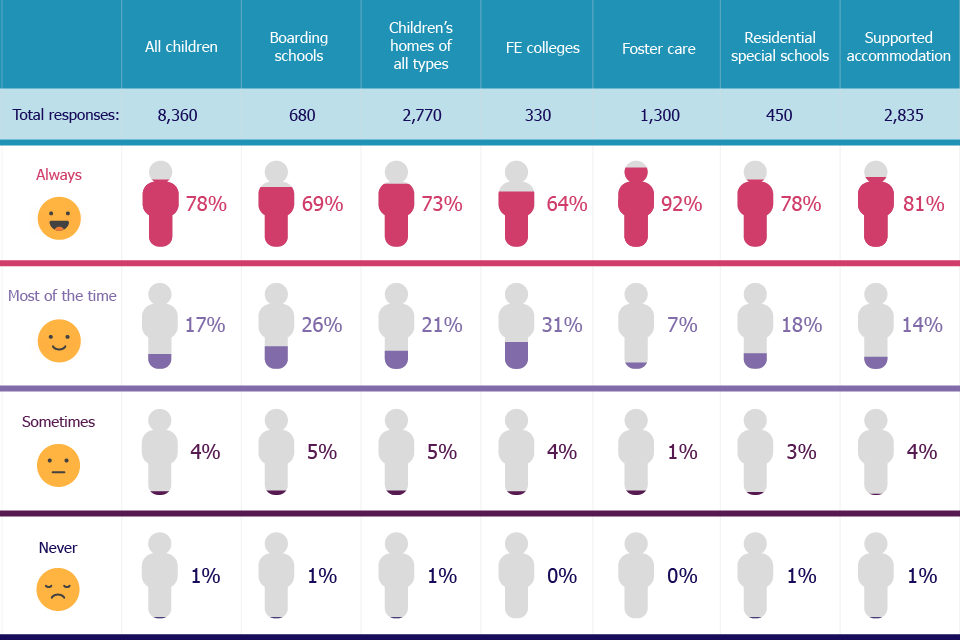
1. Figure 1 is a breakdown of children’s responses to the question ‘Do you feel safe where you live or stay?’ in 2026.
2. The data is included in the accessible table Data for Figure 2.
Figure 2: Do you feel safe where you live or stay? Breakdown of responses by year and provider type, 2024 to 2026
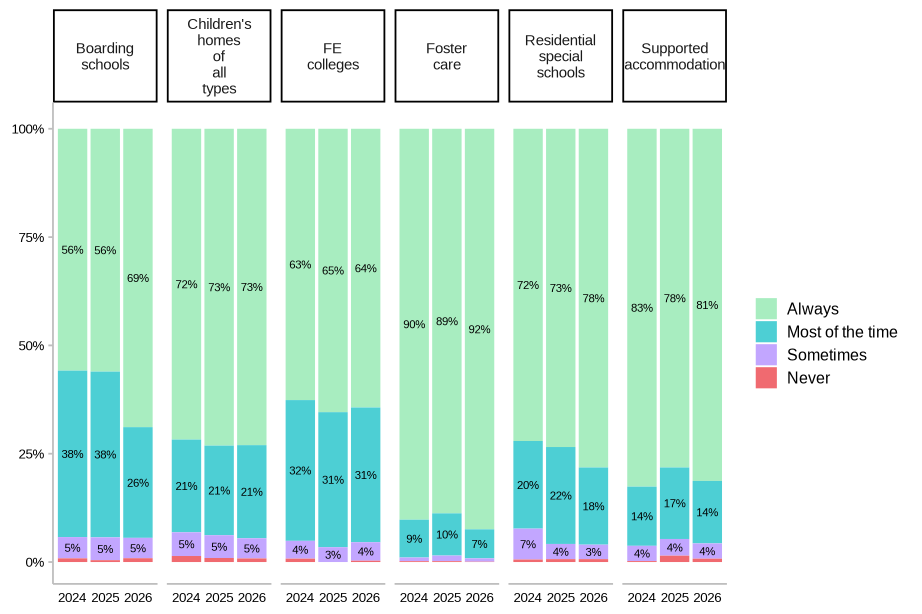
1. Figures are rounded and may not add up to exactly 100%.
2. Data labels are shown only for segments representing greater than or equal to 2% of the total.
View Data for Figure 2 in an accessible table format.
What children told us about feeling safe where they live or stay
‘It’s a very nice place. As soon as I walked through the doors it was so welcoming, and now I live here I feel much safer and better about myself.’ (Child in children’s home)
‘It’s a lovely environment that makes me feel safe and everyone, including staff, contribute to making me feel safe and welcome.’ (Child in residential FE college)
‘I find where I live a very safe environment and I get on really well with my carers and foster siblings.’ (Child in foster care)
‘It’s kinda changed my life and helped me get out of a lot of trouble and risks in my hometown and it’s learning me how to live on my own in future.’ (Child in supported accommodation)
‘I’ve been here for 4 years and never once have I felt unsafe or scared in the boarding house. I feel like even if I’m struggling in school or a bit stressed or overwhelmed, my boarding house is a place where I can just be myself.’ (Child in a boarding school)
‘I feel safe, as staff know me well. I am listened to and cared for well.’ (Child in residential special school)
Do you get along with the staff where you live or stay?
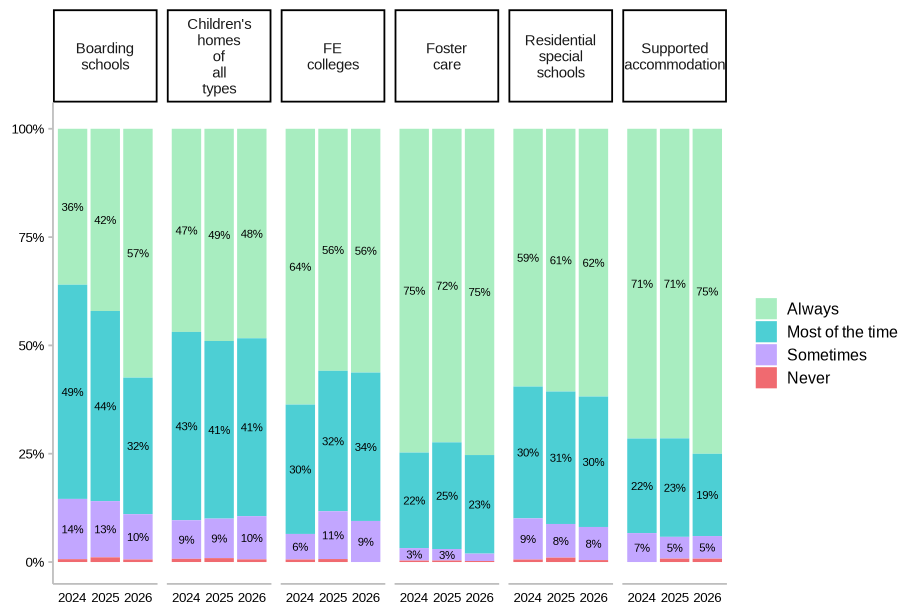
Most children (92%) reported that they got along with staff or carers ‘always’ or ‘most of the time’, which is 1 percentage point higher than last year.
In 2026, a higher proportion of children said that they ‘always’ get along with the staff in several provision types, compared with previous years. Most notably, there has been a considerable improvement in boarding schools (from 42% in 2025 to 57% in 2026), where children reported the lowest satisfaction in the previous years.
Overall, the proportion of children who said they get along with staff ‘sometimes’ or ‘never’ remained broadly stable (9% in 2025 and 8% in 2026), with slightly lower proportions in boarding schools and FE colleges, but similar in other provision types.
Figure 3: Do you get along with the staff where you live or stay?
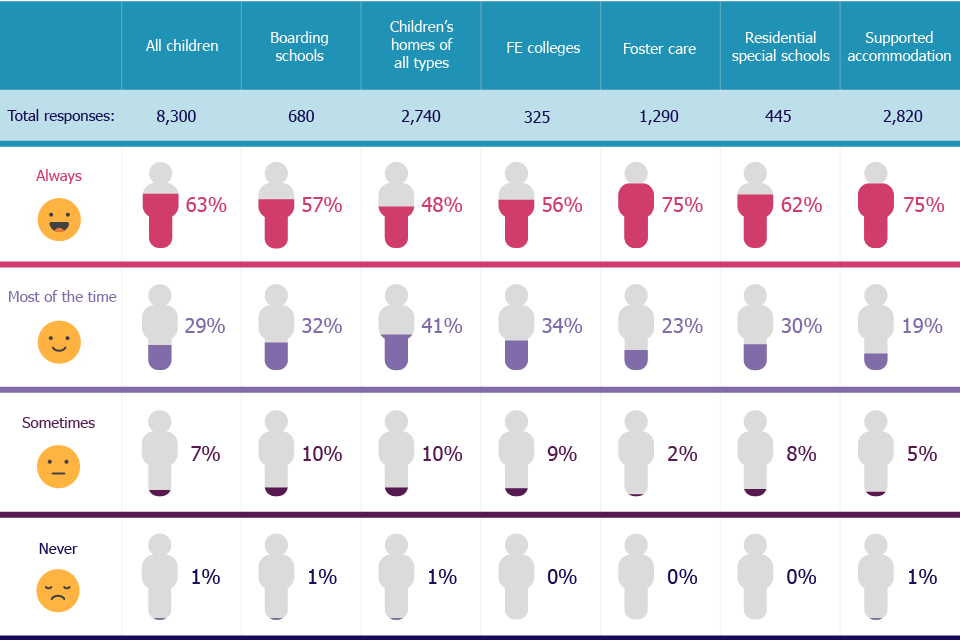
1. Figure 3 is a breakdown of children’s responses to the question ‘Do you get along with the staff where you live or stay?’ in 2026.
2. The data is included in the accessible table Data for Figure 4.
Figure 4: Do you get along with the staff where you live or stay? Breakdown of responses by year and provider type, 2024 to 2026
1. Figures are rounded and may not add up to exactly 100%.
2. Data labels are shown only for segments representing greater than or equal to 2% of the total.
View Data for Figure 4 in an accessible table format.
What children told us about getting along with staff
‘It’s good. It’s lovely. Staff care about me and we have good food. Staff speak with a nice tone. It’s a wonderful and amazing home.’ (Child in children’s home)
‘Staff give off a warm and comforting energy, which makes me feel safe when I’m in their presence. I feel listened to and my home is decorated to feel homely.’ (Child in supported accommodation)
‘It is a very nice campus with nice staff. I would like if they could arrange some better weather though.’ (Child in residential FE college)
‘I personally think it’s the best school in the world. The staff there are always so supportive of me and always try to listen to me. I feel like I’m heard and valued there.’ (Child in residential special school)
‘I want to stay here until I go to university and after that I will visit for holidays and take my carer out for nice things like she has done for me. She is family, not just a foster carer to me now because I have been here for over half of my life now.’ (Child in foster care)
‘I feel very lucky to have such a beautiful boarding house and such awesome boarding parents. They have a tough job but they do it really well.’ (Child in a boarding school)
Do you get on with the other children where you live or stay?
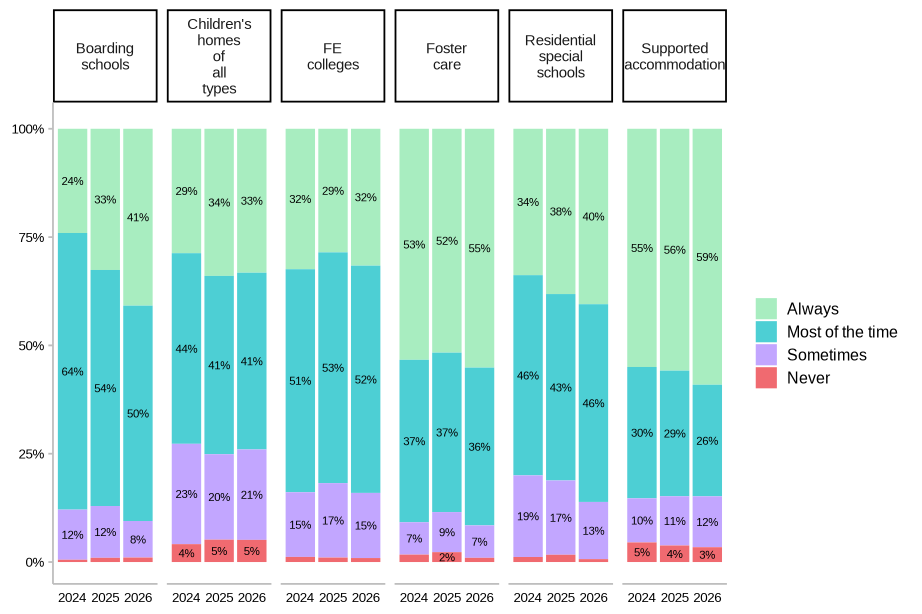
In 2026, 83% of all children said that they get on well with others ‘always’ or ‘most of the time’, consistent with last year’s figure. Children in foster care were the most likely to report positive relationships with other children in the household (92%), an increase from 88% reported in 2025, and similar to the level seen in 2024 (91%). More children living in group settings like residential special schools, boarding schools and FE colleges reported getting on with others ‘always’ or ‘most of the time’ – the highest proportion of the last 3 years.
In children’s homes, 26% of children said they get on with others only ‘sometimes’ or ‘never’, broadly in line with last year (25%). This was the lowest satisfaction rate across all provision types.
Figure 5: Do you get on with the other children where you live or stay?
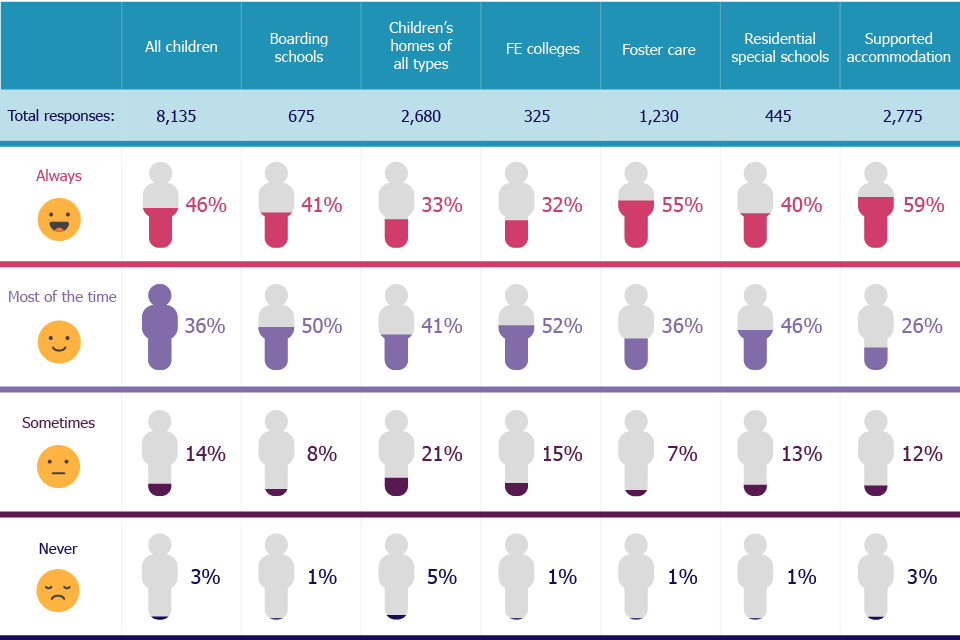
1. Figure 5 is a breakdown of children’s responses to the question ‘Do you get on with the other children where you live or stay?’ in 2026.
2. The data is included in the accessible table Data for Figure 6.
Figure 6: Do you get on with the other children where you live or stay? Breakdown of responses by year and provider type, 2024 to 2026
1. Figures are rounded and may not add up to exactly 100%.
2. Data labels are shown only for segments representing greater than or equal to 2% of the total.
View Data for Figure 6 in an accessible table format.
What children told us about getting on with the other children
‘The place I stay is a friendly and sometimes calming place because we laugh and play games. I get to hang out with friends and other people who I enjoy being around.’ (Child in residential special school)
‘I am happy where I am but don’t necessarily get on with my housemates but we are civil to each other.’ (Child in supported accommodation)
‘I like living with the other young person and we enjoying playing tricks on the grown-ups together. I love my new bedroom that has recently been re-done and the grown-ups listened to what I wanted doing to my room and have made it look amazing! I like my school and spending time with my teachers and friends having a laugh.’ (Child in children’s home)
‘This place has felt really homely as soon as I arrived. It took me some time to adjust. However, I made friends really quickly and I’ve bonded with my boarding staff. I really love it here.’ (Child in boarding school)
‘I’m friends with most people here and enjoy seeing them every day. We all get along and if there are any issues they get resolved.’ (Child in residential FE college)
‘There can be ups and downs with one of the children I live with and sometimes the things we say can get quite bad but we usually get over it.’ (Child in children’s home)
‘I feel very happy with this family because I feel very safe and I feel like the people that I live with always support me and I can trust them. If there is something wrong then I can tell them.’ (Child in foster care)
Do the staff where you live or stay ask you about things that are important to you?
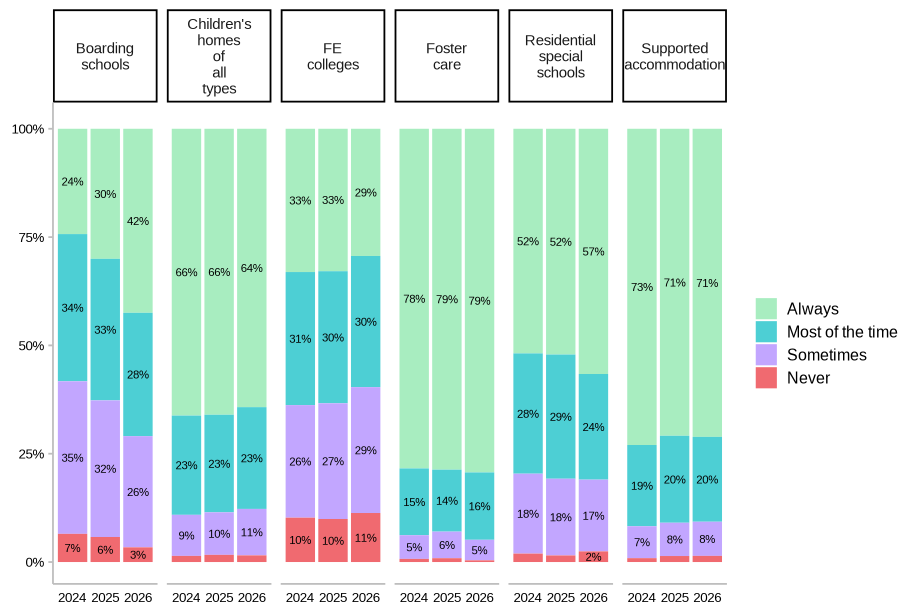
Overall, 87% of children who responded to the 2026 survey said that staff asked them about things that were important to them ‘always’ or ‘most of the time’, up from 83% reported in 2025. However, responses varied across different types of settings.
Children living with foster carers and those in supported accommodation continue to report the highest levels of positive responses, at 95% and 91% respectively. This year, 71% of children in boarding schools said that staff asked about what was important to them. This marks a continuous improvement from 63% reported last year, and 58% in 2024.
Only 3 in 5 young people staying at FE colleges said that staff asked them about important things ‘always’ or ‘most of the time’. However, more than 1 in 10 young people said this happens ‘never’ – the highest proportion across all provision types. A slightly lower proportion of children living in children’s homes also gave positive responses to this question at 87%, compared with 89% in 2025.
Figure 7: Do the staff where you live or stay ask you about things that are important to you?
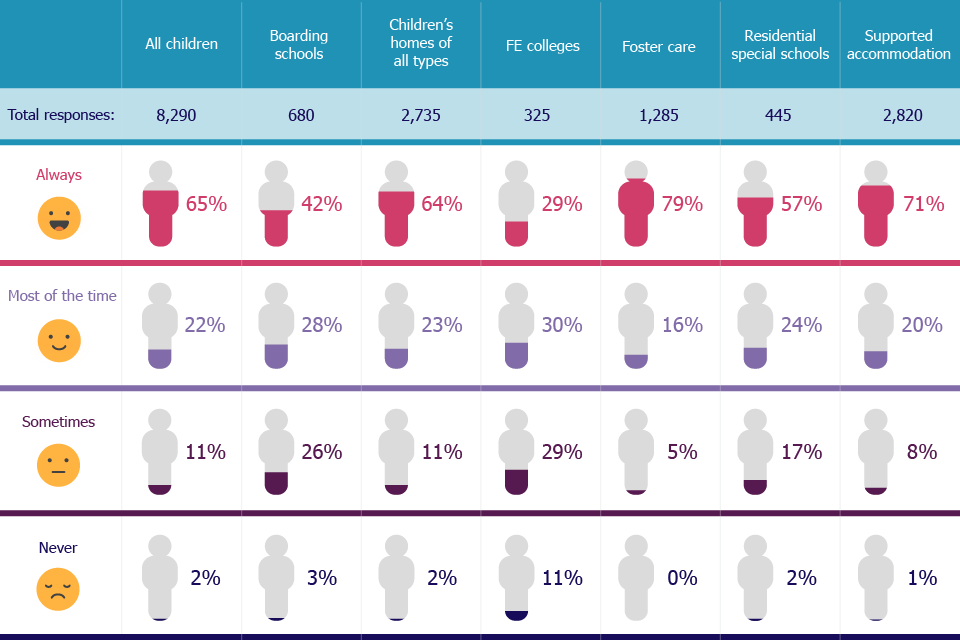
1. Figure 7 is a breakdown of children’s responses to the question ‘Do the staff where you live or stay ask you about things that are important to you?’ in 2026.
2. The data is included in the accessible table Data for Figure 8.
Figure 8: Do the staff where you live or stay ask you about things that are important to you? Breakdown of responses by year and provider type, 2024 to 2026
1. Figures are rounded and may not add up to exactly 100%.
2. Data labels are shown only for segments representing greater than or equal to 2% of the total.
View Data for Figure 8 in an accessible table format.
What children told us about staff asking about things that are important to them
‘The staff take me out to nice places that I enjoy, whereas [the] last places I lived staff wouldn’t take me. The staff listen to me and care for me all the time and make sure I am happy.’ (Child in children’s home)
‘It’s very welcoming and it’s really good for students who want to build independence and personal growth. Since staying here, I have gained massively in my independence and confidence, and residential has been supportive when needed.’ (Child in residential special school)
‘I love it because I can shower whenever I want. I like that I can have my friends stay overnight. This is important to me.’ (Child in supported accommodation)
‘They always understand you even when you are going through difficult things. They would always ask “how was your day?” and “what you have done?”.’ (Child in foster care)
‘It’s a really positive environment, full of staff that are ready to listen and care for you. Boarding has made a massive difference to me. It helped me learn independence and be more social, I get opportunities that I would never have if I didn’t come here.’ (Child in residential special school)
Do the staff where you live or stay listen to you?
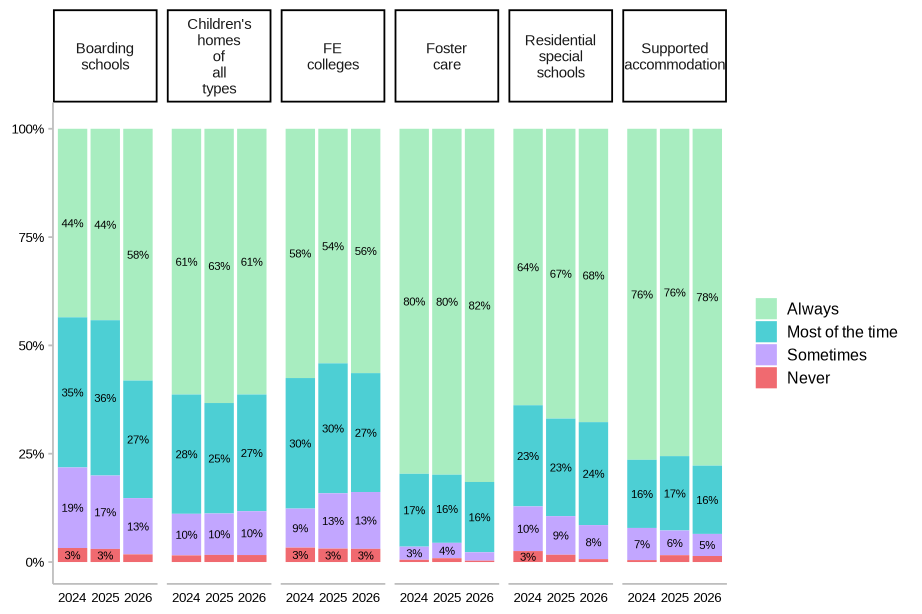
This year, 91% of all children said they felt listened to in the places where they live or stay ‘always’ or ‘most of the time’, which is an increase on last year’s figure of 89%.
Children in foster care and supported accommodation reported the most positive experiences, with 98% and 94% respectively saying that they feel listened to ‘always’ or ‘most of the time’. A slightly higher proportion of children staying at residential special schools (91%) felt listened to, compared with last year.
The highest proportion of children who said that staff listen to them ‘sometimes’ or ‘never’ was among boarders in FE colleges at 16%, which is in line with last year’s figure. In boarding schools, 15% of children gave the same response, which is an improvement on the 20% reported in 2025, and 22% in 2024.
Figure 9: Do the staff where you live or stay listen to you?
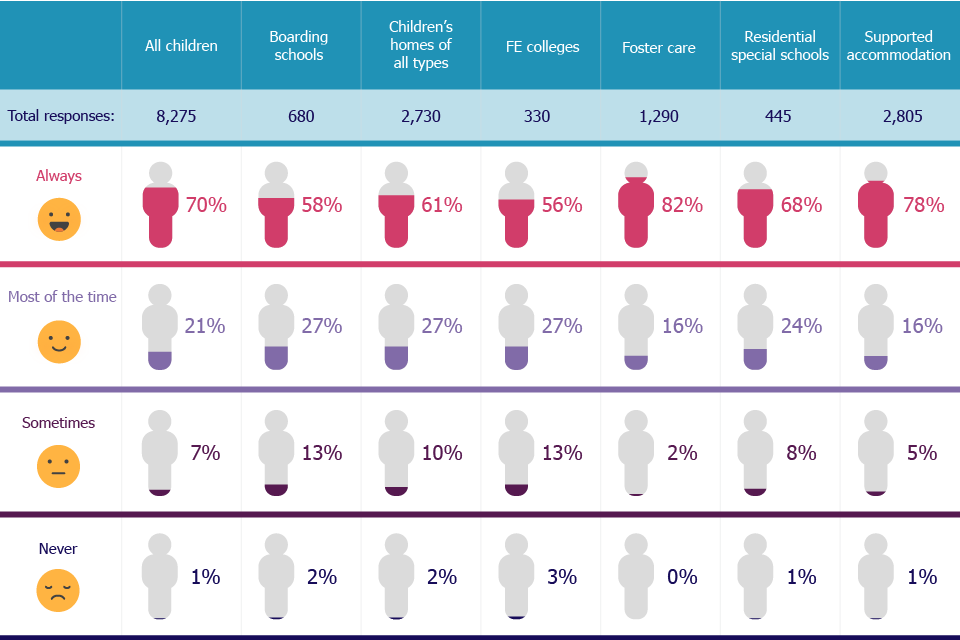
1. Figure 9 is a breakdown of children’s responses to the question ‘Do the staff where you live or stay listen to you?’ in 2026.
The data is included in the accessible table Data for Figure 10.
Figure 10: Do the staff where you live or stay listen to you? Breakdown of responses by year and provider type, 2024 to 2026
1. Figures are rounded and may not add up to exactly 100%.
2. Data labels are shown only for segments representing greater than or equal to 2% of the total.
View Data for Figure 10 in an accessible table format.
What children told us about staff listening to them
‘I feel so understood where I am and having someone listening to me really helps my emotions. The staff have helped me get back into school and show how proud they are of me. I love when they pick me up and ask about my day. It really makes me feel listened to and heard.’ (Child in children’s home)
‘It is amazing. My foster carer is kind and always listens to me. She takes me out to cafes to eat yummy food. We play games a lot.’ (Child in foster care)
‘They really listen to you whenever you are upset, stressed or not in the mood to do things.’ (Child in residential special school)
‘The boarding parents make it… always there to listen and chat after any day I have had.’ (Child in boarding school)
‘I am happy [with] everything. If I need anything, they always listen and provide for me. If I am not well, they help with booking a GP appointment for me and also prompt me to attend college. They are really [giving me the] best support. For instance, they help me applying for my provisional driving licence, opening a bank account and presently are helping me with my travel document. I always feel so safe with the house’. (Child in supported accommodation)
‘It is an amazing, beautiful place to study but can often have bad organisation and my friends and I often end up quite fed up by the end of the week due to the lack of organisation and when we speak up about it we don’t always get listened to.’ (Child in residential FE college)
Do you spend time with people who are important to you?
This year, 77% of all children who answered this question said that they spend time with people who are important to them ‘always’ or ‘most of the time’. This is consistent with the figure over the past 2 years.
Children in residential special schools were the most likely to report positive experiences in this area. The proportion of children who responded ‘always’ or ‘most of the time’ has been steadily increasing over the past 3 years, from 86% in 2024 to 90% in 2026. Similarly, 83% of children staying at boarding schools said they spend time with important people ‘always’ or ‘most of the time’, reflecting a gradual improvement over the last 2 years. A higher proportion of young people staying at FE colleges also provided positive responses, increasing from 76% last year to 80% in 2026.
The highest proportion of children who responded ‘sometimes’ or ‘never’ to this question was among children living in supported accommodation, at 28%. This is in line with the 2025 figure, and up from 26% in 2024. This was followed by children living in children’s homes, where 24% gave the same response, in line with last year.
Figure 11: Do you spend time with people who are important to you?
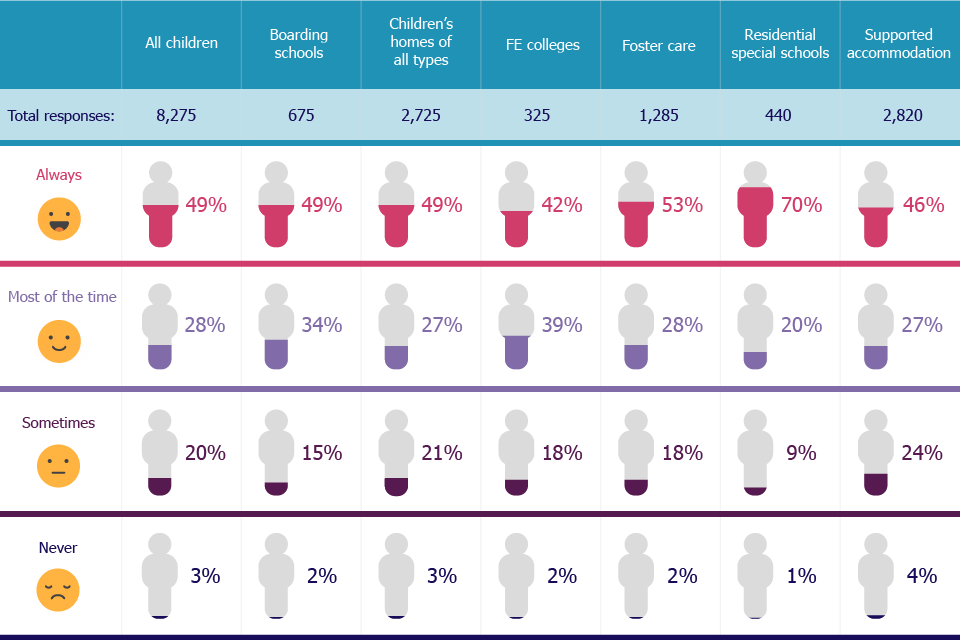
1. Figure 11 is a breakdown of children’s responses to the question ‘Do you spend time with people who are important to you?’ in 2026.
2. The data is included in the accessible table Data for Figure 12.
Figure 12: Do you spend time with people who are important to you? Breakdown of responses by year and provider type, 2024 to 2026
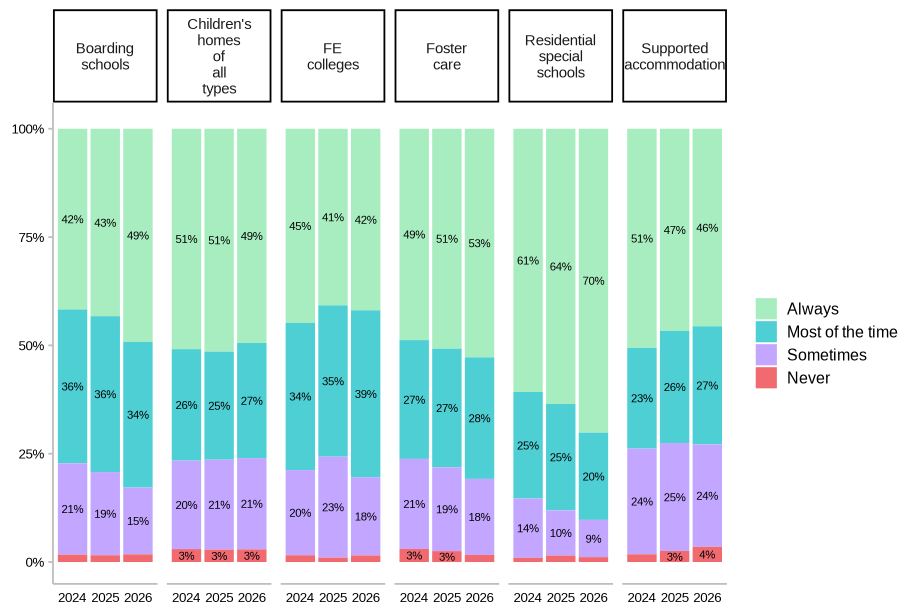
1. Figures are rounded and may not add up to exactly 100%.
2. Data labels are shown only for segments representing greater than or equal to 2% of the total.
View Data for Figure 12 in an accessible format.
What children told us about spending time with people important to them
‘Staff are supportive, funny, and they listen and want me to do well. Staff support with my family time.’ (Child in children’s home)
‘Good. I get on with the people I live with, my carers are nice, we have nice food, I’m allowed to see my friends, they support me at school, and they’ve helped me to see my mum.’ (Child in foster care)
‘I like my placement and staff are friendly and helpful. I see my friends and family regularly, which I enjoy.’ (Child in supported accommodation)
‘I like to spend time with the staff and my friends in residence. I feel comfortable here and like the activities.’ (Child in residential special school)
‘I really want to move from this area as I’m far away from my community.’ (Child in supported accommodation)
‘I enjoy staying in residential as I have time to myself whilst also having the option to spend time with friends.’ (Child in residential FE college)
In the last week, did you do something fun?
We asked children whether they had done something fun in the past week, and 88% of children said ‘yes’.
The highest proportion of positive responses was among children in foster care at 96%; this has remained steady over the past 3 years. Similarly, among children living in children’s homes, 92% did something fun in the past week, in line with the past 3 years.
While the majority of children across all settings gave positive responses, the proportion of those in FE colleges, supported accommodation and boarding schools reporting positively was slightly lower. However, there has been a positive shift in responses from children staying in boarding schools, where 86% reported doing something fun, compared with 83% in 2025.
Figure 13: In the last week, did you do something fun?
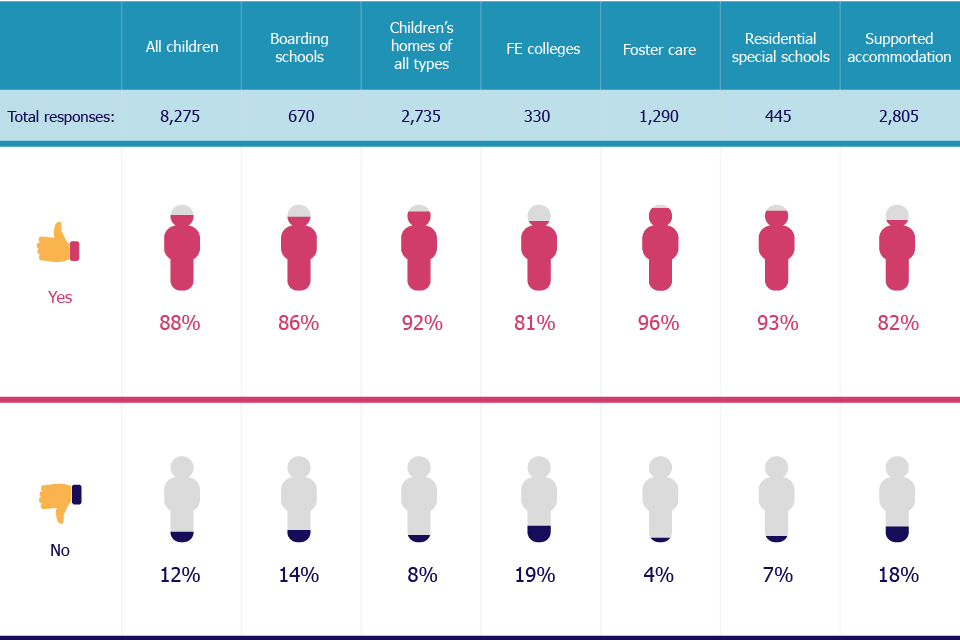
1. Figure 13 is a breakdown of children’s responses to the question ‘In the last week, did you do something fun?’ in 2026.
2. The data is included in the accessible table Data for Figure 14.
Figure 14: In the last week, did you do something fun? Breakdown of responses by year and provider type, 2024 to 2026
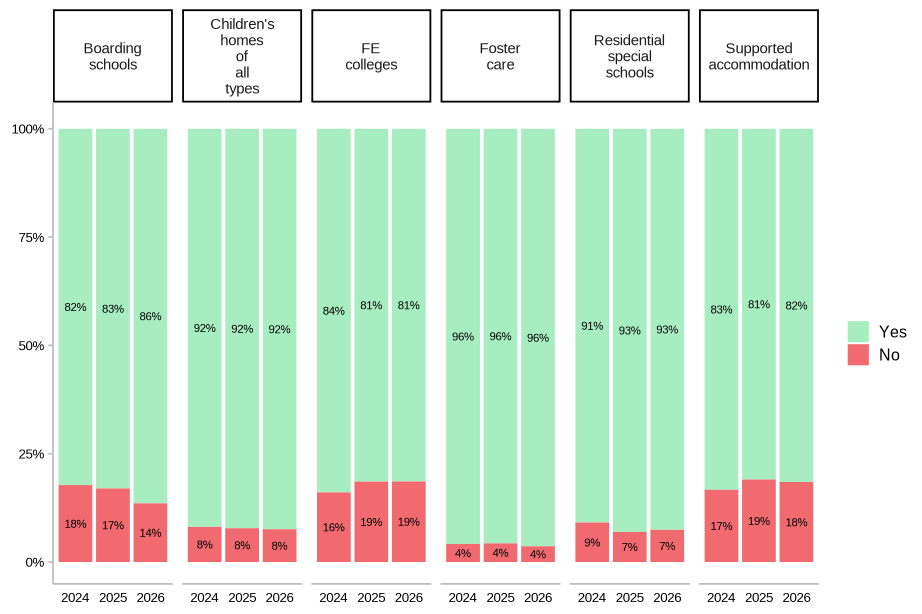
1. Figures are rounded and may not add up to exactly 100%.
2. Data labels are shown only for segments representing greater than or equal to 2% of the total.
View Data for Figure 14 in an accessible format.
What children told us about doing something fun
‘There’s always something to do and new activities or events take place.’ (Child in boarding school)
‘The activities are amazing. My favourite is climbing. They also have sooo many crafts to do. In fact there are people in front of me right now decorating wooden boxes with gems, fancy pens and stickers!’ (Child in residential special school)
‘Occasionally the whole house will go out together for activities like the arcade. We always have so much fun and if I ever need support I feel comfortable talking to my keyworkers without having to worry about being judged.’ (Child in supported accommodation)
‘We always eat dinner together and have daily chats and we go out and do fun things like going to zoos, parks and walks together.’ (Child in foster care)
‘I like going out with the adults. We do lots of fun things and I really like the house. All of the adults are like mums and dads and have fun with us. (Child in children’s home)
What would you like to tell us about the place you live?
We asked children to tell us anything they wanted to about the place where they lived or stayed. Of the 8,360 children who responded to the survey, 7,055 answered this question.
Children most often commented on their overall satisfaction with where they lived or stayed, with most describing it as ‘good’, ‘nice’ or ‘great’, and saying they were happy there. Feedback covered aspects such as location, bedrooms, and leisure activities. Children also frequently mentioned staff and carers, with comments largely positive, describing them as ‘nice’, ‘helpful’, and ‘supportive’.
Some children raised concerns. Those in group settings, such as boarding schools or FE colleges, mentioned long school days and limited free time. There were also negative comments about food quality, not getting on with others, and not being listened to when raising concerns. In addition, some children expressed a wish to spend more time with their families.
Any concerns raised by children were immediately referred to the inspectors and their managers, who decided on the appropriate action to ensure children’s safety.
Thank you to everyone who has completed our surveys and shared their views with us.
Annex of data figures
This section contains the underlying data in an accessible table format for all figures.
Data for Figure 2: Do you feel safe where you live or stay? Breakdown of responses by year and provider type, 2024 to 2026
| Provider type | Year | Always (%) | Most of the time (%) | Sometimes (%) | Never (%) |
|---|---|---|---|---|---|
| Boarding schools | 2024 | 56 | 38 | 5 | 1 |
| Boarding schools | 2025 | 56 | 38 | 5 | 0 |
| Boarding schools | 2026 | 69 | 26 | 5 | 1 |
| Children’s homes of all types | 2024 | 72 | 21 | 5 | 1 |
| Children’s homes of all types | 2025 | 73 | 21 | 5 | 1 |
| Children’s homes of all types | 2026 | 73 | 21 | 5 | 1 |
| FE colleges | 2024 | 63 | 32 | 4 | 1 |
| FE colleges | 2025 | 65 | 31 | 3 | 0 |
| FE colleges | 2026 | 64 | 31 | 4 | 0 |
| Foster care | 2024 | 90 | 9 | 1 | 0 |
| Foster care | 2025 | 89 | 10 | 1 | 0 |
| Foster care | 2026 | 92 | 7 | 1 | 0 |
| Residential special schools | 2024 | 72 | 20 | 7 | 1 |
| Residential special schools | 2025 | 73 | 22 | 4 | 1 |
| Residential special schools | 2026 | 78 | 18 | 3 | 1 |
| Supported accommodation | 2024 | 83 | 14 | 4 | 0 |
| Supported accommodation | 2025 | 78 | 17 | 4 | 1 |
| Supported accommodation | 2026 | 81 | 14 | 4 | 1 |
See Figure 2.
Data for Figure 4: Do you get along with the staff where you live or stay? Breakdown of responses by year and provider type, 2024 to 2026
| Provider type | Year | Always (%) | Most of the time (%) | Sometimes (%) | Never (%) |
|---|---|---|---|---|---|
| Boarding schools | 2024 | 36 | 49 | 14 | 1 |
| Boarding schools | 2025 | 42 | 44 | 13 | 1 |
| Boarding schools | 2026 | 57 | 32 | 10 | 1 |
| Children’s homes of all types | 2024 | 47 | 43 | 9 | 1 |
| Children’s homes of all types | 2025 | 49 | 41 | 9 | 1 |
| Children’s homes of all types | 2026 | 48 | 41 | 10 | 1 |
| FE colleges | 2024 | 64 | 30 | 6 | 1 |
| FE colleges | 2025 | 56 | 32 | 11 | 1 |
| FE colleges | 2026 | 56 | 34 | 9 | 0 |
| Foster care | 2024 | 75 | 22 | 3 | 0 |
| Foster care | 2025 | 72 | 25 | 3 | 0 |
| Foster care | 2026 | 75 | 23 | 2 | 0 |
| Residential special schools | 2024 | 59 | 30 | 9 | 1 |
| Residential special schools | 2025 | 61 | 31 | 8 | 1 |
| Residential special schools | 2026 | 62 | 30 | 8 | 0 |
| Supported accommodation | 2024 | 71 | 22 | 7 | 0 |
| Supported accommodation | 2025 | 71 | 23 | 5 | 1 |
| Supported accommodation | 2026 | 75 | 19 | 5 | 1 |
See Figure 4.
Data for Figure 6: Do you get on with the other children where you live or stay? Breakdown of responses by year and provider type, 2024 to 2026
| Provider type | Year | Always (%) | Most of the time (%) | Sometimes (%) | Never (%) |
|---|---|---|---|---|---|
| Boarding schools | 2024 | 24 | 64 | 12 | 1 |
| Boarding schools | 2025 | 33 | 54 | 12 | 1 |
| Boarding schools | 2026 | 41 | 50 | 8 | 1 |
| Children’s homes of all types | 2024 | 29 | 44 | 23 | 4 |
| Children’s homes of all types | 2025 | 34 | 41 | 20 | 5 |
| Children’s homes of all types | 2026 | 33 | 41 | 21 | 5 |
| FE colleges | 2024 | 32 | 51 | 15 | 1 |
| FE colleges | 2025 | 29 | 53 | 17 | 1 |
| FE colleges | 2026 | 32 | 52 | 15 | 1 |
| Foster care | 2024 | 53 | 37 | 7 | 2 |
| Foster care | 2025 | 52 | 37 | 9 | 2 |
| Foster care | 2026 | 55 | 36 | 7 | 1 |
| Residential special schools | 2024 | 34 | 46 | 19 | 1 |
| Residential special schools | 2025 | 38 | 43 | 17 | 2 |
| Residential special schools | 2026 | 40 | 46 | 13 | 1 |
| Supported accommodation | 2024 | 55 | 30 | 10 | 5 |
| Supported accommodation | 2025 | 56 | 29 | 11 | 4 |
| Supported accommodation | 2026 | 59 | 26 | 12 | 3 |
See Figure 6.
Data for Figure 8: Do the staff where you live or stay ask you about things that are important to you? Breakdown of responses by year and provider type, 2024 to 2026
| Provider type | Year | Always (%) | Most of the time (%) | Sometimes (%) | Never (%) |
|---|---|---|---|---|---|
| Boarding schools | 2024 | 24 | 34 | 35 | 7 |
| Boarding schools | 2025 | 30 | 33 | 32 | 6 |
| Boarding schools | 2026 | 42 | 28 | 26 | 3 |
| Children’s homes of all types | 2024 | 66 | 23 | 9 | 1 |
| Children’s homes of all types | 2025 | 66 | 23 | 10 | 2 |
| Children’s homes of all types | 2026 | 64 | 23 | 11 | 2 |
| FE colleges | 2024 | 33 | 31 | 26 | 10 |
| FE colleges | 2025 | 33 | 30 | 27 | 10 |
| FE colleges | 2026 | 29 | 30 | 29 | 11 |
| Foster care | 2024 | 78 | 15 | 5 | 1 |
| Foster care | 2025 | 79 | 14 | 6 | 1 |
| Foster care | 2026 | 79 | 16 | 5 | 0 |
| Residential special schools | 2024 | 52 | 28 | 18 | 2 |
| Residential special schools | 2025 | 52 | 29 | 18 | 2 |
| Residential special schools | 2026 | 57 | 24 | 17 | 2 |
| Supported accommodation | 2024 | 73 | 19 | 7 | 1 |
| Supported accommodation | 2025 | 71 | 20 | 8 | 1 |
| Supported accommodation | 2026 | 71 | 20 | 8 | 1 |
See Figure 8.
Data for Figure 10: Do the staff where you live or stay listen to you? Breakdown of responses by year and provider type, 2024 to 2026
| Provider type | Year | Always (%) | Most of the time (%) | Sometimes (%) | Never (%) |
|---|---|---|---|---|---|
| Boarding schools | 2024 | 44 | 35 | 19 | 3 |
| Boarding schools | 2025 | 44 | 36 | 17 | 3 |
| Boarding schools | 2026 | 58 | 27 | 13 | 2 |
| Children’s homes of all types | 2024 | 61 | 28 | 10 | 2 |
| Children’s homes of all types | 2025 | 63 | 25 | 10 | 2 |
| Children’s homes of all types | 2026 | 61 | 27 | 10 | 2 |
| FE colleges | 2024 | 58 | 30 | 9 | 3 |
| FE colleges | 2025 | 54 | 30 | 13 | 3 |
| FE colleges | 2026 | 56 | 27 | 13 | 3 |
| Foster care | 2024 | 80 | 17 | 3 | 1 |
| Foster care | 2025 | 80 | 16 | 4 | 1 |
| Foster care | 2026 | 82 | 16 | 2 | 0 |
| Residential special schools | 2024 | 64 | 23 | 10 | 3 |
| Residential special schools | 2025 | 67 | 23 | 9 | 2 |
| Residential special schools | 2026 | 68 | 24 | 8 | 1 |
| Supported accommodation | 2024 | 76 | 16 | 7 | 0 |
| Supported accommodation | 2025 | 76 | 17 | 6 | 2 |
| Supported accommodation | 2026 | 78 | 16 | 5 | 1 |
See Figure 10.
Data for Figure 12: Do you spend time with people who are important to you? Breakdown of responses by year and provider type, 2024 to 2026
| Provider type | Year | Always (%) | Most of the time (%) | Sometimes (%) | Never (%) |
|---|---|---|---|---|---|
| Boarding schools | 2024 | 42 | 36 | 21 | 2 |
| Boarding schools | 2025 | 43 | 36 | 19 | 2 |
| Boarding schools | 2026 | 49 | 34 | 15 | 2 |
| Children’s homes of all types | 2024 | 51 | 26 | 20 | 3 |
| Children’s homes of all types | 2025 | 51 | 25 | 21 | 3 |
| Children’s homes of all types | 2026 | 49 | 27 | 21 | 3 |
| FE colleges | 2024 | 45 | 34 | 20 | 2 |
| FE colleges | 2025 | 41 | 35 | 23 | 1 |
| FE colleges | 2026 | 42 | 39 | 18 | 2 |
| Foster care | 2024 | 49 | 27 | 21 | 3 |
| Foster care | 2025 | 51 | 27 | 19 | 3 |
| Foster care | 2026 | 53 | 28 | 18 | 2 |
| Residential special schools | 2024 | 61 | 25 | 14 | 1 |
| Residential special schools | 2025 | 64 | 25 | 10 | 2 |
| Residential special schools | 2026 | 70 | 20 | 9 | 1 |
| Supported accommodation | 2024 | 51 | 23 | 24 | 2 |
| Supported accommodation | 2025 | 47 | 26 | 25 | 3 |
| Supported accommodation | 2026 | 46 | 27 | 24 | 4 |
See Figure 12.
Data for Figure 14: In the last week, did you do something fun? Breakdown of responses by year and provider type, 2024 to 2026
| Provider type | Year | Yes (%) | No (%) |
|---|---|---|---|
| Boarding schools | 2024 | 82 | 18 |
| Boarding schools | 2025 | 83 | 17 |
| Boarding schools | 2026 | 86 | 14 |
| Children’s homes of all types | 2024 | 92 | 8 |
| Children’s homes of all types | 2025 | 92 | 8 |
| Children’s homes of all types | 2026 | 92 | 8 |
| FE colleges | 2024 | 84 | 16 |
| FE colleges | 2025 | 81 | 19 |
| FE colleges | 2026 | 81 | 19 |
| Foster care | 2024 | 96 | 4 |
| Foster care | 2025 | 96 | 4 |
| Foster care | 2026 | 96 | 4 |
| Residential special schools | 2024 | 91 | 9 |
| Residential special schools | 2025 | 93 | 7 |
| Residential special schools | 2026 | 93 | 7 |
| Supported accommodation | 2024 | 83 | 17 |
| Supported accommodation | 2025 | 81 | 19 |
| Supported accommodation | 2026 | 82 | 18 |
See Figure 14.
-
‘Adoption services’ include voluntary adoption agencies, local authority adoption services and adoption support agencies. We sent the surveys to regional adoption agencies, where they now carry out some local authorities’ adoption functions. ‘Fostering services’ include independent fostering agencies and local authority fostering services. ↩
-
Under the Care Standards Act 2000, Ofsted has the powers to inspect these types of services. There is no law to say that children, staff and professionals have to share their views with us through this survey. It is optional, and we highly value the information we receive. ↩
-
‘Children looked after in England including adoptions’, Department for Education, November 2025. ↩
-
A child who is looked after by a local authority (referred to as a looked-after child), as defined in section 22 of the Children Act 1989, means a child (0 to 18 years of age) who is subject to a care order (or an interim care order) or who is accommodated by the local authority. ↩
-
In relation to children’s homes and fostering services, the responses from children do not solely relate to looked-after children. A number of children who are not looked after receive services: for example, children who receive short breaks or who are placed under other arrangements. Most users of short breaks are children who have special educational needs and/or disabilities, but other children in need may also receive short breaks. The breaks usually have 2 aims: to enable the child to participate in fun, interesting and safe activities, and to provide a break for parents and carers. ↩