Small Pots: a pathway for consolidation
Published 15 September 2026

© Crown copyright 2026
This publication is licensed under the terms of the Open Government Licence v3.0 except where otherwise stated. To view this licence, visit nationalarchives.gov.uk/doc/open-government-licence/version/3 or write to the Information Policy Team, The National Archives, Kew, London TW9 4DU, or email: psi@nationalarchives.gov.uk.
Where we have identified any third party copyright information you will need to obtain permission from the copyright holders concerned.
This publication is available at https://www.gov.uk/government/consultations/small-pots-a-pathway-for-consolidation/small-pots-a-pathway-for-consolidation
Implementing the Multiple Default Consolidator solution to address the small pots problem in the DC market.
15 September 2026
Introduction
This consultation sets out proposals for the implementation of automatic consolidation of deferred small pots through the establishment of consolidator schemes, helping to tackle the increasing number of deferred small pension pots across the pensions system. This consultation asks a number of questions around these proposals and seeks the views of interested stakeholders.
About this consultation
Who this consultation is aimed at
The Department for Work and Pensions welcomes input from: pension scheme providers; trustees; scheme managers; members of workplace pension schemes; employee representatives; trades unions; consumer groups; employers and employee representative groups; pension industry professionals; and members of the advisory community and any other interested stakeholders.
Purpose of the consultation
The Consultation seeks input and evidence following royal assent of the Pension Schemes Act 2026, to support the government to make decisions ensuring the successful delivery of the Multiple Default Consolidator solution.
Scope of consultation
Occupational pensions are a devolved matter for Northern Ireland. However, DWP are working closely with counterparts in Northern Ireland at the Department for Communities in relation to the matters set out in this consultation, and consultation responses will be used to develop policy in Great Britain by DWP and in Northern Ireland by the Department for Communities. This consultation is therefore of relevance to stakeholders in Great Britain and in Northern Ireland.
Duration of the consultation
The consultation will run for 9 weeks, starting on 15 September 2026, and ending on 17 November 2026. Please ensure your response reaches us by that date as any replies received later might not be taken into account.
How to respond to this consultation
Please send your consultation responses to: smallpots.policyteam@dwp.gov.uk
Notes:
-
Responses may be shared with regulatory bodies, including The Pensions Regulator (TPR) and the Financial Conduct Authority (FCA), for the purposes of policy development and oversight. If you do not wish for the response or specific information to be shared, please ensure this is clearly stated at the time of submission.
-
When responding, please indicate whether you are responding as an individual or representing the views of an organisation, whether you are content for your response to be quoted in a future response the government issues, and whether you would prefer this to be anonymous.
Government response
We will aim to publish the government response to the consultation on the GOV.UK website. The consultation principles encourage departments to publish a response within 12 weeks or provide an explanation why this isn’t possible. Where a consultation is linked to a statutory instrument, responses should be published before or at the same time as the instrument is laid.
The report will summarise the responses, and may quote specific responses where appropriate. Where schemes do not wish to be quoted in the response, they should make this clear as part of their response.
This includes any responses that contain data that schemes do not wish to be quoted (for example, on the number of members who re-enrol in the scheme through the same employer after an absence of more than 12 months, or the number of small deferred pots within Sharia compliant funds). We will treat this data as confidential and only use it within the Department where there is a clear business need to inform policy development. DWP will not share data with any third party, other than through publication of anonymised and aggregated data.
How we consult
Consultation principles
This consultation is being conducted in line with the revised Cabinet Office consultation principles published in January 2016. These principles give clear guidance to government departments on conducting consultations.
Feedback on the consultation process
We value your feedback on how well we consult. If you have any comments about the consultation process (as opposed to comments about the issues which are the subject of the consultation), please email them to the DWP Consultation Coordinator. These could include if you feel that the consultation does not adhere to the values expressed in the consultation principles or that the process could be improved.
DWP Consultation Coordinator
2nd Floor
Caxton House
Tothill Street
London
SW1H 9NA
Email: caxtonhouse.legislation@dwp.gov.uk
Freedom of information
The information you send us may need to be passed to colleagues within the Department for Work and Pensions, published in a summary of responses received, and referred to in the published consultation report.
All information contained in your response, including personal information, may be subject to publication or disclosure if requested under the Freedom of Information Act 2000. By providing personal information for the purposes of the public consultation exercise, it is understood that you consent to its disclosure and publication. If this is not the case, you should limit any personal information provided, or remove it completely. If you want the information in your response to the consultation to be kept confidential, you should explain why as part of your response, although we cannot guarantee to do this.
To find out more about the general principles of Freedom of Information and how it is applied within DWP, please contact the Central Freedom of Information Team:
Email: freedom-of-information-request@dwp.gov.uk
The Central Freedom of Information team cannot advise on specific consultation exercises, only on Freedom of Information issues. Read more information about the Freedom of Information Act.
Ministerial foreword
Across the workplace pensions market today, there are around 13 million deferred small pension pots – and that number is growing by more than a million every year. This proliferation of pots is not just a trend; it’s a structural inefficiency. We estimate it costs the industry £240 million annually in administration – costs that ultimately fall on members.
That runs counter to what we want from this market: a system that delivers value for money, the benefits of scale provision and secure retirement incomes for the vast majority of savers. That is a system that builds trust and confidence, removing current complexity and waste of fragmented small pots.
Over recent years, working closely with the pensions industry, we’ve built a strong consensus on the way forward. That’s why, through the Pension Schemes Act 2026, the government took powers to introduce a Multiple Default Consolidator solution. This approach will allow eligible small pots to be brought together automatically, without any action from members. The result: fewer, larger pots that are easier to manage, and a system freed from unnecessary cost and wasted administration so schemes can focus on delivering the best outcomes for members.
Now is the time to turn that vision into reality. This consultation sets out the building blocks of the policy, from how consolidator schemes will be authorised, to the digital infrastructure that will underpin the model. These are big decisions, and they must be taken with one principle at their heart: what is best for members.
Our ambition is clear: to have small pot consolidation operational from 2030. This is a reform built for the long term, and we want to hear your views on how to make this work in practice - your insights will be vital in shaping a system that delivers for members and the industry.
Torsten Bell MP
Minister for Pensions
Chapter 1: Introduction
Background
1. Automatic Enrolment (AE) has made workplace pension saving the norm. However, each time an eligible worker changes jobs, they are typically enrolled into a new pension scheme by their new employer, often resulting in the creation of a new pension pot. Over time, this has led to a large and rapidly growing number of small, deferred pension pots with no ongoing contributions.
2. It is currently estimated that there are over 13 million deferred pots worth less than £1,000, representing a total value of over £4 billion[footnote 1]. This number continues to grow by around one million pots each year. These pots often represent poor value for members and create inefficiencies for pension providers, with administrative costs estimated at around £240 million per year[footnote 2] across the industry - costs which are ultimately borne by savers.
3. Low levels of member engagement further exacerbate the issue. Many individuals have limited understanding of their pension arrangements, do not regularly review their savings, or are unaware that they hold multiple small pots. In some cases, members may lose track of their pensions altogether. This fragmentation can lead to duplicated charges, reduced value for money, and poorer retirement outcomes.
4. The Department has worked closely with industry and stakeholders over several years to build the evidence base and explore potential solutions to this issue. This has included analysis of a range of models, such as “pot follows member”, a lifetime provider approach, and the multiple default consolidator model. On 22 November 2023, the previous government published its response to Ending the proliferation of small pots consultation[footnote 3], confirming its intention to proceed with the Multiple Default Consolidator solution – the legal framework for this policy has been subsequently approved by Parliament following the passage of the Pension Schemes Act 2026.
5. Under this approach, schemes will be required to transfer eligible small pots to consolidator schemes, while preserving key member protections, including the ability to opt out or select an alternative consolidator. This aims to reduce fragmentation, improve efficiency, and support a better functioning pensions market in the interests of savers.
6. To support the design and delivery of this policy, the Department convened a group of industry participants, regulators and other stakeholders to provide input on the development of an efficient and cost-effective automated consolidation system. This engagement informed key aspects of the proposed framework, including the design of transfer processes, member communications, governance and oversight of consolidator schemes, the role of supporting infrastructure, and interactions with wider reforms such as pensions dashboards.
7. The Multiple Default Consolidator solution provides a mechanism through which eligible small pots, initially those valued at £1,000 or less and inactive for at least 12 months, would be automatically transferred into a limited number of consolidator schemes. This approach is designed to balance system-wide efficiency with member protection, ensuring that individuals retain the ability to opt out or choose their own consolidator.
8. Delivering this solution will require supporting infrastructure to enable effective data matching, pot identification, and consolidator allocation. It will also require a robust authorisation and supervisory framework for consolidator schemes, including clear governance expectations, regulatory oversight, and standards to support value for money and consumer protection. A phased approach to implementation of ceding scheme duties is anticipated, however, this will be explored further at a later consultation.
9. Through the Pension Schemes Act 2026 the government has established a legal framework required to implement the Multiple Default Consolidator solution. This consultation seeks views on proposals for secondary legislation to support the operation of the regime. In particular, it covers:
-
the eligibility criteria for pension schemes and pots within scope, including the treatment of pots with guarantees
-
the authorisation regime for trust-based schemes to act as consolidator schemes, to be overseen by The Pensions Regulator (TPR), alongside provision for the Financial Conduct Authority (FCA) to make rules for contract-based schemes
-
the supervisory framework and enforcement powers available to regulators, including the ability to, where appropriate, withdraw consolidator status where standards are not met
-
the establishment of the necessary infrastructure, to enable pot matching and consolidator allocation
-
the information requirements for members, including communication of their options, such as the right to opt out or select an alternative consolidator
-
new duties on employers to provide relevant information to schemes in respect of their enrolled employees
Workplace pensions: a roadmap
10. Our programme of pensions reform delivery plans are set out in Workplace pensions: an updated roadmap, which was published on 13 July 2026[footnote 4]. The roadmap sets out the government’s current expectations for the implementation of the Multiple Default Consolidator solution, including the steps required to facilitate the consolidation of eligible deferred pension pots from 2030.
Purpose of this consultation
11. A clear and consistent framework is fundamental to the successful delivery of the Multiple Default Consolidator solution. Setting out these requirements at an early stage is essential to ensure that all parties understand their roles and responsibilities in delivering an efficient, cost-effective consolidation process on behalf of members.
12. The Multiple Default Consolidator solution will operate across both sides of the pensions market and, as such, both the Financial Conduct Authority (FCA) and The Pensions Regulator (TPR) will have important roles to play. It is therefore essential that the Multiple Default Consolidator solution functions effectively across these regulatory regimes. We are committed to minimising unnecessary friction to ensure that pots can be consolidated from trust based to contract-based schemes, and vice versa, without confusion, delay or detriment. While there may be some operational differences in how the framework is established, supervised or regulated across the two markets, we expect a high degree of parity wherever possible. Schemes should be required to meet equivalent standards and deliver comparable outcomes for members regardless of whether they operate in the trust based or contract-based market. We are therefore keen for respondents to consider these regulatory relationships and interactions when responding to this consultation.
13. Chapter 2 explores the eligibility criteria for the Multiple Default Consolidator solution, including the types of pension schemes and fund arrangements that will be in scope. It also outlines the approach to pots that include guarantees or protections, and how trustees and scheme managers may exercise discretion in members’ best interests.
14. Chapter 3 describes the information that will be provided to members to explain the consolidation process and the options available to them. This includes how members will be notified of their allocated consolidator, along with their right to opt out or choose an alternative consolidator.
15. Chapter 4 outlines the standards required to be met for a scheme to act as a consolidator. Chapter 5 explores how best to maintain high standard consolidator schemes, and the potential interventions required if standards are no longer met.
16. Chapters 6 discusses the proposed infrastructure and data requirements to support the Multiple Default Consolidator solution. It outlines the proposed delivery model, supported by an oversight body with a digital interface, alongside exploring the common data, messaging and matching standards that will be required. It also discusses how the appropriate destination consolidator will be identified, including the treatment of multiple matches and the use of a carousel allocation mechanism where a member does not already have a pot with a consolidator scheme.
17. Chapter 7 sets out the new requirements that will be placed on employers to provide relevant and up-to-date information to pension schemes in respect of their employees.
18. This consultation sets out the core components of the Multiple Default Consolidator solution. Together, these proposals form the operational and regulatory structure required to support the implementation of the Multiple Default Consolidator solution. In addition to outlining the government’s proposed approach, this consultation seeks views on a number of areas to inform further policy development ahead of implementation. Responses will inform the development of draft regulations, which will be published alongside the government’s response.
19. While this consultation considers the Multiple Default Consolidator solution in its entirety across the whole market, the Pension Schemes Act 2026 gives the FCA powers in relation to contract-based schemes. Under the Act, the FCA is empowered to establish a notification regime whereby the FCA can make rules in relation to firms that intend to become consolidator schemes. Where it does introduce rules, it will have regard to small pots regulations made by DWP.
20. The forthcoming regulatory framework will be critical to the successful delivery of consolidation. Key policy decisions are therefore required at this stage to ensure sufficient time for industry preparation, system development, and testing.
21. A further consultation, planned for late 2027/early 2028, will consider the detailed requirements for ceding schemes, the supervisory approach for those schemes, finalised data standards, and outstanding elements of the broader framework. The approach to implementation and delivery timelines will also be set out in due course.
Chapter 2: Pot eligibility and exemptions
Background
22. The eligibility criteria and exemption conditions outlined in this chapter represent a pragmatic starting point for addressing the growth of deferred small pots resulting from the implementation of automatic enrolment and increased labour market mobility. By focusing initially on automatic enrolment schemes established since 2012, the policy targets those schemes with the highest volume of deferred small pots, maximising benefits for the majority of savers. This targeted approach is considered both practical and proportionate, enabling the Multiple Default Consolidator solution to be implemented, tested, and refined within a clearly defined cohort before any potential expansion in scope.
23. The protection of members’ accrued rights and pension guarantees remains central to the design of the Multiple Default Consolidator solution. Certain guarantees, such as guaranteed annuity rates, guaranteed survivor benefits, and rights contingent on marriage or civil partnership, may be of significant value to members despite the small monetary size of the pot. In many cases, these guarantees cannot be reinstated once lost, and it is therefore important that the Multiple Default Consolidator solution appropriately safeguards such entitlements.
24. This chapter explores these issues in more detail, including the proposed eligibility criteria, the treatment of pots with guarantees, and the role of trustee and scheme manager discretion. We welcome views from stakeholders on the proposed approach, including whether the balance between consolidation and member protection has been appropriately struck and whether any additional considerations should be taken into account.
Pots in scope
25. The government has established that the Multiple Default Consolidator solution will apply to pension pots held within defined contribution, charge-capped default funds created since the introduction of automatic enrolment on 1 October 2012. A default arrangement, for the purpose of small pot consolidation, is to be defined as one in which contributions are made and invested without the member having expressed an active investment choice.
26. To be eligible for consolidation, a pot must:
-
have received no contributions for a period of at least the last 12 months
-
have a value of £1,000 or less (but greater than zero)
27. It is estimated that this will bring approximately 20 million small dormant pots into scope at the point of implementation in 2030, enabling millions of savers to benefit from having their pension savings brought together within a single, well-performing scheme.
Dormancy period
28. The government’s established position is that a pension pot will be considered dormant, and therefore eligible for consolidation, where no contributions have been made by the member or their employer in the most recent 12 months. This forms a core part of the Multiple Default Consolidator solution and ensures that the system operates in a timely and proportionate way, targeting pots that are no longer actively receiving contributions while safeguarding member interests.
29. The 12‑month dormancy period is designed to strike an appropriate balance between enabling timely consolidation and avoiding the premature transfer of pots where contributions have only temporarily ceased. Pots that are no longer receiving contributions are more likely to be eroded over time through charges, and timely consolidation can improve outcomes for members by reducing fragmentation and duplication of charges.
30. The government considers that a 12‑month threshold reflects typical patterns within the UK labour market and the operation of automatic enrolment. Some individuals experience short breaks in pension contributions due to seasonal work, irregular working patterns, or temporary exits from the labour market. A 12‑month period provides sufficient time to distinguish between these short-term gaps and a genuine cessation of saving into that pot, likely caused by a permanent cessation of that particular employment, thereby reducing the risk of consolidation being triggered unnecessarily.
31. The dormancy criterion operates alongside other features of the framework. In particular, many savers will exceed the £1,000 eligibility threshold within a relatively short period of saving, and members will be notified in advance of consolidation and retain the right to opt out or choose an alternative consolidator. These safeguards ensure that consolidation remains proportionate and aligned with member interests.
32. The continued growth in deferred small pots, currently increasing by around one million each year, reinforces the need for a clear and timely dormancy trigger. Extending the dormancy period beyond 12 months would delay consolidation activity and risk increasing inefficiencies in the system. The 12‑month threshold therefore supports the objective of addressing the proliferation of small pots in a systematic and effective manner.
33. The government recognises that there may be circumstances in which members intentionally pause contributions for longer periods while intending to resume saving at a later date, for example, during extended parental leave, planned career breaks, or periods spent overseas. In such cases, pension schemes will be expected to take account of relevant information, potentially provided by employers, as set out in Chapter 7, and temporarily exclude these pots from consolidation for a defined period. Where contributions do not resume following that period, the pot would then become eligible for consolidation after a further 12 months of inactivity. Again, individuals will also be able to opt-out of consolidation if they know they intend to return to saving into that pension pot after exceeding 12 months of inactivity.
34. Some stakeholders have raised concerns that a 12‑month period may be too short and have suggested that a longer period could provide greater protection for members who experience extended breaks in contributions. These views reflect concerns about the risk of consolidation being triggered in cases where individuals intend to resume saving, particularly in the context of modern working patterns. The government has carefully considered these arguments alongside the available operational and behavioural evidence. We are currently undertaking a data-gathering exercise with pension providers to assess the potential impact of this proposal. We intend to publish the findings as part of our response to this consultation. We would also welcome any relevant data from schemes, particularly on the number of members who re-enrol in the scheme through the same employer after an absence of more than 12 months, where such information is available.
Proposal:
On the basis of the currently available evidence and analysis, the government considers that a 12‑month dormancy period remains appropriate and will proceed on this basis. We will continue to monitor evidence and stakeholder feedback and, should circumstances change, will consider whether adjustments to this approach are required.
Schemes in scope
35. As set out above, small deferred pension pots are predominantly concentrated within large automatic enrolment Master Trusts and contract-based defined contribution schemes, where member engagement is generally low. This raises questions about how best to ensure that consolidation occurs in a way that supports member outcomes without requiring active decision-making.
36. The initial scope of the policy is therefore deliberately targeted at this part of the market, where the issue is most acute. The Pension Schemes Act 2026 provides that only automatic enrolment schemes with pots meeting the eligibility criteria set out above will fall within scope of the Multiple Default Consolidator solution. This targeted approach reflects both the scale of the problem in this segment and the opportunity to deliver early impact, while allowing consideration of whether and how scope should evolve over time.
37. Pension pots created prior to the introduction of automatic enrolment will not initially be included. This reflects the fact that the majority of small pots have arisen since 2012 and are concentrated within automatic enrolment arrangements. The Multiple Default Consolidator solution has been designed to allow for future expansion through legislation, once operational capability, supporting infrastructure, and confidence in the system have been established. However, it is right to start where the problem is most acute.
38. The Multiple Default Consolidator solution is focused on default arrangements, where members have not actively chosen how their pot is invested. Member-selected (self-select) investment arrangements will therefore be excluded at this stage. While this avoids overriding deliberate investment choices, it also raises questions about whether some members with self-select funds may nonetheless benefit from consolidation, and how any such cases might be identified and addressed in the future.
39. These arrangements are excluded because it would not be proportionate or practical, at this stage, for consolidator schemes to cater to the full range of religious, ethical, and specialist investment preferences across the market. This also reflects the fact that members who have actively chosen specific investment options have demonstrated engagement with their pension. Automatically consolidating their pots would therefore be inconsistent with the policy’s focus on individuals who are disengaged or unaware of their pension savings.
40. This approach is intended to support coherence with wider defined contribution reforms, including the Value for Money (VFM) framework and the scale pathway, which will not initially apply to these types of arrangements.
41. The government has previously committed that Sharia-compliant funds should be brought within scope of consolidation in due course, noting that many consolidator schemes may be capable of accommodating such arrangements and that while an individual has made an active choice to change how their pot is invested, this is likely to be solely due to religious beliefs rather than any wider engagement with their pension. However, these funds will initially be excluded to allow for further evidence gathering on their scale and characteristics within the market, as well as consideration of any operational or design challenges. We are currently undertaking a data-gathering exercise with pension providers to assess the potential impact of this proposal. We intend to publish the findings as part of our response to this consultation. We would also welcome any relevant data from schemes as part of their response to this consultation, where available, on the number of deferred pots with a value of less than £1,000 that are invested in Sharia funds and have received no contributions for 12 months or more. This position will be kept under review, with a view to future inclusion once supporting frameworks, such as VFM assessments, are sufficiently developed.
42. Alongside this, schemes established to meet other specific religious or values-based requirements will also be out of scope. In these cases, schemes will be able to exempt a whole class of individuals, rather than making decisions on a pot-by-pot basis, where trustees or scheme managers reasonably conclude that savers have been enrolled specifically to meet those requirements (for example, the Plymouth Brethren pension scheme). The government welcomes views on how such exemptions should be defined and applied in practice to ensure they are used appropriately.
43. We consider that, where a ceding scheme is in the process of winding up prior to the small pots regulations coming into force, small pots held within that scheme should not be eligible for consolidation under the Multiple Default Consolidator solution during the winding-up period. This is to avoid introducing additional complexity, operational burden, confusion and potential member detriment at a time when benefits are already being transferred or otherwise secured as part of the wind-up process.
44. Smaller pension schemes will also be out of scope in the initial phase. The Multiple Default Consolidator solution is intended to reduce fragmentation, lower administrative costs, and support the development of scale within the pensions system. Including smaller schemes, many of which may consolidate into larger arrangements or exit the market over time, may not be proportionate at this stage. For the purposes of the Multiple Default Consolidator solution, smaller schemes are defined as those with 100 members or fewer, including arrangements such as Small Self-Administered Schemes (SSASs), Executive Pension Plans (EPPs), and Self-Invested Personal Pensions (SIPPs). The government welcomes views on whether this threshold strikes the appropriate balance, or whether it should be set at a higher or lower level. We are also interested in views on how smaller schemes should be treated over the longer term. We are also keen to understand, how stakeholders consider that schemes in wind-up should be treated, given it may add complication or increase costs for members, if schemes are required to run both processes at the same time.
Proposal:
We propose that the Multiple Default Consolidator solution initially targets small pots in large automatic enrolment schemes, focusing on default arrangements where engagement is lowest, and excluding pre-automatic enrolment pots, self-select investments, religious or values-based arrangements, smaller schemes on proportionality grounds and ceding schemes that are winding up prior to the introduction of the Multiple Default Consolidator solution. This approach is intended to deliver early impact while allowing scope to expand over time as evidence and capability develop.
Pots with guarantees
45. Accrued pension rights and guarantees refer to the benefits and protections that a member has already built up, typically based on past service, contributions, and the scheme rules in force at the time those benefits were earned. These rights are generally legally protected. Although the monetary value of a pot may be small, any associated protections may still be significant for the member and, in some cases, may not be capable of being replicated within a consolidator scheme. This creates important considerations for the design of safeguards within the Multiple Default Consolidator solution, particularly in relation to how such rights are identified, assessed, and treated during consolidation.
46. Guarantees, protections, and additional benefits are typically set out in the governing documentation for trust based arrangements and in individual contracts for contract-based schemes. Common examples include Protected Pension Age (PPA), Guaranteed Annuity Rates (GARs), survivorship benefits, and rights linked to marriage or civil partnership, although this is not an exhaustive list. A range of other guarantees or protections may also exist. The government is therefore interested in views on how best to ensure that members are not disadvantaged where such features are present, including whether particular categories should be excluded from consolidation or made subject to additional conditions.
47. In this context, the Multiple Default Consolidator solution recognises the central role of trustees and scheme managers in exercising judgement on behalf of members, particularly where accrued rights and guarantees are involved. In line with their fiduciary and consumer duties, they are required to act in members’ best interests, prioritising good outcomes and value for money. This places them in a key position to interpret and apply these considerations when determining whether consolidation is appropriate.
48. There will be cases where a small dormant pot meets the eligibility criteria but has an associated guarantee, contractual entitlement or other protection that would be lost on transfer to a consolidator scheme. In such circumstances, it may be in the member’s best interest for the pot to be exempted from consolidation. However, the position is not always straightforward. For example, where the pot is of very low value, the practical benefit of a guarantee may be limited, and the potential gains from consolidation may outweigh any loss. In other cases, certain protections, such as survivor benefits or rights linked to marriage and civil partnership, may be capable of being replicated within the consolidator scheme, and therefore may not be a barrier to consolidation.
49. These considerations point to the need for a balanced approach, supported by appropriate safeguards, rather than a blanket exclusion of all pots containing guarantees or protections. The government is interested in views on how such an approach can be delivered in a way that is proportionate, minimises scheme burden and can be applied consistently across the market.
50. However, the government does not intend this to operate as an absolute rule. Trustees and scheme managers should also consider whether exempting a pot from consolidation would be likely to result in greater overall detriment to the member. Where the value or practical benefit of a guarantee is limited, and consolidation would be expected to deliver better member outcomes, it may be appropriate for the pot to be consolidated.
51. We do not intend for this assessment to become overly burdensome for schemes and may be assessed at a group level, rather than case by case. In many cases, we would expect schemes to conclude that pots with guarantees should be exempt from consolidation. Nevertheless, we consider it important that schemes retain a degree of discretion, to ensure the Multiple Default Consolidator solution is sufficiently flexible and does not produce poor outcomes through the rigid application of rules. This approach is intended to support proportionate, member outcomes-focused decision-making.
52. The government therefore welcomes views on how these judgements should be exercised in practice, including which factors such as the nature and materiality of the guarantee, pot size, administrative complexity and the likely outcomes under consolidation should be taken into account, and whether further guidance would help support consistent and effective decision-making.
Proposal:
53. The government proposes that pots containing guarantees or protections that increase their value beyond the total value of member and employer contributions will be generally excluded from consolidation; however, in instances where those guarantees offer limited benefit that will be outweighed by consolidation, trustees and scheme managers will be able to apply discretion to consolidate those pots[footnote 5]. This reflects the risk that valuable features could be lost on transfer and recognises that such benefits may be of material value to the member, notwithstanding the small size of the pot.
Protected Pension Age
54. A Protected Pension Age (PPA) allows a member to access their pension benefits before the Normal Minimum Pension Age (NMPA). The Finance Act 2022 introduced an increase to the NMPA from age 55 to 57, effective from 6 April 2028. As part of the associated transitional arrangements, members can retain an existing unqualified right to access benefits earlier than the new NMPA. Published guidance[footnote 6] confirms that where a member is transferred as part of a block transfer, they may retain their PPA and, in some cases, continue to accrue further savings with that protection.
55. As outlined in Chapter 4, schemes wishing to operate as consolidators will be required to honour members’ PPAs when paying benefits. Pots that include a PPA will therefore not be automatically excluded from consolidation, as this protection can often be retained following a transfer where the statutory conditions for a qualifying block transfer are met.
56. However, there may be cases where a ceding scheme is unable to transfer a member in a way that preserves their PPA, for example, where the conditions for a block transfer cannot be met. In such circumstances, trustees or scheme managers may conclude that it is appropriate to exempt the pot from consolidation. Where this occurs, clear communication with the member will be important to explain the rationale.
57. At the same time, there may be situations where proceeding with consolidation remains in the member’s best interests. For example, where the member has already passed their PPA, the protection may no longer be materially relevant, and the benefits of consolidation may outweigh its loss. This again highlights how the ability of trustees and scheme managers to apply discretion could benefit members, and the government is interested in views on how such decisions should be approached in practice.
Proposal:
We therefore propose that pots with a PPA are not automatically excluded from consolidation, as this protection can often be retained, but trustees and scheme managers should have discretion to exempt pots where it cannot be preserved or where doing so is in the member’s best interests.
Member choice and record keeping
58. To preserve member choice, individuals will have the right to opt in to consolidation where a trustee or scheme manager has decided to exempt a pot on the basis that a guarantee cannot be retained on the transfer. In these circumstances, the transfer notice will set out the nature of the guarantee and the implications of consolidation, enabling the member to make an informed decision. Where a member nevertheless wishes to proceed, they will be able to instruct that their pot is consolidated. This is designed to operate as an opt-in, rather than an opt-out, process.
59. Conversely, where a trustee or scheme manager has concluded that consolidation remains in the member’s best interests despite the presence of a guarantee or protection, a transfer notice should still be issued. This notice should clearly explain the nature of the guarantee or protection that may be lost on consolidation, ensuring that the member is fully informed of the implications. Further detail on the content and purpose of the transfer notice is set out in Chapter 3.
60. Robust record keeping and regulatory oversight will support consistency, accountability, and transparency across the Multiple Default Consolidator solution. Trustees and scheme managers will be required to maintain a clear record of the reasons why a pot has been exempted from consolidation. This will enable regulators to assess whether appropriate processes have been followed by the ceding scheme and will ensure that decisions can be clearly explained and evidenced if subsequently questioned by members.
Proposal:
We therefore propose that members retain the right to opt in to consolidation where pots have been exempted due to guarantees, supported by clear transfer notices explaining the implications, alongside requirements for trustees and scheme managers to maintain robust records to ensure transparency, consistency, and regulatory oversight.
Questions:
Question 1: Do you agree with the proposals set out in this chapter? Are there any unintended risks or consequences that may arise from these proposals outlined above?
Question 2: Can schemes reliably identify pots that have guarantees attached? Are there operational or administrative risks that could threaten the effective retention of guarantees for members. For example, data quality?
Question 3: Are there any guarantees or protections that should automatically be out of scope from trustee and scheme manager discretion?
Question 4: How frequently does the situation arise where preservation of a PPA must be considered? Do you think the proposed approach would work administratively, or is there a better way of achieving the same outcomes for members?
Question 5: Are there any additional guarantees or protections that will need to be considered that have not been outlined in this consultation?
Chapter 3: Individual choice
Policy background
61. The Pension Schemes Act 2026 places a statutory duty on trustees and scheme managers of automatic enrolment schemes to issue a transfer notice for each eligible small pot. The notice must set out the default transfer proposal, any alternative options, the implications of taking no action, and invite the member to confirm whether they accept the default proposal or wish to choose another option. It must also include prescribed information about the pot, the transferring scheme and any proposed consolidator, together with the terms of any contract the member would enter into.
62. Within the Multiple Default Consolidator solution, supporting and preserving member choice is central. Communications will play a key role in ensuring members understand both the default consolidation pathway and the options available to them, including the ability to opt out or select an alternative consolidator. Where information is unclear, late or inconsistent, members are more likely to misunderstand the process, overlook key notices, or miss the opportunity to exercise choice. This increases the risk of outcomes that do not reflect their preferences. Poor communication can also undermine trust in the consolidation process and may disproportionately affect those facing additional barriers, including older people, disabled people and those with lower digital confidence.
63. Alongside the statutory transfer notice, a clear and structured communications journey is needed to support members through the consolidation process and enable informed decision‑making, including whether to opt out of the default or select an alternative consolidator. Through the consolidation process we anticipate that there will be two core touchpoints:
-
a pre‑consolidation notice covering eligibility, the process and timelines, a clear explanation of how to opt out and exercise choice, details of the consolidator and routes for further information or support
-
a post‑consolidation notice, issued by the receiving scheme, confirming completion of the transfer and setting out key details of the member’s new arrangement[footnote 7].
64. Clear, consistent and accessible communications are central to delivering the objectives of the Multiple Default Consolidator solution. The government’s aim is that savers receive core information in a standardised and balanced format that supports transparency, builds trust and enables meaningful choice.
65. Greater consistency in communications should also reduce friction in the system, provide clearer expectations for pension schemes, and support more effective engagement over time. Ensuring materials are accessible and inclusive reflects the government’s commitment to a system that works for all savers, not only those who are digitally confident. Whilst it is acknowledged that the majority of recipients are unlikely to engage with the process, it is important that the content of the communications is simple, clear, and concise for individuals who have an interest in their pension savings.
66. All members should receive accurate information at the right time, regardless of scheme, and communications should support understanding without prompting unnecessary or detrimental action.
Content of pre-consolidation notice
67. In the Multiple Default Consolidator solution, member communications play a critical role in ensuring that individuals understand the consolidation process and are able to act where they wish to do so. It is therefore important to be clear about both the purpose and design of these communications within the overall system.
68. The policy intent is not to require or actively encourage members to make a decision. Rather, the Multiple Default Consolidator solution is designed to function effectively in the absence of engagement. Communications must therefore support a system in which inaction results in a default outcome, while still enabling those members who wish to engage to do so in a meaningful and informed way.
69. When a member is going through the process for the first time (this is the first time an eligible pot has been identified and so a member does not have an allocated consolidator), members who do not implicitly accept the default proposal without engagement are presented with two decisions:
-
whether to opt out of consolidation
-
if they do not opt out, whether to accept the default consolidator or select an alternative consolidator scheme
70. The design of communications should ensure that sufficient information is provided to support both of these decisions, while remaining clear, proportionate, and accessible. In particular, it should be made clear that members are not required to take action: they may allow the transfer to proceed to the default consolidator, choose to engage and select an alternative consolidator, or opt out of consolidation altogether, in respect of that specific pot.
Whether to opt out
71. The first decision for members who engage with the consolidation process is whether to opt out of consolidation, in respect of that specific pot. As transfers will proceed by default where members do not opt out, communications must make this choice clear and easy to understand. Members will have 30 days from the date the notice is issued to consider the communication, understand the options available to them, and respond if they wish to opt out of consolidation or exercise an alternative choice of consolidator.
72. For this decision to be meaningful, communications should clearly and prominently set out the key information. This includes how to opt out (through which channels and steps), the timeframe for doing so, including the statutory notice period, and what will happen if no action is taken, making clear that the transfer will proceed automatically. It should also explain what this means in practice, that consolidation may take place without further active consent, and whether any further communications are likely to follow, for example where consolidation exercises are repeated over time. The challenge is to ensure that this information is sufficiently clear and prominent to support understanding, without overwhelming members or prompting unnecessary disengagement.
73. As noted in Chapter 2, a further layer of complexity arises where pots include guarantees. In these cases, trustees or scheme managers may need to exercise discretion in deciding whether consolidation should proceed. Where a guarantee cannot be retained on transfer, they may conclude that consolidation remains in the member’s best interests and proceed on that basis. Equally, they may decide that preserving the guarantee is more appropriate and exempt the pot from consolidation.
74. In either scenario, the initial communication should explain the existence and nature of the guarantee, the decision taken by the trustee or scheme manager, and the rationale underpinning that decision. This raises questions about how much detail is appropriate, and how best to present potentially complex information in a way that remains accessible and supports informed member engagement.
75. Member choice should be preserved in both directions. Where consolidation is due to proceed despite the presence of a guarantee, members should be able to opt out and retain their pot. Conversely, where a pot has been exempted in order to protect a guarantee, members should be able to opt in to consolidation if they prefer, recognising that this may involve giving up that protection. In these cases, requiring an active opt-in helps to ensure that any loss of a guarantee results from a clear and informed decision.
76. The Pension Schemes Act 2026 provides an important safeguard by requiring that no transfer may take place until the end of a “required notice period” of at least 30 days. This creates a defined window in which members can consider the proposed transfer and decide whether to act.
77. Setting this period at 30 days as a standard approach offers consistency and operational simplicity and broadly aligns with established practice in automatic enrolment. However, there is a question as to whether a longer period would materially improve engagement or decision-making or instead introduce delay and complexity without clear benefit. The appropriate length of this notice period and whether 30 days remains the most suitable approach will be subject to a further consultation, when ceding scheme duties are explored.
78. We anticipate that members who intend to engage will tend to do so relatively quickly, but views are invited on whether a different approach would better support member outcomes.
79. A related consideration is how schemes should respond to late opt-out requests. Broadly, two approaches could be taken:
-
Option A: do not allow opt-outs after the deadline, prioritising clarity and administrative simplicity but offering limited flexibility to members
-
Option B: allow late opt-outs up to a defined “point of no return” in the consolidation process, which may better support fairness but introduces additional operational complexity and require clear rules on timing and cost treatment
80. Allowing late opt-outs up to a defined operational point may help to build trust in the system, particularly where members face barriers to engaging within the standard timeframe. However, it would also introduce additional complexity, and views are invited on how to strike the appropriate balance between flexibility for members and the need for clarity and efficiency in the consolidation process.
Proposal:
We therefore propose that communications clearly set out the opt-out process, timing, and default outcome, with accessible explanations where guarantees apply. Members should retain the ability to opt out or opt in as appropriate, supported by a standard 30-day notice period and scheme discretion for late opt-outs to balance fairness and simplicity.
Choosing a consolidator scheme
81. Where a member chooses to engage with the pre-consolidation notice, and does not opt-out, the member will be able to exercise choice of their consolidator scheme.
82. The Pension Schemes Act 2026 establishes a statutory minimum for the information that must be included in a transfer notice. This includes the identity of the default consolidator scheme, any alternative consolidators, a clear explanation of the member’s options, the consequences of non-response, the applicable notice period, any relevant contractual information and key details about the member’s pot, including its value and identifying information, as set out above.
83. Taken together, this provides a baseline level of information intended to ensure that members can understand both the process and its implications. A key consideration is whether this baseline strikes the right balance between completeness and accessibility, and how it can best be presented to support informed choice without creating unnecessary complexity or disengagement.
84. Where a member already has a pot with a consolidator scheme, we consider that the transferring scheme must make this clear in the transfer notice, explaining why this is the ‘default proposal’. This is intended to help members understand their existing position and take it into account when deciding whether to accept the default consolidator or actively select an alternative. It also raises broader questions about how best to present information where members have multiple pots and prior consolidation activity.
85. Members should be made aware that selecting a different consolidator scheme in these circumstances may lead to fragmentation of their savings across multiple schemes, which could run counter to their best interests. The government is therefore interested in views on how communications can best support understanding of these trade-offs and discourage outcomes that may undermine the benefits of consolidation.
Subsequent consolidations
86. Where a member has previously been through the automatic consolidation process and has an existing allocated consolidator scheme, the Multiple Default Consolidator solution will need to set out how any subsequent eligible deferred pots should be treated. There are two broad options.
Option 1: Members can still choose an alternative consolidator for subsequent consolidations if they wish
87. Under this option, where a member already has an allocated consolidator scheme, they would still be given the opportunity, at the point of a subsequent consolidation, to select an alternative consolidator if they consider that this would better meet their needs.
88. This would preserve member choice and recognise that a member’s circumstances, preferences or views of the market may change over time. It would also avoid a situation where the member feels their only choices are to opt out of consolidation altogether or proceed with a transfer to a scheme they no longer consider suitable.
89. However, this approach could introduce additional operational complexity. It would also result in more members holding benefits across more than one consolidator scheme, which could cut across the policy objective of reducing the number of deferred pots and bringing savings together in one place. The expectation would therefore be that any transfer notice is clear that the purpose of automatic consolidation is to help members have fewer pension pots and the benefit that brings them, and that choosing a different consolidator from their existing one may be inconsistent with that aim.
Option 2: Subsequent pots transfer by default to the existing consolidator
90. Under this option, where a member already has an allocated consolidator scheme, any subsequent eligible deferred pots would, by default, be transferred to that same scheme. The member communication journey would be adapted so that, rather than being presented with the full range of consolidator options again, the member is informed that their deferred pot will transfer to their existing consolidator unless they opt out within the prescribed timeframe.
91. This would provide a simpler and more streamlined process for members, schemes and consolidators, and would reduce the likelihood of members building up multiple consolidator pots. It would, however, reduce choice for members whose preferences may have changed since the last time they had a small pot consolidated. We are therefore keen to understand stakeholders’ views on which of these options should be adopted.
What information is needed to support decision-making?
92. A key question is what level of statutory minimum provides enough information in practice. While communications are not intended to prompt or encourage active choice, they must still be capable of supporting it where members choose to engage. This introduces a potential tension within the Multiple Default Consolidator solution when determining how far communications should support comparison and informed choice, without undermining the core principle that the system is intended to operate effectively on a default basis.
93. Where members do engage and seek to make a choice between consolidator schemes, the information provided needs to be sufficiently clear, relevant, and comparable, to enable a meaningful decision. This raises questions about what “sufficient” looks like in this context, particularly given the variation in member engagement and levels of financial understanding. There is also a risk that, without appropriate standardisation or framing, additional information may not in itself lead to better decisions.
94. In considering how best to support these decisions, we are interested in views on the appropriate baseline level of information that should be provided to members. For example, the following information, in relation to each consolidator scheme, may provide a useful starting point to enable members to make an informed decision:
-
Value for Money (VFM) ratings
-
charges and costs presented in a consistent and comparable format
-
a high-level summary of the investment strategy
-
a description of key scheme features and services
95. Each of these elements could support more informed decision-making and facilitate meaningful comparison between schemes. However, they also introduce additional complexity in how information is presented, understood and acted upon by members.
96. Providing more detailed information may improve outcomes for those members who actively engage with pension decisions. However, it also risks increasing the length and complexity of communications for all members, potentially reducing clarity, discouraging engagement or creating challenges around fairness and accessibility.
97. We are therefore keen to understand respondents’ views on what level of information is appropriate, how this information could be standardised, and how the right balance can be struck between simplicity and comparability. In particular, we welcome views on how communications can remain clear and accessible for the majority of members while still providing sufficient information to support meaningful choice for those who wish to exercise it.
Proposal:
We therefore propose that transfer communications provide clear, standardised information sufficient to support informed choice (underpinned by legislation), including comparable data on charges, VFM ratings, investment approach, and key features, ensuring that members who engage are able to make meaningful decisions without requiring additional information.
Questions:
Question 6: Do you agree that the proposed content of the pre-consolidation notice would provide members with sufficient information to understand the consolidation process and support informed decision-making, while remaining clear, proportionate and accessible? How do you consider what would be best to test and review this communication?
Question 7: In your view, is there any additional information that should be included in the notice, or any information proposed that is unnecessary, overly complex, or could be presented differently? Please provide reasons and evidence where possible.
Question 8: In your view, where a member already has an allocated consolidator scheme, should they be able to choose an alternative consolidator for subsequent consolidations (option 1), or should subsequent eligible deferred pots transfer by default to their existing consolidator scheme (option 2), subject to the member’s right to opt out and the scheme remaining an authorised consolidator?
Question 9: Do you have any other views on the proposed member communications journey, including the design, timing, format, delivery, accessibility or operation of communications under the Multiple Default Consolidator solution?
Chapter 4: Required standards to act as a Default Consolidator scheme
Policy Background
98. A core part of the government’s approach is to ensure that consolidator schemes are of a high standard. Therefore, to ensure members are protected, consolidators will be required to meet and maintain high standards and will be subject to ongoing scrutiny from regulators.
99. Over time, we expect consolidator schemes to become an essential part of the workplace pensions market, helping to ensure the availability of well-governed, good-value pension schemes that deliver high-quality outcomes and services for savers. As this market evolves, we see the potential for consolidator schemes to play a broader role in supporting the wider pensions landscape, including by serving areas of the market that may currently be less well served and helping to promote access to suitable pension provision.
100. Through the Pension Schemes Act 2026, we have taken a range of powers to establish a consolidator scheme framework in both the trust, and contract-based market. In the trust based market, the government will establish an authorisation regime for consolidator schemes, where legislation will set out the framework requirements for schemes to meet and that will be overseen by TPR.
101. Master Trusts are already subject to a robust authorisation and supervisory regime, and the policy approach will be to build on and enhance the existing Master Trust authorisation framework to support the delivery of small pot consolidation. Under this approach, schemes seeking to operate as a consolidator will be required to meet a set of additional criteria that reflects the specific risks and responsibilities associated with acting as a consolidator.
102. For the contract-based market, the FCA is empowered to establish a notification regime. In doing so, the FCA will have regard to small pots regulations made by DWP (accepting some differences exist between trust and contract-based schemes). Under the Act, schemes are required to notify the FCA that they intend to act as a consolidator scheme and will be included on a list of consolidators published and maintained by the FCA. The Act provides the FCA with the power not to include a potential consolidator firm on the list or to intervene and remove a consolidator firm from the list where it considers that the firm is unlikely to comply with its rules. Firms not on the list are not able to act as consolidators.
103. Whilst the two frameworks will operate differently in practice, they are designed to deliver the same outcome, ensuring that only high-quality schemes can act as consolidators, and they are held to the same high standards across the trust and contract-based markets.
104. This chapter explores the standards that schemes may need to meet to act as a consolidator scheme. The regulators will consult in due course on processes that schemes will need to undertake in order to act as a consolidator scheme, with further detail to be provided through the relevant TPR codes of practice and FCA rules. As part of this, FCA will explore the rules required for regulating FCA-regulated consolidator schemes and will have regard to small pots (draft) regulations when doing so.
Criteria 1: Terms of the Scheme / Provider
105. Under the Pension Schemes Act 2026, schemes seeking to operate as consolidators may be required to meet specific requirements relating to their structure, governance, and scheme rules. Four key elements identified through policy development are that the scheme must:
-
accept any eligible pot identified for consolidation
-
be a qualifying scheme for the purposes of automatic enrolment
-
preserve and honour members protected pension ages (PPAs), following recent legislative changes
-
only offer a single consolidator arrangement
106. These requirements are central to ensuring that consolidator schemes are appropriate for the population of savers who will be transferred into them. We are, however, keen to understand stakeholders’ views on these proposed requirements, as well as any additional criteria that may be necessary to ensure that consolidator schemes operate to a sufficiently high standard and deliver good member outcomes.
Accept any eligible pot identified for consolidation
107. All consolidator schemes will be required to accept any member with an eligible pot for consolidation. This requirement applies irrespective of whether the scheme has been selected as the default consolidator, chosen by the member, or allocated under the carousel approach described in Chapter 6.
Automatic Enrolment-qualifying schemes
108. Through engagement with industry, there is broad agreement that consolidator schemes should be capable of meeting the standards required to operate as qualifying automatic enrolment scheme. This reflects the fact that the Multiple Default Consolidator solution is primarily targeting deferred small pots within the automatic enrolment market. As such, consolidator schemes will need to be those that can already support automatic enrolment savers.
109. Within the trust based part of the market, consolidator schemes will also need to be authorised Master Trusts. This means they must meet the criteria set out in the Pension Schemes Act 2017 and will be subject to ongoing supervision by TPR.
Acceptance of Protected Pension Ages
110. Through the Finance Act 2022, the government increased the Normal Minimum Pension Age (NMPA) from 55 to 57, effective from 6 April 2028. The Act also introduced a protection framework for certain members of registered pension schemes who, before 4 November 2021, either had an unqualified right, or were in the process of a substantive transfer to a scheme that would give them an unqualified right, to take pension benefits before age 57.
111. To benefit from this protection, the rules of the relevant pension scheme must have included, on 11 February 2021, an unqualified right to take benefits before age 57. Where the relevant statutory conditions are met, these members may retain a PPA enabling access to benefits before the NMPA of 57.
112. That Act introduced a framework to protect these members, allowing them to retain a PPA in respect of their entitlements under those schemes.
113. To benefit from protection from 2028, the rules of the relevant pension scheme must have included, as of 11 February 2021, an unqualified right to take benefits before age 57. There is variation across the market in how schemes define pension access within their rules, with some specifying a fixed age (such as 55), while others link access to the prevailing NMPA. As a result, this is likely to be relevant for a subset of savers that may hold PPA’s within the automatic enrolment population.
114. Where a member holds a PPA, the treatment of that protection on transfer depends on the structure of the transfer. A key distinction exists between block transfers and individual transfers.
115. Block transfers involve the coordinated transfer of two or more members from one scheme to another. Where the relevant conditions are satisfied, members retain their PPA and may continue to accrue benefits linked to that protection in the receiving scheme. This ensures continuity of the member’s access age across both existing and future savings.
116. Individual transfers, by contrast, involve a single member transferring independently. In these cases, the PPA will typically be retained only in respect of the transferred benefits. Any future accrual will be subject to the prevailing NMPA. In practice, this can result in a member holding separate entitlements within the same scheme, with different access ages (for example, benefits accessible at age 55 alongside benefits accessible at age 57). As set out in Chapter 2, it is for this reason that a scheme may exempt a pot from consolidation if it is not able to meet the requirements for a block transfer.
117. The 2028 protection framework[footnote 8] also disapplies certain existing conditions associated with block transfers, including the requirement that a member must not have been a member of the receiving scheme for more than 12 months. This change is particularly relevant in the context of small pot consolidation, as it enables members to be transferred into an existing scheme without losing their PPA. This flexibility supports the delivery of consolidation solutions that direct pots into existing arrangements.
118. For the Multiple Default Consolidator solution to operate effectively, it will be important that transfers, where possible, meet the conditions for block transfers. This enables members to retain their PPA whilst avoiding fragmentation of savings and supporting better member outcomes.
119. Given the volume of members holding PPAs across the market, it would not be proportionate to exclude these members from consolidation. Instead, consolidator schemes will need to be capable of accepting such transfers and accommodating these protections as part of their design.
120. As part of the Multiple Default Consolidator solution enabled by the Pension Schemes Act 2026, provision is made for setting requirements relating to the terms of the scheme. A key expectation will be that consolidator schemes can accept transfers of pots where a PPA applies and ensure that these protections are maintained and honoured.
Single consolidator arrangements
121. We consider that, in order to support a streamlined consolidator market, schemes wishing to act as a consolidator should be permitted to operate only a single arrangement for the receipt of consolidated pots. This will also mean that schemes will only be able to match for the largest pot, for pots held within the consolidator arrangement. We believe this will promote simplicity and consistency within the Multiple Default Consolidator solution, making it easier for schemes and members to navigate. It also supports the government’s wider objective across the defined contribution pensions market of reducing the number of default arrangements offered by pension schemes, while concentrating scale and governance in a smaller number of well-administered arrangements.
Proposal:
Under the terms of the scheme, default consolidators must be a qualifying automatic enrolment scheme as set out under the Pensions Act 2008. Alongside this they will also need to accept and honour any existing PPA’s that a member has as a result of the scheme rules. Consolidator schemes will also only be permitted to have one consolidator arrangement.
Criteria 2: Adequate scale and financial sustainability
Scale Requirements for Consolidators
122. The Pension Schemes Act 2026 provides that secondary regulations may prescribe requirements relating to “the value of sums and assets held by the scheme for the purpose of providing money purchase benefits” as part of the criteria for consolidator authorisation.
123. There is broad agreement across government and industry that consolidator schemes must operate at sufficient scale to deliver strong member outcomes. In particular, they must be capable of achieving economies in investment, maintaining high standards of administration, and absorbing the operational and financial implications of managing a significant volume of small, potentially loss-making, pots.
124. Under the existing Master Trust authorisation framework set out in the Pension Schemes Act 2017, schemes are already required to demonstrate financial sustainability, including the ability to meet the costs of continuing to run the scheme for a period determined by the Regulator. As all trust based consolidators will be Master Trusts, these requirements will apply. In the contract-based market, firms managing pension schemes are already authorised and supervised by the FCA and must satisfy, and continue to satisfy, the ‘Threshold Conditions’, including requirements to maintain adequate financial resources. Many firms operating in this market are also subject to prudential requirements overseen by the Prudential Regulation Authority (PRA).
125. The government therefore considers that the existing financial sustainability framework provides an appropriate baseline safeguard and does not, at this stage, propose introducing additional sustainability tests specifically for consolidators. However, the appropriate scale at which schemes should operate as consolidators remains an open question.
Interaction with Scale Reforms
126. Under the Pension Schemes Act 2026, workplace pension schemes will (if not exempt) be required from 2030 to operate a Main Scale Default Arrangement (MSDA) or be approved onto a transition or new entrant pathway. This will effectively mean that pension schemes are either at, or on a pathway towards scale of £25 billion in assets in a MSDA by 2030 with schemes on the transition pathway needing to reach scale by 2035. Schemes may also qualify under the new entrant pathway where they offer an innovative product design.
127. Current estimates suggest that this could result in approximately 15–20 schemes remaining active in the workplace pensions market. This raises the question of whether a separate scale threshold for consolidators is necessary, if most pension schemes in the market will already meet, or be progressing towards, a significant scale threshold.
128. However, there are potential risks associated with relying solely on this framework. In particular, schemes on a transition pathway are expected to meet scale but may ultimately fail to reach the required scale and cease to be qualifying schemes, or schemes on the new entrant pathway which may not be suitable to act as a consolidator scheme. This could result in further consolidation activity and additional transfers for members whose pots have already been consolidated into one of these pathway schemes, increasing costs, operational complexity, and the risk of poor member outcomes.
129. Conversely, there is an argument for setting a higher scale threshold for consolidators, reflecting the policy intent of a consolidator market comprised of a smaller number of large, well-established schemes. A higher threshold could reduce the number of consolidators and strengthen confidence in their ability to deliver consistently strong outcomes for members.
130. However, this approach also carries risks. A smaller pool of consolidators could reduce competition, potentially leading to poorer value and innovation over time. There is also a risk that the largest schemes may choose not to participate in the consolidator market, limiting the effectiveness of the policy.
Policy Options
131. The government has identified three broad options for determining scale requirements for consolidators:
Option A: Alignment with scale reforms (including transition pathway and new entrant pathway)
Allow schemes that meet MSDA requirements or are on an approved transition pathway to act as consolidators.
This approach maximises participation and market coverage but carries some risk where schemes have not yet reached full scale.
Option B: Alignment with scale reforms (full threshold only)
Restrict consolidator schemes eligibility only to those that have already reached the £25 billion threshold within a single default arrangement within the MSDA.
This provides greater assurance of scale and capability but may limit the number of potential consolidators.
Option C: Higher scale threshold for consolidators
Introduce a higher asset threshold for consolidators, reducing the number of eligible schemes.
This supports a more concentrated market of large schemes but risks limiting competition and scheme participation.
132. At this stage, the government considers that aligning with the broader scale reforms provides a coherent and proportionate starting point. In particular, it allows schemes on an approved transition pathway to act as consolidators. (Option A) may support earlier market development and sufficient capacity within the consolidator framework. We also consider that schemes should only have a single arrangement in which they can use to act as a default consolidator to reduce the risk of fragmentation across the scheme.
133. However, the government recognises the risks associated with this approach, particularly in relation to schemes that may not ultimately reach full scale. The appropriateness of the scale threshold to deliver small pots consolidation, and the balance between competition and consolidation, will therefore need to be kept under review as the market evolves.
134. The government welcomes views on whether additional safeguards or alternative approaches may be necessary to ensure that only schemes capable of delivering strong and sustainable outcomes are able to act as consolidators.
Criteria 3: Scheme Charging Structure (Fees)
Flat Fee Charging and Member Protection
135. The government has been clear in its intention to protect members’ outcomes throughout the consolidation process. This includes ensuring that small, deferred pots, particularly those consolidated without active member engagement, are not eroded by charging structures that could undermine the benefits of consolidation.
136. The current regulatory framework provides some protection against flat fee charging. Under existing charges regulations, schemes are prohibited from applying flat fees to pots valued at £100 or below[footnote 9]. This safeguard was introduced to prevent the erosion of very small pension pots, particularly where they are deferred and no longer receiving contributions. Beyond this de minimis threshold, however, there are no specific restrictions on flat fee charging other than the overall charge cap.
137. In developing the Multiple Default Consolidator solution, the government considered whether additional, scheme-specific restrictions should apply to consolidators. This included options such as increasing the de minimis threshold or restricting the use of flat fees within consolidator arrangements. These approaches were explored to mitigate the risk that flat fees could diminish the value of consolidated pots.
138. However, applying restrictions solely to consolidator schemes raises a number of challenges. It could introduce complexity into the regulatory framework, particularly in determining whether such requirements should apply only to consolidated pots or across an entire scheme. It may also create inconsistencies in member protection between those within and outside consolidator arrangements.
139. Consolidator schemes should be financially resilient and capable of managing deferred small pots without relying on flat fees that may disproportionately affect members with low pot values. This is particularly important where pots are transferred without active member choice.
The government is therefore seeking views on the following options to strengthen flat fee protections:
-
targeted application within consolidators: applying an enhanced de minimis threshold (for example, £1,000) only to pots held within consolidator arrangements, reflecting the additional protections that may be appropriate where pots are moved without member consent
-
wider restriction within consolidator schemes: prohibiting consolidator schemes from charging flat fees across all pots within the scheme, supported by an increased threshold (for example, £1,000)
-
market-wide reform: exploring, through further government consultation, a broader increase to the de minimis threshold, to ensure all members are protected from flat fees up to a higher value[footnote 10].
Proposal
140. On balance, the government does not consider consolidator scheme-specific charging restrictions to be the most proportionate mechanism to support members to achieve greater outcomes and could increase the risk and detriment of cross-subsidy across savers. However, the introduction of automatic consolidation, particularly without member consent, strengthens the case for reviewing the adequacy of existing flat fee protections more broadly.
141. Given the expected lead-in time before the implementation of the Multiple Default Consolidator solution, the government considers there is an opportunity to undertake a wider review of the de minimis threshold. This could include setting out a clear roadmap for reform, with any revised threshold coming into force from 2030.
142. Such an approach would align with the expectation that schemes will have achieved greater scale and efficiency by this point, reducing reliance on flat fee charging models. It would also provide industry with sufficient time to plan and adapt business models accordingly, while ensuring stronger and more consistent protection for members.
Criteria 4: Value for Money (VFM)
VFM Requirements for Consolidators
143. It is vital that where small pots are transferred without active member engagement under the Multiple Default Consolidator solution, they are directed only to schemes that demonstrably deliver good value for money. This was emphasised by the Small Pots Delivery Group [footnote 11] who felt it was key that any framework for default consolidators was able to align with the incoming VFM framework. Accordingly, consolidators seeking authorisation will be required to meet a minimum VFM standard within the scheme’s default arrangement that will be used to consolidate small pots, with the precise threshold to be defined in regulations.
144. At the point of the Delivery Group, it was considered that consolidator scheme must meet the ‘Green’ rating – however, since then, the VFM policy has evolved and there will now be two ‘Green’ ratings, where schemes can receive a Dark Green – which demonstrate the scheme provides ‘Value’ or Light Green rating which demonstrates a scheme provides ‘Value’ but improvements could be made. There is a tension for small pots policy here between supporting members best outcomes, while having enough consolidators for the market to function competitively.
Approach to VFM Ratings
145. The government recognises that the VFM framework is being developed in parallel with the Multiple Default Consolidator solution. As such, both frameworks will need to be aligned and capable of evolving together. While there is broad agreement that consolidators should represent good value, some stakeholders have raised concerns that restricting authorisation solely to “Dark Green” arrangements may be overly limiting during the early stages of VFM implementation, when the regime is untested and likewise, runs the risk of schemes falling out of this category too easily resulting in an ineffective consolidator market, or losing the trust of savers.
146. The government acknowledges these concerns but considers it essential, given the automatic nature of many transfers, that consolidation is directed only to good performing schemes. We consider it important that the approach prioritises member outcomes, while retaining the flexibility to review and refine the thresholds as the VFM framework matures and evidence on its effectiveness develops. On balance, we are minded to allow schemes rated light or dark green to act as a consolidator scheme, and feel that this should provide sufficient safeguards against a poor performing scheme becoming a consolidator. However, we are keen to hear respondents’ views on this approach before reaching a final conclusion.
Criteria 5: Same-scheme consolidation
147. There has been longstanding consideration of whether schemes should consolidate multiple pots held for the same individual within a single scheme, in order to reduce the accumulation of deferred small pots. While some providers already link returning active members to existing inactive pots, ensuring a single pot per member, this is not standard practice across the automatic enrolment market[footnote 12].
148. Available evidence indicates that, as a result, multiple-pot holdings occur across the industry[footnote 13], and that enabling consolidation in these cases could support a reduction in the overall number of deferred small pots. Estimates suggest that aligning all schemes to a single-pot-per-member approach could result in the consolidation of a substantial volume of pots across the market.
149. Greater adoption of a “pot for life” approach, where returning members rejoin their existing pot within a scheme, could help to slow the creation of new deferred small pots and provide a foundation for wider consolidation solutions. This is particularly important in the context of the Multiple Default Consolidator solution, as reducing the number of pots generated within schemes in the first instance will directly support the effectiveness and efficiency of cross-provider consolidation.
150. Ensuring that consolidator schemes already operate on a single-pot-per-member basis will help to minimise unnecessary transfers, reduce system complexity, and improve overall value for money for savers. For this reason, we consider same-scheme consolidation to be a key underpinning feature of schemes seeking to operate as default consolidators.
151. We understand that this is currently not possible in contract-based schemes for existing pots, due to the lack of contractual override, but, following the passage of the Pension Schemes Act 2026 and planned subsequent secondary legislation, we expect these barriers to be removed ahead of the implementation of the Multiple Default Consolidator solution by enabling consolidation without explicit member consent in certain circumstances.
152. Same-scheme consolidation has clear potential benefits, including reducing administrative complexity, improving member engagement, and supporting the implementation of wider cross-provider consolidation solutions. However, stakeholders have identified operational and administrative challenges associated with implementation. These challenges mean that mandating consolidation at this stage may not be proportionate.
153. Nevertheless, we have been clear that schemes are encouraged, where possible, to consolidate multiple pots held for the same member. Doing so can improve member understanding of their retirement savings, reduce duplication of charges, reduce multiple member communications, and limit the number of pots that would otherwise need to be transferred under the Multiple Default Consolidator solution. Looking ahead, schemes seeking to operate as default consolidators would be expected to demonstrate that they already undertake effective same-scheme consolidation.
154. We recognise that there are different ways in which same-scheme consolidation could be delivered in practice. These include:
-
Option 1: a single pot per member within a scheme, with all contributions, charges, and investments unified across employments, and a single benefit statement issued
-
Option 2: multiple underlying pots reflecting different employment periods, but with aligned investment strategies and charging structures, and a single consolidated benefit statement
-
Option 3: multiple pots retained separately, potentially with different charges and arrangements, but presented through a single benefit statement showing all entitlements
Proposal
155. At this stage, a single-pot approach (Option 1) appears to offer the greatest simplicity for members and the clearest route to reducing duplicate charges. However, any consolidation should be undertaken only where it is in the best interests of the saver. This includes preserving specific guarantees or protections, as well as respecting individual investment choices where relevant.
156. In cases where different charging structures apply across pots, reflecting arrangements agreed with different employers, schemes should not be required to default automatically to the lowest charge. Instead, we consider that trustees and scheme managers should consider the overall value for money and act in the best interests of the member when determining how consolidation should be applied. We would also expect schemes to undertake same-scheme consolidation into the arrangement that the pension provider is using to act as a default consolidator scheme.
Criteria 6: Requirement to offer Sharia-Compliant Fund
157. Given the policy intention to include small Sharia-compliant pots within the scope of the solution (as set out in Chapter 2), it will ultimately be necessary for consolidator schemes to be capable of offering Sharia-compliant investment options. This is important to ensure that consolidation continues to respect the religious and ethical preferences of members.
158. However, as outlined earlier in this document, we do not consider it appropriate to include Sharia-compliant pots within the initial implementation phase of consolidation. Instead, it is our intention to introduce this element of the policy at a later stage.
159. This approach reflects the planned expansion of the VFM framework beyond default funds to a wider range of investment options. In time, this will include Sharia-compliant and other ethical funds, enabling consistent assessment of value across these products.
160. Delaying the consolidation of Sharia-compliant pots until VFM assessments are available will help ensure that members are adequately protected, and that any receiving scheme offers appropriate value and suitable investment options aligned to their needs.
Proposal
We do not therefore consider it necessary, at this stage, to require consolidator schemes to provide a Sharia-compliant offering as part of the initial authorisation criteria. However, schemes intending to operate as consolidators should note the government’s intention to include Sharia-compliant pots within scope once the necessary VFM framework is in place and there is sufficient scale of such pots in the market. At that point, all consolidator schemes will be expected to offer appropriate Sharia-compliant investment options. This will be subject to formal consultation.
Questions:
Question 10: Do you agree with the proposals set out in this chapter? Are there any unintended risks or consequences that may arise from these proposals outlined above?
Question 11: Do you consider that there should be other terms of the scheme that are explicit requirements in order to act as a consolidator scheme?
Question 12: Do you consider the existing requirements relating to financial sustainability to be sufficient as an assessment of the scheme’s ability to absorb the operational and financial implications of acting as a consolidator?
Question 13: Which approach to scale do you consider most appropriate to support positive member outcomes, and why? Are there alternative approaches that should be considered? How should this be monitored and updated over time to ensure they remain appropriate as the market develops?
Question 14: Do you agree that the most appropriate and equitable approach is to review the flat fee de minimis threshold across the market as a whole, with any changes implemented ahead of the introduction of the Multiple Default Consolidator solution? If not, which of the options discussed do you consider most effective in delivering strong member outcomes, and why?
Question 15: Do you think schemes should be prohibited from acting as a consolidator scheme if they do not receive a specific VFM rating, if so, what rating do you consider to be an appropriate level of value?
Question 16: Do you agree that consolidator schemes should undertake same scheme consolidation, and that option 1 presents the best safeguards for savers? Do you agree with the proposals on exclusions from same scheme consolidation?
Question 17: Do any of the options explored in this chapter present potential challenges specifically for contract-based schemes if the FCA were to introduce identical requirements in its rules?
Chapter 5: Maintaining High Standard Consolidator Schemes
Policy Background
161. Consolidator schemes are intended to bring together large volumes of small deferred pension pots into a more limited number of consolidator schemes, with the aim of improving both member outcomes and system efficiency. As a result, a relatively small number of schemes will come to hold significant concentrations of assets and members, many of which will have pots consolidated in automatically, without necessarily giving explicit consent. This increases the importance of their ongoing performance and governance.
162. Given the important role consolidator schemes are expected to play within the pensions landscape, it is essential that they continue to meet the standards expected of consolidator schemes and deliver good outcomes for members. This is essential to maintain confidence in the system and ensuring that consolidation delivers sustained benefits for savers over the long term.
163. The Small Pots Delivery Group[footnote 14] report highlighted the importance of an end-to-end supervisory approach. The government considers that there should be appropriate mechanisms to ensure consolidator schemes continue to satisfy the relevant criteria after entering the consolidator market. Regulators should have powers and processes available where a scheme no longer meets, or is at risk of no longer meeting, those requirements.
164. The framework that will be established by regulators will need to ensure that schemes continue to meet the standards required to act as a consolidator and, therefore, regulations will need to ensure that, where necessary, regulators have appropriate powers to respond where those requirements are no longer met.
165. This may include measures to require remedial action, restrict the receipt of additional pots into a consolidator where appropriate, and ultimately withdraw consolidator status where necessary.
166. This chapter outlines the broad parameters of the supervisory actions that may be needed to enable regulators to ensure compliance with the consolidator framework and the delivery of good member outcomes. The regulators will consult in due course on the expectations on meeting and continuing to meet the required standards to be a consolidator scheme, with further detail to be provided through the relevant TPR codes of practice and FCA rules.
Regulatory oversight of consolidator schemes
Use of existing supervisory regime
167. Both TPR and the FCA already operate well-established, risk-based approaches to supervision, supported by a range of regulatory powers and interventions designed to identify emerging risks, engage with firms and schemes, and secure improvements where required.
168. For trust based schemes, TPR’s supervisory model includes ongoing engagement, risk assessment, and the use of existing mechanisms such as significant events and triggering events. Similarly, the FCA supervises firms through a risk-based framework that focuses on governance, consumer outcomes, operational resilience and senior management accountability. Both approaches place emphasis on early intervention, regulatory judgement, and securing improvements before more formal enforcement action becomes necessary. For contract-based consolidators, firms will already be authorised by the FCA and therefore subject to the FCA’s full supervisory and enforcement powers under the Financial Services and Markets Act 2000 (FSMA).
169. While TPR and the FCA operate under different legislative frameworks and may utilise different supervisory tools, the government’s intention is that consolidator schemes should be subject to a common set of standards regardless of whether they operate in the trust based or contract-based market. Existing powers would provide the foundation for ongoing oversight and, where appropriate, any new requirements would be tailored to the specific needs of the Multiple Default Consolidator framework.
170. The government is interested in stakeholder views on whether existing supervisory and enforcement powers provide an appropriate basis for the oversight of consolidator schemes, and whether there are specific areas where additional powers, duties or regulatory mechanisms may be required.
Improvement plans
171. The government expects improvement plans to form a central component of the regulatory framework for consolidator schemes. Where a scheme no longer meets, or is at risk of no longer meeting, the standards required to operate as a consolidator, regulators may require it to develop and implement an improvement plan setting out how identified shortcomings will be addressed and compliance restored.
172. The purpose of improvement plans would be to provide a mechanism through which consolidators can address weaknesses before they become more serious or systemic, while enabling regulators to monitor progress and ensure member interests remain protected. In many cases, an improvement plan may represent the most effective means of securing a return to compliance without the need for more significant intervention.
173. The government intends, where appropriate, to build upon improvement plan mechanisms that already exist elsewhere within the pensions landscape. For example, where concerns arise in relation to VFM, regulators may be able to utilise the improvement plan processes that are due to be established through the VFM framework. Likewise, where issues relate to scale requirements, planned arrangements that oversee schemes to return to compliance could provide a basis for regulatory action.
174. However, the government recognises that consolidator schemes may present unique risks and circumstances. We consider that, regulators should therefore retain flexibility to determine the scope, content, and duration of improvement plans on a case-by-case basis. In some cases, a relatively straightforward plan may be appropriate. In others, more detailed actions, milestones, reporting requirements, and regulatory engagement may be necessary.
175. We consider that regulators should be responsible for assessing whether proposed actions are credible, whether they are likely to restore compliance within an appropriate timeframe, and whether they provide adequate protection for members. Regulators would also have discretion to require changes to an improvement plan or impose additional monitoring and reporting requirements where necessary.
Additional Regulatory Intervention
176. While improvement plans will be a useful tool, the government recognises that they will not be appropriate in all circumstances. There may be situations where the seriousness of an issue, the level of risk to members, or a scheme’s failure to implement agreed improvements require a more direct regulatory response.
177. The regulatory framework should therefore provide regulators with a range of interventions that can be deployed. This would enable regulators to respond effectively both where a scheme is unable to meet required standards and where it is unwilling or unable to deliver the improvements set out in an agreed improvement plan.
178. The government’s intention is that regulators should have discretion to determine the most appropriate intervention based on the circumstances of each case. Factors may include the severity of the issue, the extent of member detriment risk, the scheme’s track record of compliance, and the likelihood that shortcomings can be addressed through remediation.
179. Available interventions could include restrictions on a scheme’s ability to accept new members, pots or transfers, reporting requirements, financial penalties, or other enforcement measures available under existing regulatory frameworks. Finally, regulators could remove a scheme’s consolidator status and take any consequential action necessary to protect members.
180. The Small Pots Delivery Group[footnote 15] discussed potential implications of a consolidator scheme falling below expected standards and was of the collective view that a consolidator should enter an improvement period and be unable to obtain pots for new members during this period. The government continues to consider this is appropriate but is keen to understand the views of stakeholders on how this could be introduced in a proportionate manner.
181. Regulators should be able to exercise their discretion and select the most appropriate response, where the nature of the risks identified justifies more immediate action. This approach is intended to balance regulatory flexibility with clear expectations for consolidators, ensuring that member protection remains at the centre of the framework.
182. The overall objective is to create a clear escalation pathway. Consolidators that fall below standards should first be supported to improve where appropriate, but regulators must have access to stronger interventions where shortcomings are not addressed or where risks to members require prompt action.
183. The government therefore intends that the regulatory framework should support clear escalation where required, ensuring that repeated or serious failures are addressed in a way that prioritises member protection. At the same time, it is important that the approach remains flexible and proportionate, allowing regulators to distinguish between isolated issues and more fundamental or persistent shortcomings.
Proposal:
We therefore propose that, where concerns arise regarding compliance with the standards required to act as a consolidator scheme, regulators should have discretion to determine the most appropriate course of action, taking account of the circumstances of the case and the risks posed to members and the wider consolidator framework.
Treatment of members’ pots when required standards are no longer met
184. Where it is determined that a scheme is no longer fit to operate as a consolidator of small pots, the focus necessarily shifts to how a member’s pot should be treated going forward. In these circumstances, the regulatory framework must ensure that clear and appropriate mechanisms are in place to protect member outcomes, minimise disruption, and maintain confidence in the Multiple Default Consolidator solution.
185. The treatment of a member’s pot following the withdrawal of consolidator status is therefore a critical component of the regulatory framework. It determines how risks identified through supervision are addressed in practice, and how potential detriment to members is mitigated. In considering the appropriate approach, there is a need to balance member protection and operational practicality.
186. The government’s policy intent is to ensure that, where a scheme is no longer fit to operate as a consolidator, a member’s pot is secured in arrangements that continue to deliver strong value for money and are well-governed.
187. The government has identified a number of potential approaches to how members’ pots could be treated where a scheme is no longer permitted to operate as a consolidator. Each approach carries different implications for member outcomes, supervisory effectiveness, and deliverability in practice.
Option 1 - Retention within the scheme
188. One option would be for members’ pots to remain within the scheme, despite the removal of consolidator status. This could reduce immediate disruption for members and avoid the need for large-scale transfers at short notice. Under this approach, shortcomings that led to the removal of consolidator status could instead be addressed through other regulatory frameworks, such as VFM, where appropriate. This would avoid the need for action solely as a result of the scheme no longer meeting the requirements under the Multiple Default Consolidator solution.
189. However, this approach raises important concerns. Allowing assets to remain in a scheme that no longer meets the standards required of a consolidator may undermine confidence in the Multiple Default Consolidator solution, and weaken the effectiveness of removal of consolidator status as a regulatory intervention. It also raises questions about how ongoing risks to members would be managed if assets remain in place.
190. It therefore indicates that this option is most appropriate when ongoing regulatory intervention is already underway (such as under VFM) or the trustee or scheme manager can demonstrate that existing members would be at greater risk of detriment by transferring out of the scheme.
Option 2 - Transfer of Small Pot component
191. A second option would be to transfer only the small pot element that was consolidated under the Multiple Default Consolidator solution, while leaving any remaining pension savings within the scheme. This could offer a more targeted approach, enabling consolidated pots to be redirected to stronger arrangements without unnecessarily transferring other savings. Under this approach, trustees or scheme managers would be responsible for identifying an appropriate destination for affected members, and we would expect this to be another consolidator scheme.
192. However, there are practical challenges associated with this approach. Over time, consolidated pots may be combined, invested, or grown alongside other savings, making it difficult to isolate and transfer only a portion of a member’s pot.
Option 3 - Full transfer to an alternative consolidator
193. A third option would be to transfer a member’s entire pot to a new consolidator scheme. This would provide the strongest level of member protection, ensuring that all savings are moved out of a scheme that is no longer considered fit to operate as a consolidator. It also aligns with the broader policy objective of consolidating savings within well-governed, high-performing schemes. As set out in option 2, this approach would require trustees or scheme managers to identify an appropriate destination for affected members’ savings, with transfers expected to be made to another consolidator scheme.
194. However, full transfers may involve significant operational complexity, particularly where large volumes of assets are involved. There may also be implications for schemes’ investment strategies, including potential liquidity pressures where assets are held in less liquid investments. This suggests a need for careful planning, appropriate transition arrangements, and close regulatory oversight to ensure transfers can be delivered in a way that protects members, including other members of that scheme, and maintains market stability.
Proposal:
The government proposes that schemes (through trustees or scheme managers) should have initial discretion to propose the most appropriate approach to the treatment of members’ pots following the loss of consolidator status, rather than a single prescribed outcome being set in all cases, recognising the range of potential reasons for failure.
Schemes will be required to put forward a clear proposal setting out what they consider to be the best outcome for members’ pots and what outcome will best protect the members’ interests. In doing so, schemes should be able to draw on a range of approaches, including retention, partial transfer, or full transfer of members’ pots, recognising that no single option will be appropriate in all circumstances. The government considers that, given the wide range of potential reasons for a scheme ceasing to meet the requirements of a consolidator, different approaches may be required in different situations to ensure that member interests are effectively protected.
The government considers that regulators should retain an oversight role, with the ability to accept or reject the proposal. This approach would enable scheme-level expertise to inform solutions, while ensuring that member protection and wider market confidence are safeguarded through regulatory scrutiny.
Voluntary market exit
195. A further consideration within the Multiple Default Consolidator solution is how to respond where a scheme chooses to exit the consolidator market voluntarily, rather than as a result of regulatory intervention. While such decisions may arise for legitimate commercial or strategic reasons, voluntary exit can give rise to risks similar to those associated with deauthorisation, particularly where it occurs alongside, or shortly before, emerging supervisory concerns.
196. The government is clear that the regulatory framework should not allow schemes to avoid regulatory scrutiny, and therefore the consequences of voluntary exit will be aligned to a scheme having its consolidator status removed. At the same time, it is recognised that there may be circumstances in which a scheme, despite continuing to meet the required standards, determines that operating as a consolidator is no longer aligned with its business model or strategic objectives. In such cases, applying the same processes that would be used for failing schemes may not be proportionate.
197. This raises the question of how the regulatory framework can strike an appropriate balance. Schemes should be able to exit the consolidator market where there is a genuine rationale for doing so, but this must be accompanied by safeguards to ensure that member interests are protected and that voluntary exit does not undermine the integrity of the Multiple Default Consolidator solution.
198. In particular, where a scheme has consolidated members’ pots under the Multiple Default Consolidator solution, there remains an ongoing expectation that those savings will continue to be held within high-performing, well-governed arrangements. Without appropriate safeguards, there is a risk that members’ pots could remain in schemes that are no longer subject to the same level of oversight or required to meet the same standards as consolidators, potentially leading to poorer outcomes over the longer term.
199. The government therefore considers that schemes wishing to exit the consolidator market should be required to notify the regulator in advance. This notification should be accompanied by a proposal from the trustees or scheme managers setting out the rationale for exit, how members’ best interests will be protected, and the proposed approach for the treatment of members’ pots.
200. Following notification, regulators should have discretion on the appropriate course of action, in a manner aligned with the broader deauthorisation framework. This could include permitting exit with conditions attached, requiring transfers to alternative consolidators, or, where risks warrant it, treating the exit in a similar way to a deauthorisation.
201. This approach is intended to ensure that voluntary exit cannot be used to weaken the regulatory framework, while reinforcing that participation in the consolidator market carries ongoing responsibilities to members. At the same time, it seeks to avoid imposing unnecessarily burdensome or disproportionate requirements where there is a legitimate and well-managed basis for exit.
Proposal
We therefore propose that schemes wishing to exit the consolidator market must notify the relevant regulator in advance and submit a proposal setting out their rationale for exit, how members’ interests will continue to be protected, and the proposed approach to the treatment of members’ pots.
We consider that regulators will be responsible for assessing any such proposal. Where a regulator concludes that the proposal does not adequately protect members or address the relevant risks, it may impose additional requirements. Any such requirements would be applied in a proportionate manner, drawing on the same supervisory and intervention approaches available in relation to the removal of consolidator status. This approach ensures that voluntary exit is scheme-led but subject to robust regulatory oversight, so that member protection and the integrity of the consolidator framework are maintained.
Questions:
Question 18: To what extent do you agree that existing regulatory powers and supervisory frameworks, together with the proposed supervisory and intervention powers, provide a sufficient basis for the effective ongoing oversight of consolidator schemes? Please provide reasons for your answer, including whether there are any additional supervisory or intervention powers that should be considered, or any proposed interventions that you do not support.
Question 19: To what extent do you agree with the proposed approach to the treatment of members’ pots following the loss of consolidator status? Please provide reasons for your answer, including whether you consider a single approach, or an alternative approach, would better support member outcomes.
Question 20: To what extent do you agree that decisions on the removal of consolidator status should remain subject to regulatory judgement on a case-by-case basis? Are there any breaches that you consider should automatically result in the removal of consolidator status?
Question 21: To what extent do you agree with the proposed approach for schemes wishing to voluntarily exit the consolidator market? Please provide reasons for your answer, including whether you consider an alternative approach, would better support member outcomes.
Chapter 6: Digital infrastructure, data matching and data standards
Policy background
202. The Multiple Default Consolidator solution is intended to enable eligible deferred small pension pots to be consolidated into consolidator schemes without requiring members to initiate each transfer themselves. Delivering this policy will require pension schemes to identify eligible pots, determine where that pot should be consolidated - including whether a member already has a pot with a consolidator scheme, and transfer the eligible pot to the appropriate destination. Unlike member-led transfer processes, the Multiple Default Consolidator solution will require schemes to undertake these activities at scale.
203. The government recognises that this will require new operating arrangements across the pensions ecosystem. Ceding schemes will need to be able to exchange information with consolidator schemes, understand whether a match has been identified, determine which consolidator should receive the pot, and initiate the transfer process. Where a member does not already have a pot with a consolidator, the framework will also need to provide an allocation mechanism to determine the destination consolidator scheme.
204. The government has considered a range of possible delivery models, including fully centralised approaches, federated approaches, and hybrid models supported by the work of the Pensions UK small pots digital systems feasibility review[footnote 16]. Following this work, and further internal policy development, the government has concluded that a federated delivery model, underpinned by a central oversight body, is most likely to meet both the operational capabilities of the pensions industry and the needs of savers.
205. This reflects the government’s view that such a model can make use of existing and developing industry capability, reduce delivery complexity, and avoid the costs and delivery risks associated with building a fully centralised matching system. It also recognises that schemes and their administrators already hold the relevant member and pot data and are best placed to undertake matching and transfer activity, provided these activities take place within a consistent framework across the industry. The government is keen to support solutions utilising existing infrastructure and industry capabilities wherever possible and does not wish to impose unnecessary burdens on pension schemes. Respondents are therefore encouraged to consider and identify where government intervention would add value, where regulation or guidance may be beneficial, and where industry can utilise existing systems, processes and capabilities to deliver the necessary framework effectively without further intervention.
206. Under this approach, schemes would continue to exchange data, carry out matching activity and undertake transfers through scheme-led processes. However, they would do so within a common framework of rules, standards and governance arrangements. A process map for how we expect this may work is included at the end of this chapter. This chapter sets out the government’s proposed approach to the infrastructure and standards required to support that framework.
A federated model with central oversight
207. A purely federated model would rely on schemes and their service providers interacting directly with one another, with each participant responsible for its own governance, security, audit and delivery arrangements. This could make use of existing industry systems and allow flexibility for schemes and administrators. However, without an oversight function, concerns have been raised that different participants could develop inconsistent approaches to data exchange, matching, messaging and allocation. This could increase complexity, create additional costs and lead to reduced benefits to savers.
208. The government therefore considers that the most appropriate approach is to implement a hybrid model that is scheme-led, based on federated activity within centrally governed standards. This would allow schemes to use existing and developing industry capabilities, while ensuring that all participants operate to common requirements.
209. The central oversight body would have two broad purposes:
-
standards-setting and governance - establishing and maintaining the rules, standards, and operational requirements that schemes must follow when participating in the small pots framework
-
digital interface and ecosystem coordination - supporting the practical operation of the framework by enabling consistent interaction between participating schemes, consolidators, and any relevant service providers
210. The government considers that a central authority will be needed to ensure consistency across the ecosystem, particularly in relation to data standards, messaging standards, matching requirements and carousel allocation rules. The government is continuing to consider the most appropriate institutional arrangements for the central oversight function. This includes whether the function should sit within a public body, be delivered by an existing organisation, or operate through an industry-led body within a statutory framework. The government welcomes views on these options, including the advantages, risks and governance considerations associated with each.
211. The central oversight body would not replace the responsibilities of pension schemes. Schemes would remain responsible for the accuracy of the data they provide, for carrying out matching activity in line with prescribed standards, and for ensuring transfers are undertaken correctly. The role of the central oversight body would be to ensure that the framework operates on a common basis and that standards remain effective over time.
Standards-setting role of the central oversight body
212. The Multiple Default Consolidator solution will require schemes, administrators, and service providers to interact with one another. Without common standards, there is a risk that each participant could interpret requirements differently or seek to implement its own approach. This would undermine interoperability and could require schemes to build multiple interfaces or processes to interact with different providers.
213. A central standards-setting function would help avoid this by ensuring that all participants use the same core rules and technical requirements. This is particularly important because the framework is expected to operate at scale and because transfers will take place without members initiating each individual transaction.
214. The government considers that the standards-setting function should cover, at a minimum:
-
data standards
-
messaging standards
-
matching requirements
-
operational processes, potentially including service level agreements
-
carousel allocation rules
-
arrangements for updating standards over time
215. The government expects that some elements of the framework will need to be set out in legislation, while more detailed technical and operational standards may be better suited to statutory guidance, regulator rules, or standards maintained by the central oversight body. This would provide legal certainty while allowing sufficient flexibility for standards to evolve as industry capability, technology, and data quality improve.
216. The government’s intention is to strike a balance between prescription and flexibility. The framework must be sufficiently prescriptive to secure consistency and member protection, but not so rigid that it prevents innovation or makes the system difficult to adapt. This will be particularly important in areas such as data formatting, security credentials, messaging requirements, and matching tolerances, where there may be a need to update technical standards over time without reopening the core legislative framework.
Data standards
217. High-quality, consistent data will be fundamental for the operation of the Multiple Default Consolidator solution. Under the proposed framework, schemes will need to exchange member and pot information in order to identify whether a consolidator already holds a pot for the same individual. Where data is incomplete, inconsistent or shared in different formats, there is a greater risk of failed matches, delays, operational complexity or incorrect transfers.
218. The government therefore considers that participating schemes should be required to provide information in a common format when engaging with the Multiple Default Consolidator solution. This does not mean that schemes would necessarily be required to change how data is stored within their own administration systems. Instead, schemes would need to be capable of supplying the relevant information in the required format when making or responding to a small pots matching request.
219. Existing data standards developed for pensions dashboards provides a useful foundation. The government recognises that the Multiple Default Consolidator solution has a different purpose from dashboards. However, building on existing industry work where appropriate should reduce duplication, support consistency across pensions initiatives, and help schemes implement requirements more efficiently.
220. The government considers that legislation should establish the requirement for schemes to comply with prescribed data standards. These standards should set out the format in which data must be shared and the minimum requirements needed to support matching and transfer activity. The government does not consider that legislation should necessarily list each data item in detail. Instead, legislation could establish the scope of the obligation and provide the powers needed to set, maintain, and update data standards through guidance, or through standards overseen by the central oversight body.
221. This approach would allow the core obligations to be clear in legislation, while enabling the detailed content of the data standards to be maintained and updated as operational experience develops. For example, standards may need to evolve to reflect improvements in data quality, changes in scheme administration systems, or lessons learned from the operation of the framework.
Messaging standards
222. In addition to common data standards, the Multiple Default Consolidator solution will require a consistent approach to messaging between schemes. Messaging standards will determine how schemes send, receive and respond to requests under the Multiple Default Consolidator solution. This will include the process for making enquiries, confirming whether a match has been found, providing relevant pot information, identifying the appropriate consolidator and initiating transfer activity.
223. Previous policy development has considered the potential role of existing messaging standards and infrastructure, including established financial messaging approaches such as ISO 20022 and secure messaging networks already used in financial services.
224. The government recognises that there may be benefits in building on existing and proven messaging capabilities, including those already used in financial services, where these are appropriate for the Multiple Default Consolidator solution. This could support deliverability, reduce implementation burden, and allow schemes and service providers to make use of existing expertise and infrastructure. However, these benefits need to be balanced against other considerations, including whether particular messaging solutions are suitable for the specific requirements of small pots consolidation, whether they are available and accessible across the whole market, and whether they can support consistent participation by schemes with different operational structures and membership size.
225. However, relying on existing infrastructure does not remove the need for common rules. All participating schemes will need to use messaging processes that are consistent, secure and capable of supporting the required volume of transactions.
226. Legislation may therefore be needed to establish:
-
a requirement for schemes to use approved messaging standards
-
powers for the central oversight body or regulators to maintain those standards
-
requirements relating to security, auditability and record keeping
-
expectations on timeliness and service levels
227. The government does not consider that legislation should prescribe a specific commercial messaging provider or individual network. Instead, the legislative framework should enable the standards-setting body to approve or specify the messaging requirements that schemes must meet. This would allow the framework to accommodate existing infrastructure where appropriate while retaining flexibility to adapt over time. However, the government is interested in views on this, or whether it would be more appropriate to prescribe a specific messaging network standard.
Pot matching
228. At present, there is no single universal approach to pension pot matching across the market. Schemes and administrators may use different data items, tolerances, and processes when determining whether two records relate to the same individual. In a member-led context, some variation may be manageable because the member is directly involved in the process. Under the Multiple Default Consolidator solution, however, schemes will be initiating consolidation activity on behalf of members, at scale.
229. Inconsistent matching approaches could lead to inconsistent outcomes. A member may be matched in one part of the market but not another, depending on the consolidator scheme’s approach as they will ultimately be responsible for identifying matches from data provided by the ceding scheme. More seriously, inconsistent tolerances could increase the risk of incorrect matches or inappropriate transfers. The government therefore considers that a more standardised approach is likely to be required.
230. The purpose of a common matching framework would be to:
-
maximise accurate matches
-
reduce the risk of incorrect transfers
-
support consistency across schemes and providers
-
give schemes greater certainty about their obligations
-
maintain confidence in the framework
-
ensure members are treated fairly regardless of which schemes hold their pots
231. The government does not propose that legislation should prescribe a detailed matching algorithm. Matching methodologies are likely to need refinement over time as data quality improves and operational experience develops. However, legislation may need to establish the requirement for schemes to comply with approved matching standards and to apply those standards consistently.
232. The matching framework could distinguish between different outcomes, such as:
-
a confirmed match
-
no match
-
a possible match requiring further action
-
insufficient data to determine a match
233. A common matching framework will help ensure that schemes are not left to develop materially different approaches to risk, tolerance, and evidence. There will also need to be clear rules on the steps schemes should take where a match cannot be confirmed. The government recognises that an overly cautious approach could reduce consolidation rates, while an overly permissive approach could expose members to high levels of risk. The standards-setting framework will therefore need to strike an appropriate balance between accuracy and effectiveness.
234. The government is interested in views on how prescriptive the matching framework should be, and whether there are particular elements that should be set out in legislation. The government is also keen to understand from respondents, whether there are other areas where common standards and matching approaches are being developed which could support small pot consolidation, and reduce duplication.
Handling multiple matches and identifying the destination consolidator
235. Where a member has an existing pot with only one consolidator scheme, the appropriate destination for an eligible small pot should be identifiable through the matching process. However, there may be cases where more than one consolidator scheme holds a pot for the same member.
236. In these circumstances, the matching framework will need clear rules to determine which consolidator should receive the eligible small pot. The policy intent is that, where more than one consolidator is identified, the pot should be transferred to the consolidator holding the largest pot for that member. This is intended to support consolidation into the arrangement where the member already has the largest pension saving.
237. For this approach to operate effectively, schemes will need a consistent method for identifying and comparing relevant pot information. The standards-setting framework will therefore need to specify how schemes communicate whether a matching pot exists and, where necessary, the information required to establish which pot is largest.
238. The government recognises that this process must be carefully designed to avoid unnecessary sharing of information. The standards-setting framework should ensure that only the data necessary to identify the correct destination is exchanged, and that appropriate safeguards are in place to protect members’ and scheme information.
Carousel allocation
239. There will be cases where a member does not already have a pot with a consolidator scheme. In those circumstances, the Multiple Default Consolidator will need a method for allocating the eligible pot to a consolidator.
240. This will be achieved through a carousel allocation mechanism. Under this approach, eligible pots would be allocated across consolidators according to rules established for the Multiple Default Consolidator solution. The purpose of the carousel would be to provide a fair, transparent and consistent mechanism for allocation where no existing consolidator relationship has been identified.
241. The government considers that the carousel should be governed centrally. This would ensure that allocation rules are applied consistently and that all consolidators are treated fairly. It would also provide the ability to respond to operational considerations such as new consolidators entering the market, consolidators leaving the market, capacity constraints, or temporary restrictions on a consolidator receiving new pots.
242. The design of the carousel will require further development. The government recognises that a number of factors may need to be considered, including how allocations should be distributed between consolidators, whether capacity or supervisory restrictions should be reflected in allocation decisions, how new consolidators should enter the process, how allocations should be recorded and audited, and how sufficient transparency can be provided without creating incentives to game the system. The government is interested in views on how the carousel should operate in practice to ensure that it is fair, transparent, effective and capable of adapting to changes in the consolidator market over time.
The digital interface
243. The government recognises that a federated model will still require some form of digital coordination to support effective operation of the Multiple Default Consolidator solution.
244. Under a federated model, the government does not envisage the digital interface acting as a central matching system, holding member-level records for matching purposes, or determining directly whether a member has a pot with a consolidator. Matching enquiries and responses would continue to take place between ceding schemes and consolidator schemes. However, the government considers that a central digital interface may be needed to provide a trusted means of enabling schemes and consolidators to identify and communicate with one another securely.
245. The digital interface could therefore perform a limited but important coordination function. In particular, it could maintain a current list of consolidator schemes participating in the Multiple Default Consolidator solution, together with the verified contact details, technical information and secure messaging details needed by ceding schemes to make enquiries. This would allow ceding schemes to identify which consolidators they need to contact and to do so using information that has been verified.
246. The digital interface could also support the security architecture for the federated model. For example, it could issue or enable the issuing of security credentials, certificates, keys or tokens that are valid for a defined period. These credentials could help confirm that a ceding scheme or consolidator is a legitimate participant before information is exchanged. This would provide a route of trust between participating schemes without requiring all matching activity to be routed through a central matching utility. The government is keen to understand from respondents how far current practices within the pensions system cater for this or where further development is required to support small pot consolidation at scale and low cost.
247. In practical terms, the process could operate as follows. A ceding scheme would connect to the digital interface to confirm the current list of consolidator schemes, obtain verified scheme and messaging details, and receive the security credentials needed to support secure communications. The ceding scheme would then contact consolidator schemes directly to make small pots matching enquiries, using the verified information provided by the digital interface. Consolidator schemes would respond directly to those enquiries, providing details of any matches for the ceding scheme to process in line with the policy and standards framework.
248. Consolidator schemes would also interact with the digital interface. For example, they may need to confirm their compliance with the relevant standards, provide secure messaging details to be shared with ceding schemes, and obtain or use security credentials to demonstrate that responses to ceding scheme enquiries are legitimate. This would help ensure that both sides of the exchange, ceding schemes and consolidator schemes, can rely on a common route of trust.
249. This approach is intended to preserve the advantages of a federated model while addressing the practical need for common security, verification and interoperability arrangements. The digital interface would not replace the responsibilities of pension schemes, nor would it determine transfer outcomes. Instead, it would help ensure that participants can comply with the standards-setting framework, securely identify counterparts, establish secure communications, and maintain confidence in the operation of the small pots ecosystem.
250. Further detail on the scope and design of any digital interface will be developed as implementation planning progresses. The government welcomes views on the functions that may be required to support the operation of a federated model, but the immediate focus of this consultation is on the standards and governance arrangements that will underpin the Multiple Default Consolidator solution.
High level process map and functions
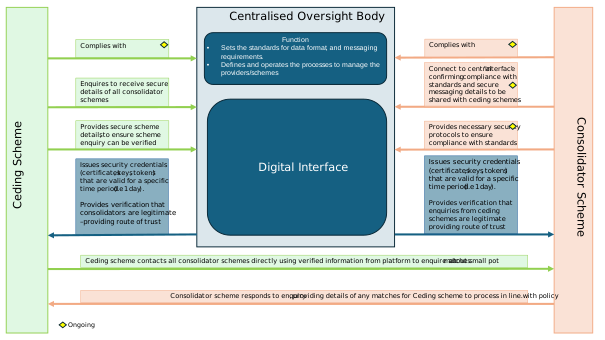
The diagram illustrates the process for enabling secure enquiries between ceding schemes and consolidator schemes.
A Centralised Oversight Body sits at the centre of the process and operates a Digital Interface. The oversight body sets standards for data formats and messaging requirements and defines and manages the processes that participating schemes must follow.
Both ceding schemes and consolidator schemes must comply with these standards. Consolidator schemes connect to the Digital Interface, confirm compliance with the required standards and messaging protocols, and provide the security controls needed to demonstrate compliance.
The Digital Interface provides ceding schemes with secure details of participating consolidator schemes and provides information that enables enquiries to be validated. The oversight body issues security credentials, such as certificates, keys or tokens, that are valid for a defined period and provides verification information so that both ceding and consolidator schemes can confirm that communications between them are legitimate and trusted.
Using the verified information obtained through the Digital Interface, ceding schemes contact consolidator schemes directly to enquire about potential small pot matches. Consolidator schemes then respond directly to the ceding schemes with details of any matches that have been identified, allowing the ceding schemes to process the results in line with the policy requirements and undertake pot transfers to consolidators.
Questions:
Question 22: How do you consider this process should be delivered for smaller schemes that are unlikely to transfer significant volumes of small pots and for which investment in dedicated digital infrastructure may not represent good value for their wider membership?
Question 23: To what extent do you agree with the government’s proposed approach of a federated model supported by a central oversight body? What factors should the government consider when determining where the central oversight function should sit, including whether it should be delivered by a public body, an existing organisation, or an industry-led body operating within a statutory framework?
Question 24: Do you agree that detailed technical and operational standards should be capable of being updated outside legislation, subject to appropriate governance and consultation?
Question 25: To what extent do you agree that legislation should require pension schemes to comply with common data standards when participating in the Multiple Default Consolidator solution? In particular we are keen to understand:
-
what matters should be included in legislation, and what matters should be left to technical standards or statutory guidance?
-
what data items are likely to be essential to support accurate matching and transfer activity under the Multiple Default Consolidator solution?
Question 26: To what extent do you agree that pension schemes should be required to use approved messaging standards when participating in the small pots framework? In particular we are keen to understand:
-
what role should legislation play in establishing messaging requirements, and what matters should be left to standards or governance arrangements?
-
how should the framework ensure that approved messaging arrangements are accessible to schemes and providers across the whole market?
Question 27: To what extent do you agree that pension schemes should be required to apply a common data matching framework when participating in the small pots consolidation process? In particular we are keen to understand:
-
are there specific aspects of data matching that should be prescribed in legislation, or should detailed matching criteria be set through standards overseen by the central oversight body?
-
what safeguards should apply where a possible match is identified but cannot be confirmed automatically?
-
what information should schemes be required to exchange in order to identify the correct destination consolidator while minimising unnecessary data sharing?
Question 28: To what extent do you agree that a carousel allocation process should be used where a member does not already have a pot with a consolidator? In particular we are keen to understand:
-
what factors should be taken into account when designing the carousel to ensure that it is fair, transparent and effective?
-
what information should be used to determine which consolidator holds the member’s largest pot, and how should that information be verified?
Question 29: To what extent do you agree that a central digital interface should maintain a list of consolidator schemes, including verified contact details and relevant information?
Question 30: To what extent do you agree that a central digital interface should issue, or enable the issuing of, security credentials, certificates, keys or tokens to support secure communications between participating schemes and consolidators?
Chapter 7: Employer duties
Policy background
251. There are persistent challenges with the accuracy and completeness of member data held by pension schemes. While schemes are provided with member information when an individual is enrolled, maintaining accurate and up-to-date records over time can be challenging, particularly where member circumstances or contact details change. Employer duties focus on enrolling eligible workers into a qualifying pension scheme and providing core information at the point of enrolment, such as name, address and date of birth. Employers are only required to provide personal email addresses where they already hold them, as set out in Regulation 3 of the Occupational and Personal Pension Schemes (Automatic Enrolment) Regulations 2010[footnote 17]. There is currently no general requirement for employers to provide updated member details following enrolment. As a result, member records may become less accurate over time, particularly after an individual has left employment and there are fewer opportunities for information to be updated or corrected.
252. To support the multiple default consolidator framework and improve the effectiveness of data matching, the government intends to strengthen employer duties under automatic enrolment. This will include:
-
requiring employers to request personal email addresses from employees and provide them to pension schemes where employees choose to supply them. Where an employer has requested a personal email address, but the employee has not provided one, the employer would be required to notify the scheme accordingly through a nil return or equivalent reporting mechanism
-
introducing a requirement for employers to update key member details periodically, including full name, date of birth, postal address and personal email address[footnote 18]
253. Employers will not be responsible for identifying which pots are eligible for consolidation. Their role will remain focused on providing accurate member data and contributions for active employees. Decisions on eligibility and consolidation will sit with pension schemes and within the Multiple Default Consolidator solution.
254. Email addresses are a particularly valuable data point for member tracing. They are more likely to remain stable over time compared to postal addresses, particularly for individuals who move residence frequently, such as those in rented accommodation. While collecting email addresses will not guarantee successful member contact, it should improve schemes’ ability to reach members and support more accurate data matching.
255. Improving data quality will not eliminate all mismatches or untraced pots, but it will significantly reduce their likelihood. Poor or outdated data remains a key barrier to effective pot matching, which is central to the success of the Multiple Default Consolidator solution. Accurate and up‑to‑date member information will improve the chances of successful consolidation and support more effective communication with members.
256. We recognise that the pensions dashboards will help to improve data quality by enabling individuals to identify and correct inaccuracies in their pension records. However, it is unlikely to address all data quality issues, and further measures will be needed to support effective pot matching under the Multiple Default Consolidator solution.
257. These changes build on existing automatic enrolment processes rather than replacing them. By extending current duties, to include requesting email addresses and introducing a requirement to keep member details up-to-date, the aim is to improve data quality and administrative effectiveness without placing disproportionate burdens on employers.
Introducing these requirements and how often should they be undertaken?
258. The success of the Multiple Default Consolidator solution will depend, in part, on pension schemes having access to accurate and up-to-date member information. Reliable member data will support more effective pot matching processes, reduce the risk of failed or incorrect transfers, and help ensure that consolidation is delivered efficiently and securely. We recognise that any new requirements will impose costs and administrative obligations on employers and must therefore be carefully designed to ensure they are proportionate and deliver clear value.
259. Employers are often best placed to hold current information about their employees and are therefore an important source of data for pension schemes. However, employers vary significantly in size, capability and existing administrative arrangements. Many already provide information through payroll and pension administration processes, while others may need to make changes to systems and procedures in order to comply with any new requirements. The government therefore considers that implementation should be designed in a way that allows employers sufficient time to adapt, while ensuring that improvements in data quality are delivered within a reasonable timeframe.
260. The government therefore proposes that any new duty should commence from a single implementation date, with employers subsequently given a period of up to one calendar year to undertake the necessary activities and provide updated member information to schemes. We consider that this approach strikes an appropriate balance between achieving improvements in member data quality and allowing employers adequate time to review existing records, update systems and processes where necessary, and comply with the new requirements in a manageable and cost-effective manner.
261. Looking beyond initial implementation, the government considers that maintaining the quality of member data on an ongoing basis will be equally important. Accurate records are not a one-off requirement but a continuing prerequisite for effective pot matching and consolidation. Without regular updates, the quality of scheme data is likely to deteriorate over time, increasing the risk of unmatched records, member communications failing to reach the intended recipient, and consolidation opportunities being missed. Regular data cleansing could therefore play an important role in ensuring the long-term effectiveness of the Multiple Default Consolidator solution.
262. The government recognises that there are a range of possible approaches to maintaining data quality and that employers and pension schemes already operate a variety of payroll, administration and reporting cycles. Any requirement for ongoing updates should therefore seek to balance the benefits of improved data quality against the additional costs and administrative burdens associated with more frequent reporting. While more regular updates may improve data accuracy, they could also introduce additional complexity and cost, particularly for smaller employers.
263. Our initial view is that employers should be required to provide updated member information, where available, at least once every 12 months. We consider that this would provide schemes with a regular mechanism for refreshing key data while avoiding the disproportionate burden that more frequent updates could place on employers. However, we recognise that different approaches to the timing of these updates may be possible. For example, updates could be linked to the date on which an employer initially complies with the duty, or they could operate on a common reporting cycle applicable to all employers.
264. We welcome views on these proposals, including whether the proposed implementation period is appropriate, whether annual updates strike the right balance between improving data quality and minimising burden, and how any ongoing reporting requirements could be structured. In particular, we are interested in understanding how these requirements can be implemented in a way that supports employers, maintains high-quality member data, and ensures that pension schemes have the information necessary to support the effective operation of the Multiple Default Consolidator solution.
Proposal:
Employers will be given 12 months to comply with this duty, from the legislation coming into force and they will then need to update records, where available, at intervals of 12 months.
Minimising burden on employers
265. The government recognises that any strengthening of employer duties must be designed in a way that delivers meaningful improvements in member data quality while minimising additional administrative burden and cost, particularly for small and micro employers. Accurate member data is a critical enabler of the Multiple Default Consolidator solution, supporting effective pot matching, reducing the risk of failed transfers, and helping consolidation take place efficiently and securely. However, these benefits must be balanced against the practical realities facing employers.
266. In developing these proposals, the government’s intention has been to build on existing automatic enrolment processes and responsibilities, rather than introduce a new reporting regime. We consider that leveraging existing employer processes represents the most proportionate and cost-effective approach. Under this requirement, employers’ responsibilities would remain focused on collecting and providing accurate member information.
267. We consider that improving the quality of member data at source is one of the most effective ways to support the successful operation of the Multiple Default Consolidator solution. More accurate and up-to-date records should improve pot matching rates, support more effective member communications and increase confidence in the transfer process. By building on existing employer responsibilities, we believe these benefits can be achieved without imposing disproportionate new obligations on them.
268. The government recognises that employer capabilities vary considerably across the economy. Any new requirements should therefore be practical, proportionate and capable of being delivered through existing payroll, pension administration and employer processes wherever possible. A key consideration in designing the requirements will be how any additional burden can be minimised, particularly for smaller employers. We are therefore keen to understand from respondents how existing systems, data flows, reporting processes and support mechanisms could be utilised to reduce implementation costs and ongoing administration, and whether there are alternative approaches that could achieve the same policy objectives more efficiently.
Career Breaks
269. As discussed in Chapter 2 on pot eligibility and exemptions, the government is considering how planned breaks from employment may affect whether a pot is identified as dormant. While individuals will have the opportunity to opt out of consolidation, there may be circumstances where employers are aware that a worker is temporarily absent but intends to return, for example during maternity leave, sick leave, or a planned career break.
270. In such cases, there may be a helpful role for employers in providing relevant information to pension schemes. Where an individual temporarily stops contributing for a period, potentially for up to 12 months, but intends to resume contributions, this information could help schemes avoid treating the pot as dormant during a planned temporary absence. This approach could complement existing safeguards within the Multiple Default Consolidator solution, including member communications and the ability to opt out before any transfer takes place.
271. The government is therefore considering whether to require employers to provide relevant information about employee status in these circumstances. The government is interested in views on how such a mechanism could operate in practice, including what information should be provided, and how it can be done in a way that is proportionate and administratively practical for employers.
Proposal:
The government proposes that employers should provide relevant information where an individual is temporarily absent from work and their contributions have ceased, but intends to return and resume contributions, helping schemes avoid incorrectly treating pots as dormant and consolidating them unnecessarily.
Questions:
Question 31: To what extent do you agree that the proposed requirements provides a proportionate basis for pot matching and contact? Please provide reasons for your answer. Are there any additional data fields that should be included in the requirements to support more effective pot matching, and if so, why?
Question 32: To what extent do you agree with the proposed approach to improving member data quality through enhanced employer data requirements? Please provide reasons for your answer, including whether the proposed 12‑month interval and information requirements are proportionate, whether any additional information should be included or any proposed information is unnecessary, and how any administrative burden on employers could be minimised.
Question 33: To what extent do you agree with the proposed approach requiring employers to provide information where an individual is temporarily absent from work but intends to return and resume pension contributions? Please provide reasons for your answer, including whether you agree that such information should be used to help schemes avoid incorrectly treating pots as dormant.
Questions
Question 1: Do you agree with the proposals set out in this chapter? Are there any unintended risks or consequences that may arise from these proposals outlined above?
Question 2: Can schemes reliably identify pots that have guarantees attached? Are there operational or administrative risks that could threaten the effective retention of guarantees for members. For example, data quality?
Question 3: Are there any guarantees or protections that should automatically be out of scope from trustee and scheme manager discretion?
Question 4: How frequently does the situation arise where preservation of a PPA must be considered? Do you think the proposed approach would work administratively, or is there a better way of achieving the same outcomes for members?
Question 5: Are there any additional guarantees or protections that will need to be considered that have not been outlined in this consultation?
Question 6: Do you agree that the proposed content of the pre-consolidation notice would provide members with sufficient information to understand the consolidation process and support informed decision-making, while remaining clear, proportionate and accessible? How do you consider what would be best to test and review this communication?
Question 7: In your view, is there any additional information that should be included in the notice, or any information proposed that is unnecessary, overly complex, or could be presented differently? Please provide reasons and evidence where possible.
Question 8: In your view, where a member already has an allocated consolidator scheme, should they be able to choose an alternative consolidator for subsequent consolidations (option 1), or should subsequent eligible deferred pots transfer by default to their existing consolidator scheme (option 2), subject to the member’s right to opt out and the scheme remaining an authorised consolidator?
Question 9: Do you have any other views on the proposed member communications journey, including the design, timing, format, delivery, accessibility or operation of communications under the Multiple Default Consolidator solution?
Question 10: Do you agree with the proposals set out in this chapter? Are there any unintended risks or consequences that may arise from these proposals outlined above?
Question 11: Do you consider that there should be other terms of the scheme that are explicit requirements in order to act as a consolidator scheme?
Question 12: Do you consider the existing requirements relating to financial sustainability to be sufficient as an assessment of the scheme’s ability to absorb the operational and financial implications of acting as a consolidator?
Question 13: Which approach to scale do you consider most appropriate to support positive member outcomes, and why? Are there alternative approaches that should be considered? How should this be monitored and updated over time to ensure they remain appropriate as the market develops?
Question 14: Do you agree that the most appropriate and equitable approach is to review the flat fee de minimis threshold across the market as a whole, with any changes implemented ahead of the introduction of the Multiple Default Consolidator solution? If not, which of the options discussed do you consider most effective in delivering strong member outcomes, and why?
Question 15: Do you think schemes should be prohibited from acting as a consolidator scheme if they do not receive a specific VFM rating, if so, what rating do you consider to be an appropriate level of value?
Question 16: Do you agree that consolidator schemes should undertake same scheme consolidation, and that option 1 presents the best safeguards for savers? Do you agree with the proposals on exclusions from same scheme consolidation?
Question 17: Do any of the options explored in this chapter present potential challenges specifically for contract-based schemes if the FCA were to introduce identical requirements in its rules?
Question 18: To what extent do you agree that existing regulatory powers and supervisory frameworks, together with the proposed supervisory and intervention powers, provide a sufficient basis for the effective ongoing oversight of consolidator schemes? Please provide reasons for your answer, including whether there are any additional supervisory or intervention powers that should be considered, or any proposed interventions that you do not support
Question 19: To what extent do you agree with the proposed approach to the treatment of members’ pots following the loss of consolidator status? Please provide reasons for your answer, including whether you consider a single approach, or an alternative approach, would better support member outcomes.
Question 20: To what extent do you agree that decisions on the removal of consolidator status should remain subject to regulatory judgement on a case-by-case basis? Are there any breaches that you consider should automatically result in the removal of consolidator status?
Question 21: To what extent do you agree with the proposed approach for schemes wishing to voluntarily exit the consolidator market? Please provide reasons for your answer, including whether you consider an alternative approach, would better support member outcomes.
Question 22: How do you consider this process should be delivered for smaller schemes that are unlikely to transfer significant volumes of small pots and for which investment in dedicated digital infrastructure may not represent good value for their wider membership?
Question 23: To what extent do you agree with the government’s proposed approach of a federated model supported by a central oversight body? What factors should the government consider when determining where the central oversight function should sit, including whether it should be delivered by a public body, an existing organisation, or an industry-led body operating within a statutory framework?
Question 24: Do you agree that detailed technical and operational standards should be capable of being updated outside legislation, subject to appropriate governance and consultation?
Question 25: To what extent do you agree that legislation should require pension schemes to comply with common data standards when participating in the Multiple Default Consolidator solution? In particular we are keen to understand:
-
what matters should be included in legislation, and what matters should be left to technical standards or statutory guidance?
-
what data items are likely to be essential to support accurate matching and transfer activity under the Multiple Default Consolidator solution?
Question 26: To what extent do you agree that pension schemes should be required to use approved messaging standards when participating in the small pots framework? In particular we are keen to understand:
-
what role should legislation play in establishing messaging requirements, and what matters should be left to standards or governance arrangements?
-
how should the framework ensure that approved messaging arrangements are accessible to schemes and providers across the whole market?
Question 27: To what extent do you agree that pension schemes should be required to apply a common data matching framework when participating in the small pots consolidation process? In particular we are keen to understand:
-
are there specific aspects of data matching that should be prescribed in legislation, or should detailed matching criteria be set through standards overseen by the central oversight body?
-
what safeguards should apply where a possible match is identified but cannot be confirmed automatically?
-
what information should schemes be required to exchange in order to identify the correct destination consolidator while minimising unnecessary data sharing?
Question 28: To what extent do you agree that a carousel allocation process should be used where a member does not already have a pot with a consolidator? In particular we are keen to understand:
-
what factors should be taken into account when designing the carousel to ensure that it is fair, transparent and effective?
-
what information should be used to determine which consolidator holds the member’s largest pot, and how should that information be verified?
Question 29: To what extent do you agree that a central digital interface should maintain a list of consolidator schemes, including verified contact details and relevant information?
Question 30: To what extent do you agree that a central digital interface should issue, or enable the issuing of, security credentials, certificates, keys or tokens to support secure communications between participating schemes and consolidators?
Question 31: To what extent do you agree that the proposed requirements provides a proportionate basis for pot matching and contact? Please provide reasons for your answer. Are there any additional data fields that should be included in the requirements to support more effective pot matching, and if so, why?
Question 32: To what extent do you agree with the proposed approach to improving member data quality through enhanced employer data requirements? Please provide reasons for your answer, including whether the proposed 12‑month interval and information requirements are proportionate, whether any additional information should be included or any proposed information is unnecessary, and how any administrative burden on employers could be minimised.
Question 33: To what extent do you agree with the proposed approach requiring employers to provide information where an individual is temporarily absent from work but intends to return and resume pension contributions? Please provide reasons for your answer, including whether you agree that such information should be used to help schemes avoid incorrectly treating pots as dormant.
-
To ensure that small pots with guarantees can be bulk transferred without consent to consolidator schemes, amendments may be required to the Occupational Pension Schemes (Preservation of Benefit) Regulations 1991. ↩
-
PTM062250 - Member benefits: pensions: protected pension age: right to keep a protected pension age after transfers 2028 - HMRC internal manual - GOV.UK ↩
-
Consideration will be given to whether additional regulations are necessary here, or whether the information shared would already be required to be sent under The Occupational and Personal Pension Schemes (Disclosure of Information) Regulations 2013. The post consolidation notice will be explored in future consultations. ↩
-
PTM062250 - Member benefits: pensions: protected pension age: right to keep a protected pension age after transfers 2028 - HMRC internal manual - GOV.UK ↩
-
We recognise that the flat-fee charge de minimis does not currently apply to contract-based schemes, as flat-fee charging structures are not a common feature of that market. ↩
-
We would expect any contract-based scheme wishing to operate as a consolidator to meet an equivalent standard, to ensure consistent member protections and maintain parity across the consolidator framework. ↩
-
The Occupational and Personal Pension Schemes (Automatic Enrolment) Regulations 2010 ↩
-
We recognise that certain details, such as name and date of birth, may rarely change. However, periodic confirmation of member information can help address transcription errors and improve overall data quality. ↩