Local Growth Fund (England): policy statement
Published 26 November 2025
Applies to England

© Crown copyright 2025
This publication is licensed under the terms of the Open Government Licence v3.0 except where otherwise stated. To view this licence, visit nationalarchives.gov.uk/doc/open-government-licence/version/3 or write to the Information Policy Team, The National Archives, Kew, London TW9 4DU, or email: psi@nationalarchives.gov.uk.
Where we have identified any third party copyright information you will need to obtain permission from the copyright holders concerned.
This publication is available at https://www.gov.uk/government/publications/local-growth-fund-england-policy-statement/local-growth-fund-england-policy-statement
1. Foreword
Foreword from the Parliamentary Under Secretary of State for Devolution, Faith and Communities
The government is delivering on its manifesto commitment to kickstart economic growth and improve living standards. At Spending Review 2025, the government announced a new approach to regional investment, comprising the new Local Growth Fund, Pride in Place funding, reforms to the local government funding system, and record settlements for Mayors. It confirmed that the Local Growth Fund would be targeted at mayoral city regions in the North and Midlands with the highest productivity catch‑up and agglomeration potential, as part of a shift in how growth funding is delivered. It moves away from fragmented, short-term competitive pots to a single, flexible, long-term fund. This approach will empower regional leaders to drive local priorities and unlock the potential that exists in places across the UK, including city regions and high-potential sectors.
For too long, local growth funding has been constrained by inefficiencies: short-termism, duplication, and wasteful competitive bidding. Opportunities for transformative change have been missed. The English Devolution White Paper set out a new vision: consolidating funding, devolving power, and allocating investment in line with locally led plans. By removing unnecessary processes and committing to long-term financial stability, we are enabling regions to plan and deliver this change with confidence.
Through the new statutory duty to develop Local Growth Plans, we know that Mayoral Strategic Authorities (MSAs) have bold, transformational plans for meeting the government’s Growth Mission. Public investment is essential to get these projects off the ground and begin assembling sites, delivering enabling infrastructure, and creating attractive propositions for private investors. By backing the shared priorities agreed in Local Growth Plans, this investment will support small businesses, create jobs, regenerate commercial centres, enable new housing, and better connect communities through integrated transport – delivering the growth needed to fund our essential public services, enable further investment, and raise living standards.
Finally, this approach recognises the opportunity presented by untapped potential in the North and Midlands - areas with the necessary foundations for agglomeration effects and innovation required to turn the dial on national prosperity. By targeting investment where it can have the greatest impact, we will reduce regional disparities and build a fairer, more productive economy for everyone.
2. Objectives and Policy Model
The Local Growth Fund introduces a long-term, flexible settlement for selected MSAs, consolidating fragmented funding into a single, locally-led pot aligned with Local Growth Plans.
The Local Growth Fund is designed to equip mayors in the North and Midlands to boost regional productivity by focusing on three interconnected themes:
- Infrastructure investment: expanding labour market reach and enabling agglomeration benefits across functional economic areas.
- Business support: strengthening regional clusters and increasing innovation and investment to drive firm-level competitiveness and sectoral growth.
- Skills development: providing the human capital aligned to priority sectors and emerging technologies.
The fund has been designed to operate within the landscape of wider funding and complement other sources of finance to get projects off the ground.
The high-level logic model (see Figure 1) frames the fund’s aims around intermediate and long-term outcomes. This model is a guide, not prescription, and local leaders should integrate other funding streams and tailor interventions to local contexts.
The fund design recognises that activities and outputs will differ between places and should be developed by local leaders in line with their Local Growth Plans. For this reason, recipients do not need to pursue all outcomes and are encouraged to make place-informed prioritisation across the outcomes.
Figure 1: High-level logic model for Local Growth Fund
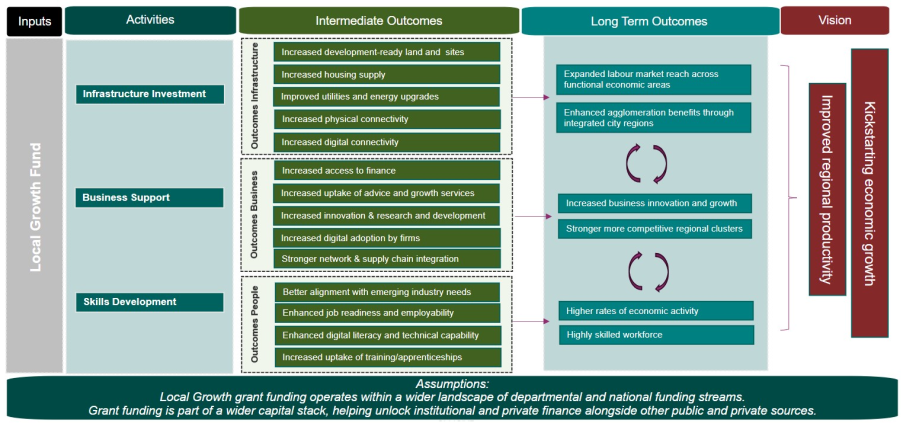
Figure 1: High-level logic model for Local Growth Fund (alt-text)
Inputs
- Local Growth Fund
Activities
- Infrastructure investment
- Business support
- Skills development
Intermediate outcomes
Infrastructure outcomes:
- Increased development-ready land and sites
- Increased housing supply
- Improved utilities and energy upgrades
- Increased physical connectivity
- Increased digital connectivity
Business outcomes:
- Increased access to finance
- Increased uptake of advice and growth services
- Increased innovation and research and development
- Increased digital adoption by firms
- Stronger network and supply chain integration
People outcomes:
- Better alignment with emerging industry needs
- Enhanced job readiness and employability
- Enhanced digital literacy and technical capability
- Increased uptake of training/apprenticeships
Long term outcomes
- Expanded labour market reach across functional economic areas
- Enhanced agglomeration benefits through integrated city regions
- Increased business innovation and growth
- Stronger more competitive regional clusters
- Higher rates of economic activity
- Highly skilled workforce
Vision
- Kickstarting economic growth
- Improved regional productivity
Assumptions
- Local Growth grant funding operates within a wider landscape of departmental and national funding streams.
- Grant funding is part of a wider capital stack, helping unlock institutional and private finance alongside other public and private sources.
3. Place selection
Building on the commitment at Spending Review 2025 that the Local Growth Fund would be targeted at city regions in the North and Midlands with the highest productivity catch‑up and agglomeration potential, the fund will be allocated to the following 11 MSAs:
- East Midlands
- Greater Lincolnshire
- Greater Manchester
- Hull and East Yorkshire
- Liverpool City Region
- North East
- South Yorkshire
- Tees Valley
- West Midlands
- West Yorkshire
- York and North Yorkshire
The total funding package of over £900 million in England over the next four years, will be allocated between these 11 MSAs. Our approach to allocations is outlined in the methodology note, with allocations as follows:
Figure 2: Final allocations for eligible Mayoral Strategic Authorities (rounded to nearest £million)
| RDEL | CDEL | TDEL | |||||||||
|---|---|---|---|---|---|---|---|---|---|---|---|
| Mayoral Strategic Authority | 26/27 | 27/28 | 28/29 | 26/27 | 27/28 | 28/29 | 29/30 | 26/27 | 27/28 | 28/29 | 29/30 |
| East Midlands | £18 | £16 | £13 | £6 | £9 | £18 | £27 | £24 | £25 | £31 | £27 |
| Greater Lincolnshire | £9 | £8 | £6 | £3 | £4 | £9 | £13 | £12 | £12 | £15 | £13 |
| Greater Manchester | £24 | £21 | £17 | £8 | £12 | £24 | £36 | £32 | £33 | £41 | £36 |
| Hull and East Yorkshire | £5 | £4 | £4 | £2 | £2 | £5 | £7 | £7 | £7 | £9 | £7 |
| Liverpool City Region | £13 | £11 | £9 | £4 | £6 | £13 | £19 | £17 | £18 | £22 | £19 |
| North East | £16 | £14 | £12 | £5 | £8 | £16 | £24 | £22 | £23 | £28 | £24 |
| South Yorkshire | £11 | £10 | £8 | £4 | £6 | £11 | £17 | £15 | £16 | £20 | £17 |
| Tees Valley | £6 | £5 | £4 | £2 | £3 | £6 | £8 | £8 | £8 | £10 | £8 |
| West Midlands | £24 | £21 | £18 | £8 | £12 | £24 | £36 | £32 | £33 | £42 | £36 |
| West Yorkshire | £19 | £17 | £14 | £6 | £10 | £19 | £29 | £26 | £27 | £33 | £29 |
| York and North Yorkshire | £7 | £6 | £5 | £2 | £3 | £7 | £10 | £9 | £9 | £12 | £10 |
| Total | £151 | £135 | £111 | £50 | £76 | £151 | £227 | £202 | £211 | £262 | £227 |
The UK suffers from deep and persistent regional economic disparities, particularly between London and the South East compared to city regions in the North and Midlands. These disparities are not just in income, but in productivity, employment opportunities, and ability to innovate. The UK’s overall economic performance is being held back by the underperformance of our major city regions outside the South East. By unlocking the untapped potential of these city regions, the UK can significantly boost national productivity and ensure the benefits of growth are felt widely.
This targeted approach enables us to focus investment where it is needed most, addressing deep-rooted challenges in underperforming areas and unlocking the greatest potential for economic growth.
Scotland, Wales and Northern Ireland
The approach in Scotland, Wales and Northern Ireland is being developed collaboratively with the Office for the Nations, working with the devolved governments and local partners where appropriate. This will ensure that this funding is spent on projects that matter to the people of Scotland, Wales, and Northern Ireland, and will drive productivity and growth across the UK.
The administration of local growth funding in Scotland, Wales and Northern Ireland will be set out separately.
4. Implementation
The Local Growth Fund will launch in April 2026.
The 11 MSAs will receive a funding envelope which can be used flexibly in line with their Local Growth Plans.
Where applicable, the fund will be delivered through Integrated Settlements and relevant MSAs will be held to account through the English Devolution Accountability Framework. For MSAs without an Integrated Settlement, accountability will be through a similar set of outcomes, indicators, and targets. The government will write to MSAs without an Integrated Settlement to collaboratively discuss their proposed vision and outcomes for the fund shortly. The government will also publish technical guidance for MSAs setting out further detail on the monitoring, assurance and evaluation approach.